Defining hazardous area lighting: a guide for engineers
TL;DR:
- Proper hazardous area lighting is crucial to prevent ignition sources and ensure compliance through correct classification, certification, and installation. The North American and Zone classification systems guide appropriate product selection based on environmental risks, with certifications like ATEX and UL844 validating safety standards. Using LED technology enhances efficiency and safety when combined with proper certification, site-specific matching, and regular maintenance.
Getting hazardous area lighting wrong is not a compliance paperwork problem. It is a potential ignition source in an environment where a single spark can be catastrophic. Yet defining hazardous area lighting correctly remains one of the most misunderstood obligations in industrial safety. Many engineers default to sourcing the nearest “industrial” fitting and assuming it qualifies. It does not. The difference between a standard IP65 luminaire and a properly certified explosion proof lighting solution is the difference between legal compliance and criminal liability.
Defining hazardous area lighting: classifications and zones
Before selecting any product, you need to understand exactly what type of hazardous area you are working in. Two major classification systems are in use globally, and conflating them creates dangerous gaps in protection.
The North American Class/Division system, governed by the NEC (National Electrical Code), categorises locations by the type of hazardous material and the probability of its presence.
- Class I covers locations where flammable gases or vapours are present (refineries, chemical plants, petrol storage)
- Class II addresses combustible dust environments (grain elevators, pharmaceutical manufacturing)
- Class III applies to locations with ignitable fibres or flyings (textile mills, woodworking facilities)
- Division 1 means the hazard is present under normal operating conditions
- Division 2 means it is present only under abnormal or accidental conditions
Class I Division 1 lighting is mandatory wherever flammable gases or vapours exist during routine operations.
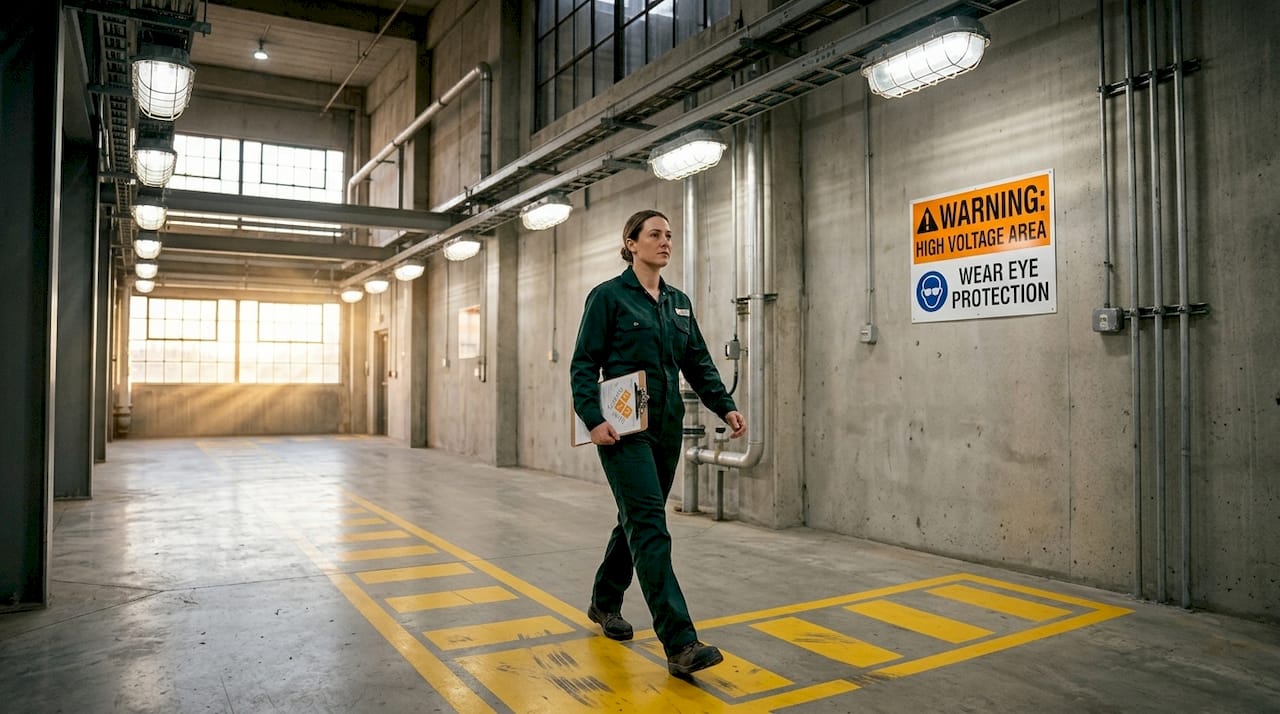
The international Zone system, used across Europe and most of the world under ATEX and IECEx frameworks, takes a slightly different approach. Rather than class-based material groupings, hazardous zones correlate directly to ignition risk frequency.
| Zone | Risk level | Equivalent North American classification |
|---|---|---|
| Zone 0 | Continuous explosive atmosphere | Class I, Division 1 |
| Zone 1 | Likely during normal operation | Class I, Division 1 |
| Zone 2 | Infrequent or abnormal presence | Class I, Division 2 |
| Zone 20 | Continuous combustible dust | Class II, Division 1 |
| Zone 21 | Likely dust during normal operation | Class II, Division 1 |
| Zone 22 | Infrequent combustible dust | Class II, Division 2 |
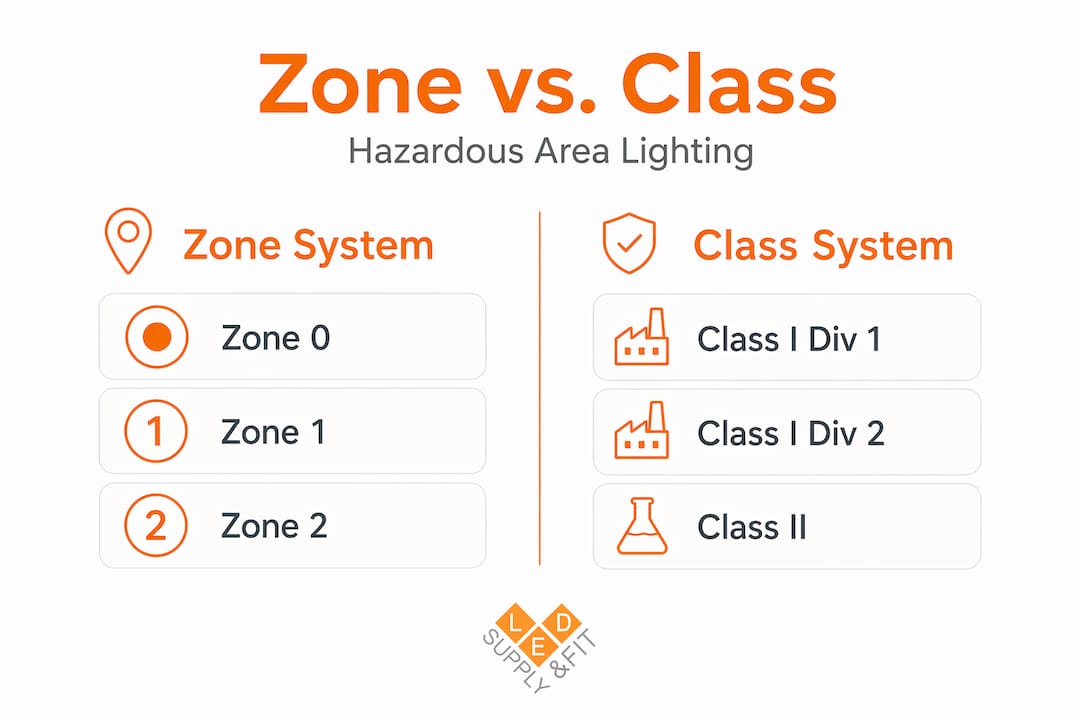
Knowing which zone or class applies to your specific area is the starting point for every other decision. Getting this wrong means your lighting, however well-built, is not appropriately rated for the risk it faces.
Standards and certifications for hazardous lighting
Once you have defined the zone or class, the certification landscape tells you what your chosen luminaire must prove. These certifications are not optional extras. They are the legal and technical validation that a product has been tested and confirmed fit for use in classified locations.
The key frameworks to understand are:
- ATEX (Equipment intended for use in Potentially Explosive Atmospheres): the European Directive covering equipment used in explosive atmospheres. Products carry the Ex symbol and a specific equipment group and category marking
- IECEx: the international equivalent, recognised in over 50 countries including Australia, the Middle East, and much of Asia
- UL844: the North American standard for explosion proof luminaires, administered by Underwriters Laboratories
- CSA: the Canadian Standards Association equivalent, often required alongside UL844 for North American projects
ATEX and UL844 certifications confirm that the fixture design prevents ignition through sealed enclosures, temperature control, and electrical safety. The certification is matched to the zone or class of the area, so a Zone 1 rated luminaire is not automatically acceptable in Zone 0.
IP (Ingress Protection) ratings are closely related but serve a distinct purpose. An IP66 or IP67 rating indicates protection against dust and water ingress, which matters for durability, but does not confer explosion protection by itself. Temperature classification (T-rating) is equally critical: the maximum surface temperature of the luminaire must remain below the auto-ignition temperature of the specific gas or vapour present in that environment.
Pro Tip: Always cross-reference the T-rating of your chosen luminaire against the auto-ignition temperature of the substances present in your classified area. A T4 rating (maximum surface temperature 135°C) will not protect against a hydrogen atmosphere, which ignites at 500°C, so this is less of a concern. However, in propane or butane environments where ignition temperatures are lower, the T-rating becomes a critical selection criterion.
Understanding the difference between ATEX and Ex ratings in detail is covered thoroughly in Ledsupplyandfit’s ATEX vs Ex rating guide, which is worth reading before specifying products for any classified zone.
Hazardous area lighting technologies and LED solutions
The dominant technology choice for hazardous zone illumination today is LED, and for good reason. Explosion proof LED solutions reduce energy consumption by up to 70% compared to traditional discharge or fluorescent alternatives, while maintaining the same output performance in classified areas.
The two principal approaches to explosion protection in luminaire design are:
Explosion proof (flameproof) construction: the luminaire’s enclosure is engineered to contain any internal explosion and prevent flame propagation to the surrounding atmosphere. These fixtures are heavy, robust, and built for environments where explosive atmospheres may form around the fitting itself.
Intrinsically safe design: electrical energy within the circuit is limited to levels too low to cause ignition, even under fault conditions. Intrinsically safe lighting for hazardous areas tends to be lighter and more adaptable for confined spaces, making it well-suited to applications like cable trays, ducting interiors, and process pipework runs.
| Technology | Best application | Zone suitability |
|---|---|---|
| Flameproof LED highbay | Large open plant areas | Zone 1, Zone 2 |
| Intrinsically safe LED strip | Confined, complex geometry | Zone 1, Zone 2 |
| Increased safety LED fitting | Low-risk boundary zones | Zone 2 only |
| Zone 0 rated LED luminaire | Continuous explosive atmosphere | Zone 0 |
Hazardous area LED strip lights are a particularly practical solution for confined or irregular spaces. They feature reinforced sealing, impact-resistant housings, and meet ATEX and IECEx certifications for Zone 1 and Zone 2 applications.
Pro Tip: For retrofit projects in existing classified areas, always verify that the mounting positions and cable entry points of new LED fittings match the original installation’s Ex certification. Introducing non-certified cable glands or conduit adaptors in a Zone 1 area invalidates the protection concept of the entire fitting, regardless of the luminaire’s own certification.
Selecting and implementing compliant hazardous lighting
Applying classification knowledge to a real installation requires a structured approach. Ledsupplyandfit’s ATEX lighting installation guide outlines the practical steps for UK projects in detail. At the broader level, the selection and implementation process follows a clear sequence.
- Conduct a formal area classification survey. Document every zone or class present, including boundary definitions. This becomes the specification baseline against which all luminaire choices are validated.
- Match certifications to zones. A luminaire certified for Zone 2 cannot be installed in Zone 1. Verify the equipment group and category markings on the fixture against the classification of the area it will occupy.
- Verify the T-rating against site-specific substances. Obtain the auto-ignition temperatures of every flammable material present and confirm the luminaire’s maximum surface temperature falls below those thresholds.
- Specify IP ratings appropriate to the physical environment. Wash-down areas, outdoor locations, and chemically aggressive environments all demand higher ingress protection beyond the explosion protection standard itself.
- Establish an inspection and maintenance schedule. Regular servicing of hazardous lighting sustains compliance and prevents degradation failures that would expose the installation to risk. Fixtures in classified areas must be inspected by competent persons at defined intervals, and records maintained.
- Address non-compliance immediately. Regulatory enforcement for incorrect hazardous area lighting is substantive. ATEX compliance is a legal obligation under UK law (post-Brexit retained legislation from the ATEX Directive 2014/34/EU), and failure can result in prohibition notices, fines, and prosecution.
OSHA illumination standards in North America add a further layer by specifying minimum foot-candle requirements in safety-critical areas. Adequate illumination is not only a protection requirement. It is a fundamental condition for workers to identify hazards, read warning labels, and respond to emergencies effectively.
My perspective on where most projects go wrong
I have seen experienced engineers spend considerable effort selecting the correct certified luminaire and then undermine the entire installation by overlooking one component. A cable gland from the wrong certification category. A junction box rated for Zone 2 installed in a Zone 1 boundary. These are not edge cases. They appear regularly, and they represent genuine legal and safety failures.
The classification survey is where I would focus attention first, because everything downstream depends on its accuracy. Organisations frequently inherit legacy area classifications that were drawn up decades ago, before process changes, new substances, or facility expansions altered the actual risk profile. Treating that inherited documentation as ground truth without a proper review is one of the most persistent problems I encounter.
On the technology side, the shift to certified LED has been genuinely positive. ATEX rated LED solutions reduce maintenance frequency and operating costs without sacrificing the safety performance the classification demands. But the certification still needs to match the zone. A well-built, energy-efficient LED product with the wrong certification marking is not a solution. It is a liability.
— John
Certified hazardous area lighting from Ledsupplyandfit
If you are specifying lighting for a classified area or upgrading an existing installation to meet current ATEX or IECEx requirements, Ledsupplyandfit supplies and fits certified solutions across the UK. The product range covers Zone 0 through Zone 2 applications, with ATEX and IECEx certified LED fittings suitable for refineries, chemical processing, pharmaceutical manufacturing, and offshore applications. Read more about how ATEX lighting protects businesses operating in classified environments, or explore the full installation guidance for ATEX projects to support your compliance planning. The team provides product consultation, next-day delivery, and installation support for commercial and industrial projects of any scale.
FAQ
What does defining hazardous area lighting actually involve?
Defining hazardous area lighting means classifying the specific zone or class of the location, matching certified luminaires to that classification, and verifying that the fixture meets the relevant safety standard (ATEX, IECEx, UL844) for the substances present.
What is the difference between Zone 1 and Zone 2 lighting requirements?
Zone 1 requires lighting certified for use where an explosive atmosphere is likely during normal operation. Zone 2 allows fittings certified for locations where hazardous atmospheres occur only infrequently or under abnormal conditions.
Is an IP66 rating sufficient for hazardous area use?
No. An IP66 rating indicates protection against dust and high-pressure water jets, but it does not constitute explosion protection. Hazardous area fittings must carry specific ATEX, IECEx, or UL844 certification in addition to an appropriate IP rating.
How often should hazardous area lighting be inspected?
Inspection frequency depends on the zone and the nature of the installation, but classified area lighting must be inspected by competent persons at regular intervals and records kept. IEC 60079-17 provides the standard framework for inspection and maintenance of Ex equipment.
Can standard LED fittings be used in hazardous areas?
No. Standard LED fittings, regardless of their quality or IP rating, are not certified for use in explosive atmospheres. Only LED luminaires carrying the appropriate Ex, ATEX, IECEx, or UL844 certification and matched to the area classification are legally and technically permissible in hazardous locations.