
Why use professional lighting fitters for your business
TL;DR:
- Lighting installation in commercial spaces requires professional expertise to ensure safety, regulatory compliance, and energy efficiency. Unqualified workers risk electrical hazards, voided insurance, and costly remedial work, making certified fitters essential for reliable results. Properly licensed electricians provide documentation, quality assurance, and long-term savings through optimized control systems and certified setups.
Lighting installation in commercial premises is not the straightforward task many assume it to be. Across offices, warehouses, retail spaces, and hospitality venues, the question of why use professional lighting fitters goes far beyond convenience. Get it wrong and you face safety hazards, voided insurance, failed compliance audits, and energy bills that should have been slashed years ago. This article covers the real risks of unprofessional installation, the compliance and energy efficiency advantages professionals deliver, and the practical steps you should take when hiring lighting fitters for your next project.
Risks of unprofessional lighting installation
Most commercial property managers would not hire an unqualified contractor to install a new fire suppression system. Yet lighting installs are routinely handed to maintenance staff or low-cost tradespeople without proper certification. The consequences can be severe.
Safety is the most immediate concern. Incorrectly wired light fittings create genuine risks of electric shock and fire. In commercial environments with high-load circuits, dense ceiling voids, and continuous operating hours, those risks multiply quickly. A poorly fitted LED driver connected to the wrong circuit can overheat silently for weeks before causing damage.
Then there is the regulatory dimension. Professional installation ensures compliance with mandatory safety standards such as NFPA 70 and NFPA 101, and in the UK context, adherence to BS 7671 is non-negotiable for commercial properties. Non-compliant work can trigger enforcement action, prohibition notices, and personal liability for the duty holder.
The financial exposure is equally serious. Insurance companies pay claims only when lighting installations have an Electrical Installation Certificate (EIC). Without one, you are not just non-compliant. You are uninsured.
Key risks at a glance:
- Electric shock and fire hazard from incorrect wiring or overloading
- Non-compliance with BS 7671 and building regulations, risking prohibition notices
- Voided insurance policies due to absence of an EIC
- Product warranties invalidated by uncertified installation
- Costly remedial work when defects are discovered during audits or property transactions
The EIC is not a formality. It is the legal record that certified work was carried out to the required standard. Without it, you have no proof, no protection, and no recourse if something goes wrong.
How professional fitters ensure compliance and quality
The advantages of expert lighting installation become most apparent when you look at what a qualified fitter actually brings to a project compared with someone working outside their competence.
- Recognised qualifications. Qualified electricians hold certifications such as City and Guilds 2382 (BS 7671 wiring regulations) and are registered with bodies like NICEIC or NAPIT. These are not optional extras. They are the baseline for legally compliant commercial electrical work.
- Electrical Installation Certificates. Only a qualified electrician or registered inspector can issue an EIC. EIC issuance is critical for warranties, insurance, and safety verification. Without it, your installation is legally and commercially exposed.
- Equipment compliance. Professionals specify fittings that meet OSHA-recognised testing and labelling standards. In the UK, CE or UKCA marking matters, but the fitter’s knowledge of what those marks actually guarantee is what distinguishes a competent installation from a box-ticking exercise.
- Documented records. A professional install produces a full paper trail including circuit schedules, test results, and compliance declarations. This is invaluable during property sales, lease renewals, insurance renewals, and regulatory inspections.
- Ongoing liability protection. Registered contractors carry professional indemnity and public liability insurance. If a fault is traced back to the installation, you have a legal route to redress.
Pro Tip: Ask every prospective fitter for their NICEIC or NAPIT registration number before work begins. You can verify it online in under a minute, and any hesitation on their part tells you everything you need to know.
Energy efficiency gains from expert installation
The importance of skilled lighting fitters is nowhere more tangible than on your energy bills. Selecting efficient fixtures is only part of the equation. How they are installed, positioned, and controlled determines whether you realise the full savings potential.

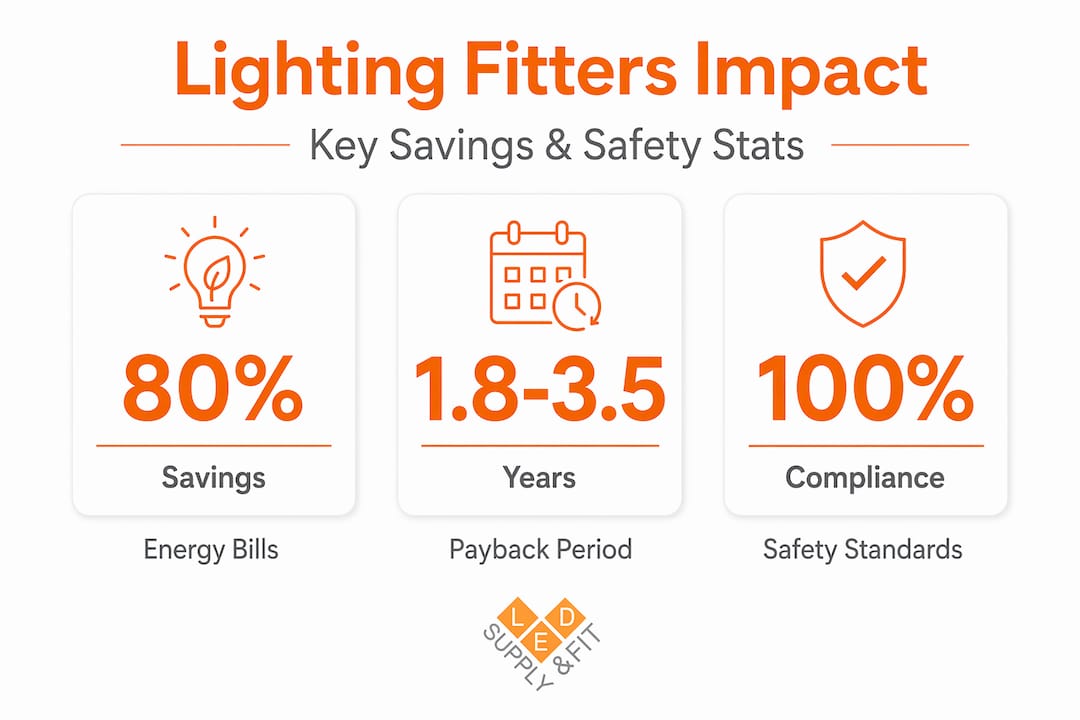
Commercial LED retrofits typically achieve a payback period of 1.8 to 3.5 years, with high-operating-hour facilities seeing payback under one year and annual ROI ranging from 25% to 80%. Those figures assume competent installation. A poorly executed retrofit using mismatched drivers or incorrect beam angles can undermine those returns significantly.
| Installation approach | Typical energy saving | Payback period | Notes |
|---|---|---|---|
| Professional LED retrofit with controls | 60–80% vs. fluorescent | 1.8 to 3.5 years | Qualifies for utility rebates |
| DIY or uncertified LED swap | 30–50% vs. fluorescent | 3 to 6 years | Rarely qualifies for rebates |
| Retrofit kits (tube replacements only) | 20–40% vs. fluorescent | 4 to 7 years | Lower efficacy, poor distribution |
Beyond the fixtures themselves, lighting controls and expert design can increase energy savings by 20 to 40% beyond fixture efficiency alone. Occupancy sensors, daylight harvesting, zoning, and scheduled dimming all require correct commissioning to function properly. A fitter who does not understand control system integration is leaving a substantial portion of your savings on the table.
Pro Tip: When reviewing quotes, ask specifically whether commissioning of controls is included. Many cheaper quotes cover hardware only. The controls setup is where you either capture or lose 20 to 40% of your projected savings.
Explore smarter LED lighting solutions to understand how professional design choices translate into measurable bill reductions across different commercial settings.
Common pitfalls of DIY and uncertified installs
Most lighting accidents and inefficiencies stem from unplanned or DIY installations that lack expert design knowledge. These are the patterns that recur most frequently.
- Thoughtless grid layouts. Placing fittings in a uniform grid without accounting for task areas, reflective surfaces, or zone requirements produces uneven illumination and wasted output. Non-experts often create layouts that waste money and lower lighting quality, despite using good-quality fixtures.
- Misreading manufacturer specifications. LED drivers, dimmer compatibility, and lumen output figures require careful interpretation. Ordering the wrong driver for a fixture renders it incompatible or causes premature failure, and professionals understand how to interpret spec sheets to avoid costly errors.
- Ignoring control integration. Dimming and occupancy systems need to be specified at design stage, not bolted on afterwards. Retrofitting controls into a completed installation costs significantly more and rarely achieves the same performance.
- Temporary fixes becoming permanent. Maintenance teams under pressure often apply quick solutions that remain in place for years. These shortcuts accumulate into a patchwork of non-compliant, inefficient, and potentially dangerous installations.
- Choosing retrofit kits over new fixtures. Using retrofit kits instead of new LED fixtures may lower upfront cost but results in poorer light distribution, lower efficacy, and uncertain reliability.
For a broader look at how commercial lighting retrofits can be planned and executed to avoid these pitfalls, the project data from completed upgrades is instructive.
Selecting the right lighting fitter for your premises
When you reach the point of hiring, knowing what to consider for lighting services is what separates a successful project from an expensive lesson.
- Verify qualifications first. Confirm NICEIC or NAPIT registration, and check that the individual or company holds a current BS 7671 qualification. For specialist environments such as warehouses with hazardous zones, ATEX certification is an additional requirement.
- Ask about compliance documentation. Before any work starts, confirm that an EIC will be issued on completion. If a contractor cannot commit to this, they are not the right choice for a commercial project.
- Review past commercial projects. Domestic lighting experience does not translate directly to commercial environments. Ask for references from comparable projects, ideally in similar property types such as offices, retail units, or industrial spaces.
- Confirm integration capability. Ask directly whether the fitter can design and commission lighting controls, including dimming, occupancy, and daylight sensors. This is where long-term savings are won or lost.
- Check post-installation support. A professional contractor should offer a maintenance schedule and be willing to support your energy management reporting. This matters for large portfolios and properties with energy performance certificate obligations.
My perspective on the value of professional fitters
I have reviewed a significant number of commercial lighting installations over the years, and the pattern that stands out most is not dramatic failures. It is the quiet accumulation of small mistakes made by well-meaning but underqualified people.
Maintenance managers fitting LED panels without understanding circuit capacity. Contractors swapping tubes without commissioning the existing emergency lighting system. Office refurbishments completed without an EIC because the builder assumed it was not required for lighting. Each of these scenarios looks fine on the surface until a lease renewal, an insurance claim, or an incident brings it into sharp focus.
What I have learned is that the benefits of professional lighting go well beyond the installation itself. You are buying compliance documentation, liability coverage, energy performance that matches the projections, and the ability to demonstrate due diligence when it matters. The cost differential between a certified fitter and an uncertified alternative is routinely recovered within the first year of energy savings alone. The compliance and insurance protection has no ceiling on its value.
Do not treat the fitting as the cheap part of a lighting upgrade. It is the part that determines whether everything else works.
— John
How Ledsupplyandfit can help with your next project
Ledsupplyandfit works with commercial clients across the UK, from offices and retail spaces to gyms, warehouses, and educational facilities. Every project combines supply of high-quality LED products with certified installation by qualified fitters who provide full compliance documentation as standard.

Whether you are managing a single-site upgrade or a multi-property portfolio, Ledsupplyandfit’s team handles specification, installation, controls commissioning, and post-installation support. Clients such as Stockton Riverside College have achieved measurable energy reductions alongside full compliance. Explore the best commercial LED lighting options for 2026, or get in touch with the team directly to discuss your project requirements and receive a tailored proposal that covers both product and professional fitting.
FAQ
Why use professional lighting fitters instead of maintenance staff?
Professional fitters are qualified to issue Electrical Installation Certificates, which are legally required for insurance coverage and code compliance in commercial properties. Maintenance staff, however capable, cannot provide this certification unless they hold the relevant electrical qualifications.
What qualifications should a commercial lighting fitter hold?
Look for NICEIC or NAPIT registration and a current BS 7671 (IET Wiring Regulations) qualification. For hazardous environments such as warehouses, ATEX certification is also required.
Does uncertified lighting installation void my insurance?
Yes. Insurance claims are only paid when an Electrical Installation Certificate is in place. An installation without one leaves you without valid cover in the event of a fire or electrical incident.
How much can professional lighting installation save on energy bills?
With expert fixture selection and controls commissioning, commercial properties typically achieve 60 to 80% energy savings versus older fluorescent systems, with payback periods of 1.8 to 3.5 years and annual ROI of 25% to 80%.
What documents should I receive after a professional lighting installation?
You should receive an Electrical Installation Certificate, circuit schedules, test results, and product compliance documentation. These records are required for insurance, lease compliance, and any future regulatory inspection.