What Is Commercial Lighting and Its UK Impact
Every British facility operator recognises the challenge of lighting busy retail and hospitality spaces that demand performance and sustainability. Meeting safety regulations and minimising energy costs are top priorities, especially as commercial lighting solutions evolve with advanced LEDs. By understanding the distinct requirements and features of professional illumination, you can identify systems that deliver durable, efficient results while supporting greener business operations. Explore how commercial lighting design achieves operational efficiency and compliance with UK standards.
Table of Contents
- Defining Commercial Lighting For Businesses
- Main Types And Technologies Used
- Key Features And Design Principles
- Legal Regulations And Compliance Standards
- Costs, Benefits, And Common Pitfalls
Key Takeaways
| Point | Details |
|---|---|
| Importance of Commercial Lighting | Commercial lighting must prioritise performance, energy efficiency, and durability to enhance productivity in various business environments. |
| Technology Transition | Businesses are increasingly adopting LED lighting technology due to its superior energy efficiency and long lifespan, which reduce operational costs. |
| Regulatory Compliance | Understanding and adhering to UK regulations is essential for ensuring safety and energy efficiency in commercial lighting installations. |
| Comprehensive Cost Analysis | A holistic approach to lighting investments should encompass long-term operational costs and the potential impact on workplace productivity. |
Defining Commercial Lighting for Businesses
Commercial lighting represents a specialised illumination system designed specifically for professional environments beyond residential spaces. These sophisticated lighting solutions are engineered to meet the demanding requirements of businesses across diverse sectors, from retail establishments to industrial warehouses.
Commercial lighting differs fundamentally from domestic lighting by prioritising performance, efficiency, and durability. Professional illumination systems are crafted to withstand extended operating hours and provide consistent, high-quality illumination across complex workplace environments. Unlike home lighting, these systems must deliver:- Higher lumen output for expansive spaces- Enhanced durability to withstand frequent usage- Improved energy efficiency- Compliance with stringent safety regulations- Adaptability to specific workplace requirementsThe primary objective of commercial lighting extends beyond mere visibility. These systems are strategically designed to create optimal working conditions, enhance productivity, and support specific functional needs across different business settings. Whether illuminating a busy retail storefront, a precision manufacturing facility, or a modern office space, commercial lighting solutions must balance technical performance with aesthetic considerations.
Unlike residential lighting, which focuses primarily on comfort and ambience, commercial lighting demands a multifaceted approach. Businesses must consider factors such as colour temperature, light distribution, energy consumption, and maintenance costs when selecting appropriate lighting solutions.
Pro tip: When selecting commercial lighting, prioritise systems that offer a balance between initial investment and long-term operational efficiency.
Main Types and Technologies Used
Commercial lighting technologies have rapidly evolved, offering businesses increasingly sophisticated illumination solutions that balance performance, energy efficiency, and cost-effectiveness. Commercial lighting fixtures encompass a range of technologies, each designed to meet specific workplace requirements and environmental conditions.
Traditional commercial lighting technologies include:
- Tubular fluorescent lights: Long-standing standard in office and industrial environments
- Compact fluorescent lamps (CFLs): Compact alternative for smaller spaces
- T5 fluorescent fixtures: High-efficiency linear lighting solutions
- LED light fixtures: Modern, energy-efficient technology gaining widespread adoption
LED technology has emerged as the dominant commercial lighting solution, offering significant advantages over traditional lighting systems. These advanced fixtures provide superior energy efficiency, dramatically reduced maintenance costs, and exceptional longevity. Modern LED technologies can be precisely engineered to deliver specific colour temperatures, light distributions, and performance characteristics tailored to unique workplace environments.
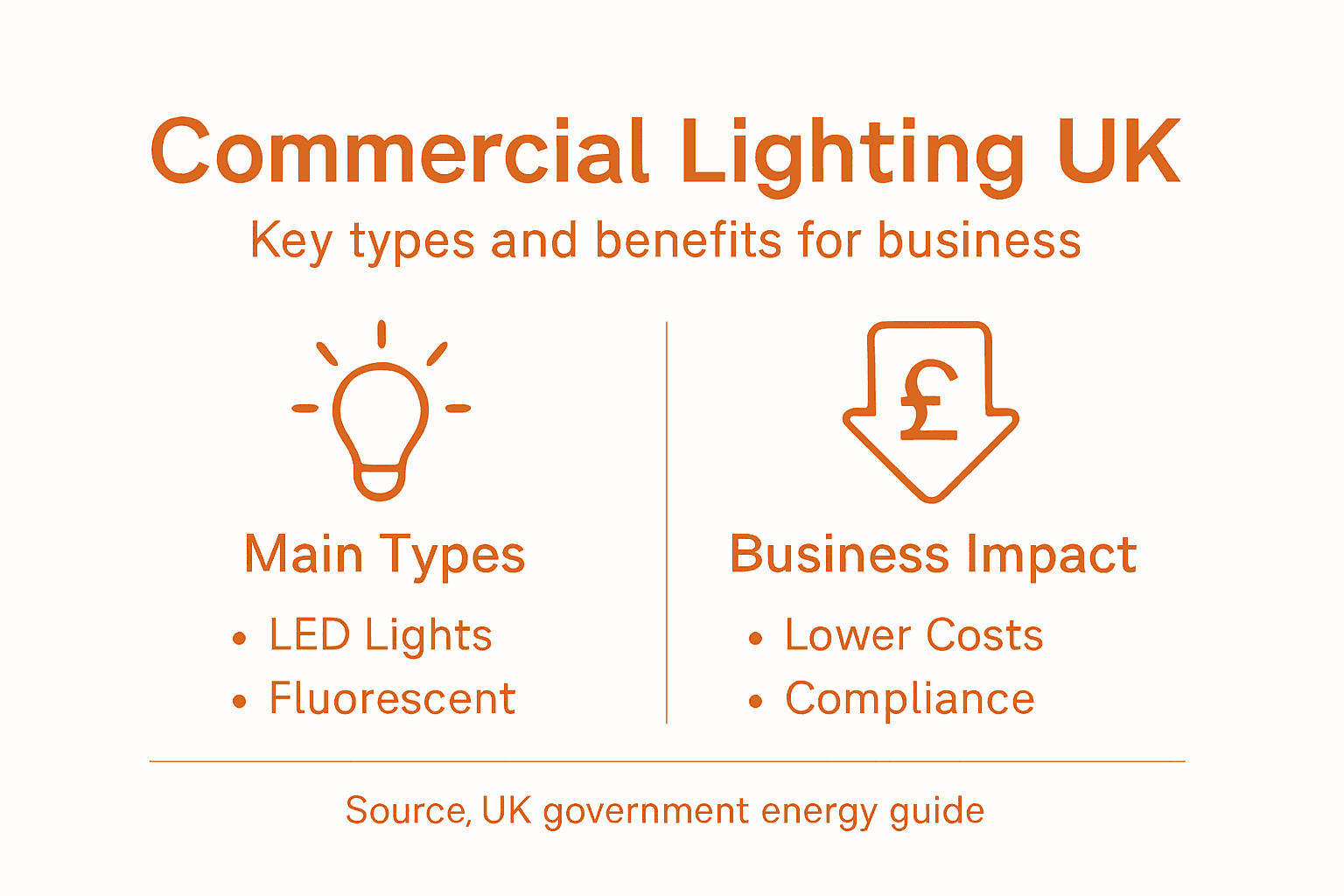
Business sectors are increasingly transitioning towards LED lighting due to its remarkable benefits. These include substantial energy savings, reduced carbon footprint, improved light quality, and enhanced workplace productivity. LED fixtures can be integrated with smart control systems, enabling dynamic lighting management that adapts to changing workplace conditions and occupancy levels.
Pro tip: When selecting commercial lighting technologies, consider long-term operational costs and energy efficiency alongside initial installation expenses.
The following table summarises how common commercial lighting technologies compare in key business aspects:
| Technology Type | Typical Use Case | Energy Efficiency | Expected Lifespan |
|---|---|---|---|
| Tubular Fluorescent | Large offices, factories | Moderate | 10,000-20,000 hours |
| Compact Fluorescent | Small offices, corridors | Moderate | Up to 10,000 hours |
| T5 Fluorescent | Warehouses, schools | High | 20,000+ hours |
| LED Fixture | Retail, all workplaces | Very High | 40,000-100,000 hours |
Key Features and Design Principles
Commercial lighting design represents a sophisticated approach to illumination that goes far beyond simple visibility. Effective lighting strategies require a nuanced understanding of how light impacts workplace performance, user experience, and overall environmental quality.
The core design principles of commercial lighting encompass multiple critical dimensions:
- Functionality: Providing appropriate illumination for specific tasks
- Visual Comfort: Minimising eye strain and fatigue
- Energy Efficiency: Reducing power consumption and environmental impact
- Aesthetic Integration: Complementing architectural and interior design elements
- Adaptability: Supporting dynamic workplace requirements
Professional lighting designers employ a strategic layered lighting approach that integrates three fundamental lighting types. Ambient lighting provides overall illumination, task lighting focuses on specific work areas, and accent lighting creates visual interest and depth. This multi-dimensional strategy ensures comprehensive coverage while allowing precise control over light intensity, colour temperature, and distribution.

Modern commercial lighting design also prioritises advanced technologies that support occupant wellbeing and operational efficiency. Smart lighting systems now incorporate sensors for automatic adjustment, daylight harvesting capabilities, and programmable control mechanisms that respond dynamically to changing environmental conditions and human activity patterns.
Pro tip: Conduct a comprehensive lighting audit to identify specific workplace illumination needs before implementing a new commercial lighting design.
Legal Regulations and Compliance Standards
Commercial lighting in the United Kingdom is subject to a comprehensive framework of legal regulations designed to ensure safety, energy efficiency, and environmental responsibility. UK lighting regulations cover multiple critical aspects of commercial illumination, ranging from electrical safety to environmental impact.
Key regulatory frameworks that businesses must navigate include:
- Part L Building Regulations: Governing energy efficiency and conservation
- Workplace Regulations: Ensuring safe and sufficient lighting conditions
- Environmental Protection Act: Addressing potential light pollution concerns
- British Standards BS 7671: Establishing electrical installation safety requirements
- British Standards BS 5266: Defining emergency lighting specifications
These regulations are not uniform across all sectors, with specific requirements varying depending on the building’s purpose, occupancy, and operational characteristics. Commercial property managers must conduct thorough assessments to ensure their lighting installations meet the precise legal standards applicable to their specific environment. This involves comprehensive evaluations of light intensity, electrical safety, emergency preparedness, and overall energy performance.
Compliance goes beyond mere technical specifications, extending to broader considerations of workplace health, safety, and environmental sustainability. Modern commercial lighting solutions must demonstrate not just legal adherence but a commitment to creating optimal working environments that support employee wellbeing, productivity, and organisational efficiency.
Pro tip: Consult a qualified electrical engineer specialising in commercial lighting to ensure comprehensive regulatory compliance across all applicable standards.
Here is a quick-reference table outlining key UK commercial lighting regulations and their focus areas:
| Regulation / Standard | Primary Focus | Applies To |
|---|---|---|
| Part L Building Regs | Energy efficiency, conservation | All commercial properties |
| Workplace Regulations | Health and safety lighting | Offices, industrial, public areas |
| Environmental Protection Act | Light pollution, environmental impact | External lighting, proximity to nature |
| BS 7671 | Electrical installation safety | All electrical systems |
| BS 5266 | Emergency lighting provisions | Public and commercial buildings |
Costs, Benefits, and Common Pitfalls
Commercial lighting investments represent a complex balance between initial expenditure and long-term strategic value. Commercial LED lighting solutions offer significant financial and operational advantages that extend far beyond traditional lighting technologies.
Key financial considerations for commercial lighting include:
- Initial Investment: Higher upfront costs for advanced technologies
- Energy Efficiency: Potential electricity use reduction of 70-80%
- Maintenance Expenses: Dramatically reduced replacement and servicing costs
- Environmental Impact: Lower carbon footprint and compliance with sustainability regulations
- Performance Longevity: Extended operational lifespan compared to conventional systems
Common pitfalls in commercial lighting selection often stem from narrow, short-term perspectives that prioritise immediate cost savings over comprehensive performance metrics. Businesses frequently make critical errors by selecting lighting solutions based solely on initial purchase price, overlooking long-term operational expenses, energy consumption, and potential productivity impacts.
Strategic lighting investments require a holistic approach that considers multiple interconnected factors. Beyond pure financial calculations, organisations must evaluate how lighting technologies influence workplace environment, employee wellbeing, operational efficiency, and brand perception. Modern commercial lighting is not merely an infrastructure expense but a strategic asset that can significantly enhance workplace performance and organisational sustainability.
Pro tip: Conduct a comprehensive total cost of ownership analysis that includes energy consumption, maintenance, replacement costs, and potential productivity gains before finalising commercial lighting investments.
Upgrade Your Commercial Lighting for Efficiency and Compliance Today
Navigating the complex demands of commercial lighting presents a challenge for businesses aiming to balance energy efficiency, legal compliance, and workplace wellbeing. If you seek to overcome issues like high operational costs, maintenance burdens, and outdated lighting technology, choosing the right LED solution is essential. At Ledsupplyandfit.co.uk, we specialise in supplying and installing high-quality LED lighting systems tailored to meet UK regulations and optimise your commercial environment. Our expertise ensures your lighting not only complies with standards such as Part L Building Regulations and BS 5266 but also enhances visual comfort and workplace productivity.

Take control of your commercial lighting challenges with our reliable solutions designed for shops, offices, warehouses, and more. Benefit from energy savings, long product lifespan, and expert installation support across the UK. Visit Ledsupplyandfit.co.uk now to explore our range or request a consultation. Start transforming your premises today with lighting solutions engineered for performance and compliance.
Frequently Asked Questions
What is commercial lighting?
Commercial lighting refers to specialised lighting systems designed for professional environments, ensuring adequate illumination, efficiency, and durability tailored to various business needs.
How does commercial lighting differ from residential lighting?
Commercial lighting focuses on performance and energy efficiency, catering to specific workplace requirements, unlike residential lighting, which centres on comfort and ambience.
What are the main types of commercial lighting technologies?
Common commercial lighting technologies include tubular fluorescent lights, compact fluorescent lamps (CFLs), T5 fluorescent fixtures, and LED light fixtures, with LED being the most energy-efficient and widely adopted option.
Why is it important to comply with commercial lighting regulations?
Compliance with commercial lighting regulations ensures safety, energy efficiency, and environmental responsibility, helping businesses create optimal working environments and avoid potential legal issues.