Emergency lighting compliance: what UK businesses must know
TL;DR:
- Emergency lighting is a legal requirement for most non-domestic premises in the UK, crucial for fire safety and evacuation. Compliance involves thorough risk assessments, proper design, installation, testing, and maintaining detailed records to avoid legal and insurance issues. Using BAFE-certified contractors ensures system competence, and ongoing documentation and regular inspection are vital for long-term adherence.
Emergency lighting is one of those legal requirements that most commercial property managers and business owners underestimate until something goes wrong. The assumption that it only matters for hospitals, nightclubs, or large industrial sites is a costly misconception. Under the Fire Safety Order duties, virtually every non-domestic premises in England and Wales must assess and, in most cases, provide emergency lighting. If you are responsible for a shop, office, gym, hotel, or warehouse, this requirement almost certainly applies to you.
Key Takeaways
| Point | Details |
|---|---|
| Legal duty clarified | Almost all UK commercial premises must provide and maintain emergency lighting under legal requirements. |
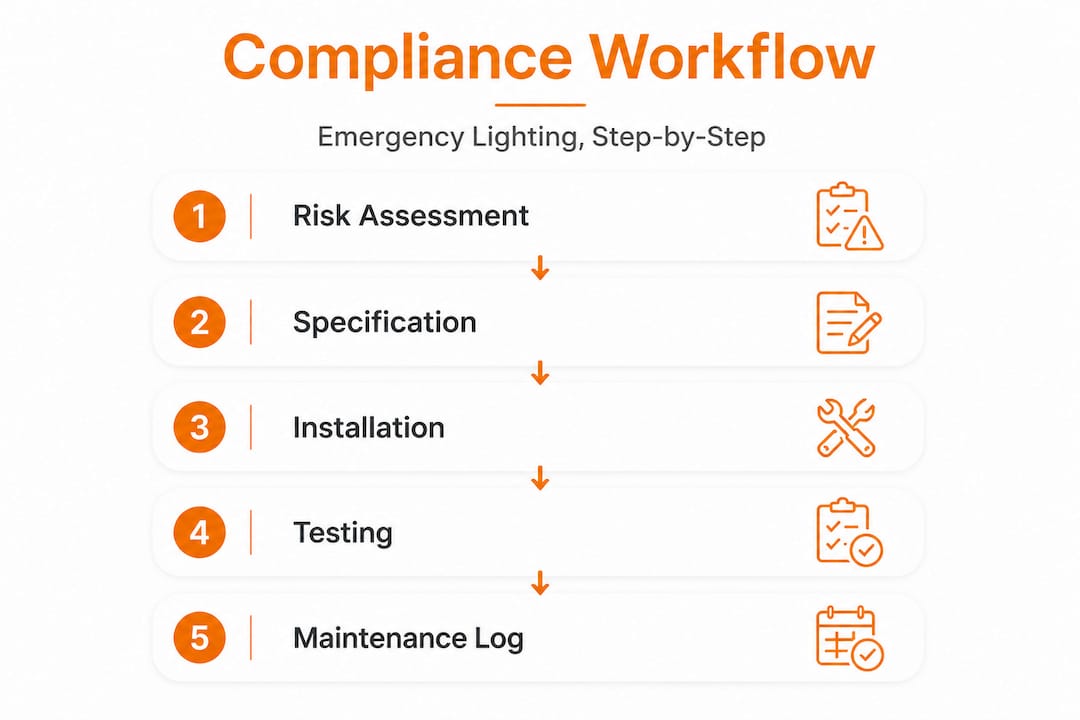
| Workflow matters | Compliance is achieved via risk assessment, specification, installation, regular testing, and proper evidence. |
| Technical standards | Systems must meet BS 5266-1 and illuminate key escape and safety points reliably. |
| Contractor competency | Using BAFE-certified contractors protects against legal pitfalls and ensures best practice. |
| Record-keeping vital | Consistent documentation is critical to demonstrate compliance in audits and inspections. |
The legal framework for emergency lighting
The Regulatory Reform (Fire Safety) Order 2005 places a clear duty on the “responsible person” for any non-domestic building. That means the employer, building owner, or occupier must take all reasonable steps to ensure safe evacuation in the event of a fire or power failure. Emergency lighting is a central part of that obligation.
The key technical standard underpinning compliance in the UK is BS 5266-1. This standard defines the minimum illuminance levels (measured in lux), the duration systems must operate for, and the requirements for emergency exit signage. It also guides the spatial layout of fittings and how systems should be designed to serve specific building types.
What makes UK lighting regulations particularly important here is that compliance is not a one-size-fits-all exercise. A fire risk assessment must first determine whether emergency lighting is needed, where it is needed, and to what specification. That assessment must be carried out by a competent person and reviewed regularly.
Key points every responsible person should understand:
- Emergency lighting applies to escape routes, open areas above 60m², toilet facilities exceeding 8m², and rooms where people could be at risk in darkness
- Non-compliance can result in enforcement notices, prosecution, fines, or even imprisonment for serious failures
- The local fire authority and Health and Safety Executive both have the power to inspect premises and enforce compliance
- Failing a fire risk assessment for emergency lighting can also invalidate your buildings insurance
“Emergency lighting is not an optional upgrade. It is a statutory requirement that sits at the heart of your fire safety responsibilities as a business occupier or owner.”
To stay on the right side of enforcement, treating emergency lighting as an integral part of your broader fire alarm compliance approach is the most logical route.
Compliance workflow: from risk assessment to maintenance
Understanding the law is only the first step. The practical compliance journey follows a clear sequence, and cutting corners at any stage creates problems that compound over time.
- Fire risk assessment — A competent assessor reviews your premises and identifies areas where emergency lighting is required, taking into account occupancy levels, layout complexity, and existing general lighting.
- System specification — A designer uses the assessment findings to specify lighting types, luminaire positions, illuminance levels, and duration requirements in line with BS 5266-1.
- Installation — A qualified contractor installs the system according to the approved design, providing a commissioning certificate upon completion.
- Testing and maintenance — The duty holder implements a defined regime of monthly functional tests and annual full duration tests, keeping detailed records at every stage.
- Audit and evidence — All documentation is retained so that if an inspector arrives, you can demonstrate ongoing compliance with minimal effort.
The BAFE compliance workflow makes clear that evidence is everything. A beautifully installed system with no maintenance records is effectively non-compliant in the eyes of an enforcing authority.
| Feature | Self-testing systems | Manual maintenance regime |
|---|---|---|
| Testing method | Automated internal test cycle | Technician-conducted testing |
| Logbook requirement | Electronic log generated automatically | Paper or digital log maintained manually |
| Cost over time | Higher upfront, lower ongoing labour | Lower upfront, higher ongoing labour |
| Reliability evidence | Consistent and auditable | Dependent on staff diligence |
| Suitability | Larger or complex premises | Smaller or simpler premises |
Self-testing systems generate their own evidence automatically. For large premises such as hotels or multi-storey offices, this removes a significant administrative burden and dramatically reduces the risk of an overlooked test cycle.

Pro Tip: Never assume a monthly test has been carried out unless it is physically logged. Verbal confirmation from a member of staff is not acceptable evidence during a compliance inspection. Establish a written or digital logbook from day one and review it quarterly.
Review your installation best practices and lighting safety guidelines to ensure your system is set up for long-term compliance from the outset.
Technical standards and specification criteria
BS 5266-1 illuminance benchmarks are specific and non-negotiable. Getting the specification wrong during design means the system may fail inspection even if every fitting is operational.
The standard broadly requires:
- Escape routes: minimum 1 lux along the centreline, with the middle half of the route achieving at least 50% of that value
- Open areas and anti-panic lighting: minimum 0.5 lux across the core area (excluding a 0.5 metre border)
- High-risk task areas: minimum 10% of normal maintained illuminance, or 15 lux (whichever is greater)
- Duration: most emergency luminaires must sustain operation for a minimum of 3 hours following mains failure
| Area type | Minimum illuminance (lux) | Minimum duration |
|---|---|---|
| Escape routes | 1 lux on centreline | 3 hours |
| Open/anti-panic areas | 0.5 lux across core area | 3 hours |
| High-risk task areas | 10% of normal or 15 lux | 3 hours |
| Covered car parks | 1 lux on driving lines | 3 hours |
Understanding lumens vs lux is relevant here because luminaire output (lumens) is not the same as the illuminance achieved at floor level (lux), which depends on mounting height, spacing, and reflectance of surrounding surfaces. A competent designer accounts for all of these variables.
Documentation required for a compliant installation includes:
- Completed fire risk assessment identifying the need for emergency lighting
- Design drawings showing luminaire positions and coverage calculations
- Installation completion certificate signed by the installing contractor
- Commissioning records confirming initial performance testing
- Ongoing monthly and annual test logs signed by a responsible individual
The lighting selection process for emergency systems should account for all of these criteria from the start, not retrospectively. Explore emergency LED lighting solutions that are specified to meet these benchmarks as a starting point.
Due diligence: choosing competent contractors
Not every electrician who can fit a maintained emergency luminaire can demonstrate the competency required for full system design, installation, and certification. This matters more than most business owners realise.
BAFE SP203-4 certification is the recognised scheme for emergency lighting contractors in the UK. It covers four modules: design, installation, commissioning, and maintenance. An organisation certificated to all four modules has been independently assessed and can provide a credible paper trail that holds up under scrutiny.
Risks of using a non-certificated provider include:
- Inability to provide a valid commissioning certificate acceptable to insurers
- Poor system design that fails BS 5266-1 benchmarks without being visibly obvious
- No structured maintenance protocol, leading to gradual system degradation
- Legal exposure for the responsible person if an incident occurs and the contractor cannot demonstrate competency
- Potential insurance claim rejection on the basis of a non-compliant installation
Pro Tip: Before signing any contract, ask the contractor to confirm their BAFE SP203-4 module coverage in writing. Request their certificate number and verify it directly on the BAFE register. A reputable contractor will welcome this scrutiny rather than avoid it.
If you are sourcing safe emergency LED solutions for your premises, ensure the supply chain and installation team are aligned on compliance from the outset. Consider also reviewing resources such as business finance options for electrical contractors if you are managing a larger remediation project with capital implications.
The uncomfortable truth about emergency lighting compliance
Having worked across a wide range of commercial sectors, from veterinary practices to hospitality venues, the pattern we see most often is not deliberate non-compliance. It is the gradual erosion of standards through misunderstanding and assumption.
Most compliance failures begin at the specification stage. The fire risk assessment correctly identifies the need for emergency lighting, but the resulting specification is underpowered or based on generic templates rather than the specific building layout. The system passes initial inspection, and then nobody scrutinises it again for years.
Routine audits consistently reveal more maintenance deficiencies than installation failures. Logbooks that were kept diligently for the first year then tail off. Bulb failures in maintained systems go unreported. Annual full-duration tests are skipped because “nothing has changed.” The cumulative effect is a system that exists on paper but cannot be demonstrated to work.
The financial and legal stakes are real. Shortcutting the specification or design phase can invalidate building insurance at precisely the moment you need it most. Prosecution under the Fire Safety Order can result in unlimited fines. Directors and named responsible persons face personal liability.
The professional lesson we would share is this: your logbook and documentation are not administrative overhead. They are your primary legal protection. Meeting lighting regulations is achievable for almost any premises type, but only if the evidence trail is treated as part of the system itself, not an afterthought.
Support for your emergency lighting compliance journey
Emergency lighting compliance does not have to be a source of anxiety. With the right expertise behind you, from initial assessment through to ongoing maintenance, it becomes a manageable and well-documented part of your overall fire safety programme.

At LED Supply & Fit, we work with commercial clients across retail, healthcare, hospitality, and industrial sectors to design, supply, and install LED emergency lighting systems that meet BS 5266-1 requirements. Whether you are upgrading an existing system, starting from scratch, or simply want clarity on your current position, our team can help. Explore our lighting design compliance service or see how we have supported projects such as the Wilson Veterinary Group to achieve compliant, cost-effective lighting across their premises.
Frequently asked questions
Who is the ‘responsible person’ for emergency lighting compliance in UK commercial premises?
The ‘responsible person’ is typically the employer, owner, or occupier who must ensure fire safety duties are fulfilled, including emergency lighting provision, as defined by the Fire Safety Order.
How often should emergency lighting systems be tested and maintained?
Emergency lighting should be functionally tested at least monthly and fully tested annually, with detailed records kept throughout for inspection, as outlined in the BAFE maintenance guidance.
Can any electrician install emergency lighting or must they be BAFE-certified?
While a qualified electrician can carry out the physical installation, using a BAFE SP203-4 certified contractor provides documented assurance of design and maintenance competency, which protects against legal and insurance risk.
What documentation should be kept for emergency lighting compliance?
You should retain risk assessments, installation certificates, commissioning records, testing and maintenance logs, and evidence of contractor competency, all of which may be requested during an enforcement inspection.