Office Lighting – Enhancing Workplace Performance and Savings
Energy costs keep rising while workplace standards demand more than just brighter spaces. Facility managers across the United Kingdom face growing pressure to create environments that support both employee well-being and operational efficiency. Choosing the right LED lighting solutions not only helps cut long-term expenses, but also delivers a measurable difference in mood, concentration, and compliance with British safety regulations. Discover why strategic office lighting is a cornerstone of modern commercial success.
Table of Contents
- Defining Office Lighting In Commercial Buildings
- Types Of Office Lighting And Led Solutions
- Legal Standards And Compliance For Uk Offices
- Workplace Comfort And Efficiency With Proper Lighting
- Cost Savings And Common Installation Pitfalls
Key Takeaways
| Point | Details |
|---|---|
| Effective Lighting Enhances Performance | Strategic office lighting improves employee wellbeing and productivity by balancing various factors such as visual comfort and energy efficiency. |
| Types of Lighting Matter | Different work zones require specific lighting solutions; for instance, ambient lighting is best for collaborative areas, while task lighting is essential for individual workstations. |
| Compliance is Crucial | Adhering to UK workplace lighting regulations ensures safety and enhances operational efficiency, avoiding potential legal and financial repercussions. |
| Smart Technology Integration | Modern lighting systems that adapt to natural light and occupancy can significantly improve the workplace environment while reducing energy costs. |
Defining Office Lighting in Commercial Buildings
Office lighting represents far more than simply illuminating a workspace. Modern commercial lighting solutions are sophisticated systems designed to enhance workplace performance, employee wellbeing, and organisational efficiency. The British Council for Offices’ Guide to Lighting emphasises that effective office lighting must strategically balance multiple critical requirements.
At its core, office lighting encompasses several essential dimensions:
- Visual Performance: Enabling clear, comfortable visibility for different work tasks
- Psychological Impact: Supporting employee mood, alertness, and cognitive function
- Energy Efficiency: Minimising electrical consumption while maximising illumination quality
- Safety and Compliance: Meeting workplace health and safety regulatory standards
Commercial lighting design requires nuanced understanding of how light influences human physiology and productivity. Different work zones demand varied lighting approaches – from collaborative open spaces requiring ambient illumination to focused individual workstations needing precise, adjustable lighting.
Effective office lighting is not just about brightness, but creating an environment that supports human performance and wellbeing.
Modern lighting solutions increasingly integrate smart technologies that can adapt to changing workplace dynamics. These systems can automatically adjust light levels based on natural daylight, occupancy, and specific task requirements, representing a significant evolution from traditional static lighting setups.
Pro tip: Conduct a comprehensive lighting audit to identify potential performance and energy-saving opportunities within your current office lighting infrastructure.
Types of Office Lighting and LED Solutions
Office lighting solutions have dramatically evolved, with LED technologies now dominating modern commercial environments. Artificial lighting technologies offer unprecedented flexibility in creating optimised workplace illumination strategies that support employee performance and wellbeing.
The primary types of office lighting solutions include:
- Ambient Lighting: General illumination providing overall workspace brightness
- Task Lighting: Focused illumination for specific work areas and detailed tasks
- Accent Lighting: Highlighting architectural features or creating visual interest
- Decorative Lighting: Enhancing aesthetic appeal and workplace atmosphere
Modern LED lighting systems bring remarkable advantages to commercial settings. These sophisticated solutions can dynamically adjust colour temperature and brightness, mimicking natural daylight cycles to support circadian rhythms and maintain employee alertness.
LED lighting represents a transformative technology that goes beyond simple illumination, actively contributing to workplace productivity and energy efficiency.
Different work zones require tailored lighting approaches. Open collaborative spaces benefit from diffused, softer lighting, while individual workstations demand precise, adjustable illumination that reduces eye strain and supports concentrated work.

Here is a summary of how key lighting types enhance different office spaces:
| Lighting Type | Best For | Notable Benefit | Example Application |
|---|---|---|---|
| Ambient Lighting | Open plan areas | Uniform visibility | Shared offices, corridors |
| Task Lighting | Individual workstations | Improved concentration | Desks, meeting tables |
| Accent Lighting | Feature-rich environments | Highlights aesthetics | Lobby displays, artwork zones |
| Decorative Lighting | Reception and leisure spaces | Boosts atmosphere and uniqueness | Reception areas, break rooms |
Pro tip: Implement a zoned lighting strategy that allows individual employees to personalise their immediate workspace lighting for optimal comfort and productivity.
Legal Standards and Compliance for UK Offices
UK workplace lighting regulations represent a comprehensive framework designed to ensure employee safety, comfort, and productivity. Workplace lighting standards are governed by stringent health and safety legislation that mandates employers provide suitable illumination across different work environments.
Key legal compliance requirements for office lighting include:
- Illumination Levels: Specific lux requirements for different work zones
- Glare Reduction: Minimising visual discomfort and potential eye strain
- Colour Rendering: Ensuring accurate colour perception for detailed tasks
- Emergency Lighting: Maintaining safe evacuation routes during power failures
- Energy Efficiency: Meeting sustainability and environmental regulations
Employers must conduct thorough risk assessments to ensure lighting meets the Health and Safety Executive’s detailed guidelines. This involves measuring light intensity, understanding specific task requirements, and implementing solutions that support both regulatory compliance and workplace performance.
This table compares core compliance factors for UK office lighting:
| Compliance Area | Business Impact | Example Risk if Ignored |
|---|---|---|
| Lux Levels | Enhances visual clarity | Increased accidents, eye strain |
| Glare Management | Reduces discomfort | Staff complaints, reduced focus |
| Colour Rendering | Accurate task performance | Errors in detail-oriented work |
| Emergency Lighting | Ensures safe evacuation | Safety breaches, legal exposure |
| Energy Efficiency | Cuts operational costs | Higher bills, sustainability fines |
Legal lighting standards are not merely bureaucratic requirements, but essential mechanisms for protecting employee wellbeing and organisational productivity.
Complex work environments require nuanced lighting strategies. Scientific research demonstrates that appropriate lighting directly impacts employee performance, with variations in colour temperature and intensity influencing cognitive function, mood, and overall workplace effectiveness.
Pro tip: Engage a professional lighting consultant to conduct a comprehensive workplace lighting audit, ensuring full compliance with current UK health and safety regulations.
Workplace Comfort and Efficiency with Proper Lighting
Workplace lighting research reveals that strategic illumination is far more than a simple environmental consideration. Appropriate lighting directly influences employee well-being, cognitive performance, and overall workplace productivity, transforming office environments from merely functional spaces to dynamic, supportive ecosystems.
Key elements of effective workplace lighting design include:
- Circadian Rhythm Support: Mimicking natural light cycles
- Visual Comfort: Reducing eye strain and fatigue
- Task-Specific Illumination: Adapting lighting to different work activities
- Personal Lighting Control: Enabling individual workspace adjustments
- Psychological Well-being: Enhancing mood and mental performance
Different workplace zones demand nuanced lighting strategies. Collaborative areas benefit from softer, more diffused lighting that encourages interaction, while concentrated work zones require precise, adjustable illumination that minimises glare and supports detailed tasks.
Lighting is not just about visibility, but about creating an environment that actively supports human performance and well-being.
Advanced lighting solutions now integrate sophisticated technologies that can dynamically adjust colour temperature, intensity, and distribution. These systems respond to changing natural light conditions, occupancy levels, and specific workplace activities, representing a significant evolution in workplace design.
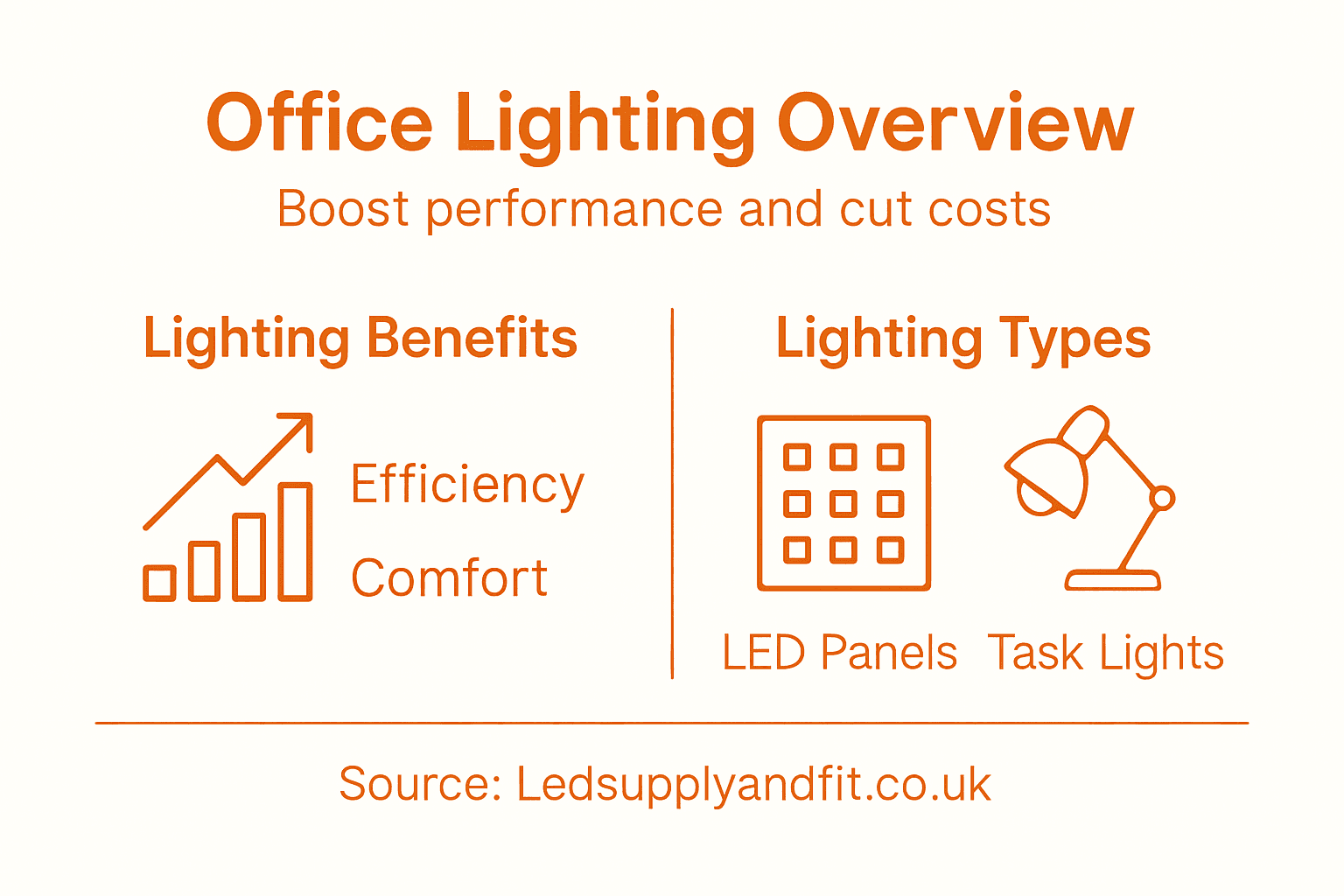
Pro tip: Implement a zoned lighting approach that allows employees to personalise their immediate workspace lighting, balancing individual comfort with overall energy efficiency.
Cost Savings and Common Installation Pitfalls
Cost factors in LED lighting retrofits reveal complex considerations beyond simple equipment replacement. Strategic planning and professional implementation are crucial to maximising financial benefits and minimising potential installation challenges in commercial lighting projects.
Key financial and technical considerations include:
- Initial Investment: Upfront equipment and installation costs
- Energy Consumption Reduction: Long-term operational savings
- Maintenance Expenses: Lower replacement and servicing requirements
- Utility Rebate Opportunities: Government and energy provider incentives
- Infrastructure Compatibility: Existing electrical system adaptations
Common installation pitfalls can significantly undermine potential cost savings. Businesses often encounter challenges such as incorrect fixture selection, inadequate electrical infrastructure, improper load calculations, and insufficient professional assessment of existing lighting systems.
Successful LED lighting projects balance technical expertise with strategic financial planning, transforming an expense into a long-term investment.
Comprehensive project planning involves detailed site surveys, precise equipment specifications, professional installation, and thorough post-implementation performance monitoring. Understanding these nuanced elements helps organisations navigate potential complications and maximise their lighting upgrade investments.
Pro tip: Engage a certified lighting consultant to conduct a comprehensive audit and develop a detailed implementation strategy before commencing your LED lighting retrofit project.
Transform Your Office with Expert LED Lighting Solutions
The article highlights common challenges in office lighting such as achieving the right balance of visual comfort, energy efficiency, and legal compliance to boost workplace performance and wellbeing. You understand how crucial it is to tailor lighting to different work zones, reduce glare, and support circadian rhythms to maintain focus and productivity. Yet, navigating installation pitfalls or meeting UK workplace lighting standards can feel overwhelming.
At Ledsupplyandfit.co.uk, we specialise in supplying and installing professional LED lighting solutions designed specifically for commercial spaces like offices. Our range supports bespoke lighting strategies including ambient, task, and accent lighting that improve employee comfort and lower operational costs. Whether you need expert advice, bulk discounts, or fast next-day delivery, we are ready to help you upgrade your office lighting efficiently and in full compliance with regulatory requirements.
Improve your workplace environment with energy-efficient LED lighting tailored for commercial offices. Visit https://ledsupplyandfit.co.uk to explore our offerings and book a consultation. Dont delay resolving your lighting challenges and start saving on energy and maintenance costs today. Discover how a customised, professional lighting upgrade can enhance productivity while protecting your teams health and wellbeing.
Frequently Asked Questions
What are the key benefits of effective office lighting?
Effective office lighting enhances visual performance, improves employee mood and alertness, promotes energy efficiency, and ensures safety and compliance with health regulations.
How can I create a lighting strategy for different work zones in an office?
Implement a zoned lighting strategy with tailored approaches: use ambient lighting for open areas, task lighting for individual workstations, and accent lighting to highlight features or create a specific atmosphere.
What is the role of LED lighting in commercial office spaces?
LED lighting provides flexible illumination options, improves energy efficiency, and can be adjusted for colour temperature and brightness, supporting workplace productivity and well-being.
How do I ensure compliance with lighting regulations in my office?
Conduct thorough risk assessments to measure light intensity and ensure it meets specified lux levels. Engage a professional lighting consultant to help identify and implement solutions that comply with current health and safety regulations.