Symmetric vs Asymmetric Flood Lighting: Understanding the Key Differences and Applications
Flood lighting plays a critical role in illuminating large external and internal areas, and selecting the correct beam distribution is essential for achieving both performance and compliance. Two of the most common configurations are symmetric and asymmetric flood lighting, each designed for distinct applications and lighting objectives.
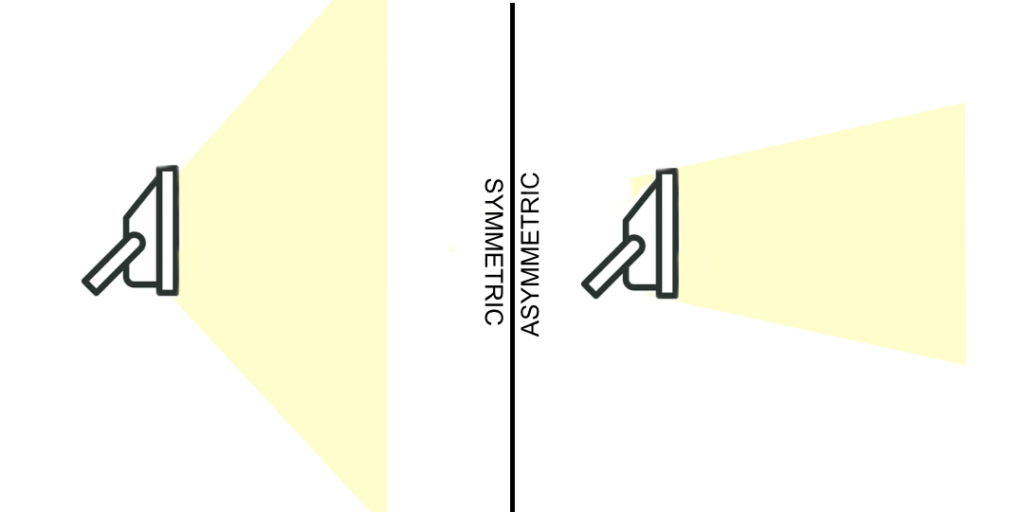
Symmetric flood lighting distributes light evenly around a central axis, typically in a circular or square pattern. This means the light output is uniform in all directions from the fixture. Symmetric floodlights are commonly used in open areas where balanced illumination is required, such as car parks, yards, warehouses, loading bays, and general outdoor spaces. Because the light spreads evenly, these fittings are ideal when the goal is to provide consistent brightness without prioritising a specific direction or surface.
One of the main advantages of symmetric lighting is its simplicity in design and installation. Fixtures can often be mounted centrally or at higher elevations without the need for precise aiming. However, this uniform distribution can also be a limitation. In perimeter or boundary installations, symmetric floodlights may produce excessive light spill beyond the intended area, contributing to glare, wasted energy, and potential light pollution.
In contrast, asymmetric flood lighting is engineered to project light predominantly in one direction. The beam is deliberately shaped to push light forward and outward rather than evenly around the fixture. This makes asymmetric floodlights particularly effective for applications such as building façades, perimeter fencing, pathways, roadways, stadiums, and sports facilities. By directing light only where it is needed, asymmetric fittings improve efficiency and visual comfort.
A key benefit of asymmetric lighting is improved control. It reduces upward and backward light spill, helping installations meet environmental and planning regulations related to glare and obtrusive light. This targeted approach also enhances uniformity across horizontal surfaces, making asymmetric floodlights especially suitable for areas where visibility and safety are critical.
When comparing the two, the choice largely depends on the application. Symmetric floodlights are best suited to open, centralised spaces requiring broad coverage, while asymmetric floodlights excel in edge-mounted or directional installations where precision and control are priorities.
Understanding the difference between symmetric and asymmetric flood lighting allows specifiers, contractors, and end users to select the most effective solution. By aligning beam distribution with the intended environment, it is possible to achieve optimal illumination, improved energy efficiency, and compliance with modern lighting standardsWe offer a complete LED supply and fit service, with a comprehensive range of flood lights that includes both symmetrical and asymmetrical lighting solutions to suit a wide variety of applications.
At LED supply and fit , we offer a comprehensive range of flood lights that includes both symmetrical and asymmetrical lighting solutions to suit a wide variety of applications. Shop now!