Warehouse Lighting Explained: Boost Safety and Savings
Warehouse managers in the United Kingdom face a unique challenge when it comes to lighting vast storage spaces. Balancing energy efficiency, safety, and cost can be daunting, especially when poor illumination directly leads to visual fatigue, accidents, and errors among staff. Modern LED lighting goes beyond simple brightness; it delivers the right quality and uniformity of light with minimal maintenance, helping large-scale facilities transform their operational costs and workplace safety. Discover practical principles and common pitfalls in the move towards energy-efficient solutions.
Table of Contents
- Warehouse Lighting: Core Principles and Challenges
- LED, Fluorescent, and ATEX-Rated Options Compared
- Factors Shaping Warehouse Lighting Design
- UK Legal Standards and Energy Efficiency Rules
- Costs, Savings, and Mistakes to Avoid
Key Takeaways
| Point | Details |
|---|---|
| Effective Warehouse Lighting | Focus on illumination quantity, quality, uniformity, and maintenance to enhance safety and productivity. |
| LED Technology Advantages | LED systems offer superior efficiency, reduced maintenance costs, and longer lifespans compared to fluorescent and metal halide options. |
| Compliance with Regulations | Ensure that warehouse lighting meets UK legal standards for safety and energy efficiency to protect workers and avoid penalties. |
| Strategic Planning | Conduct thorough assessments and select appropriate fixtures and control systems to optimise energy use and minimise costs. |
Warehouse Lighting: Core Principles and Challenges
Warehouse lighting sits at the intersection of safety, productivity, and cost management. Unlike typical office environments, warehouses present unique lighting challenges that demand a strategic approach. Your team needs adequate illumination to identify hazards such as oncoming vehicles, pedestrians, and slippery floors, but the sheer scale of these spaces makes achieving consistent, quality lighting far more complex than simply installing more fixtures. The problem isn’t just about brightness—it’s about delivering the right quality of light across thousands of square metres whilst minimising operational expenses and energy consumption.
The core principles of effective warehouse lighting rest on four critical factors. First, you must address illumination quantity, ensuring sufficient light levels across all work areas and storage zones. Second comes light quality, which includes avoiding glare, poor contrast, and flicker that create visual fatigue and strain for your staff. Third is uniformity, maintaining consistent light distribution so workers don’t experience sudden bright or dark patches that slow productivity and increase accident risk. Fourth involves system maintenance, which many warehouse managers overlook until problems emerge. Poor lighting directly leads to visual fatigue, stress, and increased errors that compound into safety incidents and lost productivity. A comprehensive maintenance programme ensures your lighting fixtures remain at peak performance rather than gradually degrading until you’re forced into expensive emergency replacements.
The real challenge lies in balancing competing demands. You’re managing a large-scale operation where traditional fluorescent or metal halide systems consume enormous amounts of energy whilst requiring frequent maintenance and lamp replacements. Task-specific lighting solutions tailored to your warehouse operations can address these inefficiencies, but implementing the right system requires understanding your facility’s specific demands. Storage areas stacked twenty metres high need different solutions than picking zones where staff identify individual items. Narrow aisles demand focused task lighting, whilst open areas require broader coverage. Many warehouse managers discover too late that their lighting design creates dark pockets where accidents happen, or generates excessive glare that forces workers to squint and make mistakes. Weather conditions matter too—if you receive goods during dark winter mornings or operate evening shifts, your lighting strategy must account for minimal natural light supplementation.
The challenge deepens when considering environmental conditions unique to warehouses. Temperature fluctuations, dust accumulation, humidity, and vibration from heavy machinery all affect lighting performance and longevity. Fixtures require proper installation rated for these conditions, and your maintenance schedule must account for dust buildup that progressively reduces light output. Add to this the compliance layer—workplace lighting regulations establish minimum standards that you must meet legally. Getting these fundamentals right isn’t optional; it’s the foundation for a safe, efficient operation where your team can work confidently and your facility runs at peak performance.
Pro tip: Begin by documenting current lighting problems—staff complaints about eye strain, accident hotspots with poor visibility, and areas where productivity dips—then match these specific challenges to targeted solutions rather than replacing your entire system at once.
LED, Fluorescent, and ATEX-Rated Options Compared
When you’re evaluating warehouse lighting options, you’re essentially choosing between three categories that serve distinctly different purposes and budgets. Traditional fluorescent systems have dominated UK warehouses for decades, but they represent outdated technology that costs you money every single month. Metal halide and high-pressure sodium alternatives offer variations on the same basic approach—they work, but they’re inefficient and require constant maintenance. Then there’s LED technology, which has fundamentally changed what’s possible in warehouse lighting. The comparison isn’t just about brightness or cost anymore. It’s about long-term value, safety compliance, and whether your facility handles hazardous materials requiring specialised explosion-proof protection.
Fluorescent lighting remains common in older warehouse facilities because the initial purchase price appears low. These systems emit white light and consume moderate energy, but here’s where the maths becomes unfavourable. A typical fluorescent tube lasts around 8,000 to 15,000 hours, meaning you’re replacing them roughly every 1-2 years depending on usage patterns. Add maintenance labour costs, disposal fees, and the operational disruption of scheduled replacements, and your true cost per year accelerates significantly. Metal halide lamps provide bluish-white illumination and deliver brightness quickly, but they’re even less efficient than fluorescent options and take time to reach full brightness—frustrating when your team needs immediate visibility. High-pressure sodium lamps offer energy efficiency and decent longevity, but their amber colour output means poor colour rendering, making it harder for staff to identify products, spot damage, or navigate accurately. By comparison, LED lighting technology provides significantly higher efficiency with vastly longer operating lifespans—20,000 to 50,000 hours or more—meaning you might install a system once and leave it undisturbed for a decade.
LED systems deliver performance advantages that transform your operation. They reach full brightness instantly with no warm-up period, provide consistent white light that makes colour recognition and safety identification straightforward, and generate minimal heat compared to traditional alternatives. A typical 100-watt LED fixture delivers equivalent illumination to a 250-watt fluorescent system, translating directly into reduced energy bills month after month. Over a 10-year period, the energy savings alone often cover your entire installation investment. Beyond efficiency, LEDs produce less flicker and glare, reducing visual fatigue and the eye-strain complaints your staff currently file. The downside? Upfront costs run higher than fluorescent systems, though the payback period typically falls between 2-4 years depending on your usage patterns and local electricity rates.
Here is a quick comparison of common warehouse lighting technologies and their operational impacts:
| Lighting Type | Lifespan (Hours) | Energy Efficiency | Maintenance Needs |
|---|---|---|---|
| Fluorescent | 8,000–15,000 | Moderate, declining | Frequent tube replacement |
| Metal Halide | 6,000–15,000 | Low, heats up quickly | Bulb replacement often |
| High-Pressure Sodium | 18,000–24,000 | Fair, amber output | Poor colour rendering |
| LED | 20,000–50,000+ | High, instant output | Minimal, long interval |
| ATEX-Rated LED | 20,000–50,000+ | High, explosion-proof | Specialist install required |
Now, if your warehouse handles flammable liquids, explosive powders, volatile chemicals, or operates in gaseous environments, you cannot compromise with standard LED systems. ATEX-rated lighting solutions meet strict safety standards designed specifically for hazardous zones, providing explosion-proof protection that prevents ignition sources from reaching dangerous materials. These specialised fixtures cost more than conventional LED systems because they incorporate additional engineering—robust construction, sealed components, temperature monitoring, and certifications proving they meet European safety directives. For facilities storing or processing hazardous substances, ATEX-rated LED systems represent not optional but mandatory investment. They combine LED efficiency advantages with essential safety compliance, meaning you reduce operational costs whilst eliminating risk of catastrophic incidents. The comparison in your case isn’t LED versus fluorescent—it’s which certified ATEX-rated LED system meets your specific hazard classification.
Here’s the reality: if you’re still operating traditional fluorescent or metal halide systems in a non-hazardous warehouse, you’re spending significantly more on electricity and maintenance than necessary. If you work with hazardous materials and haven’t upgraded to ATEX-rated systems, you’re carrying compliance and safety risks that could result in fines or worse. The decision framework is straightforward—assess your facility’s hazard classification, calculate your annual lighting costs, then evaluate LED solutions against your current spending. For most UK warehouse operators, the numbers strongly favour switching to LED technology.
Pro tip: Request a professional site survey from your lighting supplier to measure your current illumination levels and identify dark zones, then compare LED options that meet those specific brightness requirements rather than assuming all LED systems deliver equivalent performance.
Factors Shaping Warehouse Lighting Design
Your warehouse lighting design cannot follow a one-size-fits-all template. The layout, operations, and physical characteristics of your facility create a unique set of constraints and opportunities that demand a tailored approach. Think of lighting design as solving a puzzle with multiple pieces. You’re balancing ceiling height, storage rack configurations, vehicle traffic patterns, task complexity, ambient light availability, and energy efficiency all at once. Get one variable wrong and you create dark zones where accidents happen, bright spots that cause glare and eye strain, or an inefficient system that wastes money year after year. Understanding what shapes effective warehouse lighting design helps you make informed decisions about fixture placement, types, and control systems that will actually work for your specific operation.
Ceiling height stands as perhaps the most fundamental constraint. A warehouse with eight-metre ceilings requires completely different fixtures and distribution strategies than one with twenty-five-metre high-bay areas. Taller spaces demand fixtures with specific beam angles and intensity to project adequate light across greater distances without creating dark patches or excessive brightness concentration. Storage rack layouts further complicate the picture. Traditional pallet racking creates narrow aisles where workers need focused task lighting to spot damage, read labels, and navigate safely. Mobile racking systems require broader, more uniform coverage since the racks themselves move. Ambient conditions matter significantly too—if your facility receives substantial natural light from clerestory windows or skylights, you can implement daylight harvesting controls that automatically adjust artificial lighting to reduce energy consumption on bright days. Vehicle traffic areas demand different illumination than picking zones. Forklift routes need sufficient brightness and minimal glare to help operators spot pedestrians and obstacles, whilst loading bays require intense, uniform lighting for precise pallet placement and inventory verification.
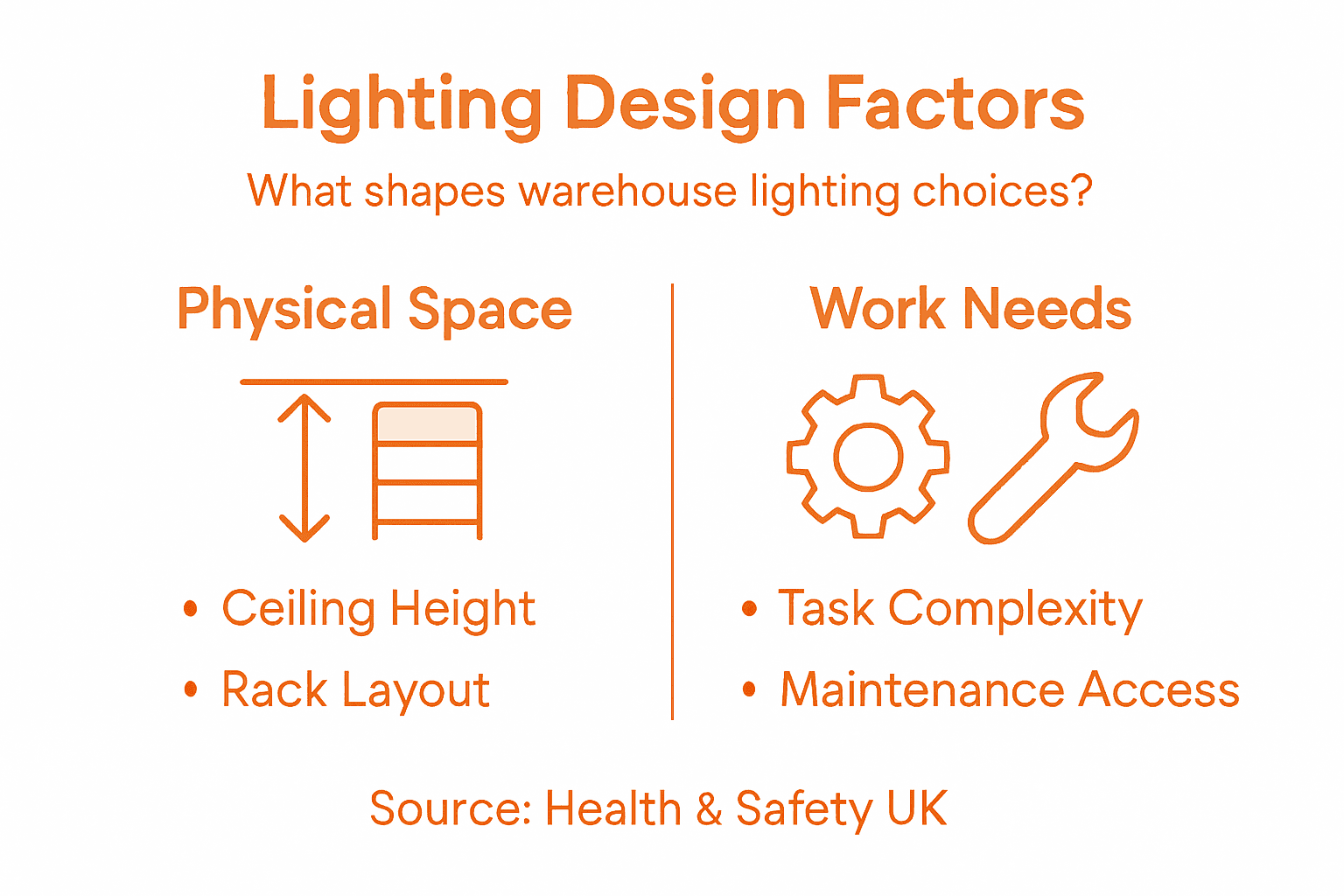
Task complexity directly influences lighting requirements. Detailed inspection work—identifying product defects, reading fine print on packaging, or quality checking—demands higher illumination levels and excellent colour rendering. General storage and retrieval tasks require moderate lighting levels. And transit areas like corridors and aisles can function adequately with lower brightness since workers aren’t performing detailed visual tasks. Uniformity of illumination and minimising glare remain essential for both safety and productivity across all areas. Inconsistent lighting creates visual adaptation problems where workers’ eyes constantly strain to adjust between bright and dim zones, causing fatigue and slowing performance. Excessive glare forces people to squint, reducing visibility of potential hazards. Poor colour rendering—particularly with older high-pressure sodium systems that emit amber light—makes it difficult to identify product colours, spot stains or damage, and navigate confidently. Energy efficiency increasingly shapes modern designs. Smart lighting controls allow you to reduce brightness in unoccupied zones, respond to natural light availability, and schedule different illumination patterns for shift changes. Motion sensors prevent waste from lighting empty aisles during slow periods. Occupancy-based dimming captures significant energy savings without compromising safety since warehouse tasks typically require the same light levels whenever anyone is present in a given zone.
Maintenance access and fixture durability round out the design considerations. Fixtures mounted on a twenty-metre ceiling become expensive to service if they require regular maintenance or quick replacement. High-bay LED systems that operate reliably for 40,000 plus hours eliminate the ladder work and disruption of frequent lamp changes. Warehouse environments introduce additional stresses—dust accumulation, temperature fluctuations, vibration from heavy equipment, and occasional impacts from lifted loads. Fixtures require proper rating for these conditions and mounting that allows reasonable access without excessive cost. Control strategy matters as much as hardware. A system with individual circuit control allows you to balance lighting in different zones independently, responding to seasonal light changes and operational patterns. Centralised control systems provide convenience but may lack flexibility for specific facility requirements.
Pro tip: Conduct a detailed walk-through documenting ceiling heights, rack configurations, natural light sources, and task types in each zone, then share this information with your lighting supplier so they can recommend fixtures and layouts tailored to your specific operation rather than applying generic standards.
UK Legal Standards and Energy Efficiency Rules
Warehouse lighting in the UK doesn’t operate in a regulatory vacuum. Your facility must comply with workplace safety legislation, building regulations, and increasingly stringent energy efficiency requirements that have real financial and legal consequences. Understanding what the law actually requires prevents costly retrofits, potential fines, and more importantly, protects your staff from preventable accidents. The regulatory landscape combines multiple frameworks—workplace safety rules demand adequate lighting for hazard identification, building regulations set minimum standards for new installations and major renovations, and energy efficiency directives push organisations toward LED technology and smart controls. For warehouse managers, this means navigating requirements that sometimes feel contradictory. You need sufficient brightness for safety, but regulations also push you toward energy conservation. The solution isn’t compromising on either front. Modern LED systems with intelligent controls deliver both safety compliance and energy efficiency simultaneously.
The Health and Safety at Work etc. Act 1974 establishes your legal duty to provide adequate lighting so workers can identify hazards and perform tasks safely. This isn’t vague guidance—the Workplace (Health, Safety and Welfare) Regulations 1992 specify minimum illumination levels for different warehouse areas. Picking zones require higher brightness than storage areas because workers perform detailed visual tasks. Loading bays demand different specifications than corridors. The key principle is that lighting must be suitable for the work being performed in each zone. UK Building Regulations Technical Guidance L (Conservation of Fuel and Power) mandates energy-efficient lighting systems in commercial buildings. For warehouses, this means implementing LED technology combined with controls that prevent wasteful operation. The Energy Performance of Buildings Directive (EPBD) influences these regulations, establishing that new buildings and major renovations must meet progressively tighter energy standards. Additionally, lighting panel installations must meet fire safety standards specified in building regulations and relevant product standards. Non-compliance can result in enforcement action during inspections or after incidents.
For reference, here are examples of UK warehouse lighting compliance requirements by zone:
| Zone Type | Minimum Standard (Lux) | Key Safety Consideration | Typical Solution |
|---|---|---|---|
| Picking Zones | 300 | Detailed visibility needed | LED high-bays, targeted |
| Storage Areas | 100 | General hazard spotting | Linear LED or fluorescent |
| Loading Bays | 150–200 | Accurate item handling | Uniformly distributed LEDs |
| Transit Corridors | 50–100 | Safe navigation | Low-glare LED fixtures |
Energy efficiency rules represent an increasingly important compliance layer. The Government’s Climate Change Act commits the UK to reducing greenhouse gas emissions, and lighting accounts for a significant portion of warehouse energy consumption. Regulations now require organisations to consider the total cost of ownership rather than just purchase price. This fundamentally changed the economics of warehouse lighting. A cheap fluorescent system that costs £5,000 upfront but consumes excessive energy and requires frequent maintenance proves far more expensive than a LED system costing £12,000 that operates efficiently for a decade. Guidance on lighting and codes of practice from the Institution of Engineering and Technology (IET) aligns with British Standards and provides detailed technical requirements for compliant installations. These standards address fixture placement, control systems, maintenance protocols, and performance verification. Your lighting system must be designed, installed, and maintained according to these standards to remain compliant.
Practical compliance means several things for your operation. First, your facility requires an up-to-date lighting assessment documenting illumination levels in each zone and demonstrating compliance with relevant standards. Second, you must implement energy-efficient fixtures combined with appropriate controls—motion sensors, occupancy-based dimming, or daylight integration where natural light is available. Third, maintenance becomes a compliance issue, not just an operational inconvenience. Dusty fixtures that have degraded to sub-standard illumination levels put you in breach of safety regulations. Fourth, if you operate in hazardous areas handling flammable materials, ATEX certification becomes mandatory rather than optional. The compliance framework isn’t designed to burden you unnecessarily. It reflects genuine safety and environmental priorities that, when properly implemented, also reduce your operating costs and create safer working conditions for your team.
Pro tip: Request a professional lighting assessment from a qualified surveyor who will measure current illumination levels, identify compliance gaps, and provide written documentation demonstrating your facility meets current standards—this protects you legally and provides the specifications needed for any future upgrades.
Costs, Savings, and Mistakes to Avoid
LED lighting upgrades for warehouses promise impressive returns, but the financial reality depends entirely on how well you plan and execute the project. Many warehouse managers make costly errors that erode expected savings or create compliance problems months after installation. Understanding the genuine cost structure, realistic payback timelines, and common pitfalls helps you avoid expensive missteps and maximise the financial benefits of upgrading your lighting system. The upfront investment in LED technology runs significantly higher than traditional fluorescent or metal halide systems. A modern high-bay LED fixture costs more than an older equivalent, and the labour for professional installation adds substantial cost to any project. But here’s where most managers get the calculation wrong. They focus exclusively on purchase and installation expenses whilst ignoring the operational cost difference between systems. When you account for electricity consumption, maintenance labour, replacement lamp costs, and disposal fees, the financial picture shifts dramatically in LED’s favour.
Consider the numbers practically. A 100-watt LED fixture delivers the same illumination as a 250-watt fluorescent system. Over a decade of operation running 16 hours daily, that efficiency difference translates into roughly £2,500 in electricity savings per fixture, depending on your local electricity rates. Multiply this across a warehouse with 200 fixtures and the cumulative savings reach £500,000 before accounting for maintenance cost reductions. Fluorescent tubes require replacement every 1-2 years, with associated labour costs and operational disruption. LED systems operate reliably for 40,000 plus hours, often lasting 8-10 years without replacement. The maintenance advantage alone typically saves £30,000 to £50,000 annually in a medium-sized warehouse operation. These genuine savings make LED investments attractive from pure financial perspective, but realising them requires avoiding common mistakes. Over-lighting remains a widespread problem where facilities install excessive brightness in all areas regardless of actual task requirements. This wastes energy, increases costs, and creates unnecessary glare. Each zone should have illumination matched to its specific purpose. Picking areas need higher brightness than general storage zones. Transit corridors need less than loading bays. Proper design analysis prevents installing excess capacity that delivers no safety benefit whilst consuming unnecessary energy.
Control system omission represents another costly mistake. Installing bright, efficient LEDs throughout a warehouse but failing to add occupancy sensors or daylight harvesting controls leaves substantial savings unrealised. Motion sensors prevent lighting empty aisles during quiet periods, cutting energy consumption by 15-30 percent depending on facility usage patterns. Daylight harvesting systems automatically reduce artificial lighting when natural daylight is sufficient, capturing additional savings in facilities with windows or skylights. These controls add modest upfront cost but pay for themselves within 1-2 years through energy reduction. Fixture selection errors create different problems. Choosing fixtures that don’t match your facility’s specific requirements results in inadequate coverage, dark zones, or unsuitable colour rendering. A high-bay fixture designed for 15-metre ceilings performs poorly at 8-metre heights. Task-specific fixtures for picking zones won’t work in broad storage areas. Poor fixture selection forces costly replacement within a few years when you realise the system underperforms. Maintenance neglect gradually destroys efficiency gains. Dust and debris accumulation on fixture lenses reduces light output by 15-25 percent annually in typical warehouse environments. A fixture that initially delivers excellent illumination degrades over 12 months into a poor performer if left uncleaned. Regular maintenance schedules cost virtually nothing but require disciplined execution.
Maintenance planning, proper fixture selection, and control system integration maximise your savings potential. The most successful warehouse lighting projects involve three steps. First, conduct a professional lighting assessment documenting current performance and identifying specific requirements for each zone. Second, select LED fixtures and control systems specifically suited to those requirements rather than adopting generic solutions. Third, establish a maintenance schedule ensuring fixtures remain clean and control systems function properly throughout the system’s lifespan. When executed properly, LED upgrades deliver energy cost reductions of 50-70 percent, payback periods of 2-4 years, and long-term savings exceeding £500,000 over the system lifetime for large facilities. The difference between projects that achieve these results and those that disappoint invariably comes down to planning quality and attention to avoiding the common mistakes.
Pro tip: Before committing to any LED upgrade, request detailed energy monitoring data from your current system and have a qualified surveyor provide written specifications for each facility zone—this prevents expensive mistakes from mismatched fixtures or oversized installations that waste energy and money.
Enhance Your Warehouse Lighting with Expert LED Solutions
Warehouse lighting challenges like uneven illumination, costly maintenance, and compliance risks demand a strategic upgrade to energy-efficient LED technology. If your facility struggles with visual fatigue, dark zones, or excessive energy costs highlighted in the article, it is time to experience tailored lighting solutions that prioritise safety and savings. At Ledsupplyandfit.co.uk, we specialise in supplying and installing LED systems designed to meet the rigorous demands of commercial warehouses across the UK, including ATEX-rated options for hazardous environments.
Discover how our professional LED lighting products deliver consistent brightness, reduce operational expenses, and ensure compliance with UK safety standards. Act now to maximise your warehouse’s productivity and safety with our expert consultation, bulk discounts, and next-day delivery. Visit our landing page to schedule a free lighting assessment and find the perfect solution for your specific needs. Don’t let outdated lighting hold your business back—upgrade today with Ledsupplyandfit.co.uk.
Frequently Asked Questions
What are the core principles of effective warehouse lighting?
The core principles include ensuring adequate illumination quantity, maintaining good light quality, achieving uniformity in light distribution, and implementing a comprehensive maintenance programme. These factors contribute to safety, productivity, and cost management in warehouse operations.
How do LED lights compare to fluorescent and metal halide in warehouse lighting?
LED lights offer higher energy efficiency, longer lifespans (20,000 to 50,000 hours or more), and reduced maintenance needs compared to fluorescent (8,000 to 15,000 hours) and metal halide (6,000 to 15,000 hours) lighting. LEDs also provide consistent colour rendering and instant brightness, making them a superior choice for warehouses.
What are the safety requirements for warehouse lighting?
Warehouse lighting must meet minimum illumination levels as specified by the Workplace (Health, Safety and Welfare) Regulations 1992. These regulations outline different brightness standards for areas such as picking zones, storage areas, loading bays, and transit corridors to ensure that workers can safely identify hazards and perform tasks effectively.
How can optimising warehouse lighting lead to cost savings?
Optimising warehouse lighting by switching to LED technology and implementing smart controls can lead to substantial energy savings and reduced maintenance costs. Over time, these changes often cover the initial investment and result in long-term savings exceeding £500,000 for large facilities, while payback periods typically range from 2 to 4 years.