ATEX-Rated Lighting: Safeguarding Hazardous Businesses
Choosing the right lighting in hazardous British industrial environments can feel like a constant balancing act between rigorous safety standards and rising energy costs. In places where explosive gases or dust are a daily concern, using ordinary lights is not an option. ATEX-rated lighting is purpose-built to minimise ignition risks and maintain strict compliance with both British and European regulations, providing facility managers with reliable safety and measurable cost-efficiency.
Table of Contents
- What Is ATEX-Rated Lighting? Key Principles
- ATEX Zone Classifications and Lighting Types
- Essential Features of ATEX-Certified Luminaires
- Legal Standards, UKCA and ATEX Compliance
- Cost, Maintenance, and Efficiency Advantages
- Common Pitfalls and Choosing the Right Solution
Key Takeaways
| Point | Details |
|---|---|
| ATEX-rated lighting ensures safety in hazardous environments. | These lighting solutions are designed to operate securely in areas where explosive atmospheres may exist, adhering to strict safety standards. |
| Zone classification is critical for effective lighting selection. | Understanding the ATEX zone classification helps determine the appropriate lighting solutions to mitigate ignition risks. |
| Compliance is essential for regulatory safety. | Manufacturers must conform to ATEX and UKCA standards to ensure that their products meet safety requirements for industrial settings. |
| LED luminaires provide economic advantages. | ATEX-rated LED lighting enhances operational efficiency, reducing energy consumption and maintenance costs significantly. |
What Is ATEX-Rated Lighting? Key Principles
ATEX-rated lighting represents a specialised category of illumination designed for environments with potentially explosive atmospheres. Originating from the French term ‘ATmosphères EXplosibles’, these lighting solutions are engineered to prevent dangerous ignition risks in high-stakes industrial settings. Comprehensive safety standards ensure these lighting systems can operate safely in zones where explosive gases or dust may be present.
The core purpose of ATEX-rated lighting is risk mitigation in hazardous environments. These sophisticated lighting systems undergo rigorous testing and certification to meet stringent European Union safety directives. Key characteristics that distinguish ATEX-rated lighting include:
- Explosion-proof construction
- Special electrical enclosures
- Heat-resistant materials
- Sealed components preventing spark generation
- Resistance to potentially reactive atmospheric conditions
Manufacturers must adhere to specific guidelines when producing ATEX-rated lighting. The certification process involves detailed assessments of equipment design, potential ignition sources, and protective mechanisms. These standards are not merely recommendations but legal requirements for businesses operating in potentially explosive industrial environments.
ATEX certification ensures that lighting equipment can safely function in zones where traditional illumination would pose significant explosion risks.
Businesses across sectors like petrochemicals, pharmaceutical manufacturing, and mining rely on these specialised lighting solutions to maintain operational safety. The CE marking and distinctive ‘Ex’ symbol indicate that a lighting product has successfully met the comprehensive ATEX safety standards.
Pro tip: Always verify the specific ATEX zone classification before selecting lighting equipment to ensure complete compliance and maximum safety protection.
ATEX Zone Classifications and Lighting Types
Industrial environments present complex safety challenges that demand precise lighting solutions. Hazardous area classifications provide critical guidelines for selecting appropriate illumination in potentially explosive atmospheres. The ATEX classification system categorises zones based on the likelihood and duration of explosive environments, ensuring targeted safety protocols.
The ATEX zone classification system divides hazardous areas into distinct categories for both gases and dust environments:
Gas Zone Classifications:
- Zone 0: Continuous explosive atmosphere presence
- Zone 1: Likely explosive atmosphere during normal operations
- Zone 2: Unlikely or brief explosive atmosphere occurrence
Dust Zone Classifications:
- Zone 20: Continuous dust explosive atmosphere
- Zone 21: Probable dust explosive atmosphere
- Zone 22: Unlikely dust explosive atmosphere
Each zone requires specific lighting types engineered to prevent potential ignition risks. Manufacturers design ATEX-rated luminaires with specialised features like sealed enclosures, heat-resistant materials, and spark-suppression mechanisms to match the specific zone’s risk profile.
Selecting the incorrect lighting for an ATEX zone can create catastrophic safety risks in industrial environments.
Lighting selection involves careful assessment of environmental conditions, potential explosive materials, and operational requirements. Facility managers must consider factors like temperature classification, gas/dust group, and equipment protection level when specifying ATEX-rated lighting solutions.
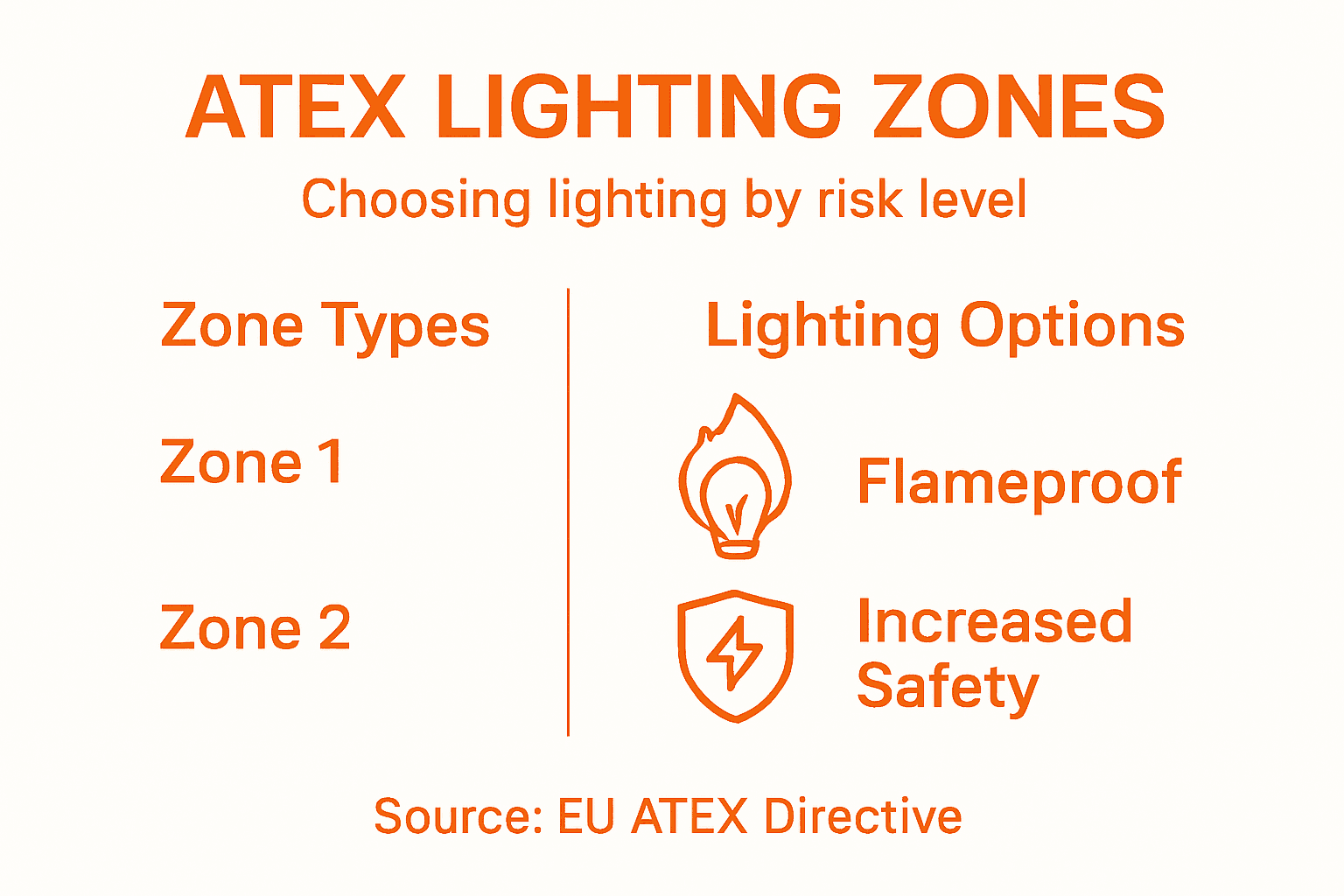
Pro tip: Conduct a comprehensive zone risk assessment before selecting ATEX-rated lighting to ensure precise safety compliance and operational reliability.
The following table summarises ATEX zone classifications with recommended lighting solutions and typical industry applications:
| ATEX Zone | Likelihood of Explosive Atmosphere | Recommended Lighting Solution | Common Industry Example |
|---|---|---|---|
| Zone 0 / 20 | Continuous presence | Highest-rated ATEX luminaires | Petrochemical storage |
| Zone 1 / 21 | Likely during operations | Enhanced-sealed luminaires | Pharmaceutical plants |
| Zone 2 / 22 | Rare, brief occurrence | Standard ATEX luminaires | Mining facilities |
Essential Features of ATEX-Certified Luminaires
ATEX-certified luminaires represent a sophisticated engineering solution designed to mitigate explosion risks in hazardous industrial environments. Rigorous certification processes ensure these specialised lighting systems meet stringent safety standards, protecting facilities from potential catastrophic incidents.
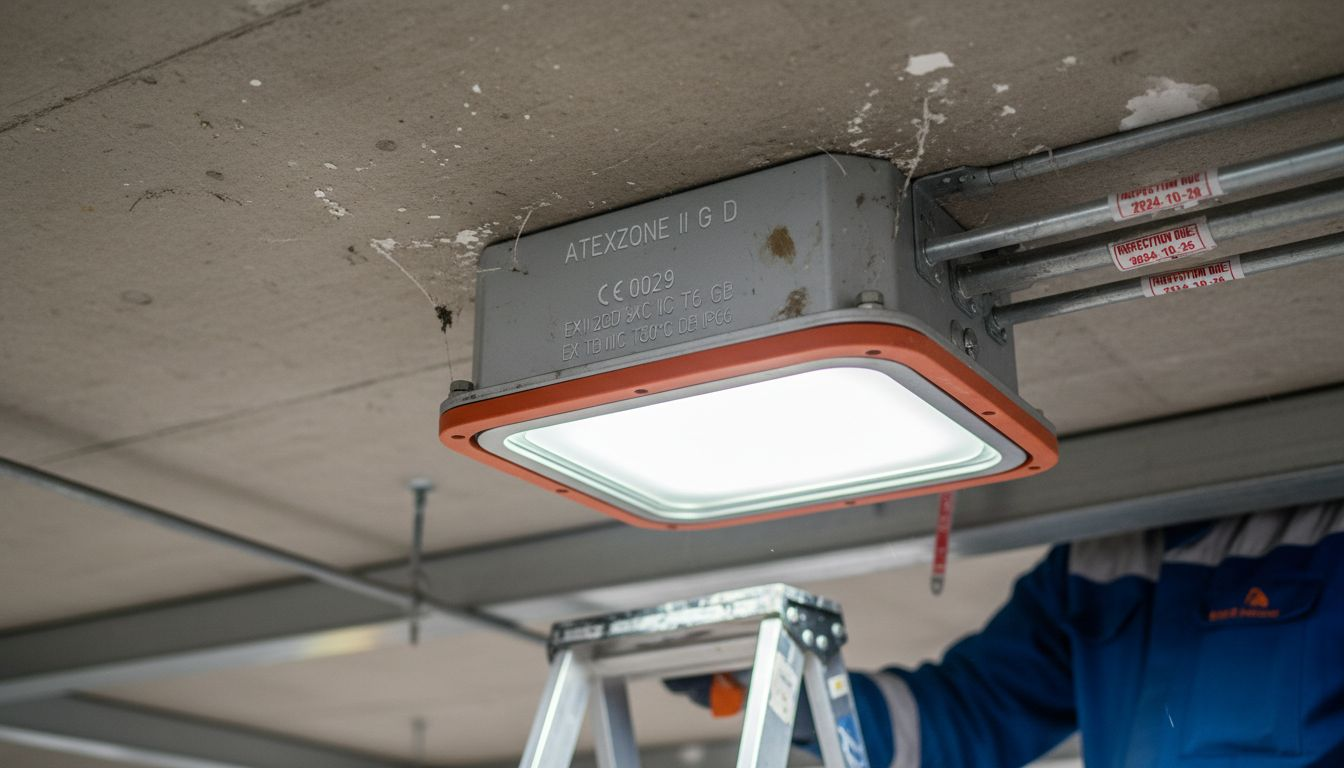
The core characteristics of ATEX-certified luminaires include several critical design elements:
Structural Integrity Features:
- Flameproof enclosures preventing external ignition
- Robust materials resistant to extreme temperatures
- Sealed construction preventing gas or dust infiltration
- Corrosion-resistant external components
- Enhanced thermal management systems
Technical Protection Mechanisms:
- Spark-suppression electrical circuits
- Intrinsically safe electronic components
- Precision-engineered thermal protection
- Explosion-containment structural designs
- Advanced electrical insulation technologies
Manufacturers must demonstrate comprehensive compliance through multiple testing protocols. These luminaires undergo extensive examination to verify their ability to operate safely in potentially explosive atmospheres, with each unit receiving detailed certification documentation.
ATEX-certified luminaires represent the gold standard in industrial safety lighting, combining advanced engineering with rigorous safety protocols.
The certification process involves detailed assessment of multiple performance parameters, including temperature classification, equipment protection levels, and specific zone suitability. Facility managers must carefully match luminaire specifications to their exact environmental requirements to ensure maximum safety and regulatory compliance.
Pro tip: Always request comprehensive certification documentation and verify the specific ATEX zone rating when selecting industrial lighting solutions.
Legal Standards, UKCA and ATEX Compliance
Industrial safety regulations have undergone significant transformations, particularly in the United Kingdom’s post-Brexit landscape. Conformity marking requirements have evolved, introducing complex compliance mechanisms for manufacturers and industrial facility managers dealing with hazardous environment equipment.
The key legal standards for ATEX compliance encompass several critical elements:
Regulatory Compliance Requirements:
- EU Directive 2014/34/EU for equipment standards
- Directive 1999/92/EC for workplace safety protocols
- UKCA marking for Great Britain market access
- CE marking for continued European market participation
- Detailed conformity assessment procedures
Marking and Certification Distinctions:
- UKCA: UK-specific conformity assessment
- CE: European conformity marking
- Ex: Explosion protection certification
- Specific zone classification indicators
- Comprehensive safety documentation requirements
The transition period has created a nuanced regulatory environment where businesses must navigate multiple compliance frameworks. Manufacturers must demonstrate meticulous attention to technical standards, ensuring their products meet rigorous safety requirements for explosive atmosphere equipment.
Compliance is not merely a legal obligation but a fundamental commitment to industrial workplace safety.
Facility managers and procurement specialists must remain vigilant, understanding the subtle differences between UKCA and CE markings. The regulatory landscape continues to evolve, with potential future divergences in safety standards between the United Kingdom and European Union.
Pro tip: Maintain comprehensive documentation of your equipment’s certification and consult regulatory experts to ensure ongoing compliance with the latest safety standards.
For convenient reference, the table below compares the main compliance standards for hazardous area lighting in the UK and EU:
| Marking | Region Covered | Certification Focus | Typical Usage Scenario |
|---|---|---|---|
| CE | European Union | Product safety and conformity | EU industrial installations |
| UKCA | United Kingdom (post-Brexit) | UK-specific safety requirements | British manufacturing sites |
| Ex | Global (explosive atmospheres) | Explosion protection | Environments with risk of ignition |
Cost, Maintenance, and Efficiency Advantages
ATEX-rated LED luminaires represent a significant technological advancement in industrial lighting solutions, offering remarkable economic benefits for facility managers. Energy-efficient lighting technologies provide substantial long-term financial advantages through reduced operational expenses and enhanced performance characteristics.
The key economic advantages of ATEX-rated LED lighting include:
Financial Benefits:
- Significantly reduced energy consumption
- Extended service life compared to traditional lighting
- Lower maintenance and replacement costs
- Enhanced operational reliability
- Improved workplace safety performance
Efficiency Metrics:
- Up to 70% lower energy usage
- Lifespan exceeding 50,000 operational hours
- Immediate illumination without warm-up periods
- Superior luminous efficacy
- Compatibility with advanced control systems
Manufacturers have engineered these specialised luminaires to deliver exceptional performance in challenging industrial environments. The robust construction minimises downtime, with intelligent design features that reduce long-term operational expenditure while maintaining critical safety standards.
ATEX-rated LED lighting transforms operational efficiency from an aspiration to a tangible, measurable reality.
The initial investment in high-quality ATEX-rated LED lighting is rapidly offset by substantial energy savings and reduced maintenance requirements. Businesses can expect significant financial returns through decreased electricity consumption, fewer replacement cycles, and improved overall lighting infrastructure reliability.
Pro tip: Conduct a comprehensive energy audit to precisely calculate potential savings and payback periods for ATEX-rated LED lighting investments.
Common Pitfalls and Choosing the Right Solution
Navigating the complex landscape of ATEX-rated lighting requires meticulous attention to detail and comprehensive understanding of industrial safety requirements. Hazardous environment certification demands strategic approach to prevent potentially catastrophic equipment selection errors.
Common pitfalls in ATEX lighting selection include:
Typical Selection Mistakes:
- Misclassifying hazardous area zones
- Overlooking temperature classification requirements
- Ignoring specific dust or gas environment characteristics
- Selecting non-compliant equipment
- Neglecting comprehensive risk assessments
Critical Evaluation Criteria:
- Precise zone classification understanding
- Comprehensive operational environment analysis
- Verification of certification documentation
- Assessment of temperature and exposure conditions
- Alignment with specific industry regulations
Facility managers must conduct thorough investigations before implementing ATEX-rated lighting solutions. This involves detailed examination of environmental conditions, potential explosive material interactions, and precise equipment protection requirements.
Incorrect lighting selection can transform a safety measure into a potential catastrophic risk.
Successful ATEX lighting implementation requires collaboration between facility managers, safety engineers, and certified equipment providers. The selection process demands technical expertise, regulatory knowledge, and a comprehensive understanding of industrial safety protocols.
Pro tip: Engage certified ATEX experts to perform a comprehensive site-specific risk assessment before finalising lighting equipment selections.
Ensure Safety and Efficiency with Certified ATEX Lighting Solutions
Businesses operating in hazardous zones face critical challenges such as strict ATEX zone classifications, legal compliance, and preventing ignition risks through specialised lighting. Understanding these complex requirements is one thing but sourcing properly certified and reliable ATEX-rated luminaires that balance safety with energy efficiency is another. If your goal is to safeguard your facility, comply fully with UKCA and CE standards, and slash lighting costs with long-lasting LED technology, you need expert support tailored to industrial environments.
Discover how Ledsupplyandfit.co.uk can help you navigate ATEX compliance with a comprehensive range of professionally certified ATEX LED lighting solutions designed for Zones 0 through 22.
Take control of your hazardous business lighting needs now with our bulk discounts, next-day delivery, and expert installation services operating across the UK. Visit Ledsupplyandfit.co.uk to secure durable, energy-saving, and fully compliant ATEX lighting systems that protect your people and premises. Act today for a safer tomorrow.
Frequently Asked Questions
What is ATEX-rated lighting?
ATEX-rated lighting is specifically designed for environments with potentially explosive atmospheres. It prevents ignition risks in hazardous industrial settings by meeting rigorous European Union safety standards.
What are the key features of ATEX-certified luminaires?
ATEX-certified luminaires have structural integrity features such as explosion-proof enclosures, sealed construction, and robust materials. They also include technical protection mechanisms like spark-suppression circuits and advanced thermal protection to ensure safety in explosive environments.
How do I determine the appropriate ATEX zone classification for lighting?
ATEX zone classifications are based on the likelihood and duration of explosive atmospheres. A comprehensive risk assessment considering environmental conditions, potential explosive materials, and operational requirements is essential for determining the right classification.
What are the advantages of using ATEX-rated LED luminaires in industrial settings?
ATEX-rated LED luminaires offer significant economic benefits, including reduced energy consumption, extended service life, lower maintenance costs, and improved operational reliability, while ensuring safety in hazardous environments.
Recommended
- Why ATEX Lighting Matters in Hazardous Industrial Environments
- Understanding ATEX Rating and its Importance in Hazardous Lighting | LED Supply & Fit
- What is ATEX Lighting? | LED Supply & Fit
- Top 4 Best ATEX Rated Lights for 2026 in UK Warehouses
- Commercial Battery Storage: Lowering Costs and Boosting Sustainability