Energy Savings with LED – Impact for UK Businesses
Every UK facility manager knows that lighting costs can quickly eat into your operational budget. With energy use from lighting making up a substantial share of building expenses, finding a smarter solution is more important than ever. Switching to LED lighting is proven to cut electricity use and lower carbon emissions, helping your site become both more profitable and sustainable. Discover how LED technology transforms energy savings for shops, offices, and hospitality venues alike.
Table of Contents
- What Are Energy Savings With LED Lighting
- How LED Technology Reduces Energy Use
- Comparing LED to Traditional Lighting Types
- Financial, Environmental, and Workplace Benefits
- Maximising Savings: Installation and Upgrade Tips
Key Takeaways
| Point | Details |
|---|---|
| Energy Savings | Replacing traditional bulbs with LEDs can reduce energy consumption by 75-80%, translating to lower utility bills and operational costs. |
| Operational Efficiency | LEDs last significantly longer than traditional bulbs, reducing maintenance time and associated costs. |
| Enhanced Environment | Using LEDs lowers carbon emissions and supports sustainability goals, aligning with corporate responsibility initiatives. |
| Smart Lighting Opportunities | Optimising lighting with smart controls can lead to further energy reductions, enhancing workplace comfort and efficiency. |
What Are Energy Savings With LED Lighting
Energy savings with LED lighting refers to the reduction in electricity consumption and operational costs when you replace traditional incandescent or fluorescent bulbs with LED alternatives. For UK facility managers, this translates to lower utility bills, reduced carbon footprint, and improved bottom-line profitability.
LED bulbs consume significantly less electricity than their conventional counterparts. A standard incandescent bulb uses around 60 watts, whilst an equivalent LED uses just 8-10 watts to produce the same light output. Over months and years, this difference compounds into substantial financial savings.
How Much Energy Do LEDs Actually Save?
LED adoption has demonstrated significant energy reductions across commercial buildings worldwide. The figures speak for themselves:
- Reduction in annual electricity use: typically 75-80% compared to incandescent lighting
- Building-wide consumption decrease: 5-10% when lighting is optimised across all areas
- Cost savings: £200-500 annually for a single shop or office space, depending on size and usage patterns
- Extended payback period: most LED installations repay their initial investment within 2-3 years
A typical 500-square-metre retail space with 40 fluorescent or incandescent fittings could save £2,000-3,000 per year by switching to LED. That’s money flowing directly to your bottom line instead of energy companies.
Why The Difference Is So Dramatic
Traditional bulbs waste enormous amounts of energy as heat. Incandescent bulbs convert roughly 90% of their energy into heat rather than visible light. You’re essentially paying to warm the air, not illuminate your space.
LEDs work differently. They emit light through a semi-conductor process that produces minimal heat waste. Nearly all the electrical energy converts into usable light, making them extraordinarily efficient.
LEDs reduce lighting energy demand whilst enabling increased lighting services—a key strategy for meeting global climate goals.
Real-World Savings For Your Venue Type
Energy savings vary depending on your business:
- Retail shops: 8-10 hours daily operation = £1,500-2,500 annual savings
- Office spaces: Extended hours, task lighting = £2,000-3,500 annual savings
- Hospitality venues: Accent and ambient lighting = £1,200-2,000 annual savings
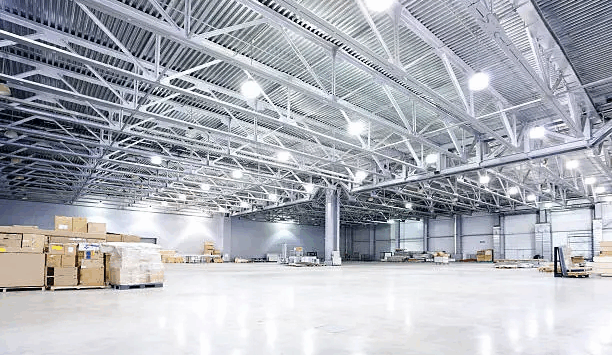
- Warehouses: Large areas, continuous operation = £4,000-8,000 annual savings
These figures assume typical UK electricity rates and straightforward like-for-like replacements. Your actual savings depend on current lighting specifications and operational hours.
To help visualise the real-world benefits of LEDs across different venues, here’s a summary of typical savings and operational impacts:
| Venue Type | Annual Energy Saving | Typical LED Payback Period | Additional Benefits |
|---|---|---|---|
| Retail Shop | £1,500-£2,500 | 2-3 years | Lower cooling costs |
| Office Space | £2,000-£3,500 | 18-24 months | Enhanced productivity |
| Hospitality Venue | £1,200-£2,000 | 2 years | Better ambience |
| Warehouse | £4,000-£8,000 | 2 years | Reduced maintenance needs |
Beyond Direct Energy Costs
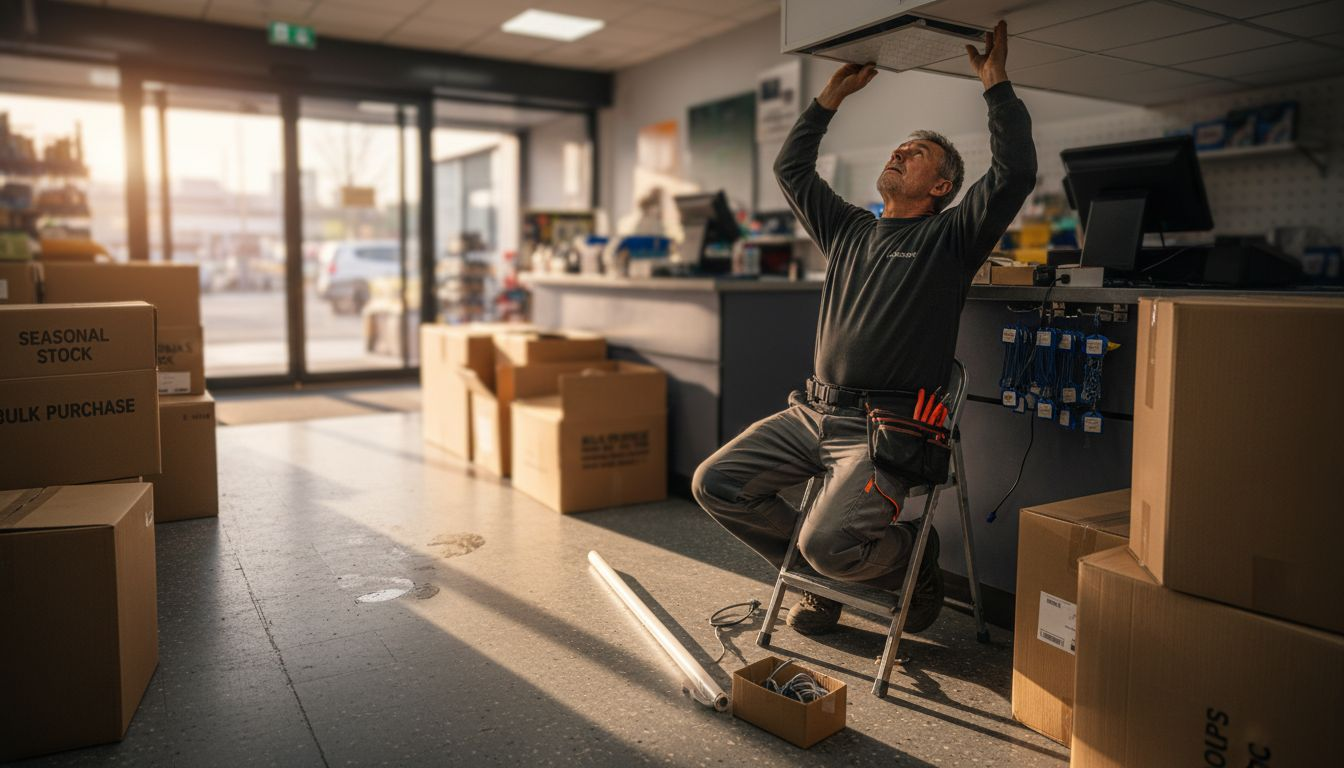
Energy savings extend beyond electricity bills. LED bulbs last 25,000-50,000 hours compared to 1,000 hours for incandescent bulbs. This means dramatically reduced replacement labour, fewer supply orders, and less operational disruption. Your maintenance team spends less time on ladders replacing burnt-out bulbs.
Additionally, reduced heat output lowers cooling costs in summer months. Your air conditioning works less hard, saving further on climate control expenses.
Pro tip: Audit your current lighting setup first—calculate how many hours each fixture runs daily, then use our energy savings calculator to determine your specific payback timeline before committing to a full retrofit.
How LED Technology Reduces Energy Use
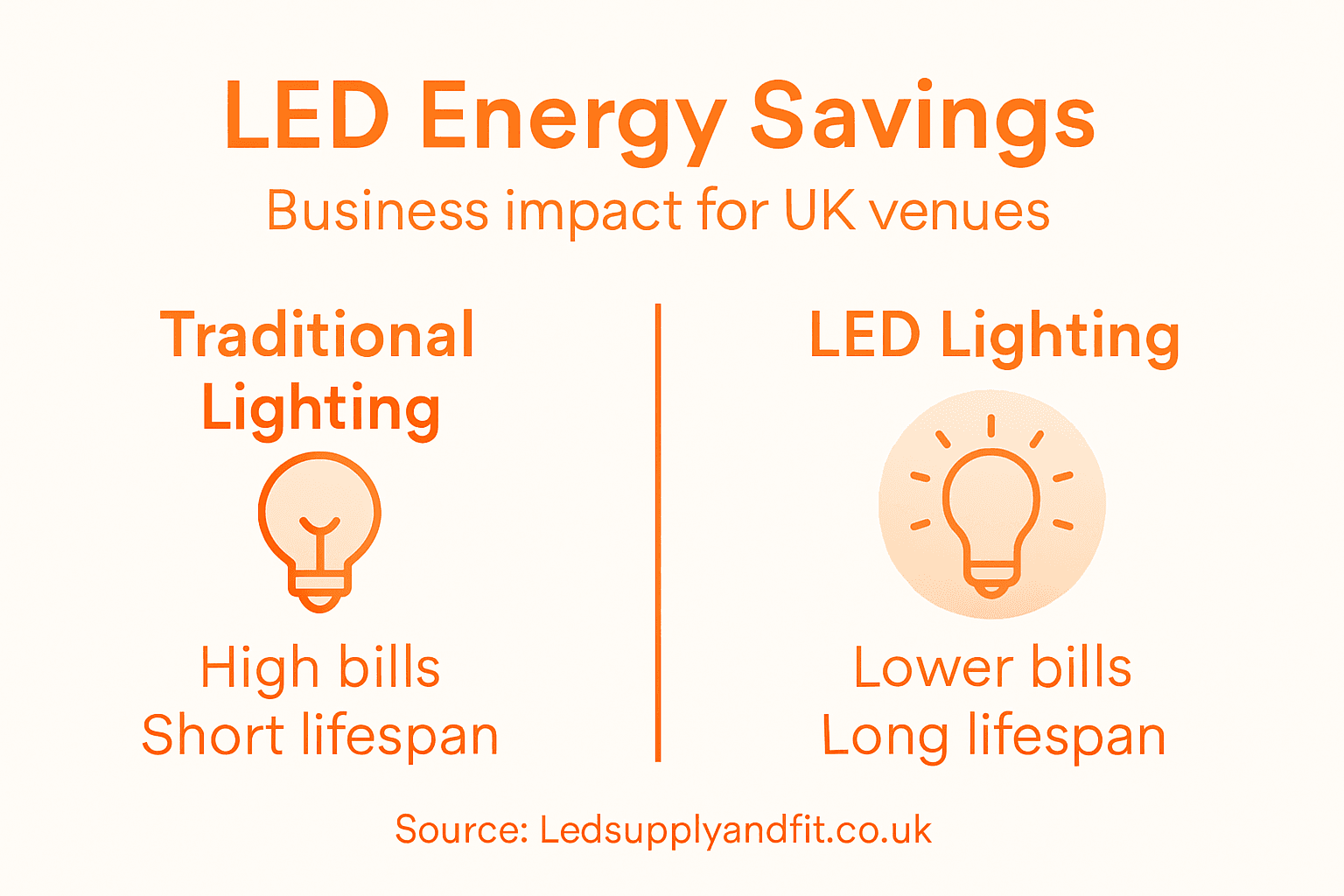
LED technology achieves dramatic energy reductions through a fundamentally different approach to producing light. Unlike incandescent bulbs that generate light by heating a filament, LEDs emit light directly from a semiconductor material. This core difference explains why they consume far less electricity.
The Science Behind LED Efficiency
LEDs convert most electricity into light rather than heat, whilst incandescent bulbs waste approximately 90% of their energy as thermal energy. When you switch to LEDs, you’re eliminating this massive waste stream.
LED bulbs achieve efficiency through:
- Directional light emission: LEDs project light in specific directions, whereas traditional bulbs emit light in all directions. This means less wasted light bouncing uselessly around your space
- Lower power consumption: LEDs require significantly less electrical current to produce equivalent brightness
- Minimal heat generation: Reduced heat means your cooling systems work less hard, compounding energy savings
- Higher luminous efficacy: LEDs convert electrical energy into usable light more effectively than any other technology
Real Energy Reduction In Your Venue
The energy reduction gap is substantial. A typical 18-watt LED delivers the same brightness as a 60-watt incandescent bulb. Over a year, that single fixture saves roughly 375 kilowatt-hours of electricity.
In a retail shop with 50 light fittings running 10 hours daily, switching to LEDs saves approximately 18,750 kilowatt-hours annually. At UK electricity rates, that’s roughly £2,250 per year from a single space.
LED technology uses at least 75% less energy than incandescent alternatives and lasts up to 25 times longer, delivering both immediate and long-term savings.
How Smart Lighting Amplifies Energy Savings
Modern LED systems go beyond simple replacements. Optimising light output through smart controls allows further energy reductions by adapting brightness to actual requirements.
Practical smart features include:
- Motion sensors that dim or turn off lights when areas are unoccupied
- Daylight harvesting that reduces artificial lighting when natural sunlight is sufficient
- Occupancy-based scheduling that matches lighting to business hours
- Colour temperature adjustment that improves circadian rhythm alignment
These innovations reduce energy consumption beyond the base LED efficiency, sometimes by an additional 10-30% depending on your venue type.
Why Heat Reduction Matters For Your Bottom Line
LED’s minimal heat output delivers a hidden benefit: reduced air conditioning costs. In summer months, your cooling system works significantly less hard when lighting no longer generates excessive heat.
For hospitality venues, offices, and retail spaces, this secondary savings stream often accounts for 15-20% of total energy reduction. Your facility literally becomes cooler to maintain, not just brighter.
Pro tip: Install LEDs with dimming capability—this allows your team to adjust brightness according to actual needs rather than relying on single fixed brightness levels, reducing consumption further without sacrificing light quality.
Comparing LED to Traditional Lighting Types
Understanding how LEDs stack up against incandescent, halogen, and CFL bulbs helps you make informed decisions about your facility. The comparison reveals why LEDs have become the industry standard for commercial spaces across the UK.
LED vs Incandescent Bulbs
Incandescent bulbs have dominated lighting for over a century, but they’re remarkably inefficient. A 60-watt incandescent produces roughly 800 lumens of light. An equivalent LED produces the same brightness using just 8-10 watts.
Key differences:
- Energy consumption: Incandescent uses 75-80% more electricity for identical light output
- Lifespan: Incandescent lasts 1,000 hours; LEDs last 25,000-50,000 hours
- Heat output: Incandescent converts 90% of energy to heat; LEDs convert 85-90% to light
- Cost per year: Incandescent costs roughly £15-20 annually per bulb; LEDs cost £2-3
LED vs CFL Bulbs
Compact fluorescent lamps (CFLs) emerged as an efficiency improvement over incandescent but fall short of LED performance. LEDs demonstrate superior energy efficiency compared to conventional bulbs including CFLs in terms of energy use and operational performance.
CFLs versus LEDs:
- Energy usage: CFLs use 25-35% more energy than equivalent LEDs
- Warm-up time: CFLs require 30-60 seconds to reach full brightness; LEDs are instant
- Lifespan: CFLs last 8,000-10,000 hours; LEDs exceed 25,000 hours
- Mercury content: CFLs contain toxic mercury requiring special disposal; LEDs are non-toxic
- Dimming capability: CFLs struggle with dimming; LEDs dim smoothly and reliably
LED vs Halogen Bulbs
Halogen bulbs improved slightly on incandescent technology but remain energy-intensive. They generate excessive heat and carry burn risks in hospitality and retail environments.
Halogen compared to LED:
- Energy efficiency: Halogens use 60-70% more electricity than LEDs for equivalent light
- Safety: Halogen bulbs reach temperatures exceeding 250°C; LEDs stay cool to touch
- Lifespan: Halogen lasts 2,000-3,000 hours; LEDs last 25-50 times longer
- Colour rendering: Both offer similar colour quality, but LEDs provide greater flexibility
LEDs outperform all traditional bulb types in energy consumption, lifespan, and operational efficiency, making them the clear choice for commercial premises.
The Real-World Impact For Your Business
Consider a 500-square-metre retail space with 50 fittings. If currently using incandescent or CFL bulbs running 10 hours daily:
- Current annual cost: £3,500-4,200 in electricity
- After LED conversion: £600-800 in electricity
- Annual savings: £2,700-3,600
- Payback period: 18-24 months on installation costs
After payback, you’re essentially running lighting for a fraction of previous costs for the next 5-10 years.
Pro tip: When comparing bulb types, focus on lumens per watt (luminous efficacy), not just wattage—this reveals true efficiency and helps you select correctly-sized LEDs that deliver equivalent brightness to your existing fixtures.
For quick reference, this table highlights the main feature differences between LED and traditional bulbs:
| Feature | LED Bulb | Incandescent Bulb | CFL Bulb | Halogen Bulb |
|---|---|---|---|---|
| Lifespan | 25,000-50,000 hrs | 1,000 hrs | 8,000-10,000 hrs | 2,000-3,000 hrs |
| Energy Efficiency | Highest | Very low | Moderate | Low |
| Heat Output | Minimal | Extreme | Moderate | High |
| Toxicity | None | None | Contains mercury | None |
| Dimming Capability | Reliable | Limited | Poor | Limited |
Financial, Environmental, and Workplace Benefits
LED lighting delivers benefits far beyond reduced energy bills. The financial, environmental, and workplace advantages create a compelling case for UK facility managers to prioritise LED upgrades. These benefits compound over time, delivering compounding returns on your initial investment.
Financial Benefits That Impact Your Bottom Line
The most obvious benefit is cost reduction. Lower electricity consumption directly reduces your monthly utility bills, but the savings extend far deeper into your operational budget.
Key financial advantages:
- Energy bill reduction: 75-80% lower lighting costs annually
- Maintenance savings: LED longevity eliminates frequent replacement labour and supply orders
- Operational efficiency: Reduced cooling costs from lower heat generation
- Tax incentives: Enhanced Capital Allowances available for energy-efficient lighting upgrades in the UK
- Payback timeline: Most commercial LED installations repay within 18-36 months
A 2,000-square-metre office typically saves £4,000-6,000 annually. After 24 months, you’re operating with effectively free lighting for the remaining 8-14 year lifespan of your LEDs.
Environmental Impact And Corporate Responsibility
LED lighting improves workplace productivity whilst reducing greenhouse gas emissions due to their lower energy consumption. This dual benefit aligns with UK net-zero commitments and corporate sustainability goals.
Environmental considerations include:
- Carbon footprint reduction: 75-80% fewer greenhouse gas emissions from lighting
- Hazardous material elimination: No mercury or toxic substances unlike fluorescent lamps
- Circular economy alignment: LED materials are fully recyclable with established schemes
- Supply chain improvement: Reduced energy demand decreases broader environmental strain
For hospitality and retail venues, this translates to genuine corporate responsibility credentials you can communicate to environmentally-conscious customers.
Workplace Benefits Beyond Cost Savings
Employee and customer experience improvements often go unnoticed but deliver measurable value. LED lighting enhances comfort and cognitive performance in ways traditional bulbs cannot match.
Workplace improvements:
- Reduced eye strain: Better colour rendering and absence of flicker improves visual comfort
- Enhanced productivity: Improved lighting quality correlates with better focus and fewer errors
- Occupant comfort: Colour temperature flexibility supports natural circadian rhythms
- Safety enhancement: Superior light distribution reduces shadows and trip hazards
- Customer perception: Brighter, clearer lighting creates more welcoming retail and hospitality spaces
LED lighting simultaneously reduces operational costs, environmental impact, and improves workplace comfort—delivering financial, environmental, and human benefits in a single upgrade.
The Complete Return On Investment
When you factor in all benefits, the true return extends beyond simple payback calculations. A retail space investing £3,000 in LED installation experiences:
- Year 1 savings: £2,500 energy reduction plus £800 maintenance savings
- Years 2-10: £3,300 annual savings with minimal additional investment
- Total 10-year return: £29,500+ in combined benefits
- Environmental benefit: 150+ tonnes CO₂ equivalent reduction
This represents genuine business transformation, not merely a cost-cutting measure.
Pro tip: Document your baseline energy consumption before LED installation, then track actual savings monthly—this data proves ROI to stakeholders, justifies future sustainability investments, and demonstrates leadership commitment to environmental responsibility.
Maximising Savings: Installation and Upgrade Tips
Successful LED upgrades require strategic planning beyond simply replacing bulbs. The approach you take determines whether you achieve baseline savings or unlock maximum efficiency gains. Facility managers who plan carefully capture significantly greater returns on their investment.
Step 1: Audit Your Current Lighting Setup
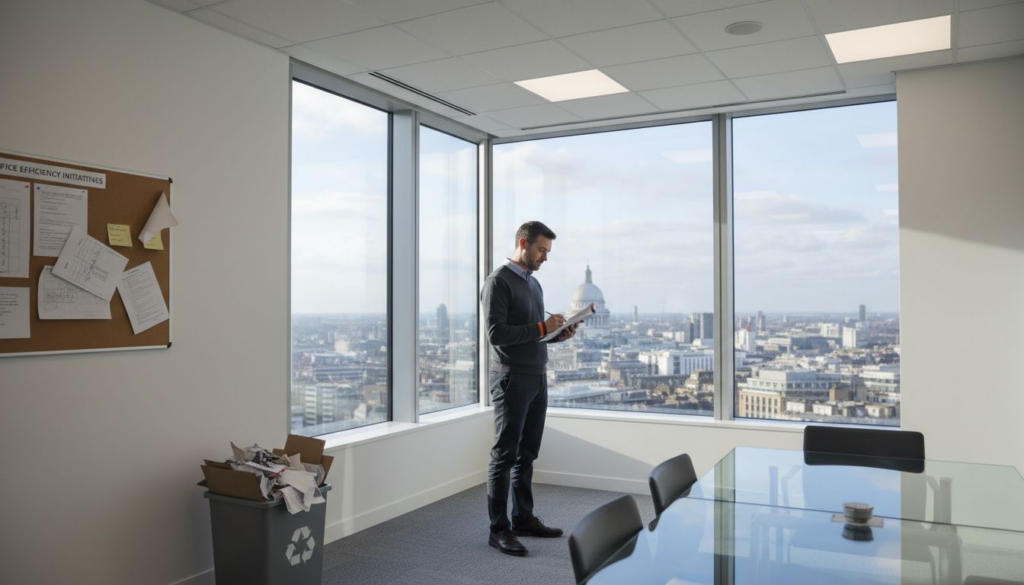
Before upgrading, understand exactly what you’re working with. Document every fixture, wattage, operating hours, and light output requirement. This baseline data enables accurate savings calculations and prevents costly mistakes during installation.
Key audit elements:
- Fixture inventory: Count and categorise all lighting types throughout your venue
- Operating schedules: Record daily hours each area runs lights
- Current consumption: Check existing electricity bills for lighting costs
- Light quality requirements: Assess colour temperature and brightness needs by area
- Existing infrastructure: Identify ballasts, dimming systems, and compatibility issues
This groundwork typically takes 2-4 hours but prevents installing unsuitable products that require replacement.
Step 2: Select The Right Upgrade Approach
Evaluating fixture type and lighting needs determines the optimal LED solution for your space. Three primary options exist: lamp replacement, retrofit kits, or complete luminaire replacement.
Upgrade options:
- Lamp replacement: Substitute existing bulbs with compatible LEDs (lowest cost, quickest)
- Retrofit kits: Install LED drivers and optical components into existing fixtures (moderate cost)
- Full luminaire replacement: Install new LED-specific fixtures (highest cost, best performance)
Retail shops typically benefit from full replacement for superior light quality. Offices often succeed with lamp replacement. Warehouses frequently choose retrofit kits for their flexibility.
Step 3: Calculate True Savings Before Committing
Assessing compatibility, colour temperature, lumens, and cost savings ensures maximised efficiency and sustained performance. Don’t rely on manufacturer estimates alone—calculate based on your actual usage patterns.
Calculation framework:
- Current annual cost: Wattage × hours operated annually × electricity rate
- Projected LED cost: LED wattage × same hours × electricity rate
- Annual energy saving: Difference between above figures
- Maintenance savings: Multiply hours saved replacing bulbs by labour rate
- Cooling cost reduction: Estimate 10-15% HVAC savings from heat reduction
- Total annual benefit: Sum all three categories above
- Payback period: Divide installation cost by total annual benefit
A 1,000-square-metre retail space might show: £3,200 energy savings + £400 maintenance savings + £600 cooling savings = £4,200 annual benefit. With £6,000 installation cost, payback occurs within 17 months.
Step 4: Optimise Installation For Maximum Performance
Proper installation determines whether you achieve projected savings. Rushed installations create ongoing problems requiring costly service calls.
Installation priorities:
- Safety protocols: Ensure power is disconnected before any work begins
- Correct product selection: Match LED specifications to existing fixture requirements
- Proper positioning: Orient directional LEDs to eliminate dark spots and wasted light
- Dimmability integration: Enable smooth dimming control for additional savings
- Baseline documentation: Photograph and record pre-installation conditions
Strategic LED upgrades combining proper assessment, product selection, and installation achieve payback within 18-24 months whilst delivering 8-12 additional years of near-zero maintenance lighting.
Step 5: Monitor And Maintain Your Investment
Post-installation monitoring ensures sustained savings. Clean fixtures quarterly—dust reduces light output by up to 20%. Review monthly electricity bills to confirm projected savings materialise.
Maintenance tasks:
- Monthly bill review: Compare current costs against baseline to verify savings
- Quarterly cleaning: Wipe fixtures and diffusers to maintain light output
- Annual inspection: Check for flickering or dimming indicating component failure
- System optimisation: Adjust dimming schedules as seasonal needs change
Pro tip: Schedule your LED installation during off-peak business periods (weekends or overnight) to minimise disruption and allow installation teams to work thoroughly without time pressures that compromise quality.
Unlock Significant Energy Savings with Expert LED Solutions
The challenge faced by UK businesses today is clear. Rising energy costs and the need to reduce carbon footprints demand more efficient lighting solutions. As discussed in the article, switching to LED lighting can cut energy use by up to 80 percent, reduce maintenance needs, and lower heat output, directly impacting operational costs and employee comfort. If your facility relies on traditional lighting that wastes energy and drives up your monthly bills, it is time to consider a change that offers lasting value and proven savings.
At Ledsupplyandfit.co.uk, we specialise in supporting commercial clients—from retail shops and offices to warehouses and hospitality venues—with tailored LED lighting upgrades that reflect these exact priorities. Our comprehensive services include supply and professional installation of energy-efficient LED systems designed to meet your venue’s specific operational hours, brightness needs, and environmental goals. Benefit from our next-day delivery, bulk discounts, and expert advice throughout your retrofit journey.
Take control of your energy expenses and environmental impact today. Visit Ledsupplyandfit.co.uk to explore how our durable LED products and professional fitting services can transform your business lighting. Start with a personalised lighting audit or consultation and see how quickly you can achieve your ideal balance of energy savings and workplace comfort. Don’t wait—unlock your full LED potential now and enjoy sustained financial and operational benefits.
Frequently Asked Questions
How much energy can UK businesses save by switching to LEDs?
Switching to LED lighting can result in energy savings of 75-80% compared to incandescent bulbs. For example, a typical retail space could save £1,500-2,500 annually by making the switch.
What are the lifespan differences between LED and traditional bulbs?
LED bulbs last significantly longer than traditional incandescent bulbs. While incandescent bulbs last approximately 1,000 hours, LEDs can last between 25,000-50,000 hours, reducing the frequency of replacements.
Why are LEDs more efficient than traditional incandescent and CFL bulbs?
LEDs are more efficient because they emit light through a semiconductor process, converting most electricity into light rather than heat. In contrast, incandescent bulbs waste roughly 90% of energy as heat, and CFLs require more energy and have longer warm-up times.
How does LED lighting affect cooling costs for businesses?
LED lighting generates minimal heat compared to traditional options, which can significantly reduce cooling costs in warmer months. With reduced heat output, air conditioning systems do not have to work as hard, resulting in further energy savings.
Recommended
- Why Choose Energy Saving Lights for UK Businesses
- Benefits of Commercial LED Lighting in the UK
- Commercial LED Lighting: Savings And Durability For UK Business
- What Is LED Lighting? Key Benefits For UK Venues
- Why Energy Star HVAC Systems Are Best for Louisville in 2025 – HVAC Service and Repair | Louisville, KY | Project Heating & Cooling