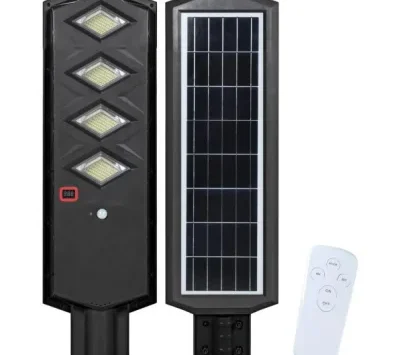

Why Upgrade to LED in UK Commercial Properties: Save 65%
Switching to LED lighting can cut energy consumption by up to 70% in UK commercial properties, yet many facility managers hesitate due to misconceptions about costs and performance. This guide examines the documented financial benefits, operational advantages, environmental impact, and practical steps for planning LED upgrades in shops, offices, warehouses, hotels, and other commercial settings across the UK.
Key Takeaways
| Point | Details |
|---|---|
| Energy Savings | LEDs reduce electricity use by 50-70% compared to traditional lighting systems. |
| Quick ROI | Commercial properties typically recover investment within 2 to 5 years. |
| Maintenance Reduction | Up to 70% lower maintenance costs due to LED longevity and reliability. |
| Environmental Contribution | Significant carbon emission reductions support UK sustainability targets. |
| Weather Performance | LEDs function reliably in cold and outdoor UK environments below -20°C. |
Understanding LED Lighting and Its Energy Efficiency
LED technology uses semiconductors to convert electricity directly into light with minimal energy waste. Unlike incandescent bulbs that lose most energy as heat, LEDs consume 50-70% less energy and emit 75% less heat than traditional lighting. This fundamental difference creates substantial cost savings for UK businesses.
The efficiency advantages extend beyond electricity consumption:
- Instant full brightness eliminates warm-up delays, improving operational responsiveness
- Reduced heat output lowers cooling system demands in buildings
- Lower wattage achieves equivalent or better illumination than fluorescents
- Consistent light output maintains quality throughout lifespan
Pro Tip: Calculate your facility’s current lighting electricity usage by multiplying bulb wattage by operating hours. Compare this against LED equivalents to estimate potential savings before purchasing.
These technical benefits translate directly into lower utility bills. A typical 60-watt incandescent bulb can be replaced with a 10-watt LED producing the same brightness. Over thousands of operating hours annually in commercial settings, this difference compounds into significant cost reductions. Understanding these fundamentals helps you evaluate commercial LED lighting benefits for your specific property needs.
Quantifying Cost Savings and Return on Investment
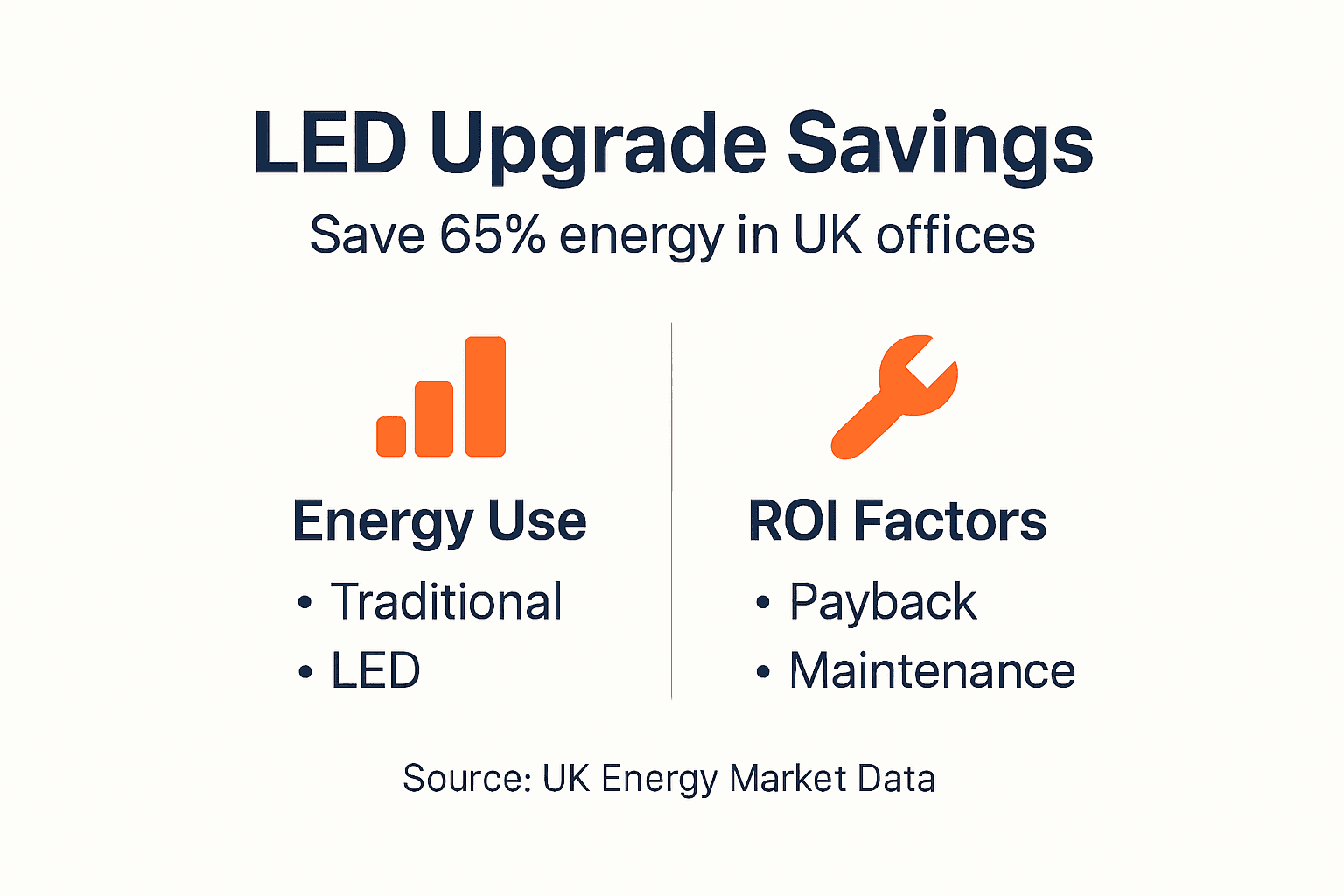
UK commercial properties achieve measurable financial returns through LED upgrades. Typical ROI periods range from 2 to 5 years, with up to 70% maintenance cost reduction depending on facility size and operating hours. Energy cost reductions of 50-70% combine with dramatically lower maintenance expenses to create compelling business cases.
| Cost Factor | Traditional Lighting | LED Lighting | Savings |
|---|---|---|---|
| Annual Energy Cost (per 100 fixtures) | £2,800 | £980 | 65% |
| Bulb Replacement Frequency | Every 1-2 years | Every 10-15 years | 80% fewer changes |
| Maintenance Labour Hours | 40 hours/year | 12 hours/year | 70% reduction |
Consider a documented UK warehouse case: transitioning 200 high-bay fixtures to LED reduced annual energy costs by 65%, from approximately £14,000 to £4,900. Maintenance visits dropped from quarterly to annual, cutting labour costs by 70%. Total project payback occurred within 3.2 years.
The financial benefits include:
- Lower electricity bills from reduced wattage consumption
- Decreased maintenance labour and replacement bulb costs
- Reduced cooling system expenses from minimal heat emission
- Extended fixture lifespan reducing capital replacement cycles
Pro Tip: Request energy consumption data from your utility provider for the past 12 months. This baseline allows accurate calculation of LED upgrade savings and ROI projections for your specific facility.
Many UK businesses leverage energy saving lights for UK businesses with bulk purchase discounts and government incentives that reduce upfront costs by up to 30%. These programmes accelerate payback periods and improve overall project economics. Factor these incentives into your financial analysis when evaluating energy savings with LED for your commercial property.
Maintenance and Operational Benefits of LED Upgrades
LEDs last an average 50,000 hours, five times longer than fluorescents, reducing maintenance frequency and associated costs. This extended lifespan transforms operational planning for commercial facilities. A typical LED fixture operating 12 hours daily lasts over 11 years before requiring replacement.
Reduced maintenance frequency creates multiple operational advantages:
- Fewer service calls minimize disruption to business operations
- Lower labour costs from eliminated bulb replacement schedules
- Decreased inventory requirements for replacement lamps
- Reduced risk of lighting failures during critical business hours
Instant activation eliminates the warm-up period required by fluorescent and HID lighting. Lights reach full brightness immediately when switched on, improving operational efficiency in time-sensitive environments like retail stores and warehouses. This responsiveness enhances both productivity and safety.
Pro Tip: Document your current annual maintenance hours and replacement bulb costs for lighting. Compare these figures against LED projections to quantify operational savings beyond energy reduction.
Reliable illumination supports health and safety compliance by maintaining consistent light levels. LEDs experience minimal lumen depreciation over their lifespan, unlike fluorescents that dim noticeably before failure. This consistency reduces workplace accidents and supports regulatory compliance.
For businesses with 24-hour operations or extended shifts, the maintenance benefits of energy saving lights become even more pronounced. Reduced service interruptions and improved reliability create measurable productivity gains beyond direct cost savings. Factor these operational improvements into your upgrade decision alongside financial considerations.
Common Misconceptions About LED Lighting
Several persistent myths prevent UK commercial property managers from pursuing LED upgrades despite documented benefits. Understanding the facts helps make informed decisions.
One common concern involves cold weather performance. LED lighting performs well in cold temperatures and outdoor environments down to -20°C, actually functioning more efficiently in cooler conditions than traditional lighting. Unlike fluorescents that struggle to start in cold weather, LEDs activate instantly regardless of temperature.
Key misconceptions clarified:
- Upfront Cost Barrier: While individual LED units cost more, bulk discounts and government incentives reduce initial investment by up to 30%, with ROI achieved within 2-5 years
- Warm-Up Delay Myth: LEDs reach full brightness instantly, unlike fluorescents requiring warm-up time, improving operational responsiveness
- Cold Performance Concerns: LEDs maintain efficiency below -20°C, outperforming traditional lighting in UK outdoor and unheated environments
- Compatibility Issues: Modern LED solutions fit existing fixtures with minimal retrofit requirements
“Many facility managers overestimate LED upgrade costs while underestimating long-term savings. The total cost of ownership strongly favours LED technology when accounting for energy, maintenance, and operational benefits over a 10-year period.”
Understanding LED lighting performance facts helps overcome hesitation. Initial cost concerns diminish when considering full lifecycle economics. For additional technical guidance, consult BSI LED lighting guidance for UK-specific standards and performance specifications.
Environmental Impact and Sustainability Advantages
LED lighting upgrades deliver substantial environmental benefits critical for UK businesses meeting sustainability targets. Reduced energy consumption directly translates to lower carbon emissions, with typical commercial installations reducing approximately 500 kg CO2 annually per site.
The environmental advantages include:
- Decreased electricity demand reduces fossil fuel consumption at generation sources
- Lower heat emission reduces building cooling requirements, further cutting energy use
- Extended lifespan minimizes manufacturing waste and disposal frequency
- Mercury-free composition eliminates hazardous material concerns present in fluorescents
LED efficiency supports compliance with UK government sustainability regulations and corporate environmental responsibility commitments. Many organizations incorporate lighting upgrades into broader carbon reduction strategies, leveraging the immediate impact of LED technology on overall emissions profiles.
Reduced cooling loads from minimal heat emission create secondary environmental benefits. Traditional lighting systems generate substantial heat that increases air conditioning demands during warmer months. LEDs eliminate this thermal load, reducing HVAC energy consumption and associated carbon emissions.
Commercial properties pursuing environmental certifications find LED upgrades contribute meaningfully to qualification requirements. The measurable reduction in energy consumption and carbon footprint supports documentation for sustainability reporting and stakeholder communications. For businesses prioritizing environmental benefits of energy saving lights, LED technology offers one of the most cost-effective pathways to demonstrable environmental improvement.
Real-World Case Studies from UK Commercial Properties
Documented results from UK businesses demonstrate the practical benefits of LED upgrades across diverse commercial sectors. These case studies provide evidence of achievable savings and operational improvements.
A UK warehouse operation with 200 high-bay fixtures achieved 65% reduction in energy costs following LED conversion. Annual electricity expenses dropped from £14,000 to £4,900, with maintenance costs decreasing by 70% due to eliminated frequent bulb replacements. The project achieved full payback within 3.2 years.
Other UK commercial success stories include:
- Retail stores reporting improved product visibility and 60% lower lighting costs
- Hospitality businesses achieving enhanced ambience with controllable LED systems while reducing energy consumption by 55%
- Office buildings extending maintenance intervals from quarterly to annual, cutting service costs substantially
- Warehouses benefiting from instant-on capability eliminating warm-up delays in temperature-controlled environments
Customer testimonials consistently emphasize reliability improvements alongside cost savings. Facility managers appreciate reduced service calls and improved light quality that enhances workplace conditions. The combination of financial and operational benefits creates high satisfaction rates among UK businesses completing LED upgrades.
Explore detailed UK commercial LED case studies to review specific implementations matching your facility type and size. These documented examples provide realistic expectations for savings potential and implementation considerations in your planning process.
Framework for Making LED Upgrade Decisions
Successful LED upgrades require systematic evaluation and planning. Follow this framework to assess your commercial property needs and implement effective solutions.
- Establish Current Baseline: Document existing energy consumption, maintenance costs, and lighting performance issues
- Evaluate Facility Requirements: Assess lighting quality needs, operational hours, environmental conditions, and UK regulatory compliance obligations
- Research Available Solutions: Compare LED products, performance specifications, and available government incentives or bulk purchase discounts
- Calculate Financial Projections: Determine ROI timeline based on energy savings, maintenance reduction, and upfront costs
- Plan Phased Implementation: Schedule installation to minimize operational disruption, potentially upgrading high-usage areas first
- Monitor Post-Installation Performance: Track actual energy consumption and cost savings against projections
Avoid these common pitfalls:
- Selecting lowest-cost LED products without verifying quality certifications and performance specifications
- Ignoring compatibility between LED fixtures and existing electrical infrastructure
- Failing to account for available incentives that reduce net project costs
- Underestimating maintenance savings in total cost calculations
Pro Tip: Prioritize upgrading fixtures with longest operating hours first. These locations generate fastest ROI and provide proof of concept for broader facility upgrades.
Consider professional consultation to optimize fixture selection and installation planning. Expert guidance ensures appropriate LED specifications for your specific applications while identifying cost-saving opportunities. Review the LED selection process for UK commercial properties to understand evaluation criteria and best practices for successful implementation.
Discover Expert LED Lighting Solutions for UK Businesses
Transforming your commercial lighting to LED technology requires expertise in product selection, installation, and ongoing support. Professional services ensure optimal results and maximize return on investment.
Expert providers offer tailored solutions matching your facility requirements, from initial assessment through installation and performance monitoring. Bulk purchasing arrangements reduce upfront costs, while experienced installation minimizes operational disruption. 
Commercial clients benefit from comprehensive support including energy audits, product recommendations, and post-installation performance verification. Review successful implementations like Wilson Veterinary Group to see documented results from UK businesses. Professional consultation helps navigate commercial lighting upgrade services options and identify optimal solutions for your specific property.
Explore detailed LED upgrade case studies showcasing real savings achieved by UK commercial properties. When ready to begin your upgrade project, request a quote for LED upgrades to receive customized recommendations and cost projections for your facility.
Frequently Asked Questions About Upgrading to LED Lighting
What is the typical payback period for an LED upgrade in UK commercial buildings?
Most UK commercial properties achieve ROI within 2 to 5 years depending on facility size, operating hours, and electricity rates. High-usage environments with extended operating hours reach payback faster, often within 2 to 3 years.
Are LED lights suitable for outdoor and cold environments in the UK?
Yes, LEDs perform reliably in outdoor UK conditions and actually function more efficiently in cold temperatures. They maintain full performance below -20°C, unlike fluorescents that struggle in cold weather, making them ideal for warehouses, outdoor signage, and unheated facilities.
How do government incentives reduce the upfront cost of LED upgrades?
UK government programmes and energy efficiency schemes can reduce LED upgrade costs by up to 30% through grants, tax incentives, and rebates. Combining these incentives with bulk purchase discounts significantly lowers initial investment and accelerates ROI.
What maintenance savings can UK businesses expect switching to LEDs?
Commercial facilities typically experience 70% reduction in maintenance costs due to LED longevity. With 50,000+ hour lifespans, LEDs require replacement every 10-15 years compared to 1-2 years for traditional bulbs, dramatically reducing labour and materials expenses.
How does LED lighting help businesses meet sustainability targets?
LED upgrades reduce carbon emissions by approximately 500 kg CO2 annually per commercial site through lower electricity consumption. This measurable reduction supports UK sustainability reporting requirements and environmental certification programmes while demonstrating corporate responsibility commitments.