Lighting Design: Impact on Cost and Compliance
Cutting unnecessary costs while keeping your facility compliant is a constant pressure for managers in UK commercial properties. Outdated lighting drains budgets and leads to avoidable maintenance, but switching to modern LED solutions offers a smarter way to cut waste without sacrificing performance. Effective commercial lighting design can improve staff comfort, meet ever-evolving regulations, and unlock real savings by integrating energy-efficient LED technology with intelligent controls and tailored layouts.
Table of Contents
- Lighting Design In Commercial Spaces Explained
- Key Lighting Types And Their Applications
- Essential Lighting Standards And Legal Requirements
- LED Efficiency, Cost Savings, And Product Selection
- Common Pitfalls And Compliance Obligations
Key Takeaways
| Point | Details |
|---|---|
| Effective Lighting Design Is Critical | A well-planned lighting strategy can reduce operational costs by 30-50% while enhancing employee comfort and productivity. |
| Regulatory Compliance Is Essential | Compliance with UK lighting standards not only avoids fines but also ensures safety and operational efficiency in commercial spaces. |
| LED Solutions Are Cost-Effective | Transitioning to LED lighting significantly cuts energy consumption and maintenance costs, with many upgrades paying for themselves within 3-5 years. |
| Documentation And Planning Are Key | Comprehensive documentation and proper planning, including consideration of local regulations, safeguard against compliance failures and potential liabilities. |
Lighting Design in Commercial Spaces Explained
Commercial lighting design goes far beyond simply installing fixtures. It directly affects how your team performs, how much you spend on energy bills, and whether your facility meets building regulations.
Your lighting strategy shapes the entire working environment. Poor design wastes money, strains eyes, and creates compliance headaches. Smart design cuts costs whilst boosting productivity.
What Makes Commercial Lighting Different
Office spaces, warehouses, retail shops, and hospitality venues all have different lighting needs. A shop floor requires bright, focused light for customer experience. A warehouse needs uniform illumination across large areas. An open office demands flexibility for different work zones.
Lighting uniformity and colour rendering significantly impact visual comfort and staff performance. Poor distribution causes shadows, glare, and fatigue. Proper design integrates ambient lighting (general room brightness), task lighting (focused areas), and accent lighting (visual interest) to create balanced, functional spaces.
Three critical elements define effective commercial lighting:
- Luminaire selection: Choose fixtures suited to your space type and task requirements
- Layout strategy: Position lights to eliminate shadows and provide even coverage
- Colour temperature: Match lighting to the work being done—cooler tones for concentration, warmer for comfort
How Design Impacts Your Costs
Lighting accounts for 15-25% of commercial electricity consumption. Outdated systems waste energy constantly. Modern LED solutions cut consumption dramatically.
When designing your lighting, consider:
- Occupancy sensors that reduce usage in empty areas
- Daylight harvesting to maximise natural light
- Zoning systems for independent control of different spaces
- Task-specific lighting to avoid over-illumination
Well-planned lighting design reduces operational costs by 30-50% whilst improving employee comfort and safety.
A warehouse might save £2,000+ annually through better fixture placement and controls. A retail space with improved brightness uniformity sees increased sales alongside lower bills.

Compliance Considerations Matter
UK commercial properties must meet specific lighting standards. Building Regulations cover energy efficiency, emergency lighting, and workplace safety requirements. Failure to comply risks fines and operational shutdowns.
When you upgrade your system, ensure it meets these standards from the start. Installation by qualified professionals guarantees compliance and prevents costly corrections later.
When selecting appropriate fixtures for your upgrade, understanding how to select LED fixtures for commercial spaces helps you balance regulatory requirements with cost savings.
Pro tip: Document your lighting design specifications, installation records, and maintenance schedules—this proof of compliance protects you during inspections and insurance claims.
Key Lighting Types and Their Applications
Different commercial spaces demand different lighting approaches. Understanding which fixture type suits your environment is crucial for achieving both performance and compliance.
Commercial facilities typically use several core lighting types, each designed for specific purposes and spaces. Choosing the right combination saves money whilst meeting building standards.
The following table compares core lighting types for commercial facilities, highlighting their best applications and distinctive advantages:
| Lighting Type | Best Applications | Distinctive Advantages |
|---|---|---|
| LED Panels/Troffers | Open offices, retail, meeting rooms | Even distribution, minimal glare |
| High Bay Fixtures | Warehouses, factories, gyms | Powerful coverage, robust design |
| Task Lighting | Desks, assembly stations, checkouts | Targeted brightness, reduces fatigue |
| Accent Lighting | Hospitality, displays, reception | Enhances aesthetics, highlights features |
LED Panels and Troffers
LED panels and troffers are the workhorses of commercial lighting. They mount flush to ceilings and provide uniform, glare-free illumination across large areas.
These fixtures excel in:
- Open offices where consistent overhead light matters
- Retail spaces requiring even brightness
- Warehouses needing reliable coverage
- Meeting rooms where shadows disrupt visibility
LED panels deliver superior energy efficiency compared to older fluorescent systems. They last 50,000+ hours, dramatically reducing replacement costs and maintenance downtime. Their flat design integrates seamlessly with modern drop ceilings.
High Bay Lighting
Large open spaces with high ceilings—warehouses, factories, gymnasiums—require high bay fixtures. These powerful lights mount 15-40 feet overhead and cast light across expansive floor areas.
High bays handle demanding environments because they:
- Project light across vast distances efficiently
- Withstand dust, moisture, and temperature fluctuations
- Deliver instant-on brightness without warm-up time
- Reduce the number of fixtures needed, cutting installation costs
Task and Accent Lighting
Ambient ceiling fixtures provide general illumination, but most commercial spaces need supplementary lighting. Task lighting illuminates specific work areas where employees concentrate on detail work—desks, assembly stations, checkout counters.
Accent lighting highlights architectural features, merchandise, or decorative elements in retail and hospitality settings. This combination approach creates functional, visually appealing environments.
Common task and accent applications include:
- Under-cabinet lighting in kitchens or retail displays
- Desk lamps in offices
- Wall-mounted lights in reception areas
- Spotlights emphasising merchandise or artwork
Layering ambient, task, and accent lighting creates flexible spaces that adapt to different activities whilst maintaining energy efficiency.
Choosing Fixtures for Your Space
Your selection depends on ceiling height, room size, task requirements, and budget. LED strip lighting offers flexibility for accent applications and decorative purposes in retail or hospitality venues.
Consider energy consumption too. Modern LED fixtures use 75% less electricity than older incandescent or fluorescent systems, delivering substantial long-term savings.
Pro tip: Mix fixture types strategically—use efficient high bays or panels for general illumination and task lighting only where it’s actually needed, maximising energy savings without compromising visibility or safety.
Essential Lighting Standards and Legal Requirements
UK commercial properties operate within strict lighting regulations. Non-compliance risks hefty fines, operational shutdowns, and insurance complications. Understanding these requirements protects your facility and your bottom line.
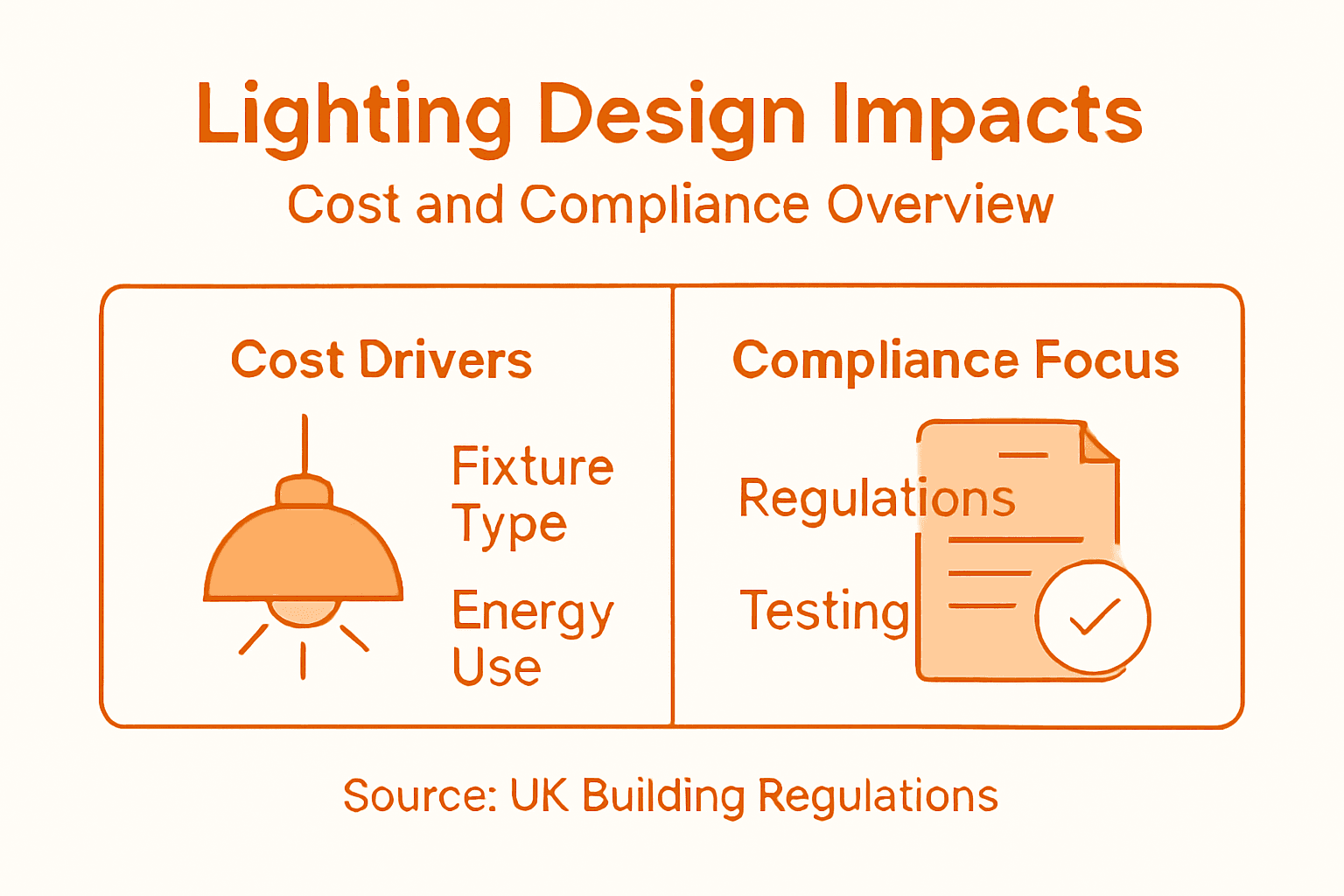
Building Regulations, fire safety codes, and energy efficiency standards all govern how you light your space. Meeting them from the outset costs far less than retrofitting later.
For quick reference, the table below summarises essential UK lighting regulations and how they impact commercial spaces:
| Regulation Area | Key Requirement | Business Impact |
|---|---|---|
| Power Density Limits | Maximum wattage per sqm | Controls energy costs, legal compliance |
| Lighting Controls | Sensors, smart dimming | Automation, reduced wastage |
| Emergency Lighting | Backup duration, exit signage | Insurance validity, life safety |
| Accessibility | Flicker-free, high CRI | Safe for all occupants |
Building Regulations and Energy Efficiency
UK Building Regulations Part L covers energy efficiency for commercial buildings. Your lighting system must meet specific power density limits—essentially, you cannot exceed a set wattage per square metre.
Mandatory lighting controls like occupancy sensors enforce energy savings automatically. When spaces sit empty, lights dim or switch off entirely. Dimmers and smart controls prevent wasteful over-illumination during daylight hours.
Building Regulations require:
- Maximum lighting power density limits for your space type
- Automatic daylight harvesting in naturally lit areas
- Occupancy sensors in certain rooms (corridors, storage, break areas)
- Emergency lighting systems that function during power outages
- Regular testing and maintenance documentation
Emergency Lighting Requirements
Every commercial property must have functioning emergency lighting. This illuminates evacuation routes when mains power fails, enabling safe exit during fires or electrical faults.
Legal emergency lighting requirements specify minimum brightness levels and battery backup duration. Non-compliance exposes you to prosecution and invalidates your insurance.
Emergency lighting considerations include:
- Exit signs clearly marking escape routes
- Battery backup systems rated 3+ hours
- Regular testing (typically monthly)
- Professional installation and certification
Fire Safety and Material Compliance
Recent legislation changes for LED panels affect which fixtures you can install in certain areas. Non-fire-rated panels may soon be prohibited in buildings above specific heights or with vulnerable occupants.
Fire safety standards demand:
- Fire-rated enclosures in high-risk areas
- Proper thermal management in sealed ceilings
- Installation by qualified electricians
- Certification documentation for audits
Compliance isn’t a one-time checkbox—regulations update as technology advances, so periodic reviews ensure your system remains legal.
Accessibility Standards
Lighting must accommodate diverse visual abilities. Glare, flicker, and poor colour rendering create hazards for people with sight impairments or photosensitive conditions.
Consider these access requirements:
- Flicker-free operation (eliminate 100Hz and visible strobing)
- Adequate colour rendering index (CRI 80+ minimum)
- Even illumination to prevent shadow hazards
- Switchable brightness for flexibility
Modern LED systems naturally meet these standards because their technology eliminates flicker and provides superior light quality.
Pro tip: Hire a qualified lighting designer or installer to conduct a compliance audit of your current system—they identify gaps, certify installations, and provide documentation protecting you during regulatory inspections.
LED Efficiency, Cost Savings, and Product Selection
LED lighting represents the most cost-effective upgrade facility managers can make. The numbers are compelling: lower energy bills, minimal maintenance, longer fixture lifespan, and rapid return on investment.
But not all LEDs deliver equal performance. Understanding efficiency ratings and selecting the right products ensures maximum savings across your entire facility.
Why LEDs Cut Costs So Dramatically
Switching from fluorescent to LED lighting reduces energy consumption by up to 44%. That translates to thousands of pounds annually for a medium-sized commercial property.
LEDs achieve savings through multiple mechanisms:
- Superior efficiency: Convert more electricity into light, less into wasted heat
- Longer lifespan: Last 50,000+ hours versus 15,000 for fluorescents—fewer replacements
- Instant on: No warm-up time, unlike older systems
- Better dimming: Work smoothly with occupancy sensors and daylight controls
- Reduced maintenance: Fewer bulb changes mean lower labour costs
A typical warehouse replacing 200 fluorescent fixtures might save £3,000-£5,000 annually on electricity alone, plus another £1,000+ on maintenance labour.
Understanding LED Efficiency Ratings
Lumens per watt (lm/W) measures LED efficiency. Higher numbers mean more light output per unit of electricity consumed. Quality commercial LEDs deliver 100+ lm/W; older fluorescents typically manage 60-80 lm/W.
Also check colour rendering index (CRI) and colour temperature. CRI 80+ ensures accurate colour representation. Cooler temperatures (4000K-5000K) suit task-focused areas; warmer tones (3000K) create comfort in break spaces.
Selecting Products for Your Facility
Choosing appropriate LED fixtures depends on your space type and requirements:
- Offices: Panels or troffers with 4000K colour temperature and CRI 90+
- Warehouses: High bay fixtures rated for dusty, temperature-variable environments
- Retail: Accent lighting with high CRI for accurate merchandise colour
- Hospitality: Dimmable systems allowing flexible ambience control
Energy savings with commercial LED lighting extend beyond the electricity meter. Reduced heat output lowers air conditioning costs in summer months. Lower power draw means you may avoid costly electrical infrastructure upgrades.
Quality LED products from reliable suppliers offer superior light output, reliability, and lifespan—avoiding cheap fixtures that fail early or deliver poor performance.
Calculating Your Return on Investment
Determine payback period using this formula: Installation cost divided by annual energy savings. Most commercial LED upgrades pay for themselves within 3-5 years, then deliver pure savings.
Factors affecting ROI:
- Hours of daily operation (24/7 facilities see faster returns)
- Current electricity rates (higher rates accelerate payback)
- Fixture quantity and type
- Availability of grant funding or tax incentives
Pro tip: Request detailed energy audits from qualified suppliers—they model your specific building, calculate exact savings, and identify which fixtures deliver best ROI, turning upgrades from guesswork into data-driven decisions.
Common Pitfalls and Compliance Obligations
Many facility managers upgrade their lighting without fully understanding regulatory requirements. This oversight leads to costly corrections, fines, and systems that don’t perform as expected.
Avoiding these mistakes protects your investment and keeps your facility operating legally and efficiently.
Ignoring Power Density Limits
UK Building Regulations specify maximum lighting power density for different space types. Exceeding these limits wastes energy and violates compliance standards.
Common mistakes include:
- Installing fixtures without consulting power density allowances
- Over-lighting spaces that don’t require high brightness
- Failing to account for task-specific lighting separately from ambient light
- Not updating calculations when space usage changes
Compliance failures result in financial penalties and operational inefficiencies because excessive fixtures consume energy unnecessarily. A poorly planned warehouse retrofit might exceed allowances by 20–30%, negating efficiency gains.
Calculate your specific limit by multiplying your floor area by the permitted wattage per square metre for your space type. Then design fixtures to stay within that budget.
Neglecting Required Controls
Occupancy sensors, daylight harvesting, and dimming systems aren’t optional extras—they’re mandatory compliance features. Building Regulations demand them in specific areas: corridors, storage rooms, break spaces, and naturally lit zones.
Facilities that skip these controls face:
- Regulatory inspection failures
- Higher energy costs and carbon footprint
- Insurance claims being denied for non-compliance
- Difficulty selling or leasing the property
Modern LED systems integrate these controls seamlessly. Smart sensors detect when spaces sit empty and automatically reduce light. Daylight harvesting systems dim fixtures when windows provide sufficient natural light.
Inadequate Planning for Local Requirements
UK regulations vary by region and building type. A warehouse requires different specifications than a hospital or school. Fire safety rules differ for listed buildings and heritage properties.
Failures in this area include:
- Assuming all commercial spaces have identical requirements
- Installing non-fire-rated fixtures where fire-rated ones are mandatory
- Not obtaining necessary approvals before installation
- Using unqualified installers who overlook local rules
Professional lighting designers understand local variations and ensure your system meets every applicable regulation from the outset, avoiding expensive rework later.
Insufficient Documentation and Testing
Compliance requires proof. Building inspectors, insurance auditors, and future property buyers all demand documentation. Poor record-keeping creates liability exposure.
Document these essentials:
- Installation certificates from qualified electricians
- Energy audit reports and baseline measurements
- Maintenance and testing logs
- Equipment specifications and compliance certifications
- Photometric reports confirming light distribution
Choosing Unsuitable Products
Budget fixtures might save money upfront but often fail prematurely, require frequent maintenance, and deliver poor light quality. False economy becomes expensive.
Evaluate products based on:
- Manufacturer warranty length (5+ years preferred)
- Lumens per watt efficiency rating (100+ lm/W minimum)
- Colour rendering index (CRI 80+ minimum)
- Heat management in sealed ceiling applications
- Compatibility with existing control systems
Pro tip: Hire qualified lighting designers to conduct detailed energy audits before upgrading—they identify code violations in your current system, model compliant retrofit designs, and provide documentation satisfying inspectors without expensive guesswork.
Transform Your Commercial Lighting for Cost Savings and Compliance
Navigating the complexities of lighting design to reduce costs while meeting strict UK regulations can be challenging. This article highlights key pain points such as power density limits, mandatory lighting controls, and the need for quality LED fixtures that improve productivity and cut energy bills. If you want to overcome issues like inefficient energy use, poor lighting quality, or compliance risks, a tailored LED upgrade designed by professionals is essential.
At Ledsupplyandfit.co.uk, we specialise in supplying and installing commercial LED lighting solutions that address these exact challenges. Our range includes energy-efficient LED panels, high bay lights for warehouses, and task lighting optimised for your workplace environment. We also offer expert installation by qualified electricians to ensure full compliance with Building Regulations and fire safety standards.
Don’t let outdated or non-compliant lighting drive up your operational costs or put your business at risk. Take control today with our comprehensive service designed to deliver dramatic energy savings, improved visual comfort, and guaranteed compliance. Visit Ledsupplyandfit.co.uk now to explore our LED solutions and schedule your personalised consultation. Make your commercial lighting upgrade a smart investment before your next inspection or energy audit.
Frequently Asked Questions
What are the key elements of effective commercial lighting design?
Effective commercial lighting design centres around three key elements: luminaire selection, layout strategy, and colour temperature. Choosing fixtures suited for the space type, positioning them to ensure even coverage, and matching the lighting to the tasks being performed are crucial for optimal performance.
How can poor lighting design affect costs in a commercial space?
Poor lighting design can lead to wasted energy, increased operational costs, and potential compliance issues. Inefficient systems may account for 15-25% of electricity consumption, and implementing smart lighting solutions can reduce costs by 30-50%.
What are the compliance requirements for commercial lighting?
Commercial properties must adhere to specific lighting regulations covering energy efficiency, emergency lighting, and workplace safety. Compliance with these regulations is essential to avoid fines and ensure the safety of the facility and its occupants.
How does LED lighting contribute to cost savings in commercial spaces?
LED lighting is highly efficient, consuming up to 75% less electricity compared to older incandescent or fluorescent systems. Their longer lifespan of over 50,000 hours reduces replacement costs, while their compatibility with smart controls further enhances energy savings.