Building compliance lighting explained: UK regulations and LEDs
TL;DR:
- UK building compliance lighting involves complex legal requirements beyond simple brightness, including safety, energy, and fire safety standards. Proper compliance demands task-specific design, control strategies, and regular testing, especially for emergency lighting, to ensure safety and legal adherence. Upgrading to LED systems offers significant energy savings and easier compliance, but must be managed through a strategic, task-focused approach.
Many commercial property managers assume that as long as a space is well lit, it is compliant. That assumption is expensive and potentially dangerous. UK building compliance lighting is a precise, multi-layered legal obligation that spans workplace safety law, energy performance standards, and fire safety requirements. Simply installing bright fittings does not satisfy your legal duties. This article unpacks exactly what compliance lighting means, which regulations apply to your premises, and how to approach LED upgrades in a way that is genuinely lawful, efficient, and future-proof.
Key Takeaways
| Point | Details |
|---|---|
| Compliance is regulatory and practical | Building compliance lighting means meeting UK safety, energy, and fire-safety regulations. |
| Task-based design matters | Proper lighting must be tailored to workplace tasks, not just installed generically. |
| LED upgrades ease compliance | Switching to LED offers energy savings and makes meeting regulations easier. |
| Emergency lighting is essential | Legal requirements mandate reliable emergency lighting for safe escape routes. |
| Review and maintain regularly | Ongoing compliance needs periodic reviews and maintenance to stay effective. |
Understanding building compliance lighting in the UK
Compliance lighting is not a single standard or a box to tick on a refurbishment checklist. According to HSE guidance on lighting, “building compliance lighting generally means designing, installing, and maintaining lighting so it meets the legal duty for safe workplace lighting plus building and energy and fire-safety requirements.” That is a broad mandate, and it matters for every commercial premises in the UK regardless of size or sector.
The key legislative drivers are:
- The Workplace (Health, Safety and Welfare) Regulations 1992, which require suitable and sufficient lighting for every workplace
- Building Regulations Part L, which governs energy performance of lighting in new builds and significant refurbishments
- Fire safety legislation, which mandates emergency lighting as a separate but connected requirement
- BS 5266, the code of practice that defines how emergency lighting should be designed and maintained
For managers, this means that meeting lighting regulations involves far more than replacing old fluorescent fittings with LEDs. It requires a planned approach that addresses safety, efficiency, and fire risk in parallel. A helpful starting point is a building regulations guide that sets out your obligations across all areas of building compliance, not just lighting.
“Compliance is not the end goal. Safety is. Compliance is simply the legal framework that keeps safety accountable.”
The distinction matters because buildings that are technically compliant on paper but poorly designed in practice still create risk. A dimly lit storage area that meets minimum lux levels on a test sheet but leaves workers squinting at labels is a liability waiting to happen.
Key regulations and standards for compliant lighting
Understanding the landscape requires knowing which regulations apply to which situations. HSE guidance on lighting identifies the core compliance drivers as the Workplace (Health, Safety and Welfare) Regulations 1992, Building Regulations Part L, and emergency lighting standards aligned via BS 5266.
| Regulation | What it covers | Who it affects |
|---|---|---|
| Workplace Regulations 1992 | Suitable and sufficient lighting for all tasks | All employers with premises |
| Building Regulations Part L | Energy efficiency and lighting controls | New builds and major refurbs |
| BS 5266 | Emergency lighting design and maintenance | All commercial premises |
| Fire Safety Order 2005 | Emergency route lighting and risk assessment | All non-domestic premises |
Practical implications for LED lighting compliance include ensuring your new LED fittings achieve the correct lux levels for each zone, that your lighting controls satisfy Part L requirements, and that your emergency lighting is tested and documented according to BS 5266.
Lighting controls are a critical but often overlooked compliance element. Occupancy sensors, daylight dimming, and zoned switching are not just efficiency tools. They are Part L requirements in many commercial settings. Managers who invest in lighting controls for compliance can reduce energy consumption significantly while satisfying their regulatory obligations in a single step.
Pro Tip: When tendering for a lighting upgrade, always ask your supplier to confirm how each product and control strategy maps to Part L and the Workplace Regulations. Vague assurances are not sufficient for a compliance audit.
Designing workplace lighting: Task-specific compliance
One of the most misunderstood aspects of compliance is that it is not about average light levels across a whole floor. HSE guidance on lighting is explicit: compliant lighting is task-specific and must consider illuminance, colour rendering, contrast, and glare for each activity carried out on the premises.
A practical task-specific audit for a commercial property typically follows these steps:
- Map all tasks performed in each zone, including maintenance areas, corridors, and emergency routes
- Identify the required lux level for each task, using the recommended values in the CIBSE Lighting Guide
- Assess colour rendering needs, particularly in areas such as food preparation, retail display, or quality control
- Check for glare from both direct fittings and reflective surfaces, which can cause fatigue and error
- Document the design rationale so that any future changes or inspections have a clear baseline
“Lighting that is suitable and sufficient for one task may be entirely wrong for another, even in the same room.”
For example, an open-plan office requires different treatment to a loading bay or a server room. LED installation best practices account for these differences, specifying the correct colour temperature, beam angle, and mounting height for each zone. Similarly, warehouse lighting best practices address the unique challenges of high-bay environments where racking creates deep shadows that uniform overhead lighting cannot resolve.
Pro Tip: Colour rendering index (CRI) is often ignored in compliance discussions but matters enormously in environments where workers are identifying colours, reading fine print, or handling goods. A CRI of 80 or above is the standard for most commercial applications.
Emergency lighting: Essential for compliance and safety
Emergency lighting is, without question, one of the most legally scrutinised elements of building compliance. Emergency lighting is a major component of compliance in UK commercial premises because it supports safe escape when normal lighting fails.
Key performance requirements under BS 5266 include:
- Minimum illuminance of 1 lux along escape routes at floor level
- Automatic activation within five seconds of mains failure
- Minimum duration of three hours for maintained operation
- Regular functional testing and a documented maintenance log
| Test type | Frequency | Who carries it out |
|---|---|---|
| Monthly flick test | Monthly | Nominated responsible person |
| Full duration test | Annually | Competent person or contractor |
| Visual inspection | Monthly | Designated staff member |
| Documentation review | Annually | Fire risk assessor |
LED emergency fittings offer a genuine compliance advantage here. Their longer lifespan and lower failure rates reduce the risk of a fitting failing between scheduled tests. Following lighting maintenance tips for emergency systems means scheduling tests consistently, keeping records up to date, and replacing ageing fittings proactively rather than reactively. An effective lighting maintenance programme treats emergency lighting as a safety-critical system, not an afterthought.
The statistics are sobering. Emergency lighting failures are among the most common findings in fire safety inspections across UK commercial properties, and failure to maintain compliant emergency systems can result in enforcement notices or prosecution under the Regulatory Reform (Fire Safety) Order 2005.
LED upgrades: Compliance benefits and energy savings
A well-planned LED upgrade is one of the most effective ways to meet multiple compliance obligations simultaneously. Building Regulations Part L requires energy performance for lighting and the integration of controls, and modern LED systems are designed precisely to satisfy these demands.
Key benefits of a compliant LED upgrade include:
- Lower energy consumption, typically 50 to 70 per cent less than equivalent fluorescent systems
- Longer lamp life, reducing maintenance frequency and associated compliance risks
- Dimming and control compatibility, enabling Part L-compliant control strategies from day one
- Improved colour rendering, supporting task-specific compliance in environments where visual accuracy matters
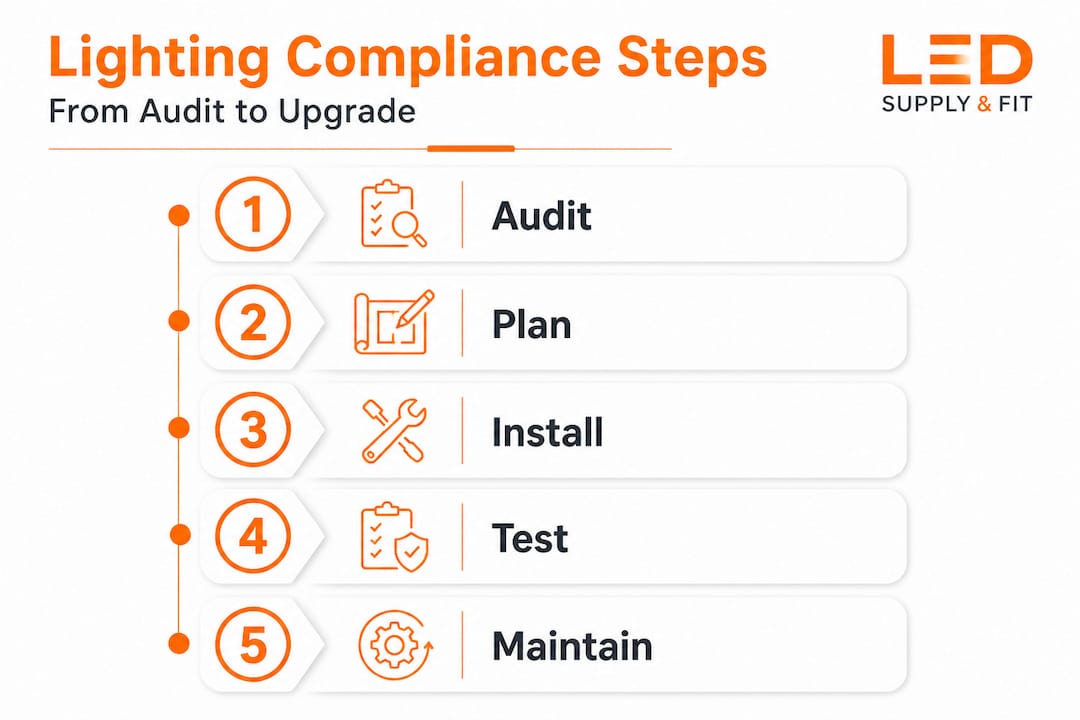
To execute a compliant upgrade, follow a structured process: audit your existing installation against current standards, commission a lighting design that addresses task-specific needs, use a competent installer familiar with UK regulations, and put a maintenance programme in place from the outset. Reviewing sustainable lighting trends shows that compliance and sustainability are increasingly aligned. Managers who explore energy-efficient LED solutions find that the best systems combine regulatory compliance with genuine running cost reduction.
Why compliance lighting is about more than ticking boxes
We see a consistent pattern in commercial lighting projects across the UK. Managers who treat compliance as a paperwork exercise end up revisiting the same problems every two or three years. New fittings go in, the inspection passes, and then a change in workspace layout or building use makes the original design obsolete overnight.
HSE guidance on lighting is clear that lighting should be designed for the tasks being performed, not installed as a uniform general-lighting solution. That single principle, consistently applied, separates genuinely compliant premises from those that are technically compliant on the day of inspection but unsafe in practice.
The real value in a compliance lighting strategy comes from treating it as part of your asset management approach. Scheduling regular reviews, particularly after refurbishments or changes in building use, ensures your lighting keeps pace with your operations. Pairing compliance reviews with a robust lighting maintenance strategy means you are never caught out by a test, an inspection, or a near-miss incident. The managers who get this right are not spending more money. They are spending it more intelligently.
Compliant lighting upgrades made easy with LED Supply & Fit
Navigating UK compliance lighting requirements is straightforward when you work with a supplier who understands the regulations as well as the products.

At LED Supply & Fit, we specialise in compliant LED lighting for commercial premises across the UK, from offices and retail spaces to warehouses and hospitality venues. Our team can help you with lighting design for compliance, ensuring every zone meets its task-specific and regulatory requirements. Browse our full range of best LED solutions for commercial settings, or get in touch to discuss your project. We offer trade accounts, bulk pricing, next-day delivery, and on-site installation across the UK.
Frequently asked questions
What regulations govern building compliance lighting in the UK?
The key compliance drivers are the Workplace (Health, Safety and Welfare) Regulations 1992, Building Regulations Part L, and emergency lighting standards including BS 5266, all of which apply to commercial premises in different ways.
Does emergency lighting have to be LED for compliance?
Emergency lighting does not legally have to be LED, but LED fittings are preferred because their reliability and longevity reduce the risk of failure between tests, making ongoing compliance significantly easier to maintain.
How often should workplace lighting be reviewed for compliance?
Workplace lighting should be reviewed after any renovation, change in building use, or significant task change, as HSE guidance on lighting requires that lighting remains suitable for the specific tasks being performed at all times.
Is energy efficiency legally required for building lighting?
Yes, Building Regulations Part L requires energy performance standards for lighting in commercial buildings, including the use of controls such as occupancy sensors and daylight dimming in many applications.
Recommended
- How to meet lighting regulations and upgrade to LEDs
- LED lighting safety tips: Secure energy savings for UK businesses
- LED lighting safety guidelines: compliance and safer workplaces
- LED installation best practices for safer, efficient workplaces
- LED-Rollout im Bestand: schnell, normkonform und wirtschaftlich – IET-Berlin