Save up to 40% on bills with smarter LED lighting
Lighting accounts for up to 40% of energy use in UK commercial buildings, yet it remains one of the most overlooked levers for cutting costs and improving sustainability. For property managers and business owners juggling rising energy tariffs, that figure represents a genuine opportunity rather than just a statistic. The right combination of technology, controls, and informed decision-making can transform your energy performance without disrupting daily operations. This article walks you through the evidence, the numbers, and the practical steps to make smarter lighting work for your premises.
Key Takeaways
| Point | Details |
|---|---|
| Lighting is a major cost | Lighting can represent up to 40 percent of a UK commercial building’s energy use. |
| LED and controls mean big savings | Upgrading to LEDs and smart controls typically saves thousands of pounds and delivers fast payback. |
| Combine tech and behaviour | Automation ensures consistent savings, but staff awareness can drive results even further. |
| Practical steps drive impact | Auditing, specifying the right system, and monitoring usage are key to maximising energy efficiency. |
Why lighting matters for energy efficiency
Lighting is not a minor line item on your energy bill. Across UK commercial properties, it consistently ranks as one of the largest single contributors to electricity consumption. The range is wide because property type, occupancy patterns, and existing infrastructure all play a role. A busy warehouse running 24-hour shifts sits at a very different point on that scale compared to a small office open nine to five.
“Lighting accounts for between 15% and 40% of energy use in UK commercial buildings, making it one of the highest-impact areas for efficiency improvements.”
One common misconception is that simply swapping old fittings for energy saving lights solves the problem entirely. LEDs are a critical first step, but they are not the whole answer. A building fitted with LEDs that run continuously, even in empty rooms or during daylight hours, will still carry unnecessary costs. The full picture includes how lights are controlled, when they operate, and how staff interact with them.
The indirect impacts matter too. Poor lighting increases maintenance callouts, shortens fitting lifespan, and can affect staff productivity and wellbeing. When you look at the full cost of ownership rather than just the unit price, the case to reduce lighting costs through a structured approach becomes very clear. Understanding energy efficiency in the workplace as a system rather than a single product decision is where most businesses find the biggest gains.
With this context in mind, let us move into exactly how much you stand to gain from focusing on lighting upgrades.
Quantifying savings from energy-efficient lighting
The financial case for upgrading is well supported by UK data. A 1,000 m² office can save around £2,000 per year after switching to LED, while a 500 m² retail unit can see savings of £1,500 to £3,000 annually depending on trading hours and existing infrastructure. These are not theoretical projections. They reflect real-world outcomes from commercial retrofits across the UK.
| Property type | Approximate area | Estimated annual saving | Typical payback period |
|---|---|---|---|
| Office | 1,000 m² | £2,000 | 2 to 4 years |
| Retail unit | 500 m² | £1,500 to £3,000 | 2 to 5 years |
| Warehouse | 2,000 m² | £4,000 to £7,000 | 3 to 5 years |
| Restaurant or bar | 300 m² | £800 to £1,500 | 2 to 4 years |
Businesses that save 65% with LEDs typically combine high-efficacy luminaires with smart controls rather than relying on hardware alone. The payback periods of 2 to 5 years are achievable across most commercial property types, and in high-usage environments such as warehouses or gyms, payback can arrive even sooner.
Key statistic: A mid-size retail unit upgrading from fluorescent to LED with occupancy controls can recover its full investment within 30 months and continue generating savings for the remaining 20-plus years of the fitting’s lifespan.
Adding smart controls on top of LED hardware pushes savings further still. The benefits of LED installation extend well beyond the energy bill, covering reduced maintenance, fewer lamp replacements, and lower carbon reporting figures. These numbers make the case, but what actually makes a lighting solution truly energy efficient?
Core components of an energy-efficient lighting system
A genuinely efficient lighting system is built from several layers working together. Understanding each one helps you specify the right solution rather than over-investing in hardware while under-investing in control.
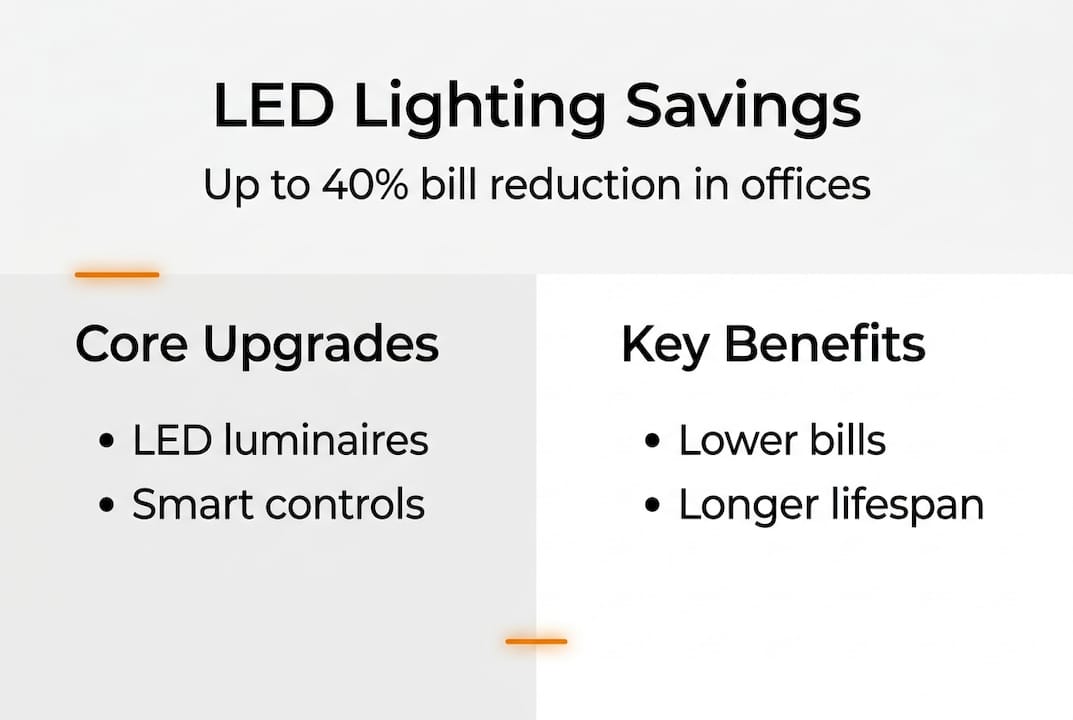
LED luminaires form the foundation. Modern commercial LEDs deliver 100 to 160 lumens per watt, compared to 50 to 80 for older fluorescent fittings. They last 50,000 hours or more, dramatically cutting maintenance costs and disruption.
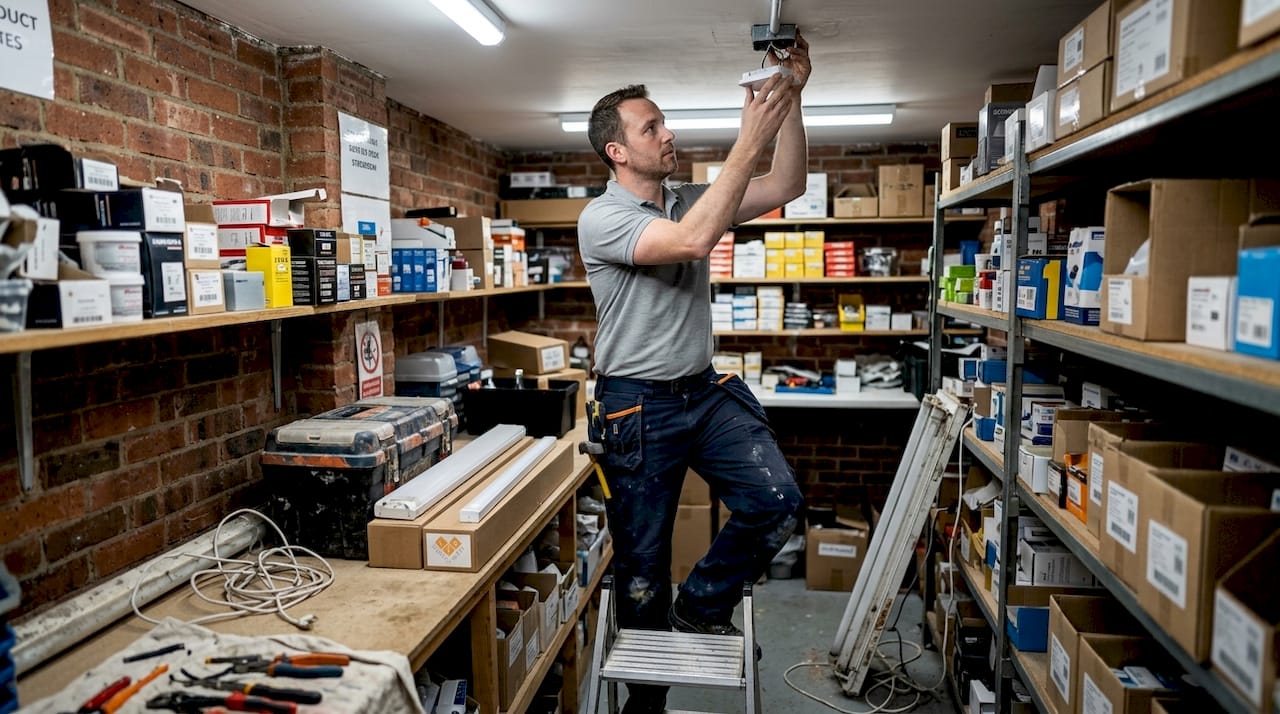
Smart controls are where the real efficiency gains compound. Occupancy sensors, daylight harvesting, and scheduling systems ensure lights only operate when and where they are needed. According to lighting controls energy savings data, controls alone can cut consumption by a further 30 to 50% on top of the LED baseline.
Daylight harvesting is particularly valuable in perimeter zones and south-facing offices. Without it, over-lighting in daylight areas wastes 20 to 40% of energy even in LED-equipped buildings.
| Control type | Advantages | Disadvantages |
|---|---|---|
| Manual switching | Low upfront cost | Inconsistent, relies on staff |
| Timer controls | Simple, predictable | Inflexible, ignores occupancy |
| Presence/absence sensors | Responsive, reliable | Higher install cost |
| Daylight harvesting | Maximum efficiency | Requires commissioning expertise |
Pro Tip: In daylight-rich zones such as open-plan offices or glazed retail frontages, always pair LEDs with daylight-linked dimming. Without it, you are paying for light your space already has for free.
Here is a straightforward upgrade sequence to follow:
- Audit your current fittings, wattages, and operating hours.
- Identify zones by occupancy pattern and daylight availability.
- Specify LED luminaires matched to the lux requirements of each zone.
- Layer in controls appropriate to each zone’s usage profile.
- Commission and test the system before full handover.
- Monitor consumption monthly for the first year to verify savings.
Exploring sustainable lighting choices and keeping an eye on the future of LED lighting will also help you future-proof your investment as technology continues to improve. Once you know the essential pieces, how does technology compare against human behaviour in real-world scenarios?
Controls, automation, and behaviour: finding the right balance
Relying on staff to switch lights off is not a strategy. It is a hope. In busy commercial environments, manual approaches work reasonably well only in small spaces with a stable, engaged team. The moment you scale up or introduce shift patterns, consistency breaks down.
Behaviour change is low-cost but inconsistent, while automated controls deliver reliable, enforceable savings regardless of who is in the building. This does not mean staff training is worthless. It means automation should carry the compliance load, with training acting as a reinforcing layer.
“The most cost-effective approach combines automated controls for baseline reliability with staff awareness to catch the gaps technology cannot always reach.”
The three most common control solutions for UK commercial properties are:
- Occupancy sensors: Detect presence and switch or dim lights automatically. Ideal for corridors, meeting rooms, and storage areas.
- Daylight-linked dimming: Adjusts output based on available natural light. Best suited to perimeter zones and glazed areas.
- Centralised building management systems (BMS): Integrate lighting with HVAC and other services for whole-building efficiency. Most appropriate for larger premises.
From a compliance perspective, Building Regulations Part L places clear expectations on new builds and major refurbishments. Automated controls are not optional in these contexts. Reviewing the LED lighting checklist for offices is a practical starting point for understanding what your premises needs to meet current standards.
Pro Tip: Use automation as your compliance backbone, then run a short staff briefing on why the system works the way it does. Engaged teams are less likely to override sensors or prop open doors that affect zoning.
For further guidance on energy-saving behaviour in commercial settings, the Energy Saving Trust provides practical frameworks that complement a technology-led approach. Mastering the balance of technology and staff behaviour means you are ready for action.
Practical steps: upgrading lighting for maximum efficiency
A structured upgrade process prevents the most common and costly mistakes. Many businesses jump straight to product selection without first understanding their actual usage patterns, which leads to over-specification, wasted budget, and disappointing results.
Follow this roadmap:
- Audit: Survey every zone for current wattage, hours of use, and control type. Calculate your baseline energy spend on lighting.
- Strategise: Prioritise zones by savings potential. High-use, poorly controlled areas deliver the fastest returns.
- Specify: Select LED luminaires and controls matched to each zone’s lux requirements and occupancy profile.
- Implement: Work with a qualified installer to ensure correct commissioning, especially for sensor-based systems.
- Monitor: Track consumption against your baseline for at least 12 months. Adjust scheduling or sensor sensitivity as needed.
Common pitfalls to avoid:
- Over-specifying lux levels in low-demand areas, which wastes energy and budget.
- Installing LEDs without controls, leaving 15 to 40% of energy use unaddressed.
- Ignoring staff input during the design phase, which can lead to workarounds that undermine the system.
- Skipping post-installation monitoring, which means you never verify whether savings match projections.
The benefits of LED installation are well documented, but they only materialise fully when the system is correctly specified, installed, and managed. Having a plan in place, you are equipped to transform energy performance and meet your sustainability goals.
Unlock next-level energy savings with expert lighting solutions
Knowing what to do and having the right partner to do it are two different things. At LED Supply & Fit, we work with commercial property managers and business owners across the UK to audit, specify, supply, and install lighting systems that deliver measurable results. Our best commercial LED lighting range covers everything from office and retail to industrial and hospitality environments.

Our work with clients such as the Wilson Veterinary Group demonstrates what a well-planned LED retrofit looks like in practice, from initial assessment through to verified savings. Whether you are managing a single site or a portfolio of properties, we offer trade accounts, bulk pricing, and next-day delivery to keep your project on schedule. Visit LED Supply & Fit to request a free site assessment or discuss your requirements with our team.
Frequently asked questions
How much can UK businesses save by switching to LED lighting?
Typical UK commercial properties can save up to £3,000 per year with LED upgrades, with the exact figure depending on property size, usage hours, and whether smart controls are included.
What is the typical payback time for LED lighting upgrades?
Most UK businesses achieve payback within 2 to 5 years for LED retrofit projects, with high-usage sites such as warehouses and gyms often reaching payback sooner.
Are lighting controls required by UK building regulations?
Automated controls are strongly encouraged under Part L compliance requirements, particularly for new builds and major refurbishments, where manual-only approaches are unlikely to meet the standard.
Do lighting upgrades increase sustainability as well as reduce bills?
Yes. Reducing 15 to 40% of energy use attributed to lighting directly lowers your carbon footprint and supports sustainability reporting, alongside the financial savings.
Is behaviour change or automation more important for energy savings?
Automation delivers more reliable savings consistently, but pairing it with staff awareness training ensures you capture every available efficiency gain rather than relying on technology alone.