Cost-saving lighting strategies: top LED solutions for UK businesses 2026
Managing energy expenses remains one of the most pressing challenges for commercial property managers and business owners across the UK. Commercial lighting represents the largest single operating cost in many buildings, yet most properties still rely on outdated fluorescent or halogen systems that drain budgets and require frequent maintenance. LED technology offers a proven pathway to substantial savings, combining up to 75% energy reductions with dramatically extended lifespans. This guide explores practical strategies for selecting and implementing LED lighting solutions that deliver measurable cost reductions whilst improving workspace quality and environmental performance.
Key takeaways
| Point | Details |
|---|---|
| Energy efficiency | LEDs reduce consumption by up to 75% compared to traditional lighting, cutting operational costs significantly |
| Smart controls | Occupancy sensors and daylight harvesting can reduce energy use by an additional 10-30% |
| Maintenance savings | LED lifespans of 50,000+ hours eliminate frequent replacement costs and labour |
| Environmental impact | Upgrading to LEDs cuts carbon emissions whilst improving workspace lighting quality |
| ROI timeline | Most commercial LED projects achieve payback within 2-5 years through combined energy and maintenance savings |
Evaluating key criteria for cost-saving lighting solutions
Selecting the right LED lighting requires evaluating several critical factors that directly impact your bottom line. Energy efficiency stands as the primary consideration, measured through the relationship between wattage consumed and lumens produced. High-efficacy LEDs deliver more light per watt, translating to lower electricity bills without compromising illumination levels. You should examine product specifications carefully, looking for fixtures that offer at least 100 lumens per watt for optimal performance.
Lamp lifespan determines your maintenance budget over the coming years. Quality LEDs typically last 50,000 to 100,000 hours, compared to 10,000 hours for fluorescent tubes and just 1,000 hours for halogen bulbs. This extended operational life means fewer replacements, reduced labour costs, and minimal disruption to your business operations. Calculate the total cost of ownership rather than focusing solely on upfront purchase prices.
Colour rendering index (CRI) affects how accurately colours appear under your lighting, which matters enormously in retail environments, restaurants, and any space where visual quality influences customer experience or employee productivity. Look for LEDs with a CRI of 80 or higher, with 90+ being ideal for colour-critical applications. Poor colour rendering can make products appear unappealing or create eye strain for staff working extended shifts.
Compliance with EN 12464-1 lighting standards ensures your installation meets legal requirements for workplace illumination whilst protecting employee wellbeing. These standards specify minimum lux levels, uniformity ratios, and glare limits for different commercial environments. Non-compliant lighting can result in enforcement notices and potential liability if accidents occur due to inadequate illumination.
Smart controls compatibility represents the final crucial criterion. Modern LED systems integrate seamlessly with occupancy sensors and daylight harvesting technologies that automatically adjust lighting based on presence and natural light availability. This compatibility unlocks an additional layer of savings beyond the LEDs themselves.
Pro Tip: Request detailed photometric data and energy calculations from suppliers before committing to large orders. Reputable providers will demonstrate projected savings based on your specific usage patterns and existing installation.
Top LED lighting options for commercial properties
LED panel lighting has become the preferred choice for offices, retail spaces, and healthcare facilities due to its even light distribution and sleek profile. These slim fixtures mount flush to ceilings, providing uniform illumination without the harsh shadows or flickering associated with older fluorescent troffers. Panels typically consume 40-50 watts whilst delivering equivalent light to 100-watt fluorescent fixtures, making them ideal for spaces requiring consistent, comfortable lighting throughout operating hours.
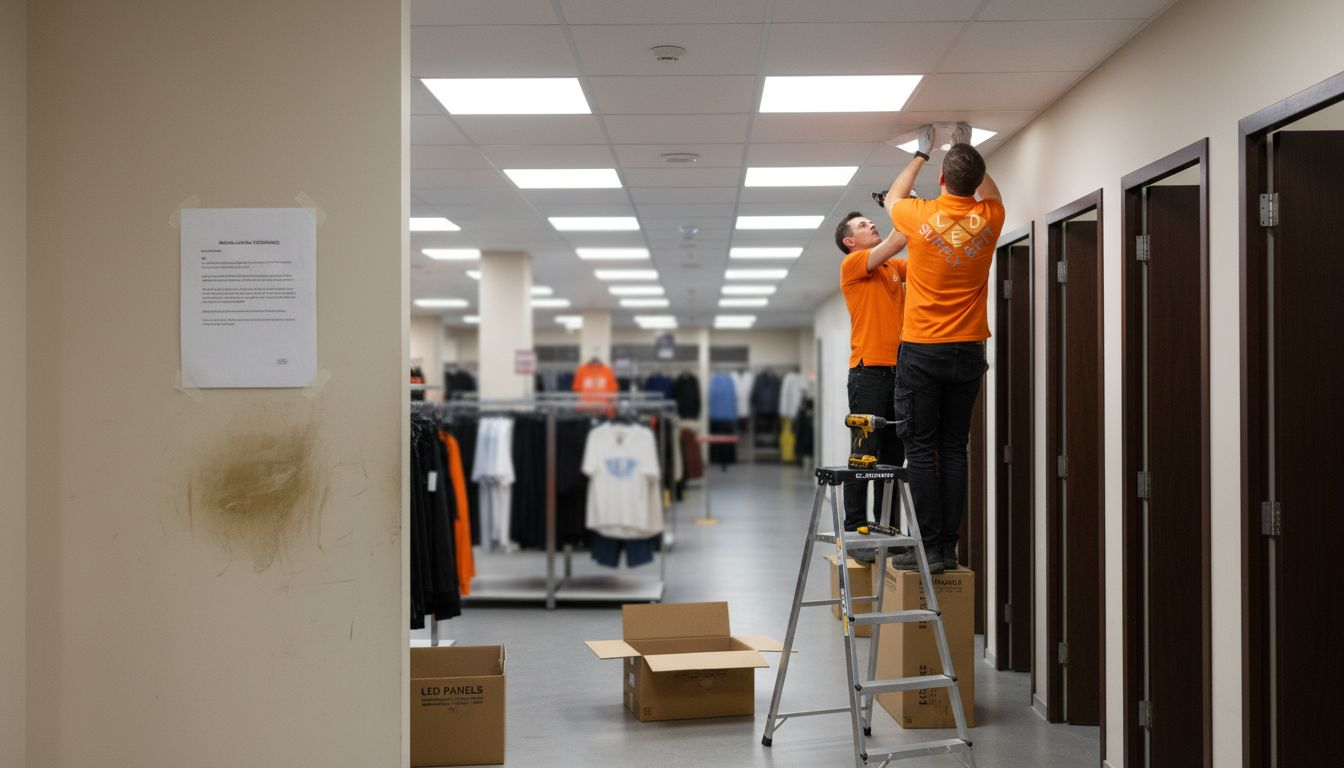
LED bulbs and tubes serve as straightforward retrofit solutions for businesses wanting to upgrade existing fixtures without complete system replacement. Screw-in LED bulbs directly replace incandescent and compact fluorescent lamps in standard sockets, whilst LED tubes fit into fluorescent fittings after simple ballast modifications. This approach minimises installation costs and allows phased upgrades as existing lamps fail, spreading capital expenditure over time.
Smart lighting controls amplify the inherent efficiency of LED technology through intelligent automation. Occupancy sensors detect movement in rooms and corridors, switching lights off automatically when spaces remain unoccupied for preset periods. Daylight harvesting systems use photocells to dim artificial lighting when sufficient natural light enters through windows, maintaining consistent illumination levels whilst reducing energy consumption. Time scheduling allows you to programme different lighting scenes for various operational periods, ensuring lights never run unnecessarily during closed hours.
The following table compares key performance metrics across common LED options:
| Lighting type | Typical wattage | Lifespan (hours) | Energy saving vs fluorescent | Best applications |
|---|---|---|---|---|
| LED panels | 40-50W | 50,000+ | 50-60% | Offices, retail, healthcare |
| LED tubes | 18-24W | 50,000+ | 50% | Warehouses, workshops, car parks |
| LED bulbs | 8-15W | 25,000-50,000 | 75-80% | Hospitality, corridors, task lighting |
| Smart LED systems | 30-45W | 50,000+ | 60-75% | Mixed-use spaces, conference rooms |
LED lighting can significantly reduce energy consumption compared to traditional lighting types, offering up to 75% savings versus incandescent and 50% versus fluorescent. These reductions compound over time, particularly in properties operating extended hours or maintaining 24/7 lighting in security areas, stairwells, and emergency exits.
Pro Tip: Combine LED panels with smart controls in spaces with variable occupancy patterns. Conference rooms, meeting areas, and staff rooms benefit enormously from automated switching, often achieving total energy reductions exceeding 80% compared to continuously lit fluorescent systems.
Comparing the financial and environmental benefits of LED upgrades
Real-world case studies demonstrate the transformative impact of comprehensive LED programmes on operational costs and environmental performance. Mole Valley Farmers achieved over £1,118,694 in net savings and 3,420 tonnes CO₂e reduction over six years with LED upgrades across their retail and warehouse facilities. This agricultural retailer replaced outdated metal halide and fluorescent lighting with high-efficiency LEDs, cutting energy consumption by 68% whilst improving light quality for customers and staff.
Healthcare facilities have realised similarly impressive returns. Addenbrooke’s Hospital saved £15,000 annually with LED and saw a 53% carbon footprint reduction, achieving ROI in 4.32 years. The hospital’s upgrade encompassed corridors, wards, and clinical areas, demonstrating that even complex environments with stringent lighting requirements can benefit substantially from modern LED technology.
The following comparison illustrates typical metrics across different commercial sectors:
| Sector | Annual cost saving | CO₂e reduction | Payback period | Maintenance saving |
|---|---|---|---|---|
| Retail (medium) | £8,000-£15,000 | 35-45 tonnes | 2.5-3.5 years | 60% reduction |
| Office (large) | £20,000-£35,000 | 80-120 tonnes | 3-4 years | 70% reduction |
| Warehouse | £12,000-£25,000 | 50-90 tonnes | 2-3 years | 65% reduction |
| Hospitality | £10,000-£18,000 | 40-60 tonnes | 3-4.5 years | 55% reduction |
These financial returns stem from multiple sources beyond simple energy savings. Reduced maintenance costs contribute significantly, as LED longevity eliminates the labour expenses and business disruption associated with frequent lamp changes in high-ceiling warehouses or customer-facing retail spaces. Improved lighting quality often correlates with increased productivity and sales, though these benefits prove harder to quantify precisely.
Environmental benefits extend beyond carbon reduction. LEDs contain no mercury, unlike fluorescent tubes that require specialised disposal procedures and pose contamination risks if broken. The extended lifespan reduces waste volumes substantially, with a single LED potentially replacing 50 incandescent bulbs or 10 fluorescent tubes over its operational life.
“The combination of immediate energy savings, reduced maintenance burden, and environmental benefits makes LED upgrades one of the most compelling investments available to commercial property managers. Projects consistently deliver returns exceeding those of many traditional capital improvements whilst supporting corporate sustainability commitments.”
You can explore detailed LED energy savings projections specific to your property type and usage patterns to build a robust business case for upgrading your lighting infrastructure.
Implementing smart lighting controls for enhanced savings
Smart lighting controls represent the next evolution beyond basic LED installation, enabling dynamic adjustment of illumination based on actual occupancy and ambient conditions. These systems integrate sensors, timers, and networked controls that communicate with LED fixtures to optimise energy consumption automatically. The technology has matured significantly, with wireless solutions now offering straightforward installation without extensive rewiring.
Occupancy sensors detect movement within defined zones, switching lights on when people enter and off after a preset vacancy period. Passive infrared (PIR) sensors work well in smaller spaces like offices and meeting rooms, whilst ultrasonic sensors better suit larger areas where line-of-sight obstructions might block PIR detection. Dual-technology sensors combine both approaches for maximum reliability, preventing false triggering whilst ensuring lights activate reliably when needed.
Daylight harvesting uses photocells to measure natural light levels, automatically dimming artificial lighting when sufficient daylight enters through windows or skylights. This technology proves particularly effective in perimeter offices, retail spaces with large glazed facades, and warehouses with roof lights. The system maintains consistent illumination at task level whilst reducing energy consumption during daylight hours, when lighting costs traditionally peak alongside other electrical loads.
Smart lighting controls can reduce energy consumption by 10-30% beyond the savings achieved through LED conversion alone. This additional reduction compounds over time, particularly in properties with irregular occupancy patterns or significant natural light availability. The controls also extend LED lifespan by reducing total operating hours, further improving return on investment.
Practical implementation requires careful planning. Zone your property based on usage patterns, installing separate controls for areas with distinct occupancy schedules. Corridors and toilets benefit from short vacancy delays (2-5 minutes), whilst private offices might use longer periods (15-20 minutes) to prevent annoying switching during brief absences. Adjust sensitivity settings during commissioning to match actual movement patterns in each space.
Compatibility between controls and LED drivers matters enormously. Ensure your chosen LEDs support dimming protocols used by the control system, whether 0-10V analogue, DALI digital, or wireless protocols like Zigbee. Incompatible combinations result in flickering, limited dimming range, or complete system failure. Request demonstration installations before committing to large-scale deployments.
Pro Tip: Select scalable control platforms that support future expansion and integration with building management systems. Starting with standalone sensors in high-traffic areas allows you to prove the concept and refine settings before rolling out comprehensive networked controls across your entire property. This phased approach reduces risk whilst building internal expertise and stakeholder confidence in the technology.
You can find detailed guidance on upgrading commercial lighting systems that incorporates both LED fixtures and intelligent controls for maximum operational efficiency.
Discover tailored LED lighting solutions with LED Supply & Fit
Transforming your commercial property’s lighting infrastructure requires specialist expertise to navigate product selection, compliance requirements, and installation logistics. LED Supply & Fit brings extensive experience delivering cost-effective upgrades across diverse UK commercial environments, from compact retail units to expansive warehouse facilities.
Our team provides comprehensive support throughout your project, beginning with detailed lighting audits that identify optimisation opportunities specific to your operations. We’ll calculate projected savings, recommend appropriate fixtures and controls, and manage installation to minimise disruption to your business. Explore our commercial lighting upgrade guide for detailed planning frameworks, or review our best commercial LED lighting options to understand product capabilities. Case studies like the Wilson Veterinary Group LED project demonstrate our practical approach to delivering measurable results for UK businesses.
Frequently asked questions
Which LED lighting upgrades offer the best return on investment?
Upgrades targeting high-usage areas deliver the fastest payback, particularly spaces operating extended hours like warehouses, retail floors, and 24/7 facilities. Replacing high-wattage metal halide or fluorescent fixtures with LED alternatives in these environments typically achieves ROI within 2-3 years through combined energy and maintenance savings. Adding smart controls to variable-occupancy spaces like meeting rooms and corridors further accelerates returns by reducing unnecessary runtime. Focus initial investments on the highest-consumption areas identified through energy audits, then expand systematically to lower-priority zones as budgets allow. You’ll find comprehensive strategies in our LED lighting cost saving tips resource.
How do smart lighting controls contribute to energy savings?
Smart controls reduce consumption by ensuring lights operate only when and where needed, rather than running continuously throughout business hours. Motion sensors switch off lighting in temporarily vacant spaces, eliminating the waste from lights left on in empty rooms, corridors, and toilets. Daylight harvesting dims artificial lighting when natural light provides adequate illumination, reducing midday consumption without compromising visibility. Time scheduling prevents lights operating during closed periods, catching instances where manual switching fails. These technologies typically reduce lighting energy use by 10-30% beyond LED conversion savings alone, whilst extending lamp life by reducing total operating hours. The controls also provide usage data that helps optimise scheduling and identify further efficiency opportunities.
What standards ensure compliance and quality in commercial lighting?
EN 12464-1 establishes minimum requirements for indoor workplace lighting across the UK and Europe, specifying illumination levels, uniformity, and glare limits for different tasks and environments. Compliance protects employee wellbeing whilst reducing liability for accidents caused by inadequate lighting. Colour rendering index (CRI) measures how accurately colours appear under artificial light, with values above 80 considered acceptable for most commercial applications and 90+ preferred for retail and hospitality. Conducting professional lighting audits before upgrades ensures your new installation meets these standards whilst optimising energy efficiency. Audits identify current deficiencies, calculate required improvements, and verify post-installation performance. Learn more about EN 12464-1 lighting standards and their practical application in commercial settings.
Can LED upgrades improve employee productivity and customer experience?
Quality lighting significantly influences workplace performance and customer perception. LEDs with high CRI values render colours accurately, reducing eye strain during detailed tasks and making products appear more appealing in retail environments. Flicker-free operation eliminates the subtle visual disturbance associated with fluorescent lighting, which can cause headaches and fatigue during extended exposure. Improved light distribution creates more comfortable spaces with fewer shadows and glare issues. Research consistently links better lighting with increased productivity, reduced errors, and improved employee satisfaction. In customer-facing environments, enhanced illumination quality influences purchasing decisions and overall experience perception, potentially increasing sales alongside the direct energy savings.
How should businesses finance LED lighting upgrades?
Multiple financing approaches suit different business circumstances and cash flow priorities. Direct purchase offers the fastest ROI and lowest total cost but requires upfront capital investment. Many suppliers provide lease or hire purchase arrangements that spread costs over 3-5 years, aligning payments with energy savings to maintain positive cash flow from day one. Energy performance contracts transfer project risk to specialist providers who guarantee savings levels and fund installations through a share of achieved reductions. Government schemes and grants periodically support commercial energy efficiency improvements, though availability varies by region and sector. Evaluate total cost of ownership across the full LED lifespan rather than focusing solely on initial outlay, as maintenance savings and extended replacement cycles substantially improve long-term economics.
What maintenance do LED systems require after installation?
LEDs demand minimal ongoing maintenance compared to traditional lighting technologies. Regular cleaning of fixtures maintains light output, as dust accumulation on lenses and reflectors gradually reduces illumination levels. Schedule cleaning annually for most environments, or quarterly in dusty industrial settings. Inspect control sensors periodically to ensure proper operation and adjust sensitivity settings if occupancy patterns change. Keep spare drivers and power supplies for critical areas to enable rapid replacement if failures occur, though quality LED systems rarely experience component failures during their rated lifespan. Document installation details including fixture locations, model numbers, and control zone configurations to simplify future troubleshooting and expansion projects. Most commercial LED installations operate maintenance-free for years, with the primary intervention being eventual fixture replacement after 50,000+ operating hours.