
Essential lighting upgrades for UK facilities in 2026
TL;DR:
- Managing a commercial property in 2026 requires compliance with escalating regulations and high energy costs. Upgrading to LED lighting with controls can reduce consumption by up to 83% and ensure legal standards are met effectively. Proper planning, system-level design, and ongoing management are essential for maximizing savings and maintaining compliance.
Managing a commercial property in 2026 means navigating a tightening regulatory landscape at the same time as energy bills remain stubbornly high. The essential lighting upgrades 2026 agenda is no longer optional: ESOS Phase 4 audits are approaching, Approved Document L energy performance requirements are in force, and EPC ratings increasingly affect your ability to let premises. Done properly, a transition to LED lighting with integrated controls can cut energy consumption by up to 83%, while simultaneously building the audit trail your compliance team will need. This article gives you the criteria, technology options, and practical steps to get it right.
Key Takeaways
| Point | Details |
|---|---|
| Compliance is foundational | Meeting ESOS, HSE, and Part L standards ensures legal and financial success for your lighting upgrades. |
| Choose system-level solutions | Modular and controllable LED systems maximise savings and extend asset lifecycles. |
| Smart controls multiply savings | Integrating occupancy and daylight sensors can boost energy reductions up to 83%. |
| Commissioning and monitoring matter | Regular tuning and documentation are essential to maintain performance and audit readiness. |
| Plan phased, professional upgrades | Structured assessments and phased installations reduce disruption and deliver reliable ROI. |
Essential lighting upgrades 2026: understanding key criteria
Before you specify a single luminaire, you need to know what the upgrade must actually achieve. The answer sits across three legal pillars.
ESOS Phase 4 requires organisations to cover at least 90% of energy use in their audits, with a compliance deadline of 5 December 2027. Lighting typically represents 20 to 40% of a commercial building’s electricity demand, so it is almost always within scope. Gathering accurate 2026 baseline data now positions you well ahead of the deadline.
The second pillar is workplace safety and task quality, governed by HSE HSG38. This sets minimum lux levels, colour rendering index (CRI) values, and glare limits by task type. The third is energy performance, covered by Approved Document L and minimum EPC ratings under MEES. The compliance and efficiency checklist for 2026 outlines exactly how these pillars interact for commercial lighting decisions.
Key criteria to document before and after any upgrade:
- Lux levels per zone (task area, circulation, reception, warehouse aisles)
- Colour temperature in Kelvin, matched to activity (4000K for offices, 5000K for warehouses)
- Energy consumption in kWh per square metre annually
- Control system settings including occupancy time-outs and daylight thresholds
- Installed watts per square metre for Part L compliance calculations
You can find a fuller breakdown of what UK law requires in the UK lighting compliance guide. Documenting everything now means your ESOS auditor has a clean, defensible evidence trail rather than a guessing exercise.
Choose the right LED lighting technology and controls
With compliance criteria established, the next decision is which products actually deliver. Not all LEDs are equal, and the gap matters significantly over a 50,000 hour lifespan.
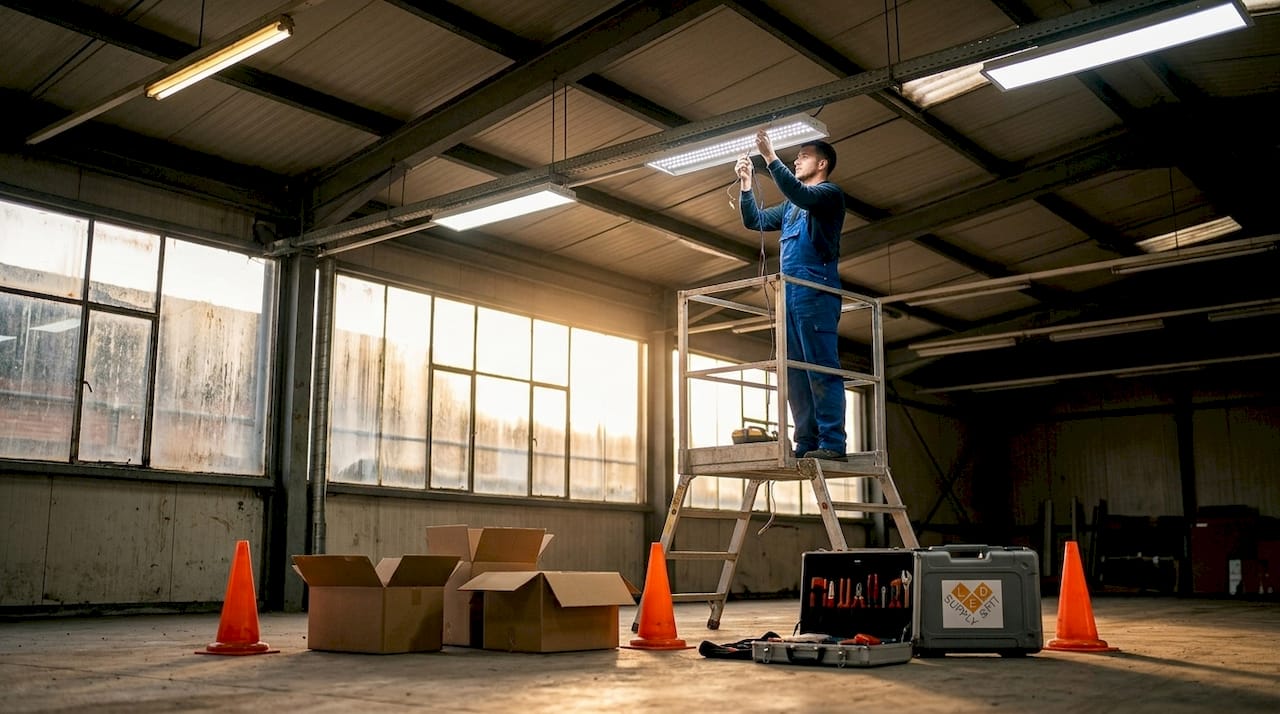
High-efficacy LEDs exceeding 95 lumens per watt are the current standard for offices, retail, and warehouses. Cheaper fittings often fall below 80 lm/W, eroding your projected savings before the first bill arrives. Colour rendering index should be Ra80 or above for most workplaces, Ra90 or above for retail display or precision manufacturing, as poor CRI causes visual fatigue and increases error rates.
The IEA’s assessment of LED system design is unambiguous: the biggest gains now come from system-level design combining modularity, smart controls, and circularity rather than lamp efficacy alone. A high-efficacy LED in a dumb fitting with no controls still underperforms a slightly lower-efficacy unit that dims to 20% in an empty room.
Smart controls to specify:
- Occupancy sensors with time-out settings calibrated to room use patterns
- Daylight harvesting using photocells to reduce output when natural light is sufficient
- Zoned dimming for open-plan offices where different areas have different occupancy cycles
- Scheduling for car parks, corridors, and external areas with predictable off-peak periods
Circular design is the third consideration and the one most often overlooked. Modular LED systems allow drivers, optics, and control nodes to be replaced independently, avoiding the full luminaire replacement that vendor-locked systems force on you every eight to ten years. Modular also means you can upgrade controls without replacing housings as sensor technology improves.
Pro Tip: Commission a photometric survey before installation. Software modelling ensures luminaire spacing achieves the required lux distribution rather than relying on rule-of-thumb averages. It prevents both under-lit zones that fail HSG38 and over-lit zones that waste energy. The benefits of LED upgrades for commercial properties extend well beyond the energy bill when specification is done correctly.
Compare popular upgrade options and their trade-offs
The table below summarises the three main upgrade routes available to UK facility managers in 2026.
| Upgrade type | Typical upfront cost | Energy savings potential | Lifecycle flexibility | Compliance ease | Best suited to |
|---|---|---|---|---|---|
| Standalone LED replacement | Low | 50 to 60% | Limited (fixed units) | Moderate | Low-budget retrofit, storage areas |
| Integrated modular system | Medium to high | 60 to 75% | High (component swap) | High | Offices, warehouses, schools |
| Smart control-enhanced LED | High | Up to 83% | High (upgradable nodes) | Very high | High-occupancy offices, retail, hospitality |
Standalone LED replacements suit tight budgets or spaces where occupancy is consistent and controls would add little value, such as a 24-hour warehouse. The trade-off is that you leave significant savings on the table and face a full replacement cycle sooner.
Integrated modular systems cost more upfront but allow you to swap drivers and controls independently as technology evolves. This approach aligns with the LED lighting cost strategies that reduce total cost of ownership over ten to fifteen years.
Smart control-enhanced systems are the highest-performing option for variable-occupancy spaces. They require commissioning time and ongoing management but deliver the best savings, the strongest ESOS evidence trail, and the highest EPC improvement.
Quick decision guide:
- Low traffic, consistent hours → standalone LED
- Mixed-use premises with sustainability targets → modular system
- High-occupancy offices or retail with ESOS obligations → smart control-enhanced LED
Best practices for successful lighting upgrades and ongoing management
Installing the right product is half the job. The other half is ensuring it actually performs as designed month after month.
- Baseline audit: Record existing lux levels, energy consumption, and fitting inventory across every zone.
- Photometric modelling: Model luminaire placement before ordering to confirm compliance with HSG38 lux requirements.
- Phased installation: Prioritise highest-energy zones first to accelerate payback and demonstrate ROI to budget holders.
- Post-install commissioning: Verify lux levels against the photometric model, calibrate sensors, and set initial control schedules. Commissioning is where lighting quality and savings are actually realised in practice, not just on paper.
- Staff feedback loop: Gather occupant feedback within four weeks to identify zones where controls are too aggressive or lux levels feel inadequate.
- Controls tuning: Adjust occupancy time-outs and daylight thresholds based on real usage data from the first month.
- Sub-metering: Isolate lighting circuits to monitor savings independently and identify any fittings that are underperforming.
An energy-efficient lighting guide for UK businesses confirms that maintaining a detailed documentation trail covering baseline energy use, post-install verification, and commissioning reports is essential for both audit defensibility and sustained savings claims. Do not treat commissioning as a one-time event.
Pro Tip: Schedule quarterly checks of occupancy sensor coverage (positions shift when furniture moves) and biannual control recalibrations. Sensor drift and seasonal daylight changes erode savings quietly over time, and a half-day site visit twice a year protects the full ROI of your original investment.
Review your LED safety documentation and records against your ESOS evidence requirements at least six months before the audit deadline.
Why system-level thinking is the future of UK commercial lighting upgrades
Most facility managers still evaluate lighting upgrades primarily on lamp efficacy and payback period. It is an understandable shortcut, but it misses the majority of the opportunity.
The IEA’s analysis of modern LED design frames the shift clearly: the biggest gains in the next decade will come not from squeezing more lumens per watt from the lamp, but from designing systems where controls, modularity, and circularity compound savings over the entire lifecycle. A 95 lm/W luminaire dimming to 30% output for six hours a day in a sensored open-plan office saves far more energy than a 120 lm/W unit running at full output because the controls were never properly commissioned.
Vendor lock-in is the risk that rarely appears in procurement discussions. Many integrated LED products use proprietary driver or control interfaces that prevent third-party component upgrades. When the driver fails at year eight, you are forced into a full fitting replacement rather than a £15 driver swap. That is not a sustainability outcome; it is a manufacturer revenue model. Insisting on DALI-2 or other open control protocols and modular construction at the specification stage protects your future maintenance budget.
The latest LED trends and innovations are moving firmly in this direction. Think of your commercial lighting infrastructure as a platform, not a fixed asset. The luminaire housing stays. The driver, the control node, and eventually the optic get upgraded as technology and occupancy patterns evolve. That framing changes the procurement conversation entirely and produces far better long-term outcomes.
How LED Supply & Fit supports your 2026 lighting upgrade journey
Translating compliance requirements and technology options into a delivered, commissioned, and documented lighting upgrade takes specialist support. LED Supply & Fit works with UK facility and maintenance managers to handle every stage, from initial audit and photometric design through to installation, commissioning, and post-install documentation suited to ESOS and Approved Document L requirements.

Whether you are specifying top commercial LED fittings for a warehouse retrofit or need professional installation and commissioning for a multi-site office programme, the team brings hands-on expertise in modular systems, smart controls, and compliance documentation. For projects where design detail matters, the lighting design and compliance service provides photometric modelling and specification support. Engage early, and your 2026 upgrade becomes an ESOS asset rather than a last-minute cost.
Frequently asked questions
What is the deadline for ESOS Phase 4 compliance and how does it affect lighting upgrades?
ESOS Phase 4 audits must be completed by 5 December 2027, covering at least 90% of energy use. Collecting accurate 2026 lighting consumption data now gives you a robust evidence base and avoids a rushed audit process.
How much energy can UK commercial properties save by upgrading to LED lighting with controls?
LED retrofits typically deliver 50 to 75% energy savings, and adding smart controls can push total savings to 83% depending on occupancy patterns and how well the system is managed.
What are some key compliance standards UK businesses must meet in 2026 for lighting upgrades?
Businesses must satisfy HSE HSG38 for task-appropriate lux levels, Approved Document L 2026 for energy performance, and minimum EPC rating requirements under MEES to legally let commercial premises.
Why is commissioning and ongoing management important after installing LED lighting with controls?
Proper commissioning ensures controls perform as designed from day one, while regular monitoring catches sensor drift and usage changes that silently erode savings over time.