
Cost-saving lighting workflow: cut energy costs by 83%
TL;DR:
- Upgrading to LED lighting with smart controls can save up to 83% on energy costs.
- Proper data collection, auditing, and ongoing management are essential for sustained savings.
- Continuous verification and adjustment of controls ensure long-term efficiency and compliance.
Inefficient lighting silently drains thousands of pounds from commercial properties every year. Ageing fluorescent and halogen fittings consume far more electricity than they should, and most property managers don’t realise how quickly those costs accumulate. A structured approach to upgrading your lighting can deliver 50 to 83% energy savings, combining LED retrofits with smart controls. This guide walks you through each step of that workflow, from initial preparation through to verification, so you can act with confidence and start seeing results on your energy bills.
Key Takeaways
| Point | Details |
|---|---|
| Follow a structured workflow | A step-by-step process ensures consistent, maximised savings and compliance with UK standards. |
| Target highest-consuming areas first | Start with zones that drain the most energy for the quickest financial impact. |
| Combine LEDs and smart controls | Upgrading LEDs and adding controls achieve up to 83% energy savings together. |
| Ongoing management is key | Regular checks and calibration secure long-term savings and audit readiness. |
What you need before starting a cost-saving lighting workflow
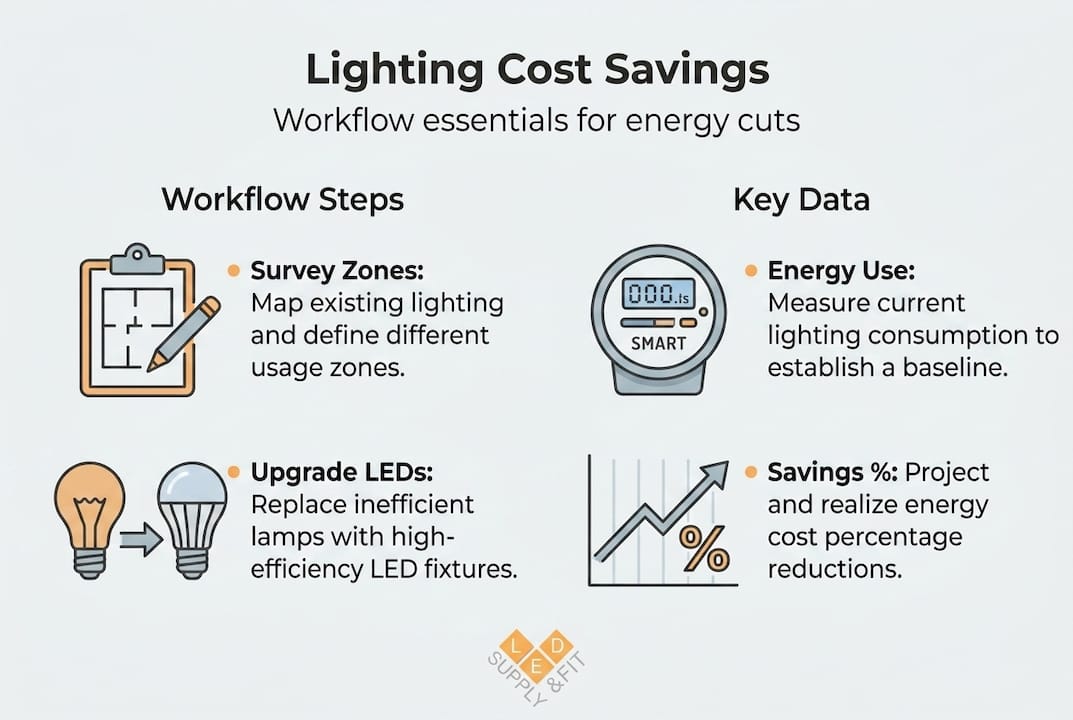
Before you touch a single fitting, you need the right data and tools in place. Skipping this stage is one of the most common reasons upgrades underdeliver. A structured 5-step process requires proper groundwork, and that starts with gathering the basics.
Here is what to collect before you begin:
- Meter readings: At least 12 months of electricity consumption data, broken down by area if possible.
- Lux meter: To measure current light levels against required standards.
- Circuit diagrams: Your current wiring layout, updated and accurate.
- Zone mapping: A plan of which areas are high-consumption and which are intermittently used.
Two standards you must understand are BS EN 12464-1, which sets minimum lux levels for different work environments, and BS 7671, the wiring regulations that govern electrical compliance. Staying within these isn’t optional. Your sustainable lighting compliance obligations also extend to ESOS compliance if your organisation meets the qualifying criteria.
Use this table to structure your baseline data collection:
| Data point | Why it matters |
|---|---|
| Monthly kWh per zone | Identifies biggest savings opportunities |
| Current lux readings | Confirms compliance gaps or over-lighting |
| Lamp type and wattage | Calculates replacement potential |
| Circuit load data | Prevents overloading during upgrade |
Review your office LED lighting checklist to make sure nothing is missed before you move forward.
Pro Tip: Map your highest-consumption spaces first. Tackling those areas delivers the fastest return on investment and builds a strong business case for rolling out the rest of the site.
Step-by-step cost-saving lighting workflow for commercial buildings
With your prerequisites in place, you’re ready to follow a proven workflow for maximum impact. Each step builds on the last, and skipping any one of them weakens the overall result.
- Audit current lighting: Walk every zone with your lux meter. Record actual light levels against BS EN 12464-1 requirements. Note where you’re over-lit as much as where you’re under-lit. Over-lighting wastes energy just as much as the wrong lamp type.
- Specify efficient LEDs: Look for fittings with an efficacy above 95 lumens per watt, a CRI of 80 or higher, and a colour temperature of around 4000K for workspaces. These specifications ensure good visibility and long lamp life.
- Integrate smart controls: Occupancy sensors, daylight harvesting, and DALI-2 dimming protocols all contribute to additional savings. The right top LED solutions will be designed to work with these systems from the outset.
- Plan phased installation: Don’t try to upgrade the entire site at once. Phasing reduces disruption and allows you to verify savings zone by zone before committing to the full rollout.
- Meter and verify: Track post-installation consumption against your baseline. Align your reporting with ESOS or internal KPIs.
LED retrofits alone save 50 to 75% on lighting energy, and controls can add a further 10 to 40% on top of that. These LED lighting cost tips can help you get closer to the upper end of those figures.
Pro Tip: Start with zones that run lights for the longest hours each day, such as corridors, reception areas, or 24-hour operations. The cumulative savings from those spaces accelerate your overall payback period.
Maximising savings with advanced controls and correct commissioning
Once LEDs are installed and phased in, additional savings come from smart controls, but only if they are set up and managed correctly. This is where many projects stall. The hardware is in place, but nobody has properly calibrated the system.
Key benefits of correctly commissioned controls:
- Daylight harvesting reduces output when natural light is sufficient, adding 15 to 30% further savings and pushing total reductions to between 40% and 80%.
- Occupancy sensors prevent lights running in empty rooms, a surprisingly large source of waste in offices and meeting rooms.
- Zoning allows different areas to be managed independently, matching light levels to actual activity.
- DALI-2 integration enables centralised monitoring, meaning facilities managers can identify faults or inefficiencies remotely.
The importance of correct setup cannot be overstated. Poorly calibrated sensors lead to occupant frustration and manual overrides, which effectively switch off all the savings you’ve worked to achieve.
“At 20 Fenchurch Street, lighting controls optimisation saved 3,780 kWh over 13 months, simply by recommissioning existing systems more carefully.”
That figure represents real money returned to the business without purchasing a single new fitting. Read more about sustainable lighting best practices to understand how commissioning fits into a wider strategy.

Pro Tip: Review your occupancy sensor settings at least quarterly. Usage patterns change across seasons and as teams reorganise, and your controls need to reflect that reality.
Verifying, reporting and sustaining your lighting savings
After implementation, continuous verification keeps savings on track and ensures compliance. Many businesses install new lighting, record an initial improvement, then never revisit the data. Within a year, drift creeps in and savings quietly erode.
Here is how to maintain verified performance:
- Sub-meters per zone: Where possible, install sub-meters rather than relying on whole-site readings. This lets you isolate exactly where savings are occurring and where they aren’t.
- Baseline comparison: Every quarterly review should compare current consumption against your pre-upgrade audit data. Numbers don’t lie.
- Controls recalibration: Sensors drift, daylight profiles shift with seasons, and new tenants bring new habits. Recalibrate at least twice a year.
- Audit-ready documentation: Maintain clear records of lamp specifications, installation dates, metered savings, and control settings.
ESOS Phase 4 requires large organisations to audit 95% of their energy use, with a compliance deadline in 2027. If your business qualifies, your lighting audit data feeds directly into that process. The energy-saving lighting benefits of proper documentation extend beyond compliance. They also support board-level sustainability reporting and can strengthen applications for green finance.
| Verification task | Frequency |
|---|---|
| Sub-meter data review | Monthly |
| Controls calibration check | Quarterly |
| Full savings audit vs baseline | Bi-annually |
| ESOS-aligned documentation update | Annually |
The real challenge: sustainable savings require ongoing adjustment
Looking back at projects that have delivered lasting results versus those that faded within 18 months, the pattern is consistent. Technology is not the differentiator. Process is.
Businesses that install LEDs and walk away typically recapture about half of what they could. Those that treat the upgrade as the beginning of a workflow, rather than the end of a project, consistently outperform. Controls add meaningful savings, but the ROI varies significantly by usage pattern, occupancy schedule, and how rigorously the system is managed.
Funding options like Salix Finance exist specifically to improve the economics for public sector and high-usage organisations. Exploring advanced LED solutions alongside available financing can shorten payback periods considerably. The uncomfortable truth is that a modest lighting budget spent well, and then actively managed, will always outperform a large spend that is left to run without oversight.
Start your cost-saving lighting upgrade today
If this guide has shown you anything, it’s that the savings are real, the steps are clear, and the tools exist to make it happen. The gap between where you are and where you could be is narrower than most people expect.

At LED Supply and Fit, we supply and install best commercial LEDs across the UK, with bulk pricing, next-day delivery, and full installation support. Whether you’re upgrading a single floor or an entire estate, our team can help you build a workflow that delivers measurable returns. Explore our LED lighting tips or browse the full range at LED Supply and Fit to take the next step.
Frequently asked questions
How much can I realistically save by upgrading to LED lighting and controls?
Most UK businesses achieve 50 to 75% savings on lighting energy with LEDs alone, and adding smart controls can push total savings to 83%.
What standards do I need to comply with when upgrading lighting?
You must meet BS EN 12464-1 for minimum lux levels and BS 7671 for electrical safety; larger businesses may also need to satisfy ESOS audit requirements.
How do I verify actual savings after my lighting project?
Install sub-meters per zone, compare monthly consumption against your pre-upgrade baseline, and maintain metering and reporting records aligned with ESOS or internal KPIs.
Who can benefit most from daylight harvesting and zoning?
Spaces with significant natural light variation and mixed usage patterns, such as open-plan offices and warehouses, see the greatest gains, as daylight harvesting adds 15 to 30% in additional savings when zones are correctly configured.