
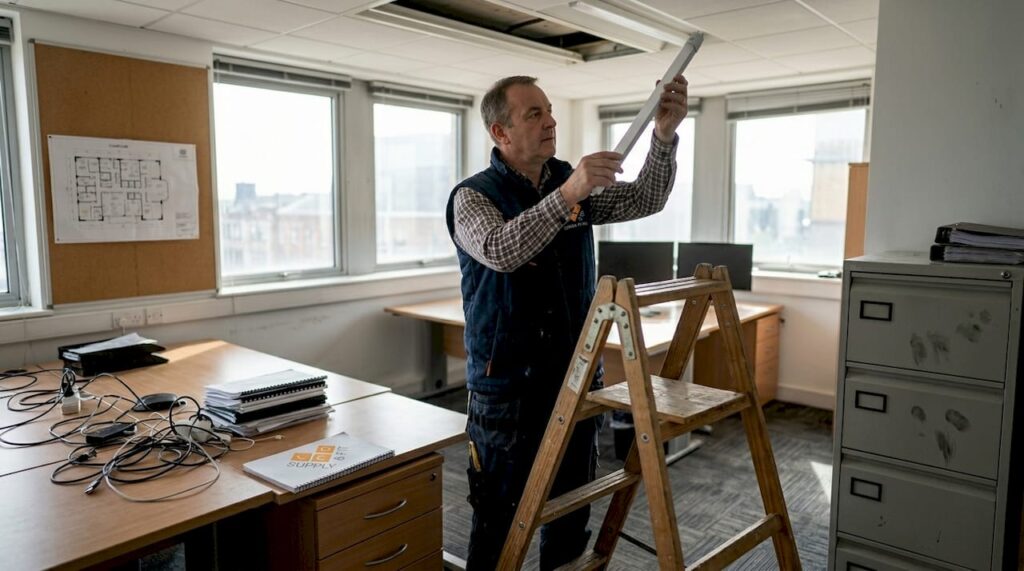
How to retrofit office lighting for maximum energy savings
TL;DR:
- Switching to LED lighting offers UK offices 40–75% energy savings with a 1–3 year payback.
- Proper assessment, expert installation, and ongoing monitoring are essential for maximum ROI.
- Funding options and compliance checks are critical to avoid costly mistakes in retrofit projects.
Switching your office lighting to LED is one of the fastest ways to cut operating costs and meet sustainability targets. Upgrading office lighting can reduce energy use by 40–75%, often repaying investment in just 1–3 years. With UK energy bills still elevated and pressure mounting from both regulators and stakeholders, retrofitting is no longer a nice-to-have. This guide walks you through every stage, from initial assessment to post-installation monitoring, so you can act with confidence and avoid the costly mistakes that trip up so many commercial projects.
Key Takeaways
| Point | Details |
|---|---|
| Major energy savings | LED retrofits typically cut UK office lighting bills by 40–75% and repay investment quickly. |
| Stepwise approach is crucial | A systematic plan and trusted expert input prevent compliance risks and maximise ROI. |
| Funding support is available | Many offices access grants or loans to further reduce the cost of energy-efficient upgrades. |
| Monitoring sustains gains | Track energy usage after installation to ensure savings continue over time. |
Why retrofit your office lighting?
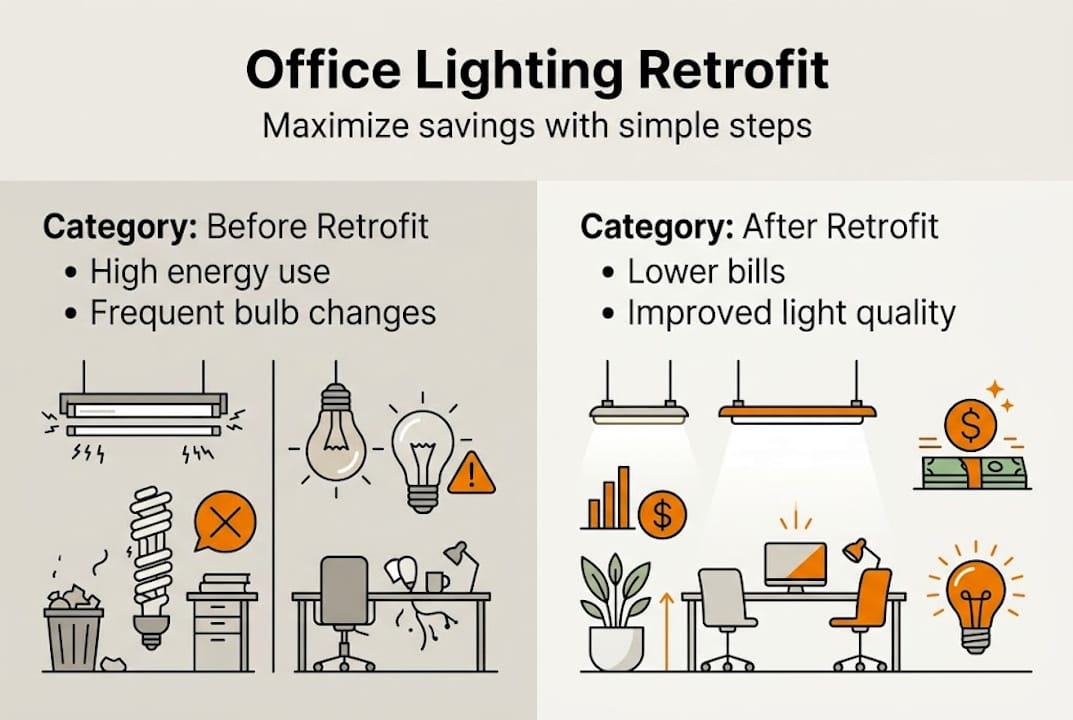
The business case for LED retrofits is straightforward, but the numbers still surprise most property managers when they see them in black and white. Energy savings of 40–75% with a payback period of just 1–3 years make this one of the strongest capital investments available to UK commercial operators right now.
Beyond the headline figures, there are several layers of value worth considering:
- Lower maintenance costs: LED fittings last up to 50,000 hours, drastically reducing lamp replacement frequency.
- Improved staff productivity: Better light quality reduces eye strain and supports concentration, particularly in open-plan offices.
- Carbon footprint reduction: Cutting electricity consumption directly lowers your Scope 2 emissions, supporting net-zero commitments.
- EPC improvements: A stronger Energy Performance Certificate can raise your property’s market value and rental appeal.
Here is a quick snapshot of what a typical mid-sized UK office might expect:
| Metric | Before retrofit | After retrofit |
|---|---|---|
| Annual lighting energy cost | £12,000 | £3,600–£7,200 |
| Carbon emissions (lighting) | High | Reduced by up to 75% |
| Average lamp lifespan | 1,000–2,000 hrs | Up to 50,000 hrs |
| Payback period | N/A | 1–3 years |
You can explore LED energy savings data in more detail to model figures specific to your premises. The lighting performance benefits extend well beyond the energy bill, making this a genuinely strategic upgrade rather than a simple swap.
Planning your lighting retrofit: Assessment and requirements
Before you order a single fitting, a thorough assessment is essential. Rushing this stage is where most retrofit projects go wrong. You need a clear picture of what you currently have, what you need, and what compliance obligations apply.
Start by auditing your existing setup. Walk each zone and record:
- Fixture types and wattage (fluorescent tubes, halogen downlights, metal halide bays)
- Current control systems (manual switches, timers, presence sensors)
- Lux levels in each work area, measured against the HSE workplace lighting standard of 500 lux for general office tasks
- Any areas with specialist requirements such as server rooms or reception zones
Here is a comparison of what is required versus what is optional but high-value:
| Assessment item | Required | Optional upgrade |
|---|---|---|
| Fixture inventory | Yes | Photometric survey |
| Wattage audit | Yes | Energy monitoring software |
| Compliance check | Yes | BREEAM lighting assessment |
| Control mapping | Yes | Smart dimming/sensor retrofit |
“A structured approach covering assessment, LED selection, installation, and monitoring delivers the most reliable outcomes.” Source
Pro Tip: Commission a photometric survey before purchasing any products. This maps actual light distribution across your floor plan, preventing over-ordering and ensuring compliance with workplace regulations from day one.

Also check whether lighting grants and funding are available for your property type before committing to a budget. Many commercial landlords and owner-occupiers leave significant subsidy money unclaimed simply by not looking.
Step-by-step process to retrofit office lighting
With your assessment complete, here is how to move from plan to finished installation without losing momentum or compliance standing.
-
Finalise your fixture selection. Match LED products to each zone’s lux requirements. Prioritise fittings with over 95 lm/W efficiency, as these deliver the deepest energy cuts. For offices, 4,000K colour temperature is the standard choice, supporting alertness without harshness.
-
Choose your controls. Dimming and occupancy sensors can add a further 20–40% in savings on top of the LED baseline. Factor these into your specification from the start, not as an afterthought.
-
Appoint an accredited installer. Electrical work in commercial premises must comply with BS 7671 wiring regulations. An accredited installer handles certification, reducing your liability and ensuring your insurance remains valid.
-
Sequence the installation. Work zone by zone to minimise disruption. Many offices complete retrofits over weekends or in phases aligned with floor occupancy.
-
Test and commission. Once installed, verify lux levels in every zone. Adjust sensor sensitivity and dimming profiles before handing back to staff.
“Selecting compatible LED products and following a structured retrofit methodology is the single biggest determinant of long-term ROI.”
Pro Tip: Ask your installer for an as-built record of all fittings, wattages, and control settings. This document is invaluable when benchmarking savings and planning future upgrades. You can also review LED lighting tips for businesses to identify quick wins that sit alongside the main retrofit.
Funding and compliance: How to avoid common retrofit mistakes
Once your plan is solid, the next hurdle is funding and making sure you stay on the right side of the regulations. Both areas catch out more commercial operators than you might expect.
Key UK funding routes in 2026:
- Salix Finance: Interest-free loans for public sector and eligible commercial organisations to fund energy efficiency upgrades.
- Green loans: Several high street and challenger banks now offer preferential rates for energy-efficiency capital projects.
- EPC-linked financing: Some lenders tie favourable terms to post-retrofit EPC improvements, rewarding measurable outcomes.
- UKSPF and local authority grants: Check your local enterprise partnership for region-specific incentives.
Visit the LED funding options page for a current summary of what is accessible to commercial properties.
On compliance, the risks of cutting corners are significant. DIY retrofits risk non-compliance and lost savings, while professionally installed systems consistently achieve the required standards and deliver projected ROI. Specific obligations to check include:
- BS 7671 18th Edition wiring regulations
- Workplace (Health, Safety and Welfare) Regulations 1992 on lighting adequacy
- Fire safety implications of altered emergency lighting circuits
- Building regulations Part L for energy efficiency in commercial buildings
Pro Tip: Always request a completion certificate from your installer. Without it, you may face complications during property sales, lease renewals, or insurance claims.
Measuring success and maintaining results
A retrofit that is not monitored is a retrofit that underperforms. Post-installation measurement closes the loop between projected and actual savings, and it protects your investment over the long term.
Monitoring savings post-installation ensures actual performance matches projections and flags any issues early. Controls that are correctly managed can deliver 20–40% additional savings beyond the LED baseline itself.
| Indicator | How to track | Target |
|---|---|---|
| Energy consumption | Smart meter or sub-metering | 40–75% reduction vs baseline |
| Lux levels | Periodic lux meter readings | Zone-specific (500 lux for offices) |
| Lamp failures | Maintenance log | Near zero in years 1–3 |
| Sensor performance | Manual spot checks | Consistent activation/deactivation |
For ongoing performance, review your cost-saving LED tips to identify any quick adjustments that can squeeze further value from your installed system. If lux levels drop or energy use creeps up unexpectedly, check sensor calibration and driver health before assuming a fitting has failed.
A fresh perspective on office lighting retrofits: What most guides miss
Most retrofit guides focus heavily on product selection and installation. What they rarely address is the post-installation gap, the period where savings quietly erode because no one is watching the numbers.
In our experience, the retrofits that fail to deliver their promised ROI almost always share one trait: the project was treated as finished the moment the last fitting went in. Sensors drift. Dimming profiles get overridden by staff. Controls are never optimised. The result is a system that looks modern but behaves like the old one.
DIY retrofits risk non-compliance and lost savings, but even professionally installed systems need active stewardship. Treat your retrofit as a programme, not a project, and you will see the measurable LED savings compound over time rather than plateau.
Ready to reduce costs? Discover top retrofit solutions
If you are ready to move from planning to action, we can help you every step of the way. From product selection to full installation and post-fit support, our team works with commercial property managers and business owners across the UK to deliver retrofits that hit their targets.

Explore our best LED commercial options to find fittings suited to your office layout and budget. Our cost-saving lighting tips guide offers practical quick wins, and our sustainable LED solutions range covers everything from energy-efficient panels to smart control systems.
Frequently asked questions
How much can I save by retrofitting office lighting to LED?
Most UK offices achieve 40–75% energy savings with payback typically occurring within 1–3 years, depending on existing fixtures and hours of use.
What is the most common mistake in office lighting retrofits?
Skipping a professional survey or overlooking compliance requirements often leads to wasted spend and missed savings, as DIY retrofits risk non-compliance and underperformance.
Do I need to replace every fitting or just the bulbs?
Bulb-only upgrades work if existing fixtures are compatible, but selecting compatible LED products through a full retrofit usually delivers better efficiency and a longer service life.
Are there grants to help cover retrofit costs?
Yes, several schemes including Salix and other funding options are available to UK commercial properties to help subsidise LED retrofit projects in 2026.