Maximise workplace safety: the crucial role of lighting
TL;DR:
- Proper lighting is essential for workplace safety, as glare, contrast, and uniformity impact vision and accident risk. Upgrading to LED solutions allows precise control over these factors, improving safety and reducing energy costs. Regular assessment and task-specific lighting benchmarks ensure environmental and legal compliance while safeguarding staff.
Bright lights and a safe workplace do not always go hand in hand. Many property managers assume that if a space is well lit, it is also safe, but glare, poor uniformity, and badly positioned fittings can create hazards just as serious as a dim corridor. Lighting directly affects how staff perceive their environment, how quickly they fatigue, and how likely they are to make a mistake near moving machinery or a steep staircase. This article walks you through the evidence, the HSE benchmarks, and the practical steps to build a lighting strategy that genuinely protects people while keeping energy costs firmly under control.
Key Takeaways
| Point | Details |
|---|---|
| Lighting is a safety control | Good lighting is essential for reducing risks, not just for appearance or comfort. |
| Task-specific design is crucial | Different tasks and spaces require tailored lighting levels for true safety. |
| Watch out for hidden hazards | Glare, poor uniformity and overlooked shadows can endanger workers even when spaces seem well-lit. |
| LEDs offer more than savings | LED solutions can both cut costs and deliver safer, compliant lighting. |
Why lighting matters for workplace safety
After the previewing of what you will learn, let us ground the conversation in why lighting is more than just an aesthetic decision. Many businesses treat lighting as a fixed asset, something installed once and left until a bulb fails. That mindset carries real risk.
HSG38 Lighting at work frames lighting as a health and safety risk and details the effects of poor lighting, including eyestrain, headaches, and poor concentration. These are not minor inconveniences. Persistent eyestrain leads to slower task performance, more errors, and increased sick days. In a warehouse or manufacturing facility, slower reactions and impaired focus can have serious consequences.
“Poor lighting at work is not merely uncomfortable. It is a controllable hazard that, left unmanaged, creates liability and reduces the capacity of your workforce to operate safely.”
Common health and productivity effects from inadequate or unsuitable lighting include:
- Eyestrain and visual fatigue after short periods of focused work
- Tension headaches caused by flickering or excessively bright sources
- Difficulty concentrating on fine or detailed tasks
- Increased error rates on repetitive or precision-based work
- Heightened accident risk near steps, edges, and machinery
You also have legal obligations. The Workplace (Health, Safety and Welfare) Regulations 1992 require employers to provide lighting suitable to the work being carried out. How lighting enhances safety in UK workspaces is a topic that sits squarely in both your duty of care and your operational performance strategy.
Core elements of safe lighting: beyond brightness

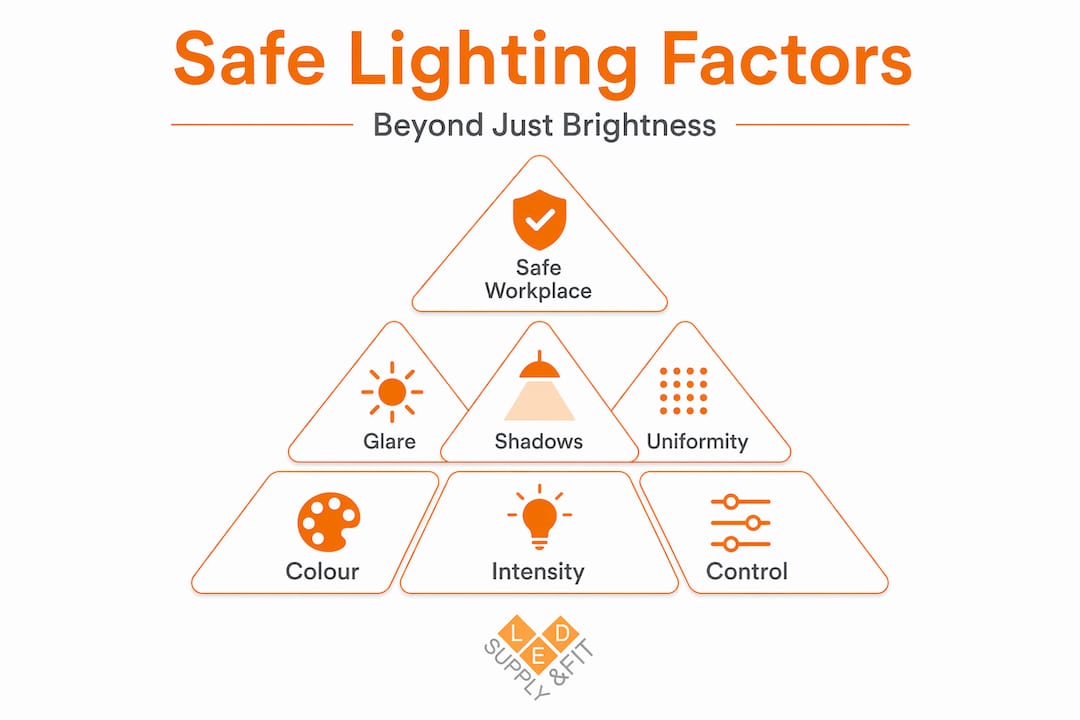
Having established the importance of workplace lighting, let us clarify exactly what “safe” lighting means in modern, energy-efficient environments. Brightness in lumens or lux is only one part of the picture. HSE highlights that lighting must consider task needs, glare, contrast, uniformity, and adaptation, and that sudden changes in lighting level directly affect safety.
Here are the four core elements every property manager should understand:
- Glare occurs when a light source is far brighter than the surrounding environment. It forces the eye to work harder and can temporarily impair vision, which is particularly dangerous near vehicles or moving parts.
- Contrast refers to the difference in brightness between a task surface and its background. Too little contrast makes it hard to distinguish objects; too much creates visual strain.
- Uniformity is the evenness of light distribution across a space. Patchwork lighting, bright patches surrounded by darker zones, causes the eye to constantly readjust, increasing fatigue.
- Adaptation is the eye’s ability to adjust when moving between differently lit spaces. Walking from a bright production floor into a dim corridor is a genuine accident risk if lighting transitions are not managed.
| Lighting factor | Risk if poorly managed | LED solution |
|---|---|---|
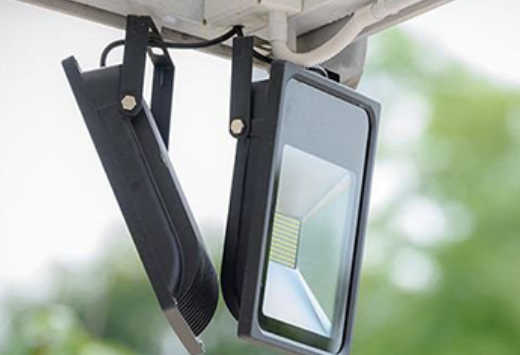
| Glare | Temporary vision loss, headaches | Diffused fittings, correct beam angles |
| Contrast | Object recognition errors | Balanced ambient and task lighting |
| Uniformity | Constant eye strain, fatigue | Evenly spaced, high-output LED panels |
| Adaptation | Trip and collision risk at transitions | Graduated lux levels between zones |
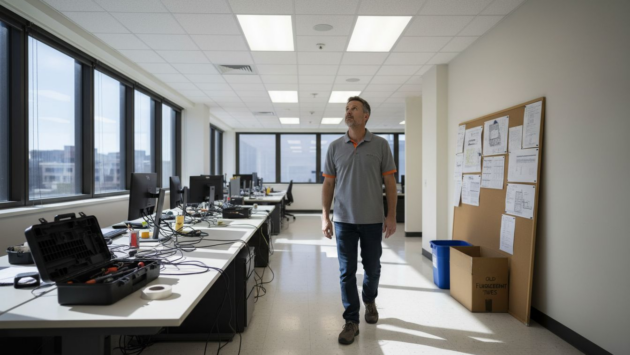
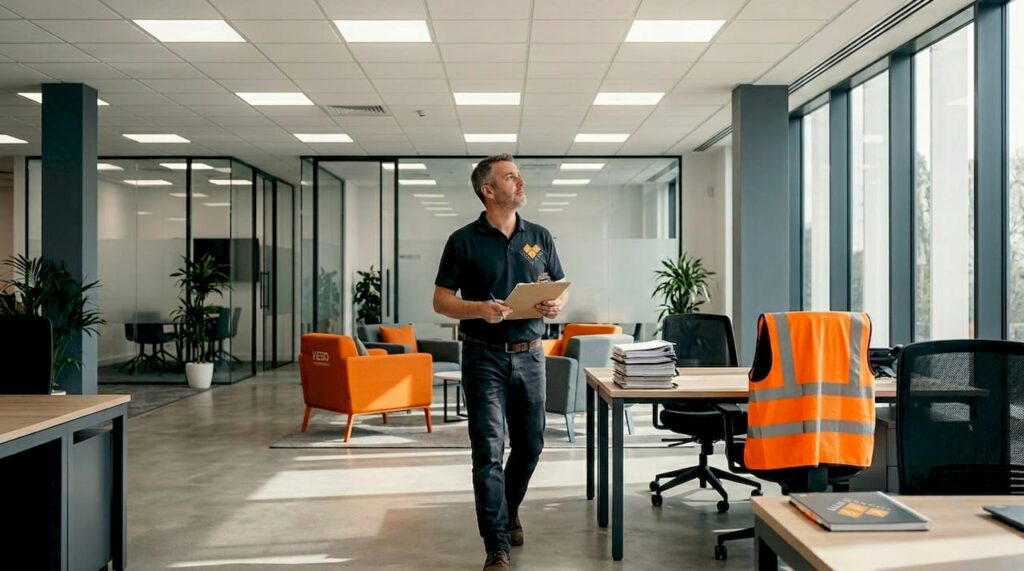
Pro Tip: When reviewing your site, walk the same routes your staff use at shift changeover. Note every transition from a brightly lit space to a dimmer one. Those transition points are where adaptation risks are highest and where small LED adjustments deliver the greatest safety gains.
Upgrading to LED does not automatically fix all of these issues, but LED technology gives you far greater control over beam angle, colour temperature, and dimming, which means you can address every one of these factors precisely. Understanding lighting compliance regulations in the UK will help you ensure your design meets both legal and practical standards, while lighting safety tips for UK businesses can guide your day-to-day management decisions.
Matching lighting to tasks and areas: HSE benchmarks in action
Now that you know which lighting qualities matter, here is how HSE guidelines turn into specific, actionable lighting plans tailored to your facility. One of the most common and costly mistakes in commercial lighting design is applying a single lux level across an entire site. It wastes energy in low-demand areas and under-serves high-risk zones.
HSE provides benchmark illuminance examples for specific tasks: approximately 300 lux for process control, as little as 50 lux for corridors and walkways, and as much as 750 lux for detailed engineering drawings.
| Work area or task | Recommended lux level |
|---|---|
| Corridors and walkways | 50 lux |
| Loading bays and storage | 100 to 150 lux |
| General office and process control | 300 lux |
| Fine assembly and inspection | 500 to 750 lux |
| Engineering drawings and detailed work | 750 lux |
These figures matter for several reasons:
- Over-lighting a low-use corridor wastes electricity without improving safety
- Under-lighting a picking aisle or inspection bench creates genuine injury risk
- Matching lux levels to actual tasks optimises your energy spend and your duty of care simultaneously
A practical example: a regional distribution centre might have a single lighting specification across its entire footprint. The result is often 300 lux in corridors where 50 would suffice and 150 lux at picking stations where 300 is the minimum. Correcting this through zone-specific LED planning typically cuts the energy bill by 25 to 40 percent while visibly improving worker confidence and speed.
For specialist environments, warehouse lighting best practices provide a detailed framework for matching fittings to racking height, aisle width, and task type. For office environments, office lighting guidance covers how colour temperature and flicker rates affect screen-based work.
Addressing overlooked lighting hazards: shadows, equipment and walkways
With benchmarks in mind, the next crucial step is preventing hidden dangers that arise from poor planning, especially in complex or changing workplaces. This is where even well-intentioned lighting schemes can fail.
HSE warns that lighting is often designed for empty environments and stresses the need for area-specific solutions, particularly for walkway lighting where equipment may remain in place. A new building or empty warehouse photographs beautifully with even light distribution. That same space with racking, machinery, and staff moving around it is a completely different lighting challenge.
Common oversights include:
- Designing ceiling layouts without accounting for tall shelving units that cast deep shadows at floor level
- Ignoring the effect of seasonal changes in natural light, which can dramatically shift glare and contrast in perimeter offices
- Failing to reassess lighting after a significant change in how a space is used, such as converting a storage area to an active workstation zone
- Overlooking walkways that run alongside machinery, where reflective surfaces can create unexpected glare
Pro Tip: Before signing off any lighting installation or upgrade, run a shadow audit during an active working period, not during setup. Walk every walkway with equipment in its normal operating position. Any shadow that obscures a floor hazard, a step edge, or a machinery control panel needs to be addressed before go-live.
“Structured risk assessment, as outlined in HSG38, should include evaluation of shadow effects and task presence. Treating lighting as a controllable risk is the foundation of effective workplace safety management.”
For environments where additional risks exist, such as flammable atmospheres or chemical exposure, ATEX-rated lighting for hazardous areas is a non-negotiable requirement rather than an optional upgrade.
Our take: what most lighting safety advice gets wrong
Most guidance on workplace lighting focuses on hitting a lux number and calling it done. That is the box-ticking approach, and it consistently misses the point. In our experience working across UK commercial sites, from food production facilities to multi-storey office blocks, the problems that lead to accidents and complaints are almost never about total brightness. They are about uniformity, adaptation, and shadows.
The sites that get it right are the ones where the lighting strategy is treated as a live, revisable document rather than a one-off specification. They review their lighting after every significant layout change. They train facilities staff to recognise glare complaints and shadow risks as legitimate safety signals, not aesthetic gripes.
LED upgrade planning done properly does not just replace old fittings with brighter ones. It starts with a site-specific audit, maps task requirements to lux levels and uniformity targets, and designs a scheme that transitions safely between zones. The energy savings are real and significant, but the safety improvement is what keeps liability low and staff confident.
The uncomfortable truth is that many UK businesses are spending more on energy than they need to while simultaneously operating spaces that do not meet HSE guidance. Fixing both problems at once is entirely achievable with the right LED design approach.
Upgrade your workplace lighting for safer, smarter operations
If this article has prompted you to look more critically at your current lighting, that is exactly the right response. The good news is that moving from a reactive approach to a proactive, safety-led lighting strategy does not require a complete overhaul overnight.
At LED Supply and Fit, we work with commercial property managers and business owners across the UK to audit existing installations, identify compliance gaps, and deliver LED solutions tailored to your site. Whether you manage a single office floor or a network of warehouses, our range of commercial LED lighting covers every task and environment. We also offer sustainable LED options for businesses with environmental reporting commitments. With next-day delivery, trade accounts, and installation support, we make it straightforward to act on what you have learned here.
Frequently asked questions
How does poor lighting affect employee wellbeing?
Poor lighting causes eyestrain, headaches and fatigue, reducing both productivity and concentration, and may increase absenteeism over time. Addressing these issues through proper lighting design is one of the most cost-effective wellbeing investments available to employers.
What is the recommended brightness for offices and walkways in the UK?
HSE recommends approximately 300 lux for process control and office environments and around 50 lux for corridors and walkways, though the right level depends on the specific task being performed. Always factor in glare and uniformity alongside the raw lux figure.
Do LED lights improve workplace safety?
Yes, properly specified LED lighting can be designed with accurate intensity, uniformity, and colour temperature to deliver better visual comfort and safer working conditions than ageing fluorescent or HID systems.
How can I assess if my workplace has sufficient lighting?
Follow a structured risk assessment using HSE’s HSG38 guide, accounting for shadow effects, glare, and the actual tasks being carried out in each area. Assess during active working conditions rather than in an empty space to get an accurate picture.