Types of LED fixtures: a 2026 commercial guide
TL;DR:
- LED fixtures include various forms tailored for specific spaces, from recessed downlights to high bays, each impacting energy use, light distribution, and aesthetic. Proper selection requires considering ceiling height, room function, and design goals, with quality certifications ensuring performance and longevity. Specifying fixtures based on design integrality and manufacturer consistency prevents costly mistakes and optimizes energy savings.
Types of LED fixtures refer to the distinct physical forms and mounting configurations of LED luminaires, each engineered for a specific application, ceiling height, or aesthetic purpose. The right fixture type determines not just energy consumption but light distribution, maintenance frequency, and occupant comfort. Standards from ENERGY STAR® and the DesignLights Consortium (DLC) now define minimum efficacy thresholds across most fixture categories, giving buyers a reliable benchmark when comparing products. This guide covers every major LED fixture type, from recessed downlights to high bay industrials, so you can match the correct fitting to your space from the outset.
1. Types of LED fixtures: recessed downlights explained
Recessed LED fixtures, commonly called can lights or downlights, are installed flush within the ceiling void and direct light downward. They suit retail floors, hotel corridors, office reception areas, and any space where a clean ceiling line matters. Recessed LED can lights come in three distinct forms: integrated LED (the driver and emitter are built into one unit), retrofit LED (a new LED trim and module fits inside an existing incandescent housing), and replaceable LED bulb (a standard GU10 or MR16 lamp in a conventional holder).
Integrated units offer the longest lifespan and best optical control, but replacing them means replacing the entire fitting. Retrofit options preserve the existing ceiling cutout and are the most popular upgrade route for commercial refurbishments. Retrofit dimensions must match the existing housing geometry precisely, otherwise the trim sits proud of the ceiling or the thermal path is compromised, both of which shorten product life.
Pro Tip: Before ordering retrofit downlights in bulk, measure the internal diameter of your existing housings and confirm the fire-rating requirement. A mismatch at scale means costly rework.
2. High bay LED fixtures for industrial and commercial spaces
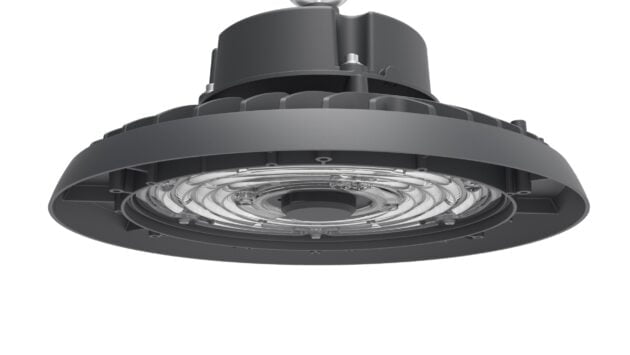
High bay LED fixtures are designed for ceilings between 6 and 14 metres and are the standard choice for warehouses, factories, sports halls, and distribution centres. They come in two principal styles: UFO (round, compact) and linear (rectangular, elongated). UFO high bays suit open floor plans where wide-angle distribution is needed, while linear models work better over racking aisles where a narrower beam concentrates light exactly where workers need it.
High bay LED lighting cuts energy costs by 30% compared with older metal halide systems, and rated lifespans of 50,000 hours or more reduce lamp replacement labour significantly. Many current models include 0-10V dimming and integrated motion sensors, which add further savings in spaces with variable occupancy such as loading bays.
| Feature | UFO high bay | Linear high bay |
|---|---|---|
| Beam shape | Wide, symmetrical | Narrow, elongated |
| Best application | Open floor, sports halls | Racking aisles, production lines |
| IP rating typical | IP65 | IP65 to IP66 |
| Dimming support | 0-10V standard | 0-10V standard |
| Mounting | Hook, chain, or surface | Chain or surface |
Pro Tip: Start fixture selection by confirming ceiling height and the desired light distribution shape. Choosing a UFO fitting for a narrow aisle wastes lumens on walls rather than work surfaces.
3. Flush mount and semi-flush LED ceiling lights
Flush mount and semi-flush LED fixtures attach directly to or just below the ceiling surface and are the most common types of LED ceiling lights in low-ceiling commercial spaces such as small retail units, staff rooms, and hotel bedrooms. Flush mounts sit completely against the ceiling and suit rooms with less than 2.4 metres of headroom. Semi-flush versions drop 15 to 30 centimetres, allowing a decorative element without the visual weight of a pendant.
Both types are available in circular and square formats, with colour temperatures ranging from 2700K (warm white for hospitality) to 6500K (cool daylight for utility areas). The LED driver is typically integrated, making installation straightforward for a qualified electrician. For commercial operators fitting out multiple rooms, these fixtures offer a consistent aesthetic at a manageable unit cost.
4. LED panel lights and troffers for offices and commercial interiors
LED panel lights are thin, square or rectangular luminaires that sit within a suspended ceiling grid or surface-mount onto a solid ceiling. They are the dominant fitting in open-plan offices, schools, healthcare facilities, and retail back-of-house areas. Troffers are the recessed grid equivalent, designed to replace fluorescent tube fittings in existing suspended ceilings, making them a direct retrofit solution for commercial refurbishments.
Key advantages of panels and troffers include:
- Uniform light distribution across large floor areas without hotspots or shadows
- Low glare output, which reduces eye strain in screen-heavy office environments
- Slim profile (typically 10 to 12 millimetres deep for edge-lit panels) that suits low ceiling voids
- Simple grid installation that slots into standard 600 x 600 mm or 1200 x 600 mm ceiling systems
- Compatibility with DALI and 0-10V dimming for energy management systems
For businesses upgrading from fluorescent tubes, commercial LED retrofit options in the troffer format offer the fastest payback because no structural ceiling work is required.
5. Track lighting systems for directional and flexible illumination
Track lighting consists of a powered rail mounted to the ceiling, into which individual LED spotlights or pendants clip and rotate. Track lighting provides adjustable directional light that can be repositioned without rewiring, making it the preferred choice for retail display areas, galleries, restaurants, and showrooms where merchandise or focal points change regularly.
Modern LED track heads use COB (chip-on-board) or multi-chip arrays to produce tight, high-CRI beams that render product colours accurately. A CRI above 90 is the standard expectation in retail and hospitality settings. Three-circuit track systems allow independent switching of different fixture groups on the same rail, giving operators precise control over zones without additional wiring.
6. LED pendant fixtures for focal point and task lighting
Pendant LED fixtures hang from the ceiling on a cable, rod, or chain and concentrate both light and visual interest on a specific area. They are standard above restaurant tables, bar counters, hotel reception desks, and kitchen islands. The fixture body can range from a simple industrial shade to a decorative blown-glass form, and the LED source is typically a filament-style or integrated module depending on the aesthetic intent.
Pendants work best when the bottom of the shade sits 70 to 90 centimetres above the surface being lit. Hanging them too high reduces task illumination; too low creates glare for seated occupants. For large commercial dining rooms, linear pendant arrays over banquette seating create a defined zone without requiring individual ceiling penetrations for each light.
7. Accent and wall-mounted LED fixtures
Accent LED fixtures include spotlights, wall sconces, and picture lights, all of which highlight architectural features, artwork, or merchandise rather than providing general illumination. Wall sconces in particular serve a dual purpose in hospitality settings: they add warmth and texture to a space while reducing the load on overhead fittings.
- Spotlights on adjustable arms direct a narrow beam at a specific object or surface
- Wall sconces provide ambient uplighting or downlighting along corridors and dining areas
- Picture lights use a low-wattage LED strip or bar mounted above artwork to illuminate without UV degradation
- Cove and pelmet lighting uses LED strip or linear modules concealed in architectural recesses to produce indirect wash effects
LED white light quality depends on the generation method used, whether phosphor conversion, colour-mixed, or hybrid, and this directly affects how accent fixtures render surfaces and materials. Specifying a high-CRI source (90 or above) is non-negotiable for accent applications where colour accuracy matters.
8. How to choose the right LED fixture for your space
Selecting from the different LED fixture styles available comes down to four variables: ceiling height, room function, aesthetic requirement, and energy target. The table below summarises the key decision points.
| Fixture type | Ceiling height | Best use case | Energy priority |
|---|---|---|---|
| Recessed downlight | 2.4 to 4 m | Retail, hotel, office reception | High |
| High bay | 6 to 14 m | Warehouse, factory, gym | Very high |
| Flush or semi-flush | Under 2.4 m | Staff rooms, hotel bedrooms | Medium |
| Panel or troffer | 2.4 to 4 m | Offices, schools, healthcare | High |
| Track lighting | 2.4 to 5 m | Retail display, galleries, restaurants | Medium |
| Pendant | 2.4 to 5 m | Dining, bar, reception desks | Low to medium |
| Accent or sconce | Any | Hospitality, feature walls, artwork | Low |
Good lighting design for commercial spaces layers these fixture types rather than relying on a single solution. A restaurant, for example, typically combines recessed downlights for general coverage, pendants over tables, and wall sconces for atmosphere.
Pro Tip: Never specify a fixture on wattage alone. Compare lumens per watt (efficacy) and confirm the product carries DLC or ENERGY STAR® certification to guarantee the claimed performance.
What I have learned from specifying LED fixtures at scale
The most common mistake I see in commercial LED projects is treating fixture selection as a product decision rather than a design decision. Clients focus on price per unit and overlook beam angle, colour temperature consistency across a batch, and whether the driver is replaceable. A fitting that costs 20% less but ships with a non-replaceable driver will cost more over its lifetime once you factor in full fixture replacement rather than a driver swap.
The second issue is colour temperature inconsistency. LED light quality varies depending on the white-generation method used, and two fittings from different manufacturers at the same stated Kelvin value can look noticeably different side by side. For any space where multiple fixture types share a ceiling, specify from a single manufacturer or at minimum confirm MacAdam ellipse tolerance (SDCM 3 or below) across all products.
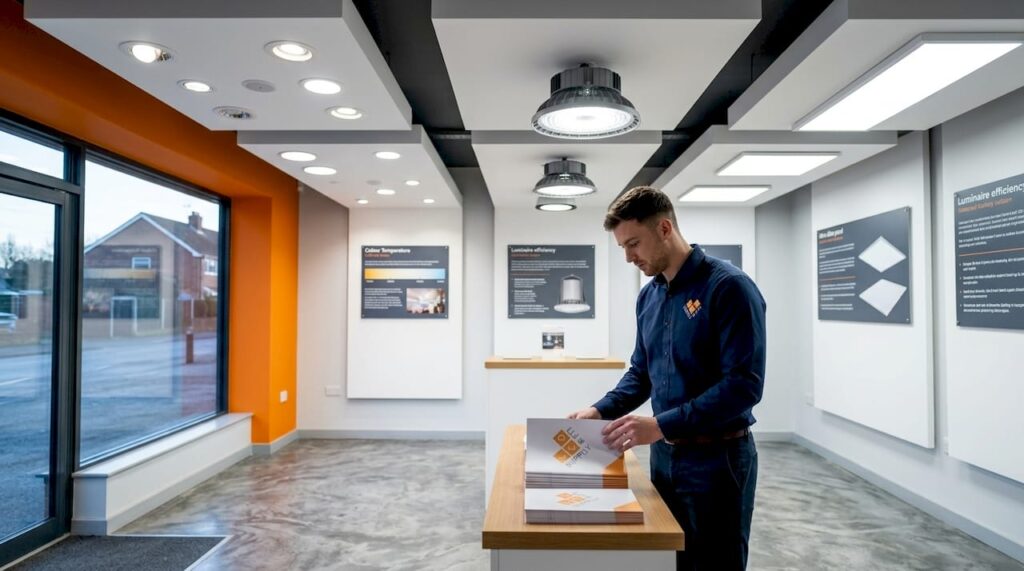
My honest recommendation: always request a physical sample or a site demonstration before committing to a large order. Ledsupplyandfit offers exactly this for commercial clients, and it eliminates the most expensive surprises before installation begins.
— John
How Ledsupplyandfit helps you specify and install the right fittings
Ledsupplyandfit supplies and installs the full range of LED fixture types discussed in this guide, from recessed downlights for hotel refurbishments to high bay systems for warehouses and distribution centres across the UK. The team provides pre-purchase consultations, physical product demonstrations, and next-day delivery on stocked lines, so your project does not stall waiting on lead times.
Whether you are upgrading a single office floor or fitting out a multi-site retail chain, Ledsupplyandfit’s best commercial LED lighting range covers DLC and ENERGY STAR® certified products with bulk pricing available on larger orders. Trade accounts are available for contractors and facilities managers who need consistent supply across multiple projects. Contact the team in Darlington to discuss your specification or browse the full product catalogue online.
FAQ
What are the main types of LED fixtures?
The main types of LED fixtures are recessed downlights, high bay fittings, flush and semi-flush mounts, panel lights, troffers, track lighting, pendants, and accent or wall-mounted fixtures. Each type suits a different ceiling height, room function, and lighting purpose.
What is the difference between integrated and retrofit LED downlights?
Integrated and retrofit LED downlights are not interchangeable. Integrated units combine the driver and emitter in one sealed fitting, while retrofit models fit inside an existing incandescent housing, preserving the ceiling cutout and reducing installation cost.
Which LED fixture type is best for a warehouse?
High bay LED fixtures are the correct choice for warehouses with ceilings between 6 and 14 metres. UFO models suit open floor areas, while linear high bays work better over racking aisles where a narrower beam distribution is needed.
How do I choose between panel lights and recessed downlights for an office?
Panel lights provide uniform, low-glare illumination across large open-plan areas and slot directly into standard suspended ceiling grids, making them the preferred choice for offices. Recessed downlights suit smaller zones, reception areas, or spaces where directional light is needed.
Do LED fixture types affect energy savings?
Yes. High bay LED fittings in particular deliver significant savings, with energy costs typically reduced by 30% compared with metal halide alternatives. Across all fixture types, specifying DLC or ENERGY STAR® certified products guarantees minimum efficacy levels and supports accurate payback calculations.