Warehouse High Bay Lighting That Cuts Costs
A dim warehouse costs more than most sites realise. Pick errors rise, forklift routes become harder to read, maintenance calls keep coming, and energy bills stay stubbornly high. Well-specified warehouse high bay lighting changes that quickly, but only when the fittings match the building, the task and the operating pattern.
For warehouses, this is not just about making a space look brighter. It is about delivering the right lux levels across racking aisles, loading zones, packing benches and mezzanines while keeping running costs under control. The best results come from treating lighting as part of site performance, not as a simple box-ticking replacement project.
Why warehouse high bay lighting matters
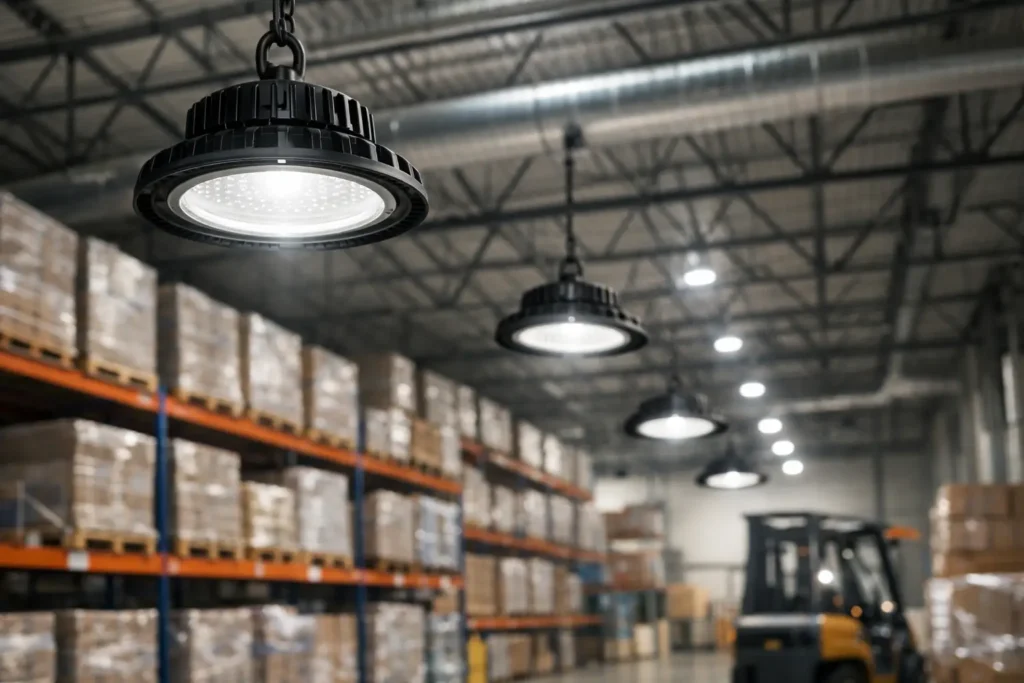
High bay lighting is designed for spaces with tall ceilings, typically from around 6 metres upwards. In warehouses, that extra mounting height creates a different set of demands to offices, retail or lower-level industrial units. Light has further to travel, shadows can fall heavily between racks, and poor fitting placement often leaves bright patches in one area and weak coverage in another.
That matters in practical terms. Teams need clear visibility for stock identification, scanning, order assembly and vehicle movement. If lighting is inconsistent, productivity suffers and the site can feel less safe than it should. On top of that, older metal halide or fluorescent systems often draw far more power than necessary and require more regular lamp changes, which adds labour and access equipment costs.
LED high bay fittings address both issues. They deliver stronger, more consistent output, switch on instantly and use significantly less energy. For many warehouse operators, the savings on electricity and maintenance are what justify the project. The improved working environment is what makes the upgrade feel worthwhile from day one.
Choosing the right warehouse high bay lighting
Not every high bay fitting suits every warehouse. Ceiling height is one factor, but it is not the only one. Layout, stock profile, aisle width, ambient temperature, operating hours and whether the site has natural daylight all affect the right specification.
A warehouse with wide open storage and low racking may need broad beam distribution for even general coverage. A site with tall narrow aisles can benefit from fittings that push light down more precisely where it is needed. If the wrong optic is used, you may end up lighting the tops of racks better than the floor below.
Output also needs care. More lumens are not automatically better. Over-lighting wastes energy and can create glare, particularly for forklift drivers and staff working with scanners or labels. Under-lighting causes the opposite problem – poor visibility, slower work and a site that never feels fully fit for purpose.
Colour temperature is another decision with operational impact. In many warehouse settings, a cooler white light helps improve perceived brightness and visual clarity. That said, it still depends on the environment. In mixed-use facilities with adjacent packing or staff areas, a balanced approach may be preferable so the lighting feels practical rather than harsh.
What to assess before replacing old fittings
A proper upgrade starts with the building, not the brochure. Existing mounting points, wiring routes and power supplies all influence what can be installed efficiently. If the warehouse has legacy fittings spaced for older technology, that layout may not be ideal for LED replacements without adjustment.
You also need to look at working patterns. A warehouse running 24 hours a day will see a faster return on investment than one used for occasional storage. Similarly, a site with changing occupancy can benefit from controls such as microwave sensors or daylight dimming, but those features are not always necessary in every zone.
Maintenance access should not be overlooked. One reason businesses move to LED is to avoid repeated lamp failures at height. A fitting with a long lifespan and dependable driver quality can reduce disruption significantly. Cheap products may look attractive on initial price, but if failures start early, the saving disappears quickly.
LED high bays and the case for lower operating costs
Energy efficiency is usually the main driver behind warehouse lighting upgrades, and for good reason. Older discharge fittings can be expensive to run, especially across large floorplates with long daily operating hours. LED high bays cut wattage while maintaining or improving usable light on the floor.
That reduction has a direct effect on monthly electricity spend. For larger warehouses, even a modest percentage saving becomes a meaningful annual figure. When combined with lower maintenance demand and longer replacement intervals, the total cost picture improves further.
There is also the issue of performance over time. Traditional lamps can degrade noticeably, shift in output and take time to reach full brightness. LED fittings are more stable and provide instant illumination, which is particularly useful where zones are controlled independently or occupancy sensors are used.
For businesses under pressure to reduce carbon output as well as energy bills, LED upgrades support both goals. The financial case tends to lead the conversation, but environmental improvements increasingly matter for reporting, procurement standards and wider operational policy.
Installation quality makes a difference
A good fitting can still underperform if it is poorly installed. Positioning, aiming, circuit planning and commissioning all affect final results. In warehouses, where mounting heights are significant and layouts can be complex, installation quality is not a minor detail.
This is where practical site experience matters. Some projects are straightforward one-for-one replacements. Others need a redesign to reduce fitting numbers, improve uniformity or account for changes in racking and workflow. Emergency lighting integration, access constraints and out-of-hours working may also need to be planned around normal operations.
For contractors and facilities teams, dealing with one supplier that understands both product selection and fitting can save time and reduce costly back-and-forth. LED Supply & Fit works in that space, combining supply with installation support so customers can move from specification to completion with clearer technical guidance.
Common mistakes with warehouse high bay lighting
One of the most common errors is choosing on wattage alone. Wattage tells you energy use, not lighting quality. The more useful comparison is how the fitting performs in the actual space, including beam angle, efficacy, mounting height suitability and light distribution.
Another mistake is ignoring glare. In a warehouse, strong light output needs control. If staff are repeatedly looking towards exposed bright sources, comfort and concentration can suffer. The right diffuser, optic or fitting design can make a noticeable difference.
It is also easy to miss the value of controls. Not every warehouse needs a fully connected smart system, but some sites waste energy by running every fitting at full output regardless of activity or available daylight. Zoned control can deliver extra savings where usage patterns vary through the day.
Finally, there is the temptation to buy on headline price. Commercial lighting is a cost-sensitive purchase, especially across large quantities, but the cheapest route is rarely the best long-term option. Product reliability, warranty support and suitability for the environment all carry weight when the fittings are going 8 or 10 metres above the floor.
How to plan a better lighting upgrade
Start with a clear picture of what the warehouse needs to achieve. That means identifying the key tasks in each area, reviewing current energy use and noting any recurring maintenance issues. A picking aisle, a loading bay and a dispatch bench may all need different lighting treatment even within the same building.
From there, build the specification around performance rather than assumptions. Lux requirements, fitting spacing, beam pattern and controls should all be considered together. If the warehouse includes cold storage, dusty areas or specialist operational zones, the selected fittings need to reflect those conditions.
It is also sensible to think beyond the immediate replacement. If the business expects layout changes, expansion or revised operating hours, choosing a flexible LED solution now can avoid another round of alterations later. Trade buyers and facilities managers usually get the best value when they treat lighting as a medium-term operational asset rather than a short-term spend.
The strongest projects balance upfront budget with running costs, installation practicality and lighting quality. When that balance is right, warehouse high bay lighting does more than reduce bills. It helps the site work better every day, with fewer interruptions and a clearer, safer environment for the people using it.
If you are reviewing a warehouse lighting scheme, the useful question is not simply what fitting replaces the old one. It is what level of performance the building should be delivering, and how quickly the right LED setup can start paying that back.