Lighting lifespan explained: how long do LEDs really last?
TL;DR:
- LED lighting lasts between 25,000 and 100,000 hours, outperforming traditional options significantly.
- Proper installation, material quality, and maintenance are crucial for maximizing LED lifespan.
- Upgrading to LED reduces ongoing costs and maintenance by up to 80%, offering long-term savings.
Replacing lighting every year or two is simply how it works, or so many commercial property managers assume. That assumption is costing UK businesses far more than it should. LED lighting has fundamentally changed what you should expect from your fixtures, and understanding the difference between a 1,000-hour bulb and a 50,000-hour fitting changes every calculation you make around upgrades, budgets, and maintenance schedules. This guide covers how long LEDs genuinely last, what affects their lifespan in real commercial settings, and how to get the most from every fitting you install.
Key Takeaways
| Point | Details |
|---|---|
| LEDs outlast traditional lighting | Quality LED fixtures offer 10–15 years of use, reducing frequent replacements and downtime. |
| Material and usage matter | Choosing the right materials and smart controls can greatly boost the lifespan of LEDs. |
| Strong ROI through lower costs | LED upgrades save money on energy bills and maintenance, paying for themselves within 2–5 years. |
| Proactive care maximises value | Routine cleaning, proper installation, and scheduled inspections protect your investment for years. |
What is lighting lifespan and why does it matter?
Lighting lifespan is not simply how long a bulb glows before it goes dark. In the industry, it refers to the point at which a fixture drops below 70% of its original light output. This is known as the L70 standard, and it is the benchmark used by manufacturers to give you a rated lifespan figure. Once a fitting falls below that threshold, it is considered to have reached the end of its useful life, even if it still produces some light.
Why does this matter for your business? Because running degraded lighting costs you energy without delivering the brightness your space actually needs. You end up paying full operating costs for diminished results.
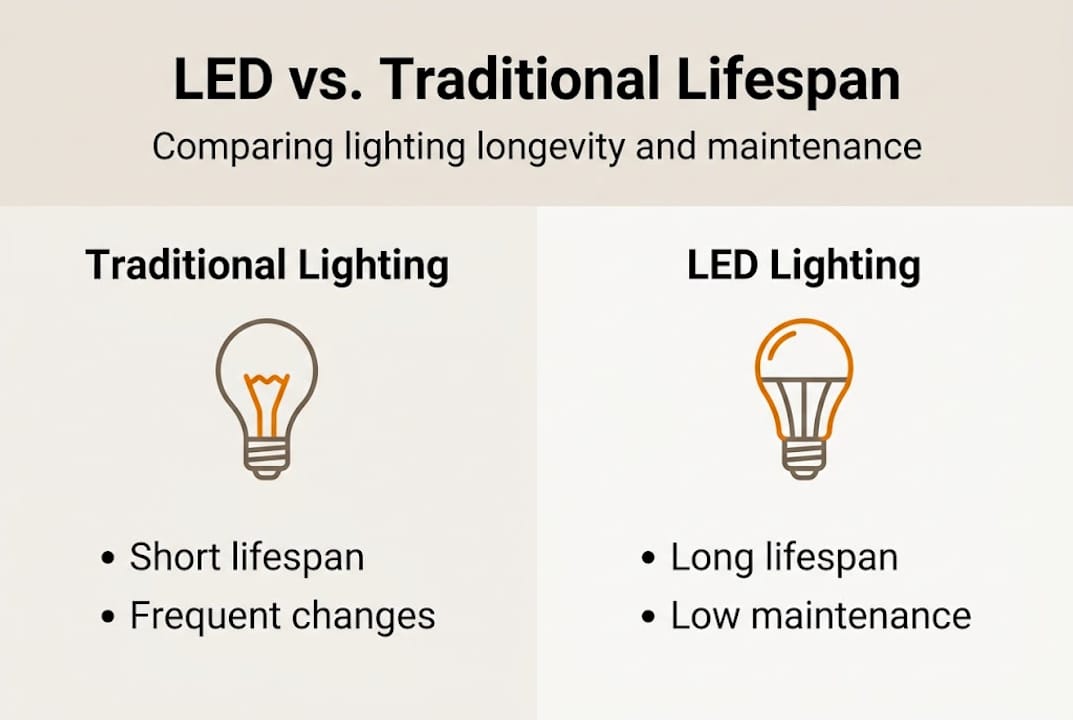
With commercial LED lighting in the UK, the rated lifespan sits between 25,000 and 100,000 hours depending on quality and application. Compare that to traditional alternatives:
- Incandescent bulbs: 1,000 to 2,000 hours
- Halogen lamps: 2,000 to 4,000 hours
- Fluorescent tubes: 8,000 to 15,000 hours
- Commercial LEDs: 25,000 to 100,000 hours
That is not a marginal improvement. It is a step change in how often you need to replace fittings and how much business disruption you accept from maintenance schedules.
Fewer replacements mean fewer engineers on site, fewer closures, less waste, and substantially lower ongoing costs. For a busy shop, hotel, or warehouse, that operational continuity is worth as much as the energy saving itself.
When you factor in that LED upgrades save 65% on energy costs for UK commercial properties, the financial case becomes difficult to argue against. Lifespan is the multiplier that makes every other benefit compound over time.
Key factors affecting LED lighting lifespan
Knowing the rated lifespan of an LED is a starting point, not a guarantee. Real-world performance depends heavily on how your fixtures are selected, installed, and used. Here are the factors that genuinely move the needle:
- Material quality of optics. The lens material covering an LED matters enormously over time. Thermoplastic optics degrade through photothermal ageing, yellowing and eventually failing. Silicone optics resist heat and UV degradation far more effectively, making them the smarter choice for demanding commercial environments.
- Daily usage patterns. How many hours per day your lights run directly affects when they reach L70. Frequent switching on and off can also create thermal stress, particularly with lower-quality drivers.
- Ambient environment. Heat, humidity, and dust all reduce LED lifespan. A fitting rated for a controlled office may underperform in a busy kitchen, loading bay, or gym without the right IP and thermal rating.
- Installation quality. Poor wiring, incompatible drivers, or incorrect mounting all create conditions where LEDs fail well before their rated hours.
- Ongoing maintenance. Dust accumulation on fixtures traps heat. Clean fittings run cooler and last longer.
Taking a structured approach to the LED selection process for your property type prevents the most common causes of early failure.
Pro Tip: Always ask your supplier for the IP rating and operating temperature range of any fitting before purchasing for commercial use. A product rated for indoor office conditions will not perform the same in a warehouse with dust and temperature swings.
Comparing lighting types: LEDs vs. traditional options
Once you understand what shortens LED lifespan, the comparison to legacy technology becomes stark. Here is how the main lighting types stack up for typical UK commercial use:
| Lighting type | Rated lifespan | Daily usage at 12 hrs | Approx. years of use | Maintenance frequency |
|---|---|---|---|---|
| Incandescent | 1,000 hrs | 12 hrs/day | ~3 months | Very high |
| Halogen | 3,000 hrs | 12 hrs/day | ~9 months | High |
| Fluorescent | 12,000 hrs | 12 hrs/day | ~2.7 years | Moderate |
| Commercial LED | 50,000-100,000 hrs | 12 hrs/day | 10-15+ years | Very low |
For a UK business running lights 12 hours daily, LEDs last 10 to 15 years compared to just one to two years for traditional alternatives. The ROI period for most commercial upgrades sits between two and five years, meaning after that point your savings are essentially pure gain.

That is a compelling argument when you consider the LED benefits for UK businesses go beyond energy bills alone. Reduced call-outs, fewer lamp purchases, and minimal disruption to staff and customers all add value that does not always show up in a simple energy comparison.
The real cost of staying with legacy lighting is not just the energy bill. It is the cumulative cost of every replacement, every maintenance visit, and every hour your team spends managing a lighting system that is fighting against your operational efficiency.
How to maximise LED lifespan in your property
Getting the full value from your LED investment requires more than choosing the right fitting at the point of purchase. These steps make a measurable difference to how long your LEDs perform at full effectiveness:
- Keep fixtures clean. Dust buildup on LED housings acts as insulation, trapping heat and accelerating degradation. A simple quarterly wipe-down on accessible fittings maintains thermal performance.
- Install smart controls. Dimming systems and occupancy sensors reduce the total hours your LEDs run at full power. Fewer operating hours means a longer functional lifespan, simple as that.
- Schedule regular inspections. Catching early signs of overheating or optical discolouration before they cascade into failure saves replacement costs down the line.
- Use compatible drivers. Mismatched drivers are one of the leading causes of premature LED failure. Always follow manufacturer specifications.
- Calculate total cost of ownership (TCO). LEDs reduce maintenance costs by 60 to 80% versus fluorescent lighting, and dimming or sensors extend life even further. Price per unit tells you nothing useful without this context.
Thinking carefully about LED cost saving tips at the planning stage, alongside the sustainable lighting benefits for your property, sets you up for a much stronger return.
Pro Tip: If you manage multiple sites, stagger your inspection schedule rather than waiting for failures to appear. Proactive checks across a portfolio cost far less than reactive replacements at scale.
A fresh perspective on lighting lifespan for UK businesses
Here is something the product specifications rarely tell you: lab-rated lifespans are measured under controlled conditions that bear little resemblance to a working restaurant, gym, or warehouse. Voltage spikes, cleaning chemicals, ambient heat, and rushed installations all chip away at those headline hours.
The businesses that get the most from their LED investment treat lighting as a managed asset, not a set-and-forget purchase. They track performance, schedule proactive replacements before failure, and use data from smart controls to inform decisions. That mindset consistently outperforms the approach of simply buying the longest-rated product and hoping for the best.
Looking at the future of commercial LED lighting, the trend is firmly towards integrated monitoring and responsive systems. The managers who build that thinking into their upgrade decisions now will be ahead of the curve in both cost and compliance.
Upgrade your lighting and see long-term savings
At LED Supply & Fit, we work with commercial property managers and business owners across the UK to ensure LED upgrades deliver their full lifespan potential, not just on paper but in practice.
Whether you are planning a full site upgrade or exploring your options, we can provide a tailored audit and product recommendations matched to your environment and usage patterns. Explore our best LED options for UK businesses or find out how we approach design for cost and compliance to protect your investment from the start.
Frequently asked questions
How long do commercial LED lights last in the UK?
High-quality commercial LEDs typically last between 50,000 and 100,000 hours, which is over 10 years at standard daily usage rates.
Can you extend LED lighting lifespan with smart technology?
Yes. Dimming and occupancy sensors reduce operating hours, and sensors extend lifespan by reducing the total hours run at full power.
What makes some LEDs fail earlier than expected?
Heat build-up, degraded thermoplastic optics, and incorrect installation are the most common causes of early LED failure in commercial settings.
What is the main financial benefit of choosing long-lifespan LEDs?
Long-lifespan LEDs cut maintenance and replacement costs significantly, with ROI achieved in 2 to 5 years for most UK commercial upgrades.