
Future of LED lighting: save 75% on commercial energy costs
Commercial property managers across the UK face a critical decision in 2026: upgrade to LED lighting now or risk non-compliance with increasingly stringent energy efficiency regulations. LED lighting achieves up to 75% energy savings and reduces operational costs for UK commercial properties, yet many businesses delay adoption due to misconceptions about upfront investment and installation complexity. This guide explores emerging LED technologies, regulatory requirements, and practical strategies to help you maximise energy efficiency whilst ensuring compliance with MEES standards through 2030.
Key Takeaways
| Point | Details |
|---|---|
| High energy savings | LED lighting delivers up to 75 per cent energy savings, with smart controls providing additional reductions. |
| MEES compliance timeline | From 2026 commercial properties must reach EPC E, rising to EPC C by 2027 and EPC B by 2030, making upgrades essential. |
| Emerging tech gains | Emerging technologies such as AI integration and micro LEDs are expected to boost efficiency further. |
| High efficacy LEDs | Prioritising high efficacy LEDs and smart controls delivers the quickest return on investment. |
| UK case savings | Real UK case studies show substantial cost and carbon savings from LED retrofits. |
Current landscape of LED lighting in UK commercial properties
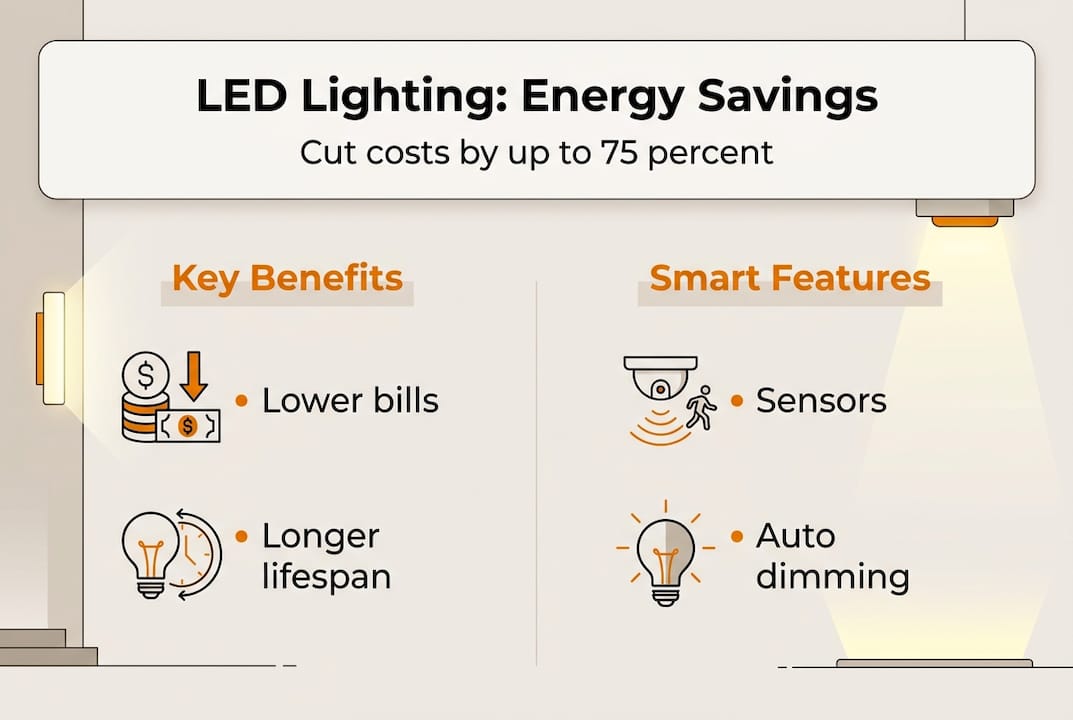
The commercial lighting sector has undergone a dramatic transformation as businesses recognise the financial and environmental advantages of LED technology. LED lighting achieves 50-75% energy savings versus fluorescent and halogen lights, with smart controls delivering an additional 10-40% reduction in consumption. These savings translate directly to lower operational costs, making LED upgrades one of the most cost-effective improvements for commercial properties.

Many property managers hesitate due to perceived complexity and initial investment requirements. However, LEDs have a long lifespan of 50,000-100,000 hours, offering a return on investment within 2-4 years. This extended lifespan eliminates frequent replacement costs and reduces maintenance disruption, particularly valuable in high-ceiling warehouses or round-the-clock operations.
Smart lighting controls amplify these benefits by adapting illumination to real-time conditions. Occupancy sensors detect when spaces are vacant, daylight harvesting adjusts artificial lighting based on natural light availability, and scheduling systems ensure lights operate only during necessary hours. These business lighting upgrade benefits extend beyond energy savings to include enhanced occupant comfort and productivity.
The misconception that LED installations are technically challenging prevents many businesses from acting. Modern LED systems integrate seamlessly with existing infrastructure, and professional installers handle the transition efficiently. Understanding the current LED installation benefits UK businesses enjoy helps dispel these concerns and encourages informed decision-making.
Pro Tip: Calculate your potential savings by auditing current lighting usage hours and comparing your existing technology’s wattage to equivalent LED alternatives. This provides concrete ROI projections to justify upgrade investments.
Key advantages of current LED technology include:
- Immediate energy consumption reduction of 50-75% compared to traditional lighting
- Minimal heat generation, reducing cooling costs in temperature-sensitive environments
- Superior colour rendering for retail and hospitality applications
- Instant illumination without warm-up periods required by older technologies
- Compatibility with dimming and control systems for flexible operation
Meeting UK energy efficiency standards with LED lighting upgrades
Regulatory pressure is accelerating LED adoption across the UK commercial sector. As of 2026, commercial properties must meet at least EPC E, progressing to EPC C by 2027 and EPC B by 2030, putting many buildings at risk without LED upgrades. The Minimum Energy Efficiency Standards (MEES) regulations prohibit letting properties that fall below these thresholds, creating urgent compliance requirements for landlords and property managers.
Non-compliance carries significant financial and legal consequences. Properties failing to meet MEES standards become unlettable, resulting in lost rental income and diminished asset values. Enforcement actions can result in penalties, whilst persistent non-compliance damages reputation and limits future letting opportunities. These risks make LED upgrades not merely optional improvements but essential investments for commercial property viability.
LED retrofits provide a low-capital, effective way to improve EPC ratings, though heritage properties may face higher retrofit costs. Lighting typically represents one of the most straightforward and impactful EPC improvements, delivering measurable energy performance gains without structural modifications. For properties hovering near compliance thresholds, LED upgrades often provide the boost needed to achieve required ratings.
The escalating nature of MEES requirements demands forward-thinking planning. Properties meeting 2026 standards may still require additional improvements to satisfy 2027 and 2030 targets. Comprehensive LED upgrades commercial properties implement today position buildings for long-term compliance whilst maximising immediate energy savings.
Critical MEES compliance considerations include:
- EPC assessments identify specific improvement opportunities and projected rating changes
- LED lighting upgrades typically contribute 5-15 points to EPC scores depending on existing systems
- Combined with other measures like insulation, lighting improvements create synergistic rating benefits
- Documentation of upgrades supports compliance verification during property transactions
- Exemptions exist for certain building types, but most commercial properties must comply
“The transition to higher EPC standards represents both challenge and opportunity. Businesses that proactively invest in sustainable lighting choices UK not only ensure compliance but also reduce operational costs and enhance property values, creating competitive advantages in an increasingly environmentally conscious market.”
Emerging LED technologies shaping the future of commercial lighting
Innovation continues to expand LED capabilities beyond simple energy efficiency improvements. Emerging technologies include AI adaptive lighting, IoT smart systems, tunable LEDs, and micro-LEDs, which promise enhanced control and efficiency but face commercialisation and supply challenges. These developments will fundamentally transform how commercial properties manage illumination, creating opportunities for unprecedented customisation and automation.
Artificial intelligence integration enables lighting systems to learn occupancy patterns and adjust automatically without manual programming. AI algorithms analyse usage data to optimise schedules, predict maintenance needs, and identify further efficiency opportunities. When combined with IoT connectivity, these systems provide real-time monitoring and remote control capabilities, allowing facility managers to oversee multiple properties from centralised platforms.
Tunable LED technology offers dynamic colour temperature adjustment throughout the day. Research demonstrates that cooler colour temperatures enhance alertness and productivity during morning hours, whilst warmer tones promote relaxation in evening periods. Commercial applications include offices optimising employee performance, retail environments influencing customer behaviour, and healthcare facilities supporting patient wellbeing through circadian rhythm alignment.
Micro-LED technology represents the cutting edge of solid-state lighting, delivering higher luminous efficacy and improved colour accuracy compared to conventional LEDs. However, thermal management challenges and manufacturing complexity currently limit widespread commercial adoption. As production processes mature and costs decrease, micro-LEDs may become viable alternatives for applications demanding superior light quality.
Pro Tip: When evaluating emerging technologies, prioritise solutions with proven track records over experimental options. Early adoption carries risks, whilst established innovations like occupancy sensors and daylight harvesting deliver reliable returns today.
Implementation considerations for advanced LED systems:
- Assess compatibility with existing building management systems before committing to IoT platforms
- Evaluate whether AI features justify additional costs for your specific occupancy patterns
- Consider tunable LED benefits for spaces where occupant comfort directly impacts productivity or sales
- Monitor micro-LED developments but wait for cost reductions before large-scale deployment
- Ensure chosen technologies support open standards to avoid vendor lock-in
| Technology | Primary Benefit | Current Limitation | Best Application |
|---|---|---|---|
| AI adaptive lighting | Automatic optimisation based on learned patterns | Higher upfront cost | Multi-zone offices with variable occupancy |
| IoT connectivity | Remote monitoring and control | Requires network infrastructure | Multi-site property portfolios |
| Tunable LEDs | Dynamic colour temperature adjustment | Premium pricing | Healthcare, hospitality, high-end retail |
| Micro-LEDs | Superior efficacy and colour rendering | Limited availability and high cost | Specialised applications requiring exceptional quality |
The lighting design UK commercial sector increasingly incorporates these technologies into comprehensive solutions. Whilst bleeding-edge innovations carry higher costs, proven top LED solutions 2026 deliver immediate value without experimental risk. Strategic adoption balances innovation with practical ROI considerations.
Strategies for successful LED lighting upgrades in commercial properties
Effective LED implementation requires systematic planning to maximise energy savings whilst managing costs and minimising disruption. High-efficacy LEDs over 150 lm/W combined with smart controls in variable occupancy areas offer the quickest returns and highest savings. This targeted approach ensures limited budgets deliver maximum impact by addressing the most energy-intensive and frequently used spaces first.
Prioritisation begins with comprehensive energy audits identifying current consumption patterns and inefficiencies. High-use areas such as open-plan offices, warehouses, and retail floors typically consume the most energy and benefit most from LED conversion. Spaces with variable occupancy, including meeting rooms, corridors, and storage areas, gain additional savings through occupancy sensors and automated controls.
Smart control implementation amplifies LED efficiency gains substantially. Occupancy sensors can reduce lighting energy use by 20-40%, alongside daylight harvesting and time scheduling for total savings up to 83%. These systems pay for themselves rapidly in commercial environments with fluctuating usage patterns, particularly when combined with high-efficacy LED fixtures.
Phased upgrade approaches manage capital requirements whilst demonstrating value to stakeholders. Begin with the highest-return spaces to generate immediate savings that fund subsequent phases. This strategy builds internal support by providing tangible evidence of benefits before requesting additional investment for lower-priority areas.
Pro Tip: Document baseline energy consumption before upgrades and monitor post-installation performance. Concrete data demonstrating actual savings strengthens business cases for future efficiency investments and validates initial projections.
Practical implementation steps include:
- Conduct detailed lighting audits measuring current consumption, fixture types, and usage patterns
- Calculate ROI projections for different upgrade scenarios to identify optimal investment levels
- Engage qualified installers familiar with MEES regulations and UK building codes
- Schedule installations during off-peak hours to minimise operational disruption
- Implement commissioning procedures ensuring systems operate as designed
- Train facility staff on new control systems to maximise ongoing efficiency
Critical success factors for LED upgrades:
- Select fixtures with verified performance certifications rather than relying solely on manufacturer claims
- Ensure adequate light levels for tasks whilst avoiding over-illumination that wastes energy
- Consider colour rendering requirements for specific applications like retail product display
- Plan for future flexibility by installing control infrastructure supporting additional sensors
- Maintain detailed records of installations for EPC assessments and compliance verification
The LED cost saving tips professionals recommend emphasise systematic approaches over piecemeal fixes. Comprehensive strategies addressing both fixtures and controls deliver superior results compared to simple lamp replacements. Understanding reduce energy consumption lighting techniques ensures upgrades achieve their full potential.
Discover how LED Supply & Fit supports your lighting upgrades
Navigating LED technology options and regulatory requirements demands specialised expertise. LED Supply & Fit provides comprehensive lighting solutions designed specifically for UK commercial properties, combining proven products with professional installation services. Our team understands MEES compliance requirements and designs systems that enhance energy efficiency whilst meeting current and future regulatory standards.
We specialise in best commercial LED lighting solutions for diverse applications including offices, warehouses, retail spaces, and hospitality venues. Our approach begins with detailed site assessments identifying your specific requirements and opportunities. We then recommend tailored solutions balancing performance, cost, and regulatory compliance to deliver optimal value for your investment.
Explore our proven cost-saving lighting strategies through detailed case studies demonstrating real-world results. From initial consultation through installation and beyond, we support your lighting upgrade journey with expert guidance and reliable service. Ready to reduce energy costs and ensure MEES compliance? Request a quote today to discuss your commercial lighting needs.
Frequently asked questions about the future of LED lighting
What is the typical lifespan of commercial LED lighting compared to traditional lighting?
Commercial LED fixtures last 50,000 to 100,000 hours, approximately 25 to 50 times longer than traditional incandescent bulbs and 5 to 10 times longer than fluorescent tubes. This extended lifespan dramatically reduces replacement costs and maintenance disruption, particularly valuable in high-ceiling or difficult-to-access installations where lamp changes require specialised equipment.
How do MEES regulations affect commercial landlords and tenants in 2026 and beyond?
MEES regulations prohibit letting commercial properties below EPC E from 2026, rising to EPC C in 2027 and EPC B by 2030. Landlords face penalties and lost rental income if properties fail to meet these standards, whilst tenants may find lease renewals contingent on efficiency improvements. LED installation benefits include straightforward compliance pathways for both parties.
Can smart lighting controls really reduce operational costs significantly?
Yes, smart controls deliver substantial additional savings beyond LED fixtures alone. Occupancy sensors, daylight harvesting, and scheduling systems can reduce lighting energy consumption by 20 to 40% individually, with combined implementations achieving total reductions up to 83%. These systems pay for themselves within 1 to 3 years in typical commercial applications with variable occupancy patterns.
What upfront investments are generally required for LED lighting upgrades in commercial properties?
Upfront costs vary based on property size, existing infrastructure, and chosen technologies, typically ranging from £15 to £45 per square metre for basic LED retrofits. Adding smart controls increases initial investment by 20 to 40%, but accelerates ROI through enhanced savings. Most commercial installations achieve payback within 2 to 4 years through reduced energy and maintenance costs. Review LED cost saving tips to optimise your investment strategy.
Are emerging LED technologies like tunable lighting worth the additional cost for commercial applications?
Tunable LED technology delivers measurable benefits in specific commercial contexts where occupant comfort and productivity directly impact business outcomes. Offices, healthcare facilities, and high-end retail environments often justify premium pricing through improved employee performance or enhanced customer experiences. However, standard high-efficacy LEDs with smart controls provide superior ROI for warehouses, storage areas, and other utility spaces where colour temperature variation offers limited value.