Benefits of LED installation for UK businesses in 2026
UK businesses face electricity costs that have surged by over 50% since 2021, making energy efficiency a critical priority. LED installation offers a proven solution, cutting energy consumption by up to 75% whilst delivering measurable cost savings and environmental benefits. This guide explains how commercial LED lighting transforms your bottom line, supports sustainability goals, and positions your business for long-term success in 2026.
Key takeaways
| Point | Details |
|---|---|
| Energy savings | LED lighting reduces energy use by up to 75% compared to traditional bulbs |
| Return on investment | Typical ROI for UK businesses ranges from 2 to 4 years through combined energy and maintenance savings |
| Lifespan advantage | LEDs last 25,000 to 50,000 hours, dramatically outlasting fluorescent and incandescent alternatives |
| Environmental impact | Significant CO2 emission reductions help meet UK 2030 climate targets whilst enhancing business credentials |
| Smart controls | Automated dimming and sensors can add up to 30% extra savings beyond standard LED benefits |
Understanding LED technology and its energy efficiency
LED stands for light-emitting diode, a semiconductor device that produces light when electrical current passes through it. This process differs fundamentally from incandescent bulbs that waste energy as heat or fluorescent tubes that require inefficient ballasts.
The efficiency advantage is substantial. LED technology basics show these systems convert approximately 95% of energy into light, with only 5% lost as heat. Incandescent bulbs reverse this ratio, converting just 5% to light whilst wasting 95% as heat. This LED lighting reduces energy use by up to 75% compared to traditional options.
Key technical advantages include:
- Semiconductor technology eliminates filaments and gases that degrade quickly
- Minimal heat generation reduces cooling loads in commercial spaces
- Instant illumination without warm-up periods required by fluorescents
- Directional light output eliminates wasted illumination from omnidirectional bulbs
- Lifespan ranging from 25,000 to 50,000 hours compared to 1,000 hours for incandescent or 8,000 hours for fluorescent
These technical features translate directly into lower electricity bills and reduced maintenance cycles. A warehouse running lights 12 hours daily would replace incandescent bulbs every 3 months, fluorescents every 2 years, but LEDs only every 8 to 11 years. The UK government energy technology list recognises these efficiency gains through formal qualification programmes.

Quantifying cost savings and return on investment
Financial benefits extend beyond simple energy reduction. UK businesses typically see comprehensive savings across multiple cost centres when upgrading to commercial LED systems.
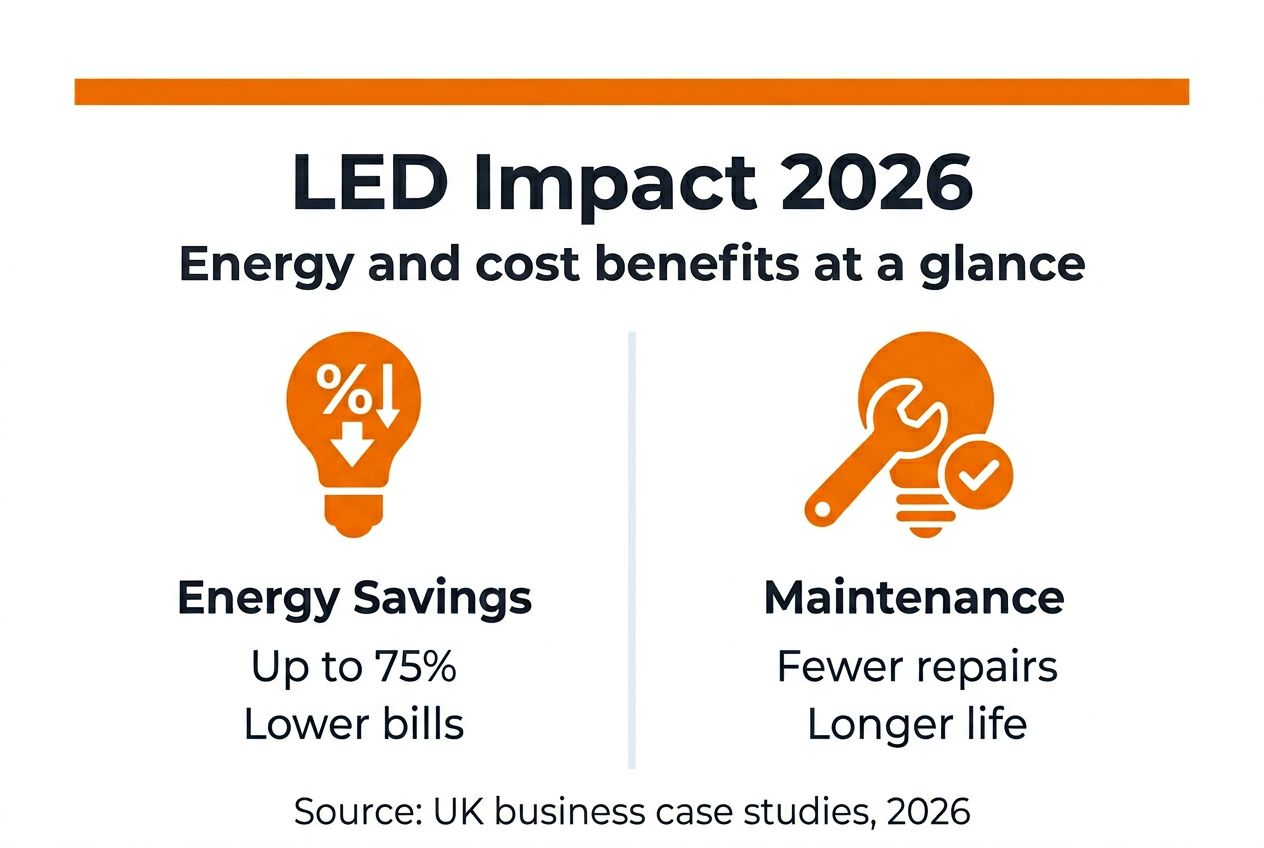
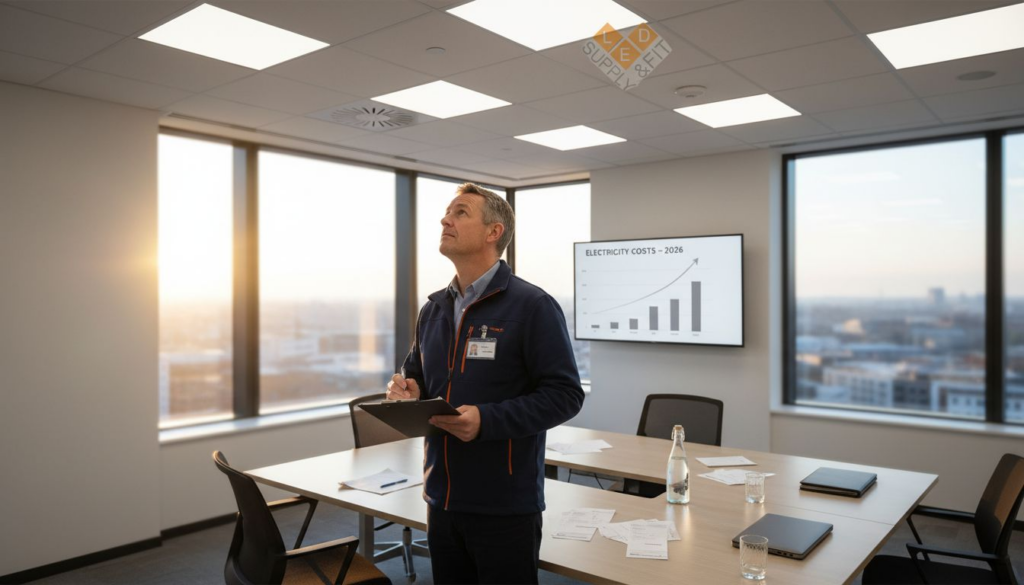
Energy expenditure drops immediately upon installation. A typical office consuming 50,000 kWh annually for lighting at £0.28 per kWh pays £14,000 yearly. Switching to LEDs cuts consumption to 12,500 kWh, reducing costs to £3,500 and saving £10,500 annually. Manufacturing facilities and warehouses with higher usage see proportionally larger reductions.
Maintenance savings compound over time:
- Replacement frequency drops from multiple times yearly to once per decade
- Labour costs for changing bulbs decrease by 80% or more
- Disposal costs for hazardous fluorescent tubes vanish
- Emergency lighting compliance becomes simpler with longer-lasting units
- Stock holding requirements shrink, freeing working capital
Cooling cost reductions often surprise facility managers. Traditional lighting systems generate substantial heat that air conditioning must remove. LEDs produce minimal thermal output, lowering HVAC loads by 10% to 20% in lighting-intensive environments like retail showrooms or gymnasiums.
The typical return on investment timeline for UK commercial LED upgrades is between 2 and 4 years, factoring in all savings sources. Businesses with high usage hours or expensive electricity rates see faster payback. The LED upgrade ROI improves further when including Enhanced Capital Allowances for LED investments, which allow 100% first-year tax deductions.
Pro Tip: Calculate your specific payback period by dividing total installation cost by annual combined savings from energy, maintenance, and cooling reductions to get accurate financial projections.
Environmental and regulatory benefits in the UK context
Sustainability considerations increasingly influence business decisions as stakeholders demand environmental accountability. LED installation delivers measurable carbon footprint reductions that support UK climate commitments.
Every kilowatt-hour saved prevents approximately 0.233 kg of CO2 emissions based on current UK grid carbon intensity. A business saving 37,500 kWh annually through LED upgrades prevents 8,737 kg of CO2 emissions yearly. Over a typical 10-year LED lifespan, this totals 87,370 kg, equivalent to taking 19 petrol cars off the road for a year.
Regulatory advantages strengthen the business case:
- UK businesses can claim 100% of the LED investment cost in the first year under the Enhanced Capital Allowances scheme
- Compliance with Minimum Energy Efficiency Standards becomes simpler
- Energy Performance Certificate ratings improve, enhancing property values
- Supply chain sustainability requirements are easier to meet
The ECA scheme particularly benefits businesses with significant lighting infrastructure. A £50,000 LED upgrade generates a £9,500 corporation tax saving in year one for businesses in the 19% bracket. This immediate cash benefit shortens effective payback periods substantially.
“Commercial LED upgrades represent one of the fastest, most measurable steps UK businesses can take toward net zero targets whilst simultaneously improving profitability.”
Energy saving incentives UK extend beyond tax benefits. Some local authorities offer grants for energy efficiency improvements, and UK government LED incentives continue evolving to encourage widespread adoption. Environmental credentials gained through LED installation enhance tender applications, customer perception, and employee satisfaction.
Overcoming common misconceptions about LED lighting
Several persistent myths deter businesses from pursuing LED upgrades despite overwhelming evidence supporting the technology. Addressing these misconceptions directly removes barriers to adoption.
Myth: LED lighting produces harsh, poor-quality illumination unsuitable for commercial environments. Reality: Modern LED technology provides light quality equal or superior to traditional options with customisable colour temperatures, excellent colour rendering, and uniform distribution. LEDs are available in warm whites matching incandescent tones or cool whites providing clarity for detailed work.
Myth: Installation requires extensive downtime that disrupts business operations. Reality: Professional installers work around your schedule, often completing upgrades outside business hours or in phases that maintain operational lighting. Most installations involve straightforward retrofits into existing fixtures, minimising structural changes and installation time.
Myth: Upfront costs make LED investment prohibitively expensive for small to medium businesses. Reality: When evaluating total cost of ownership rather than purchase price alone, LEDs prove more economical. The payback typically occurs within 2 to 4 years, after which savings continue for decades. Financing options and government incentives further reduce initial barriers.
Additional concerns addressed:
- LED lights do not flicker or hum like degrading fluorescents
- Dimming capabilities work smoothly with compatible controls
- Cold weather performance exceeds fluorescent reliability
- Disposal is simpler without mercury or hazardous materials
Pro Tip: Request demonstrations from suppliers to see actual light quality in your specific environment before committing to large-scale installation.
The LED myths debunked through practical testing show businesses consistently report satisfaction exceeding initial expectations. Staff appreciate improved visibility, reduced eye strain, and better colour accuracy for tasks ranging from product inspection to detailed assembly work.
Case studies demonstrating real-world impact
Theoretical benefits become compelling when supported by documented results from UK businesses across various sectors. These examples illustrate typical outcomes from commercial LED installations.
A 50,000-square-foot warehouse in the Midlands replaced 400 high-pressure sodium fixtures with LED high bays. Annual energy consumption dropped from 480,000 kWh to 192,000 kWh, reducing electricity costs by 60%. The installation cost £78,000 but generated annual savings of £80,640 in energy and £12,000 in maintenance, achieving full payback in 10 months.
A retail chain with 23 locations upgraded to LED panels and track lighting. Beyond the 68% energy reduction, store managers reported 15% sales increases attributed to improved product visibility and more inviting atmospheres. Customer dwell time increased measurably under the enhanced lighting conditions.
| Sector | Energy Reduction | Annual Savings | Payback Period | Additional Benefits |
|---|---|---|---|---|
| Warehouse | 60% | £92,640 | 10 months | Improved safety, reduced insurance premiums |
| Office complex | 72% | £34,500 | 2.1 years | Enhanced productivity, better employee satisfaction |
| Manufacturing | 58% | £127,000 | 1.8 years | Fewer defects from better visibility |
| Hotel | 65% | £48,200 | 2.4 years | Guest comfort scores improved 22% |
Worker comfort improvements appear consistently across installations. Manufacturing facilities reported fewer quality control errors under better illumination. Office environments saw reduced headaches and eye strain. Hospitality venues received positive guest feedback about ambience improvements.
Sustainability reporting benefited substantially. One logistics company’s LED upgrade eliminated 342 tonnes of annual CO2 emissions, becoming a centrepiece of their environmental commitments to major clients. This competitive advantage helped secure two significant contracts requiring demonstrated sustainability programmes.
The LED impact case studies demonstrate consistent patterns: energy savings meet or exceed projections, payback occurs faster than conservative estimates, and ancillary benefits provide unexpected value beyond simple cost reduction.
Advanced LED features and practical installation considerations
Maximising LED benefits requires understanding available features and making informed installation decisions suited to your specific environment and usage patterns.
Smart controls amplify energy savings beyond static LED efficiency. Occupancy sensors ensure lights operate only when spaces are occupied, particularly valuable in warehouses, meeting rooms, and storage areas. Daylight harvesting systems dim artificial lighting as natural light increases, optimising energy use in spaces with windows. Time scheduling prevents lights running unnecessarily outside business hours. These technologies combined can add 20% to 30% extra savings.
Professional installation ensures compliance and performance:
- Qualified electricians verify electrical capacity and compatibility
- Proper thermal management prevents premature LED degradation
- Correct driver selection ensures consistent performance and dimming capability
- Zoning optimises control flexibility for different areas
- Emergency lighting integration maintains safety compliance
Selecting appropriate LED types by application maximises effectiveness. High bay LEDs suit warehouses and factories with ceilings above 4 metres. LED panels provide uniform office illumination. Track lighting offers flexibility for retail displays. Tube replacements retrofit existing fluorescent fixtures economically.
| Feature | LED | Fluorescent | Incandescent |
|---|---|---|---|
| Lifespan | 25,000-50,000 hrs | 8,000 hrs | 1,000 hrs |
| Energy efficiency | 90-95% | 60-70% | 5-10% |
| Maintenance frequency | Every 8-11 years | Every 2 years | Every 3-4 months |
| Heat output | Minimal | Moderate | Substantial |
| Environmental disposal | Simple | Hazardous (mercury) | Simple |
Pro Tip: Conduct a lighting audit before upgrading to identify usage patterns, prioritise high-impact areas, and calculate accurate savings projections for your specific circumstances.
The selecting and installing LEDs process benefits from expert guidance. Colour temperature selection influences productivity and comfort. Warehouses typically use 5000K to 6500K cool whites for alertness and visibility. Hospitality venues prefer 2700K to 3000K warm whites for relaxed atmospheres. Office environments often split the difference at 4000K neutral white.
Summary and next steps for LED installation success
LED installation delivers compelling advantages across financial, operational, and environmental dimensions. The technology has matured beyond early adoption challenges, offering reliable, high-quality illumination that exceeds traditional alternatives in virtually every measurable parameter.
Key benefits recap:
- Energy consumption reductions of 60% to 75% translate to immediate cost savings
- Maintenance cycles extend from months to years, freeing resources for productive activities
- Environmental benefits support sustainability commitments whilst enhancing business reputation
- Financial returns typically occur within 2 to 4 years, followed by decades of ongoing savings
- Government incentives improve financial viability through tax benefits and potential grants
The misconceptions that previously deterred businesses have been thoroughly debunked through millions of successful installations across UK commercial environments. Light quality, installation disruption, and cost concerns all prove unfounded when examined against actual project outcomes.
Ledsupplyandfit.co.uk specialises in guiding UK businesses through the assessment, selection, and installation process. Their expertise ensures you maximise available benefits whilst minimising implementation challenges. Professional project management maintains business continuity throughout the upgrade process.
Your next steps should include assessing current lighting costs, identifying priority areas for upgrade, and consulting specialists who understand UK commercial requirements. The combination of immediate savings, long-term value, and environmental benefits makes LED installation one of the most straightforward business improvement decisions available in 2026.
Partner with Ledsupplyandfit.co.uk for your UK commercial LED upgrade
Transitioning to LED lighting requires expertise in product selection, installation planning, and regulatory compliance. Ledsupplyandfit.co.uk brings specialised knowledge of UK commercial environments, ensuring your upgrade delivers maximum benefits with minimum disruption.
The company has successfully completed installations for diverse clients, from commercial LED upgrade success stories like Wilson Veterinary Group to educational facilities such as trusted LED installation partner Stockton Riverside College. Each project receives tailored solutions matching specific operational requirements, usage patterns, and budget constraints.
Services include comprehensive lighting audits, customised product recommendations, professional installation coordinated around your schedule, and ongoing support ensuring long-term performance. Trade accounts offer preferential pricing for larger projects, whilst next-day delivery options maintain project momentum.
Their Darlington location enables direct consultations and product demonstrations, allowing you to evaluate light quality and features before committing. Bulk discount structures make large-scale upgrades more economical, improving return on investment calculations.
Contact professional LED solutions today to schedule an assessment of your commercial lighting needs and receive a detailed proposal showing projected savings, payback periods, and available incentives specific to your situation.
Frequently asked questions
What are the main benefits of installing LED lighting in commercial spaces?
LED lighting reduces energy usage by up to 75%, dramatically lowering electricity bills whilst requiring minimal maintenance over lifespans exceeding 25,000 hours. The technology improves lighting quality through better colour rendering and uniform distribution, enhancing workplace comfort and productivity. Environmental benefits include substantial CO2 emission reductions that support UK sustainability commitments and improve business credentials with environmentally conscious stakeholders.
How long does it typically take to see a return on investment after upgrading to LED?
Most UK commercial LED upgrades achieve full return on investment between 2 and 4 years through combined energy and maintenance savings. Facilities with high usage hours or expensive electricity rates often see faster payback, sometimes under 18 months. The calculation improves significantly when including Enhanced Capital Allowances tax benefits, which allow 100% first-year deductions that generate immediate cash flow improvements.
Are there any government incentives available for LED installation in the UK?
UK businesses can claim 100% of qualifying LED investment costs in the first year under the Enhanced Capital Allowances scheme, generating substantial corporation tax savings. Products must appear on the Energy Technology List to qualify, but most commercial LED systems meet these criteria. Some local authorities offer additional grants for energy efficiency improvements, and businesses should investigate regional programmes that may provide further financial support.
How disruptive is the installation process for businesses?
Professional LED installers minimise disruption by working around your operational schedule, often completing upgrades outside business hours or in carefully phased implementations. Most installations involve straightforward retrofits into existing fixtures rather than extensive structural modifications. Experienced contractors ensure continuous lighting availability in critical areas throughout the upgrade process, maintaining normal business operations with minimal impact on staff or customers.