Essential LED lighting checklist for offices: boost efficiency
Selecting the right LED lighting for your office isn’t just about swapping old bulbs for new ones. Facility managers and business owners across the UK face a complex decision that impacts energy bills, employee productivity, and regulatory compliance. With energy efficient lighting capable of reducing operational costs by up to 75%, a systematic approach to LED selection, installation, and maintenance ensures you maximise returns whilst meeting British standards. This comprehensive checklist guides you through every stage, from initial audit to ongoing maintenance, helping you make informed decisions that deliver lasting value.
Key Takeaways
| Point | Details |
|---|---|
| Comprehensive lighting audit | Carry out a comprehensive lighting audit before upgrades to establish current performance, energy use and compliance gaps across zones. |
| Select compliant fixtures | Choose LED fixtures that meet BS EN 12464 1 requirements and balance efficiency with suitability for office tasks. |
| Professional installation and verification | Ensure installation is performed by qualified personnel with post installation checks to verify performance against design targets. |
| Ongoing maintenance sustains efficiency | Implement regular maintenance and verification to sustain efficiency and regulatory compliance over time. |
Conduct a comprehensive lighting audit
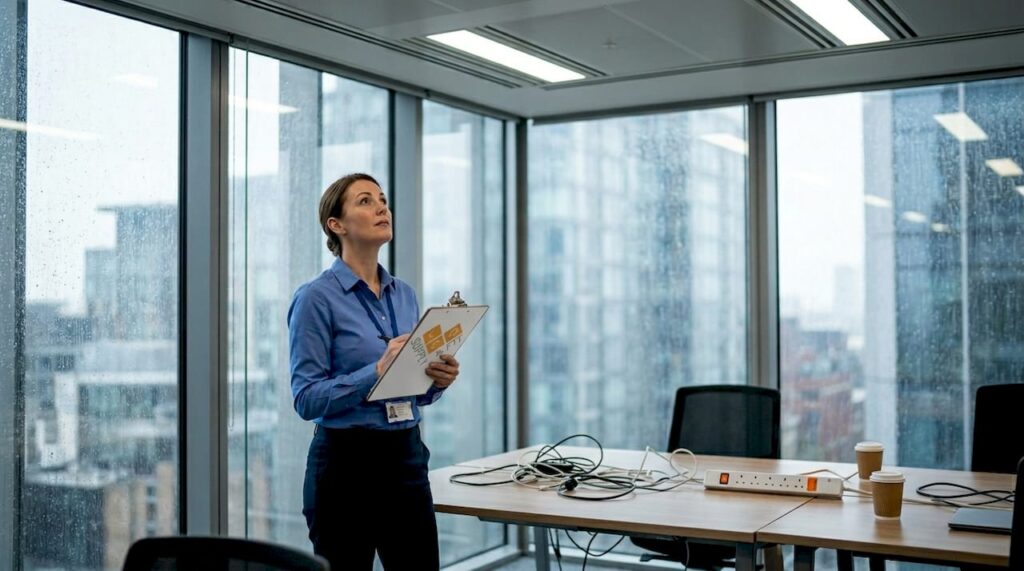
Before investing in LED upgrades, you need a clear picture of your current lighting performance. A thorough audit establishes baseline metrics for energy consumption, illuminance levels, and compliance gaps. Start by measuring existing lux levels across different office zones using a calibrated light metre. Document readings at desk height in workstations, meeting rooms, corridors, and reception areas during typical working hours.
Assess your current energy consumption by reviewing electricity bills and identifying lighting-related costs. Examine fixture conditions, noting any flickering, discolouration, or physical damage that signals immediate replacement needs. Check for compliance with current British standards, particularly BS EN 12464-1 requirements for office environments. This process reveals which areas fall short of the required 500 lux for workstations or suffer from excessive glare.
Your audit should include:
- Lux level measurements in all functional areas
- Energy consumption data from utility bills
- Fixture age, type, and condition assessment
- Compliance gap identification against British standards
- Employee feedback on lighting quality and comfort
Pro Tip: Schedule your audit during different times of day and weather conditions to understand how natural light affects your artificial lighting needs. This insight helps you optimise control strategies later.
Regular maintenance checks form part of your ongoing audit process. Daily visual inspections, monthly cleaning, and quarterly detailed reviews keep your lighting system performing optimally. Use audit results to prioritise areas for LED upgrades, focusing first on spaces with the highest energy consumption or poorest lighting quality. Document everything systematically, creating a reference point for measuring improvement after your LED installation.
Select suitable LED fixtures for office environments
Choosing the right LED fixtures requires balancing technical specifications with practical office needs. Your selection must meet British Standard BS EN 12464-1 requirements: 500 lux for general workstations, 300 to 500 lux for meeting rooms, and 200 lux for corridors. These aren’t arbitrary numbers but carefully researched levels that support visual comfort and productivity.

Look for fixtures with high luminous efficacy, typically 100 to 140 lumens per watt. This metric directly impacts your energy savings. Colour rendering index (CRI) should exceed 80 to ensure accurate colour perception, crucial for tasks involving design work or client presentations. Correlated colour temperature (CCT) around 4000K provides neutral white light that suits most office environments without feeling too clinical or too warm.
Pro Tip: Request sample fixtures for trial installation in a representative office area. This hands-on evaluation reveals how the lighting performs in your specific environment before committing to a full order.
Consider these essential fixture attributes:
- Luminous efficacy of 100 to 140 lm/W for optimal efficiency
- CRI ≥80 for accurate colour rendering
- CCT 4000K neutral white for office comfort
- Lifespan exceeding 50,000 hours to minimise replacements
- UGR ≤19 to prevent disabling glare on screens
| Fixture attribute | Standard requirement | Benefit to your office |
|---|---|---|
| Luminous efficacy | 100-140 lm/W | Lower energy bills, faster payback |
| Colour rendering | CRI ≥80 | Accurate colours, reduced eye strain |
| Unified glare rating | UGR ≤19 | Comfortable screen work, fewer headaches |
| Lifespan | 50,000+ hours | Reduced maintenance, lower replacement costs |
| IP rating | IP20 minimum (IP40 for kitchens) | Appropriate protection for environment |
Electrical compatibility matters significantly. Verify that your chosen fixtures work with existing circuits and control systems. Check IP ratings match the environment, with IP20 sufficient for standard offices but IP40 or higher needed for kitchens or areas with moisture. High-quality LED fixtures deliver consistent performance across their lifespan, maintaining light output and colour stability year after year.
Plan professional installation and integrate controls
Proper installation planning minimises disruption to your business operations whilst maximising LED performance. A phased rollout allows you to upgrade different office zones sequentially, avoiding the chaos of a complete shutdown. Start with areas that deliver the quickest returns, such as spaces with longest operating hours or highest current energy consumption.
Assess your electrical infrastructure before installation begins. Older buildings may require circuit upgrades to handle new LED loads safely, even though LEDs draw less power than traditional lighting. Check that existing wiring, switches, and distribution boards meet current regulations. Professional electricians should verify earth bonding, circuit protection, and compliance with BS 7671 wiring regulations.
Integrating lighting controls amplifies your energy savings dramatically. Occupancy sensors automatically switch off lights in unoccupied meeting rooms, toilets, and storage areas. Daylight sensors dim artificial lighting near windows when natural light suffices. These technologies can boost energy savings from 40% to 75% compared to basic LED upgrades alone. Phased installation with control integration reduces disruption whilst enhancing long-term returns.
Follow this installation checklist:
- Schedule installation during evenings or weekends to minimise disruption
- Verify electrical infrastructure capacity and compliance
- Install fixtures according to manufacturer specifications and British standards
- Integrate occupancy sensors in meeting rooms, toilets, and intermittent-use spaces
- Add daylight sensors near windows and perimeter zones
- Configure control systems and set appropriate time delays
- Test all circuits, controls, and emergency lighting functionality
- Commission the system with full documentation
- Train facilities staff on operation and basic troubleshooting
- Provide user guides for employees on control features
Professional installation ensures safety and performance. Qualified electricians understand the nuances of LED driver compatibility, dimming protocols, and emergency lighting integration. They provide certification confirming compliance with building regulations, essential for insurance and liability purposes. The benefits of lighting controls extend beyond energy savings to include improved occupant comfort and simplified facility management.
Verify post-installation performance and maintain efficiency
Installation completion isn’t the finish line but the start of your LED system’s operational life. Comprehensive performance verification confirms that your investment delivers promised benefits. Measure lux levels across all office zones using the same methodology as your initial audit. Compare results against BS EN 12464-1 requirements and your design specifications. Check that workstations achieve 500 lux, meeting rooms reach 300 to 500 lux, and uniformity ratios meet standards.
Assess glare using unified glare rating (UGR) measurements, particularly at workstations with computer screens. UGR should remain below 19 to prevent discomfort and productivity loss. Test all control systems thoroughly, verifying that occupancy sensors trigger correctly, daylight sensors respond appropriately, and time schedules operate as programmed. Emergency lighting requires separate testing to confirm compliance with BS EN 1838 standards.
Your verification checklist includes:
- Lux level measurements in all functional areas
- UGR assessment at representative workstations
- Control system functionality testing
- Emergency lighting duration and illuminance tests
- Energy consumption monitoring and comparison with projections
| Maintenance activity | Frequency | Impact on efficiency |
|---|---|---|
| Visual inspection for faults | Daily | Immediate issue identification |
| Luminaire cleaning | Monthly | Maintains light output levels |
| Detailed system inspection | Quarterly | Prevents performance degradation |
| Control sensor calibration | Annually | Optimises energy savings |
| Emergency lighting testing | Six-monthly | Ensures safety compliance |
Staff training ensures your LED system performs optimally throughout its lifespan. Educate facilities teams on basic troubleshooting, cleaning procedures, and when to call specialists. Train office employees on control features, encouraging them to report faults promptly and use manual overrides appropriately. Regular maintenance sustains the efficiency gains that justified your LED investment.
Implement a structured maintenance programme immediately after installation. Daily visual checks, monthly cleaning, and quarterly detailed inspections prevent minor issues from becoming costly problems. Clean luminaires maintain light output, whilst sensor calibration ensures controls continue saving energy. Keep detailed maintenance records, tracking lamp failures, control issues, and energy consumption trends.
Pro Tip: Set up automated energy monitoring to track consumption patterns over time. Unexpected increases signal potential issues like failed controls or incorrect settings, allowing quick intervention before costs escalate.
“Proper post-installation verification and ongoing maintenance typically add 10% to 15% to overall efficiency gains compared to systems without structured upkeep programmes. The investment in regular checks pays for itself through sustained performance and extended equipment life.”
Verify compliance with Part L Building Regulations requiring average luminous efficacy of 95 lm/W, HSE workplace lighting requirements, and BS EN 1838 emergency lighting standards. Document everything systematically, creating an audit trail that demonstrates due diligence and supports insurance claims if needed. Schedule annual professional reviews to assess system performance, identify optimisation opportunities, and plan for future upgrades.
Discover professional LED lighting solutions for UK offices
Navigating the LED lighting checklist becomes significantly easier with expert guidance and proven solutions. LED Supply & Fit specialises in commercial LED upgrades across the UK, bringing extensive experience in office environments similar to yours. Our team has successfully completed projects ranging from small business premises to large educational facilities, consistently delivering energy savings exceeding 50%.
Consider our work at Stockton Riverside College, where we transformed outdated lighting into an efficient LED system that reduced energy consumption by 65%. The Utility Alliance office project demonstrates our capability to integrate advanced controls whilst minimising disruption to daily operations. These case studies reflect the comprehensive approach outlined in this checklist, from initial audit through to ongoing maintenance support.
We offer complete solutions including lighting design, supply, professional installation, and aftercare. Our Darlington location provides convenient access for consultations, product demonstrations, and direct collection. Whether you need a full office refit or targeted upgrades in specific zones, our team tailors solutions to your operational requirements and budget. Contact LED Supply & Fit today to discuss how we can help you implement this checklist and achieve substantial, lasting energy savings.
Frequently asked questions
What is the recommended lux level for office lighting?
Office workstations require approximately 500 lux, whilst meeting rooms need 300 to 500 lux according to BS EN 12464-1. Corridors and circulation areas typically need 200 lux. These levels ensure comfortable visual conditions that support productivity without causing eye strain or excessive energy consumption.
How often should office LED lighting be maintained?
Implement daily visual checks, monthly cleaning, and quarterly detailed inspections to maintain optimal LED performance. Annual professional reviews assess system-wide performance and identify optimisation opportunities. This structured approach prevents degradation, sustains energy savings, and extends fixture lifespan significantly beyond manufacturers’ base estimates.
What energy savings can offices expect from LED upgrades?
LED upgrades typically deliver 40% to 75% energy savings compared to traditional lighting, with most office projects achieving reductions exceeding 50%. Payback periods range from one to three years depending on usage patterns and electricity costs. Control integration amplifies savings, with occupancy and daylight sensors adding an extra 15% to 25% reduction in consumption.
What standards must office LED lighting comply with in the UK?
Compliance with BS EN 12464-1, Part L Building Regulations, HSE workplace requirements, and BS EN 1838 is mandatory for UK office lighting. BS EN 12464-1 specifies illuminance levels and quality parameters. Part L requires minimum 95 lm/W average efficacy. HSE standards ensure adequate lighting for health and safety, whilst BS EN 1838 governs emergency lighting in commercial premises.