
Why lighting controls boost energy savings for UK firms
Many UK business owners believe lighting controls fail to deliver meaningful cost savings, often due to stories of systems that underperform or get overridden by frustrated staff. Yet this perception stems largely from poor commissioning and overly complex setups rather than flawed technology. When chosen carefully and installed correctly, lighting controls deliver substantial energy savings beyond LED upgrades alone. This guide explains why lighting controls matter for commercial properties, how to avoid common pitfalls, and what steps ensure you realise genuine financial and environmental benefits in 2026.
Key takeaways
| Point | Details |
|---|---|
| Additional savings potential | Lighting controls provide 10 to 40 per cent extra energy savings beyond LED upgrades when properly commissioned. |
| Commissioning quality matters | Up to 65 per cent of lighting control inefficiencies arise from poor setup, not technology faults. |
| Sensor technology advances | Presence detection sensors like PIR+ eliminate unnecessary linger time, reducing wasted energy significantly. |
| User-friendly design essential | Simple, intuitive controls prevent staff override and non-use, maximising system effectiveness. |
| ROI depends on measurement | Post-installation utility data tracking validates savings and strengthens the business case for investment. |
Common misconceptions about lighting controls and their true benefits
You might have heard colleagues complain that lighting controls waste more energy than they save or that staff constantly override sensors because rooms go dark unexpectedly. These frustrations are real, but they rarely reflect fundamental technology failures. Research shows 65 per cent of lighting control inefficiencies stem from commissioning errors like dead sensor zones, misconfigured dimming levels, or incorrect linger time settings. When installers skip proper calibration or use generic factory defaults, systems behave unpredictably and users lose trust.
Linger time is a prime example of misunderstood technology. Traditional occupancy sensors keep lights on for a preset period after detecting no movement, often 10 to 20 minutes. This design wastes energy in spaces where people briefly pass through or sit very still. Advanced presence detection sensors, known as PIR+, continuously monitor micro-movements and switch off lighting within seconds of a room becoming truly vacant. Eliminating excessive linger time can cut lighting energy use by another 20 to 30 per cent compared to basic occupancy sensors.
User resistance often arises from overly complex control interfaces. Staff faced with confusing wall panels or smartphone apps that require multiple steps simply revert to manual switches or disable automation entirely. Effective systems prioritise simplicity, offering intuitive physical controls and clear visual feedback. When users understand how sensors work and trust them to respond appropriately, override rates plummet and energy savings materialise.
Key factors for successful lighting control deployment:
- Professional commissioning tailored to each space’s usage patterns
- Presence detection technology (PIR+) instead of basic occupancy sensors
- Simple, clearly labelled physical controls accessible to all staff
- Comprehensive user training explaining system benefits and operation
- Regular maintenance checks to ensure sensors remain properly aligned
Proper setup transforms lighting controls from a source of frustration into a reliable energy management tool. The technology works when given the right foundation.
How lighting controls enhance energy efficiency beyond LED upgrades
Switching from fluorescent or halogen lighting to LEDs typically cuts energy consumption by 50 to 70 per cent. Adding lighting controls can deliver another 10 to 40 per cent savings on top of that baseline, though actual results vary widely based on building type, occupancy patterns, and system sophistication. A warehouse with irregular shift patterns might see 35 per cent additional savings from occupancy sensors and scheduling, while a consistently occupied office might achieve 15 per cent through daylight dimming alone.
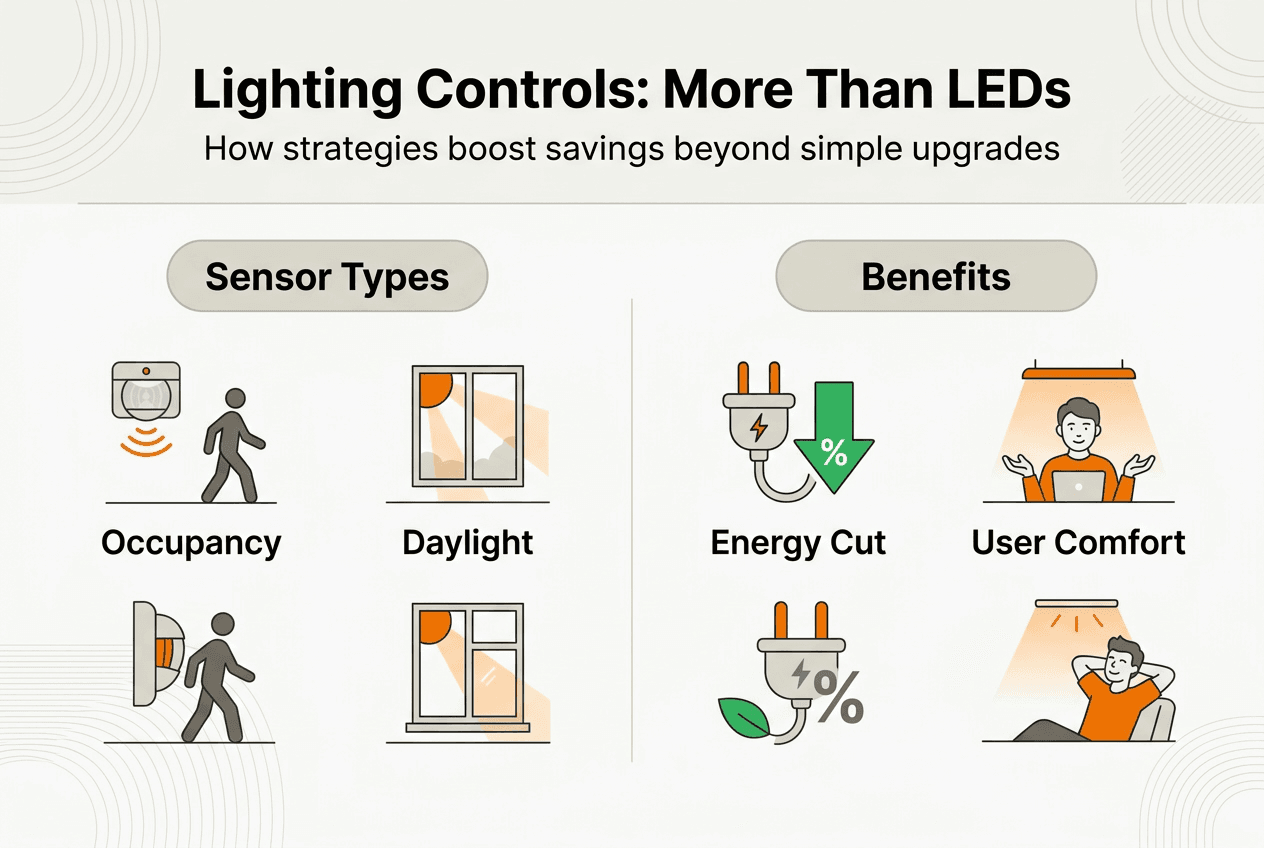
The most effective lighting control strategies combine multiple technologies matched to specific spaces. Occupancy sensors suit meeting rooms, toilets, and storage areas with intermittent use. Daylight harvesting systems adjust artificial lighting levels in perimeter zones with windows, maintaining consistent illumination whilst reducing electricity demand during sunny periods. Time-based scheduling ensures lights switch off outside business hours, eliminating the common problem of entire floors staying lit overnight because one person forgot to flip a switch.
High upfront costs remain a significant barrier for many businesses. A comprehensive lighting control system for a 5,000 square metre commercial building might cost £15,000 to £30,000 including hardware, installation, and commissioning. However, cost-saving LED lighting strategies that include controls often pay back within three to five years through reduced electricity bills and lower maintenance requirements. Simpler, fit-for-purpose systems cost substantially less and deliver faster returns than all-in-one platforms with features you’ll never use.
Common lighting control technologies and typical applications:
- Occupancy sensors: Meeting rooms, toilets, storage areas, corridors
- Daylight dimming: Perimeter offices, retail spaces with skylights, atriums
- Time scheduling: Entire buildings, car parks, external signage
- Manual dimming: Presentation rooms, restaurants, hotel lobbies
- Integrated systems: Large multi-zone facilities requiring centralised management
| Control type | Energy saving potential | Best suited for | Typical cost per zone |
|---|---|---|---|
| Basic occupancy sensor | 20 to 30 per cent | Small rooms, toilets | £80 to £150 |
| Presence detection (PIR+) | 30 to 40 per cent | Offices, meeting rooms | £150 to £300 |
| Daylight harvesting | 15 to 25 per cent | Perimeter zones with windows | £200 to £400 |
| Time scheduling | 10 to 20 per cent | Entire building zones | £500 to £2,000 |
| Integrated smart system | 25 to 40 per cent | Multi-zone facilities | £3,000 to £10,000+ |
Pro Tip: Measure your baseline energy consumption before installing controls, then track utility data monthly for at least six months afterwards. This evidence-based approach proves actual savings to stakeholders and helps refine system settings for optimal performance.
Choosing simpler systems improves both user acceptance and reliability. A basic occupancy sensor with clear on/off behaviour is far more likely to remain in active use than a sophisticated dimming controller requiring staff training and regular adjustment. LED lighting cost-saving tips emphasise matching technology sophistication to genuine operational needs rather than purchasing unnecessary features.
Best practices for selecting and commissioning lighting controls in commercial buildings
Not every lighting control system suits every space. Microwave sensors excel in large open areas like warehouses and sports halls because they detect movement through partitions and shelving, whilst PIR sensors work better in smaller offices where line-of-sight coverage is straightforward. Photocells optimise outdoor lighting by automatically adjusting output based on ambient light levels, reducing energy waste during dawn and dusk periods. Expert guidance recommends fit-for-purpose controls like microwave sensors for expansive interiors and photocells for car parks rather than attempting to force one technology into every application.
Commissioning quality determines whether your investment delivers promised savings or becomes another source of frustration. Professional installers calibrate sensor sensitivity, adjust time delays, set dimming curves, and verify coverage zones during commissioning. Skipping this step or rushing through it causes the dead zones, false triggers, and inappropriate dimming levels that plague poorly performing systems. Allocate sufficient budget and time for thorough commissioning, ideally with occupants present to provide real-world feedback during testing.
Measuring post-installation utility data validates energy savings and identifies remaining optimisation opportunities. Smart meters or sub-metering systems provide granular consumption data that reveals whether specific zones or times of day still waste energy. This evidence-based approach transforms lighting controls from a speculative investment into a proven energy consumption reduction strategy with quantifiable returns.
Training end users reduces override risks and non-use. Staff need to understand how sensors work, why lights might dim or switch off, and how to manually override controls when necessary without permanently disabling automation. A brief 15-minute training session during installation, supplemented by simple visual guides near control panels, dramatically improves acceptance rates and long-term system effectiveness.
Essential selection criteria for commercial lighting controls:
- Match sensor technology to space characteristics (size, layout, occupancy patterns)
- Prioritise simple, intuitive interfaces over feature-rich complexity
- Verify compatibility with existing LED fixtures and electrical infrastructure
- Confirm installer experience with commercial commissioning, not just residential
- Request post-installation support and optimisation services
| Space type | Recommended control | Key benefits | Common pitfalls to avoid |
|---|---|---|---|
| Large warehouse | Microwave sensors | Detects movement through obstacles | Poor zone design causing dead spots |
| Small office | PIR presence detection | Instant response to occupancy | Excessive sensitivity causing false triggers |
| Perimeter office | Daylight dimming | Maintains consistent light levels | Incorrect photocell placement or calibration |
| Car park | Photocell plus timer | Optimises outdoor lighting automatically | Failing to account for seasonal light changes |
| Meeting room | Occupancy sensor plus manual override | Balances automation with user control | Inadequate override duration settings |
Pro Tip: Implement lighting controls in phases, starting with high-traffic areas where savings will be most visible and measurable. Success in initial zones builds stakeholder confidence and provides lessons that improve subsequent rollouts.
Maintain simple and intuitive interfaces to encourage proper use. Wall-mounted control panels should feature clearly labelled buttons, LED status indicators, and obvious override options. Avoid smartphone apps or complex programming requirements for day-to-day operation, reserving advanced features for facilities managers who receive comprehensive training.
Overcoming challenges and maximising return on investment with lighting controls
Initial investment costs deter many businesses from adopting lighting controls, particularly when budgets are tight or payback periods extend beyond three years. However, long-term energy cost reductions typically offset upfront expenses within three to five years, with systems continuing to deliver savings for 10 to 15 years afterwards. Financing options like energy performance contracts or green business loans can spread costs whilst capturing immediate savings.
Integration complexity increases when retrofitting controls into existing buildings with mixed lighting types, outdated wiring, or no central management infrastructure. Choosing compatible, scalable systems that work with current LED fixtures minimises disruption and additional electrical work. Wireless control solutions eliminate the need for extensive rewiring, though they require reliable network connectivity and periodic battery replacements for sensor nodes.
User resistance decreases substantially with proper training and easy-to-use controls. Staff who understand why lighting turns off after they leave a room, or why brightness adjusts automatically near windows, are far less likely to disable sensors or complain about system behaviour. Involving key staff members in system design and testing phases builds buy-in and identifies usability issues before full deployment.
Practical strategies for maximising lighting control ROI:
- Start with high-impact zones offering quickest payback (toilets, corridors, meeting rooms)
- Choose wireless systems to avoid costly rewiring in existing buildings
- Negotiate bulk pricing when combining lighting upgrades with control installation
- Leverage government energy efficiency grants or tax incentives available in 2026
- Document baseline energy consumption before installation for accurate savings measurement
- Schedule annual maintenance checks to ensure sensors remain properly calibrated
Stepwise implementation eases transition and budget impact. Rather than attempting a building-wide rollout, focus initial efforts on 20 to 30 per cent of floor space where occupancy patterns make savings most certain. Demonstrable success in these pilot zones secures funding and stakeholder support for broader deployment. This phased approach also allows you to refine installation processes and user training based on early feedback.
Common implementation phases for commercial properties:
- Assessment: Energy audit identifies highest-potential spaces and establishes baseline consumption
- Pilot installation: Deploy controls in 2 to 3 representative zones with different usage patterns
- Measurement period: Track energy data for 3 to 6 months whilst gathering user feedback
- Optimisation: Adjust sensor settings, dimming curves, and time schedules based on real-world performance
- Phased rollout: Extend controls to remaining zones using lessons learned from pilot
- Ongoing monitoring: Continue tracking consumption data and conducting annual maintenance
Regular maintenance keeps systems efficient and effective. Sensor lenses accumulate dust that reduces sensitivity, mounting brackets loosen causing misalignment, and software updates improve functionality. Annual service visits cost £200 to £500 for typical commercial installations but prevent the gradual performance degradation that undermines long-term savings.
Measuring and communicating savings reinforces stakeholder support. Monthly energy reports showing consumption trends, cost reductions, and carbon emissions avoided demonstrate tangible value and justify continued investment in optimisation. Visual dashboards displaying real-time lighting energy use can engage staff and encourage energy-conscious behaviour beyond automated controls.
Upgrading commercial lighting with integrated controls delivers greater total savings than LED fixtures alone, whilst smart lighting solutions provide the flexibility to adapt to changing business needs over time. The key is matching system sophistication to genuine operational requirements rather than over-engineering solutions that confuse users and waste budget.
Explore smart lighting solutions with LED Supply & Fit
LED Supply & Fit specialises in tailored LED lighting and smart control systems designed specifically for UK commercial properties. Whether you manage a retail space, warehouse, office complex, or hospitality venue, our team helps you select fit-for-purpose solutions that deliver measurable energy savings without unnecessary complexity. We’ve supported businesses like Utility Alliance in achieving significant cost reductions through properly commissioned lighting systems.

Our commercial LED lighting range includes products compatible with leading control technologies, from basic occupancy sensors to sophisticated daylight harvesting systems. Expert guidance ensures you invest in controls matched to your building’s characteristics and usage patterns. Discover how lighting controls cut energy costs by exploring our case studies and product specifications, or contact our team for a tailored assessment of your property’s lighting optimisation potential.
Frequently asked questions
What are lighting controls and how do they work?
Lighting controls are automated systems that manage artificial lighting based on occupancy, available daylight, time schedules, or manual input. They use sensors, timers, and dimming circuits to optimise energy consumption whilst maintaining appropriate illumination levels. Common technologies include occupancy sensors that detect movement, photocells that measure ambient light, and programmable timers that switch lights on or off at predetermined times.
How much can businesses save with lighting controls in 2026?
Properly commissioned lighting controls typically deliver 10 to 40 per cent additional energy savings beyond LED lighting upgrades alone. Actual savings depend on building type, occupancy patterns, control sophistication, and commissioning quality. A warehouse with irregular usage might achieve 35 per cent savings through occupancy sensing and scheduling, whilst a consistently occupied office might realise 15 per cent through daylight dimming.
What challenges could affect lighting control performance?
Poor commissioning causes approximately 65 per cent of lighting control inefficiencies, including dead sensor zones, incorrect dimming levels, and inappropriate time delays. Overly complex systems may lead to user override or non-use without comprehensive training. Integration challenges in existing buildings, high upfront costs, and inadequate post-installation optimisation can also undermine performance and return on investment.
How do I choose the right lighting control system for my commercial property?
Select fit-for-purpose systems matched to each space’s characteristics rather than all-in-one solutions with unnecessary features. Microwave sensors suit large open areas, PIR presence detection works well in offices and meeting rooms, and photocells optimise outdoor lighting. Prioritise simple, intuitive controls that staff can understand and operate without extensive training. Professional commissioning and post-installation measurement are essential for verifying savings and optimising performance.