Role of emergency lighting: a guide for UK property managers
TL;DR:
- Emergency lighting ensures safe evacuation during power failures and must comply with UK standards like BS 5266-1 and the Fire Safety Order. Routine monthly and annual tests, documented in dedicated logbooks, are essential to maintain legal compliance and safety; upgrading to LED reduces energy costs and improves system reliability. Proper management and regular testing safeguard against enforcement penalties and insurance issues, making ongoing maintenance critical regardless of installation age.
Emergency lighting is one of those building systems that property managers rarely think about until something goes wrong. Yet the role of emergency lighting extends well beyond a legal checkbox. It directly affects whether your occupants can evacuate safely during a power failure, whether your premises pass a fire safety inspection, and how much you spend on energy and maintenance each year. If you are managing a commercial property in the UK and have not revisited your emergency lighting setup recently, this guide covers everything you need: legal duties, testing regimes, upgrade options, and practical management habits.
Key Takeaways
| Point | Details |
|---|---|
| Emergency lighting is legally mandatory | All UK commercial premises must have emergency lighting that complies with BS 5266-1 to ensure safe evacuation. |
| Routine testing is crucial | Monthly functional tests and annual full duration tests prove your system works when needed and keep you compliant. |
| LED upgrades save costs and improve reliability | Modern emergency LED lighting reduces energy use and maintenance demands while meeting current regulations. |
| Keep accurate records | Document all testing and repairs meticulously to avoid enforcement penalties and insurance issues. |
| Compliance depends on testing, not just installation age | Regular, documented tests demonstrating full performance are your legal safeguard, not the date of installation. |
Understanding emergency lighting and its legal role
Emergency lighting exists for one purpose: to ensure people can safely evacuate a building when normal lighting fails. That means illuminating escape routes, exit signs, and areas of high risk, such as stairwells, plant rooms, and corridors, at a level sufficient for people to navigate and reach safety.
In the UK, emergency lighting compliance is built around two key pillars. The first is BS 5266-1, the code of practice covering the design, installation, and maintenance of emergency lighting in non-domestic premises. The second is the Regulatory Reform (Fire Safety) Order 2005, which places a legal duty on the “responsible person,” typically the owner or manager of a commercial premises, to ensure fire safety measures, including emergency lighting, are fit for purpose.
BS 5266-1 governs emergency lighting alongside fire safety legal duties for responsible persons across all non-domestic settings. That covers a wide range of premises:
- Offices and retail units
- Hotels and serviced accommodation
- Restaurants, bars, and hospitality venues
- Gyms, leisure centres, and sports facilities
- Warehouses and industrial premises
- Public buildings and healthcare facilities
Emergency lighting installations fall into two broad categories. Maintained systems remain illuminated at all times, doubling as normal lighting while also functioning as emergency lighting. Non-maintained systems only activate when the mains supply fails. Which type you need depends on the occupancy type and the findings of your fire risk assessment.
Testing requirements and compliance maintenance for emergency lighting
Knowing your legal obligations is one thing. Keeping your system compliant week to week is another. BS 5266-1 sets out a clear testing regime that every responsible person must follow, and the emergency lighting compliance picture for most commercial premises involves two distinct test types.
Monthly functional tests and annual full-duration tests are required by BS 5266-1, with annual tests typically running for three hours. Here is how each works in practice:
- Monthly functional test. Simulate a mains failure for five to ten seconds. Every luminaire and exit sign should illuminate immediately. Record the result, including any units that failed to activate, and arrange repairs promptly.
- Annual full-duration test. Disconnect the mains supply and allow the battery-backed system to run for its full rated duration, typically three hours. This proves battery capacity and confirms the system will perform as required in a real emergency.
- Post-test rectification. Any faults identified during either test must be logged and fixed before the next inspection or occupancy period. Leaving known faults unresolved is one of the most common reasons premises fail fire safety audits.
- Record keeping. Every test result, fault, and remedial action must be documented in a logbook. This is your primary evidence of compliance if enforcement authorities visit.
- Certification. For premises subject to formal inspections, consider having your annual test independently certified to provide defensible proof of compliance.
Pro Tip: Use a dedicated emergency lighting logbook rather than adding test results to a general maintenance spreadsheet. Inspectors expect a clear, dedicated record, and mixing it with other maintenance logs creates unnecessary confusion during audits.
Benefits of upgrading to energy-efficient emergency LED lighting
Older emergency lighting systems, particularly those using fluorescent or tungsten lamps, are far more costly to run than most property managers realise. Switching to modern LED technology changes the economics significantly.
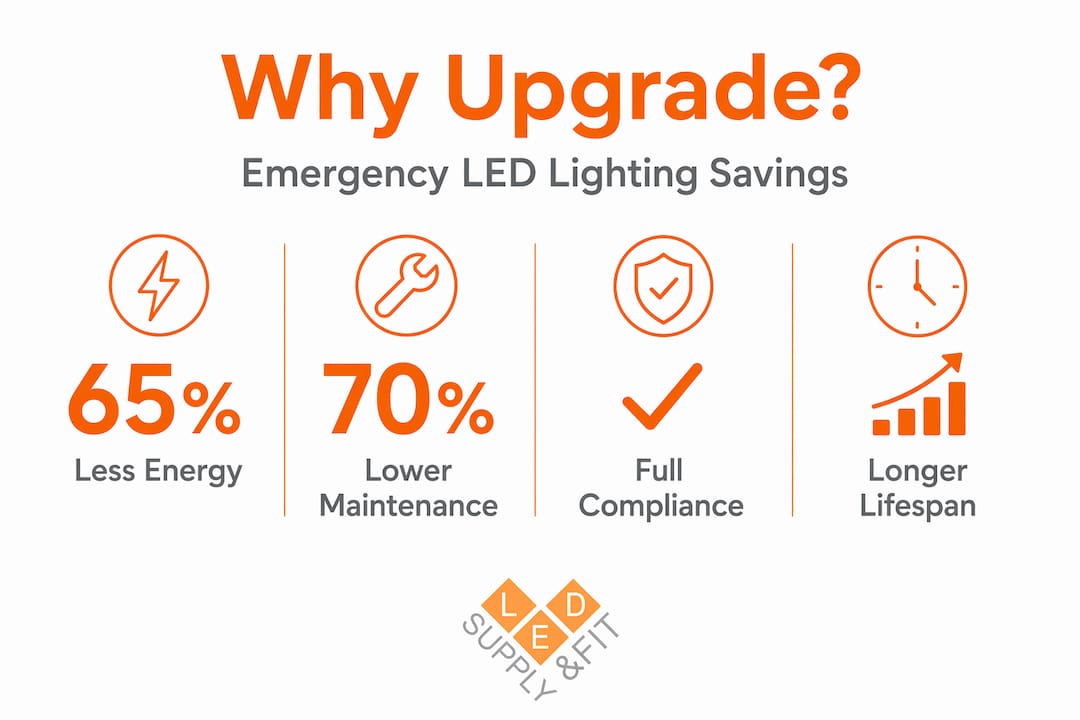
Emergency LED lighting reduces energy use by up to 65% and maintenance costs by 70%, while delivering full compliance and improved safety. That is not marginal, it is transformational for a system that runs continuously in maintained installations.
| Feature | Traditional (fluorescent/tungsten) | Modern LED emergency lighting |
|---|---|---|
| Lamp lifespan | 2,000 to 8,000 hours | 30,000 to 50,000+ hours |
| Energy consumption | High | Up to 65% lower |
| Battery type | NiCd (often older, bulkier) | Lithium-ion or NiMH |
| Maintenance frequency | Every 1 to 2 years typically | Every 3 to 5 years |
| BS 5266-1:2025 compliance | Often non-compliant in older installs | Designed to current standards |
| Carbon footprint | Higher | Significantly lower |
Modern systems also bring improved battery health management as a practical benefit. Lithium-ion and NiMH cells hold their charge more consistently over time than older nickel-cadmium batteries, which are now banned from sale in many applications due to environmental regulations.
For commercial property managers, the business case stacks up quickly:
- Lower electricity bills from reduced wattage in maintained systems
- Fewer lamp replacements and call-out costs
- Longer intervals between full system overhauls
- Reduced carbon emissions, relevant if your premises targets sustainability ratings
- Compliance with the updated BS 5266-1:2025 standard from day one
Pro Tip: When specifying an upgrade, check that your new LED emergency fittings meet BS 5266-1:2025 requirements for circuit diversity and full escape route coverage. A cheaper fitting that does not meet the standard saves nothing if it triggers a compliance failure.
Practical tips for managing emergency lighting efficiently
Understanding the compliance framework and the benefits of upgrading still leaves the day-to-day management question unanswered. Here is what well-run commercial premises actually do.
Routine testing and evidence-based maintenance are the foundation of a system that performs effectively and holds up under scrutiny. These habits make the difference:
- Maintain a dedicated logbook. Record every monthly test, annual test, fault discovered, and action taken. This is your legal paper trail and your best protection if anything goes wrong.
- Set calendar reminders for monthly tests. It sounds obvious, but missed monthly tests are one of the leading causes of compliance failures in commercial premises during routine inspections.
- Monitor battery condition proactively. Do not wait for the annual test to discover a dead battery. Many modern LED emergency units include self-diagnostic indicators that flag battery issues between scheduled tests.
- Integrate emergency lighting into your broader fire safety review. Your fire risk assessment should reference your emergency lighting provision. When you update one, update the other.
- Plan upgrades during scheduled maintenance cycles. Replacing a failing fluorescent emergency fitting with a compliant LED unit during a planned maintenance visit costs far less than an emergency call-out, and you avoid a compliance gap.
- Work with a qualified contractor for annual full-duration tests. Self-certification is permitted in some settings, but independent testing provides documentation that carries more weight with insurers and enforcement bodies.
Pro Tip: If your premises has multiple floors or complex escape routes, number each emergency luminaire on a site plan and reference those numbers in your logbook. It turns a vague test record into a traceable, auditable document.
Why routine testing and records matter more than installation date
Here is something that does not get said often enough: a brand-new emergency lighting system that is never properly tested is less compliant than a five-year-old system with thorough, documented maintenance records.
Property managers sometimes assume that a recent installation gives them a clean bill of health for several years. It does not. Compliance audits focus on demonstrated capability during full discharge tests, not on when the system was installed. Battery degradation can begin within 18 months on cheaper units. Skipping even one or two monthly tests creates a gap that looks troubling in an audit.
The Regulatory Reform (Fire Safety) Order is explicit: the responsible person must be able to show that fire safety measures, including emergency lighting, are functional and maintained. That means records, not receipts. Enforcement officers are not interested in your installer’s invoice. They want to see a logbook showing monthly tests, annual results, and faults resolved.
This is also worth considering from an insurance standpoint. If a fire or evacuation incident occurs and you cannot demonstrate that emergency lighting was regularly tested and maintained, your insurer may have grounds to challenge a claim. The emergency lighting testing records you keep are not just a compliance formality. They are a financial safeguard.
The practical implication is straightforward: make testing and documentation habits, not tasks you get round to eventually.
How LED Supply & Fit can help with your emergency lighting upgrades
Taking everything covered in this guide and turning it into action is where many property managers stall. The knowledge is there; finding the right supplier and installer to execute it efficiently is the harder step.
At LED Supply & Fit, we work with commercial property managers across the UK to plan and deliver emergency LED lighting upgrades that are fully compliant with current UK standards, reduce running costs, and simplify your ongoing maintenance responsibilities. Whether you manage a single retail unit or a portfolio of commercial properties, our team handles specification, supply, and installation. We also offer ongoing testing and maintenance support so your emergency lighting compliance stays on track without taking up your time. For a broader view of how better lighting choices can cut your energy bills across the whole building, explore our cost-saving LED lighting strategies for UK commercial properties.
Frequently asked questions
What is the legal standard for emergency lighting in UK commercial properties?
For UK compliance, emergency lighting in non-domestic premises is governed by BS 5266-1, the British Standard covering design, installation, and maintenance, alongside duties set out in the Regulatory Reform (Fire Safety) Order 2005.
How often must emergency lighting be tested?
Monthly functional tests and annual full-rated duration tests are required by BS 5266-1, with the annual test typically lasting three hours to confirm battery and system performance.
What are the benefits of upgrading to emergency LED lighting?
Emergency LED lighting reduces energy use by up to 65% and lowers maintenance costs by 70%, while ensuring your installation meets current UK standards from day one.
Who is responsible for emergency lighting maintenance in commercial premises?
The “responsible person,” typically the building owner or manager, must ensure regular testing, maintenance, and documentation under the Regulatory Reform (Fire Safety) Order 2005. This duty cannot be delegated away, only managed with the right support.
What happens if emergency lighting tests are not documented or faults not fixed?
Lack of maintenance records exposes the responsible person to enforcement action under the Regulatory Reform (Fire Safety) Order, including fines, prosecution, or potential insurance invalidation.