
LED Lighting Terminology – Smarter Choices for UK Businesses
Navigating LED lighting terms can be challenging when specifying smarter solutions for commercial spaces. Facility managers across the United Kingdom face increasing pressure to reduce energy costs and improve sustainability. By mastering the essentials of LED lighting terminology, you gain the confidence to choose products that optimise efficiency, long-term value, and comfort for every business environment.
Table of Contents
- Key LED Lighting Terms Defined
- Types of LED Lighting and Their Uses
- Essential Metrics: Brightness, Colour, and Efficiency
- Understanding IP Ratings and Safety Standards
- Common Pitfalls in LED Lighting Selection
Key Takeaways
| Point | Details |
|---|---|
| Understanding Key Terminology | Facility managers must grasp essential LED vocabulary such as Lumens, Colour Temperature, and CRI to make informed lighting decisions. |
| Importance of Thermal Management | Effective heat dissipation is critical for prolonging LED lifespan and optimising performance in commercial environments. |
| Comprehensive Evaluation of Metrics | Key metrics like Efficacy and Luminaire Efficacy should be carefully evaluated to ensure energy efficiency and optimal lighting system performance. |
| Avoiding Common Pitfalls | Businesses should avoid selection mistakes by seeking independent verification of performance claims and matching lights to installation conditions. |
Key LED Lighting Terms Defined
Navigating the world of LED lighting can feel like decoding a complex technical language. Understanding key terminology empowers facility managers to make smarter, more strategic lighting decisions for commercial spaces across the United Kingdom.
Let’s break down the essential LED lighting terms every business professional should know:
- LED (Light Emitting Diode): A semiconductor device that converts electrical energy directly into light, offering significantly higher energy efficiency compared to traditional lighting technologies
- Lumens: A measurement of total light output, indicating how bright a light source appears to the human eye
- Colour Temperature: The perceived warmth or coolness of white light, measured in Kelvin (K), ranging from warm yellow tones (2700K) to cool bluish-white (6500K)
- Colour Rendering Index (CRI): A scale from 0-100 measuring how accurately a light source reveals object colours compared to natural daylight
Technical specifications become critically important when selecting LED lighting options. Modern LED technology goes beyond simple illumination, offering nuanced performance characteristics that can dramatically impact workplace environments.
For commercial settings, understanding thermal management is crucial. Heat sinks play a vital role in LED performance, dissipating excess heat to maintain consistent light output and extend the product’s operational lifespan. The more effectively heat is managed, the longer and more reliably your LED lighting will perform.
Lumen Depreciation represents how LED lights gradually reduce brightness over time, rather than suddenly burning out like traditional bulbs. Professional-grade LEDs typically maintain 70% of their original brightness after 50,000 hours of operation, providing exceptional long-term value for businesses.
Pro tip: When specifying LED lighting, always request manufacturer photometric data to understand precise light distribution and performance characteristics in your specific commercial environment.
Types of LED Lighting and Their Uses
LED lighting has revolutionised commercial illumination with its versatility and efficiency, offering businesses multiple options to enhance workspace functionality and aesthetic appeal. Understanding the diverse range of LED lighting types enables facility managers to make strategic choices tailored to specific environmental requirements.
Commercial LED lighting solutions can be categorised into several key types:
-
Recessed Downlights: Ideal for creating uniform, focused illumination in offices, reception areas, and conference rooms
-
Panel Lights: Perfect for suspended ceiling installations in corporate environments, providing even, glare-free lighting
-
Strip Lighting: Versatile option for task lighting, display areas, and creating ambient architectural effects
-
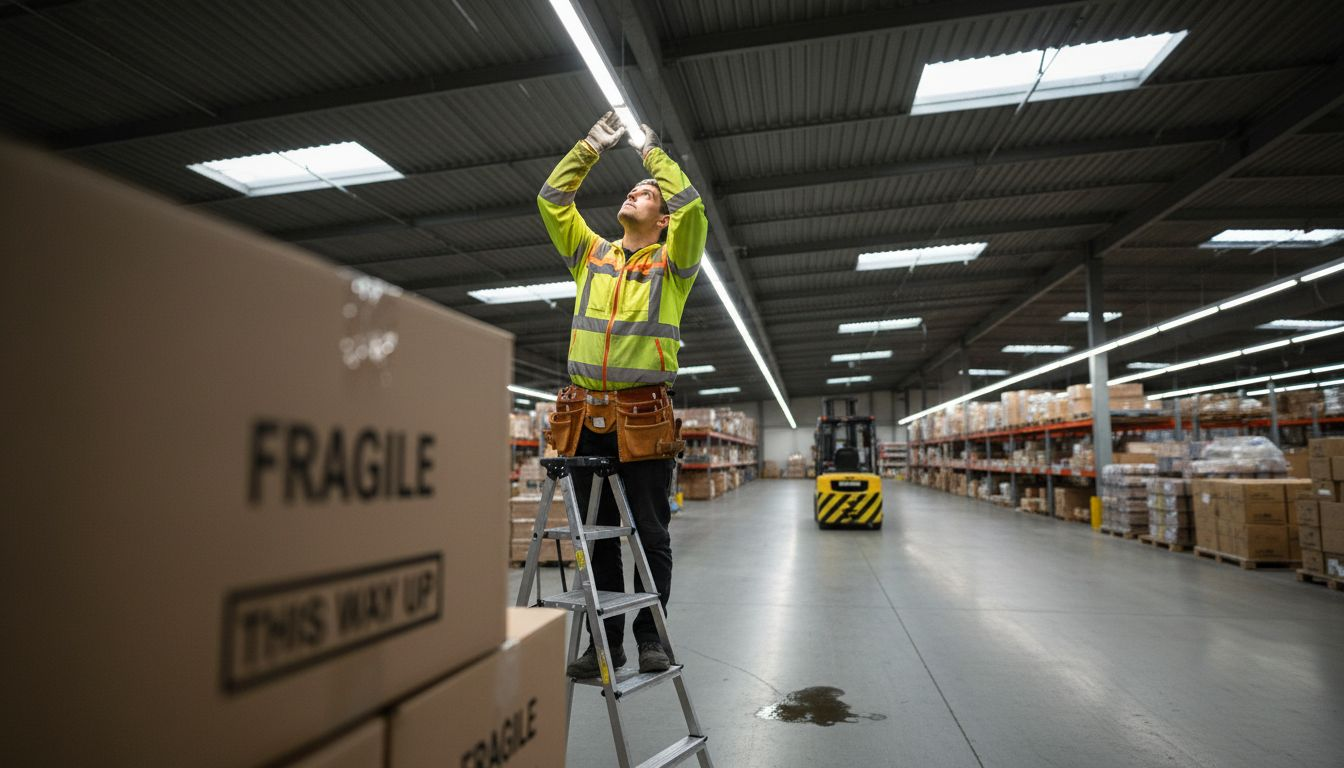
High Bay Lights: Essential for industrial spaces, warehouses, and manufacturing facilities with high ceiling heights
Industrial and commercial LED lighting options demonstrate remarkable technological advancement. Modern LED solutions go beyond basic illumination, offering targeted light distribution that dramatically improves workplace efficiency and energy consumption.
Specialised LED technologies continue to emerge, expanding potential applications across different commercial sectors. Surface-emitting LEDs provide general illumination, while edge-emitting LEDs offer more focused optical output suitable for precise task lighting. Some advanced variants like organic LEDs (OLEDs) are finding innovative uses in display technologies and specialised commercial environments.
The adaptability of LED lighting allows businesses to create customised lighting solutions that enhance both functional performance and aesthetic appeal. From retail display areas to complex industrial settings, LED technologies can be precisely configured to meet specific environmental and operational requirements.
Here is a summary of key LED lighting technologies and their ideal business applications:
| LED Type | Typical Application Area | Main Advantages |
|---|---|---|
| Recessed Downlights | Offices, reception, conference | Uniform lighting, modern appearance |
| Panel Lights | Corporate ceilings | Even, glare-free illumination |
| Strip Lighting | Task zones, displays, retail | Flexible placement, subtle ambience |
| High Bay Lights | Warehouses, manufacturing | Suitable for high ceilings, robust |
| Surface-emitting LEDs | General commercial areas | Diffuse, broad coverage |
| Edge-emitting LEDs | Task-specific, accent lighting | Focused, controlled beam direction |
| Organic LEDs (OLEDs) | Speciality displays, retail | Thin, flexible, premium quality |
Pro tip: Conduct a comprehensive lighting audit to determine which LED types will provide optimal performance and energy efficiency for your specific commercial space.
Essential Metrics: Brightness, Colour, and Efficiency
Understanding the critical metrics of LED lighting empowers UK businesses to make informed decisions that balance performance, energy consumption, and visual quality. These essential measurements go far beyond simple illumination, providing a comprehensive framework for evaluating lighting solutions.
Key performance metrics for LED lighting include:
- Lumens: Measuring total light output and brightness levels
- Colour Temperature: Indicating the warmth or coolness of light (measured in Kelvin)
- Colour Rendering Index (CRI): Assessing how accurately colours appear under the light source
- Efficacy: Calculating the ratio of light output to electrical power consumed
LED energy efficiency metrics reveal the significant technological advantages of modern lighting solutions. Efficacy, in particular, demonstrates how LEDs convert electrical power into luminous output with remarkable precision, typically outperforming traditional lighting technologies by substantial margins.
Commercial facility managers must pay close attention to luminaire efficacy, which accounts for the entire lighting system’s performance. This metric considers not just the LED package efficiency, but also factors like driver performance and thermal management. A high-quality LED solution might lose up to 20-30% of its theoretical efficiency through these secondary system components, making comprehensive evaluation crucial.
Colour performance remains equally critical in commercial environments. The Colour Rendering Index (CRI) helps businesses select lighting that accurately represents colours, which is particularly important in retail, design studios, and presentation spaces. Higher CRI values (80+ on a 100-point scale) ensure that colours appear natural and vibrant, directly impacting visual comfort and perception.
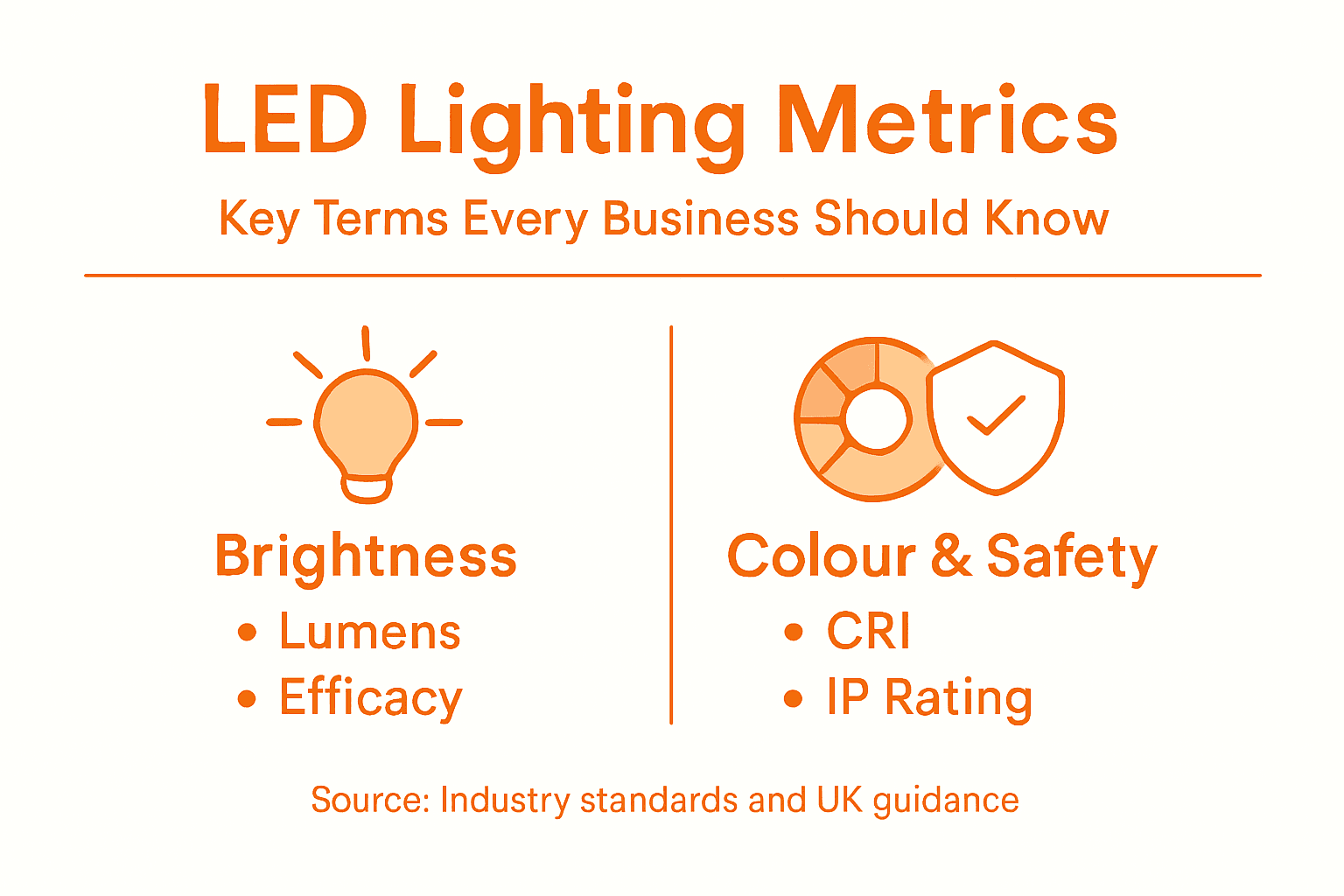
The following table provides a quick reference to major LED performance metrics and their influence on commercial environments:
| Metric | What it Measures | Business Impact |
|---|---|---|
| Lumens | Total light output | Visible brightness for users |
| Colour Temperature | Perceived warmth or coolness | Visual mood and ambience |
| Colour Rendering Index | Naturalness of colour representation | Accuracy in colour-critical settings |
| Efficacy | Light output per power consumed | Determines energy efficiency, cost |
| Luminaire Efficacy | Complete system performance | Realistic assessment of value, savings |
Pro tip: Request comprehensive photometric data from manufacturers to understand the complete performance profile of LED lighting solutions beyond basic specification sheets.
Understanding IP Ratings and Safety Standards
Navigating the complex world of LED lighting safety standards requires a comprehensive understanding of IP ratings and certification requirements. These technical specifications are crucial for ensuring electrical safety, environmental protection, and optimal performance across diverse commercial environments in the United Kingdom.
Key components of LED lighting safety standards include:
- IP Ratings: Indicating ingress protection against solid objects and moisture
- Electrical Safety Certifications: Verifying product compliance with national standards
- Performance Testing: Evaluating durability and operational reliability
- Environmental Compliance: Ensuring minimal hazardous material usage
LED lighting safety standards and certifications provide critical guidance for commercial facility managers. IP Ratings, a fundamental safety metric, consist of two digits describing protection levels: the first indicates solid object protection (0-6 scale), while the second measures moisture resistance (0-8 scale).
Commercial environments demand rigorous safety standards. Understanding these ratings helps businesses select appropriate lighting solutions. For instance, an IP65 rating signifies complete dust protection and resistance to water jets, making it ideal for industrial settings with challenging environmental conditions. Different sectors require specific protection levels, from minimally protected indoor spaces to heavily exposed external installations.
Regulatory bodies like Underwriters Laboratories (UL) and ENERGY STAR play pivotal roles in establishing comprehensive safety benchmarks. These organizations develop stringent testing protocols that evaluate not just individual component performance, but entire lighting system reliability, including potential failure modes and long-term operational integrity.
Pro tip: Always request comprehensive certification documentation when selecting LED lighting, ensuring complete compliance with UK safety regulations and industry standards.
Common Pitfalls in LED Lighting Selection
Selecting the right LED lighting solution requires more than a simple product comparison. UK businesses often encounter complex challenges that can significantly impact their lighting investment’s long-term performance and cost-effectiveness.
Common LED lighting selection mistakes include:
- Overlooking Lumen Depreciation: Assuming constant light output throughout product lifetime
- Ignoring Thermal Management: Underestimating heat dissipation requirements
- Misinterpreting Performance Claims: Accepting manufacturer specifications without independent verification
- Neglecting Environmental Compatibility: Failing to match lighting to specific installation conditions
LED lighting project challenges reveal critical decision-making errors. Lumen depreciation represents a significant technical nuance that many facility managers misunderstand, potentially leading to premature performance degradation and unexpected replacement costs.
Thermal management remains a crucial yet frequently overlooked aspect of LED lighting selection. Inadequate heat dissipation can dramatically reduce a lighting system’s operational lifespan, causing premature failure and increased maintenance expenses. Professional-grade LED solutions must incorporate sophisticated heat sink designs that effectively manage thermal dynamics across various environmental conditions.
Comprehensive performance evaluation extends beyond basic specifications. Businesses must demand rigorous testing documentation, independent certification, and detailed performance data that demonstrates real-world reliability. This approach helps mitigate risks associated with unverified manufacturer claims and ensures optimal lighting system performance.
Pro tip: Request comprehensive photometric and thermal performance documentation from manufacturers, and conduct independent site-specific testing before large-scale LED lighting installations.
Make Smarter Lighting Choices with Expert LED Solutions
Choosing the right LED lighting means understanding terms like lumens, colour temperature and IP ratings to ensure your commercial environment is efficient and safe. Many UK businesses face challenges such as managing lumen depreciation and thermal heat which impact long-term cost savings and lighting quality. At Ledsupplyandfit.co.uk, we specialise in simplifying these complexities by offering tailored LED lighting products and professional installation services designed for offices, warehouses, retail spaces and more.
Take control of your lighting project with our expert guidance and extensive range of energy-efficient LED options. Benefit from next-day delivery, bulk discounts and trade accounts to maximise your investment starting today. Visit Ledsupplyandfit.co.uk now for a personalised consultation and discover how professional-grade LED solutions can transform your commercial space with lasting value and environmental benefits.
Frequently Asked Questions
What does LED stand for and how does it work?
LED stands for Light Emitting Diode. It is a semiconductor device that converts electrical energy directly into light, making it much more energy-efficient than traditional lighting technologies.
What is lumen depreciation and why is it important?
Lumen depreciation refers to the gradual reduction in brightness of LED lights over time. Understanding this concept is crucial for ensuring consistent lighting performance and for budgeting long-term lighting costs, as professional-grade LEDs typically maintain 70% of their brightness after 50,000 hours of use.
How do colour temperature and CRI impact lighting choices?
Colour temperature affects the warmth or coolness of light, which influences the mood and ambience of a space. The Colour Rendering Index (CRI) measures how accurately a light source reveals object colours compared to natural daylight. A higher CRI value ensures that colours appear vibrant and true to life, which is particularly important in settings like retail or design studios.
Why is thermal management important for LED lighting?
Thermal management is essential in LED lighting because it helps dissipate excess heat, ensuring optimal performance and longevity of the lights. Effective heat management prevents premature failure and maintains consistent light output, which is critical in commercial environments.