Lighting for hazardous areas: stay safe with ATEX LEDs
TL;DR:
- Hazardous areas require specially certified LED fittings to prevent ignition and ensure safety.
- UK regulations mandate DSEAR risk assessments, correct certifications, and periodic inspections for compliance.
- Proper product choice, maintenance, and zone management are critical to safe and cost-effective hazardous zone lighting.
Not every LED fitting belongs in every building. If your site handles flammable gases, vapours, or combustible dust, the wrong luminaire can trigger a catastrophic ignition. Many commercial property managers assume any modern LED will do the job, but hazardous areas operate under an entirely different set of rules. This guide covers what makes a location legally hazardous, how zone classifications shape your lighting choices, which UK regulations govern compliance, and what to look for when selecting and maintaining certified LED fittings.
Key Takeaways
| Point | Details |
|---|---|
| Zone-based requirements | Lighting for hazardous areas must match or exceed the assigned zone rating to ensure safety and compliance. |
| Regulatory compliance | UK property managers must follow DSEAR, UKCA, and routine inspection standards for hazardous area lighting. |
| Ex protection types | Different ATEX, Ex d, e, nR, and tb standards apply depending on the environment and the lighting technology. |
| LED benefits | Choose LED solutions for reduced maintenance, energy efficiency, and enhanced long-term safety in hazardous zones. |
| Expert guidance | Consult lighting specialists to ensure product and installation choices suit both the legal and practical site needs. |
Understanding hazardous areas and lighting needs
A hazardous area is any workplace where flammable gases, vapours, mists, or combustible dusts are present in quantities that could cause fire or explosion. Think chemical processing plants, paint spray booths, grain storage facilities, fuel depots, and certain pharmaceutical manufacturing spaces. The risk is not hypothetical. A standard LED driver or lamp can generate enough surface heat or produce a small arc to ignite an explosive atmosphere.
The UK follows a zone-based classification system. Gas hazards are split into three zones:
- Zone 0: Explosive atmosphere present continuously or for long periods
- Zone 1: Explosive atmosphere likely to occur in normal operation
- Zone 2: Explosive atmosphere not likely in normal operation, but possible briefly
Dust hazards mirror this with Zones 20, 21, and 22, where Zone 20 is the most severe. A flour mill conveyor enclosure might be Zone 20, while its surrounding production floor could be Zone 22. UK hazardous area zones are classified into gas zones 0/1/2 and dust zones 20/21/22, and lighting must match or exceed the zone rating.
Fitting a luminaire rated for Zone 2 into a Zone 1 environment is not a minor oversight. It is a serious safety breach that puts lives at risk and exposes your business to significant legal liability.
Understanding ATEX lighting is the essential first step for any compliance officer managing these spaces. Once you grasp the zone system, you can see precisely why hazardous businesses need ATEX lighting rather than off-the-shelf commercial fittings.
Key UK regulations and compliance for hazardous area lighting
The Dangerous Substances and Explosive Atmospheres Regulations 2002, known as DSEAR, is the primary legislation governing hazardous areas in the UK. It requires employers to carry out a risk assessment, classify zones, and ensure all equipment installed is appropriate for those zones.
Since Brexit, the UKCA mark has replaced the CE mark for equipment placed on the market in Great Britain. Lighting products must carry UKCA certification to demonstrate conformity with the relevant protection standards. UK compliance requirements include DSEAR obligations, UKCA marking, and HSE-mandated inspection standards under BS EN 60079-17.
Here is what a property manager or safety officer must do to stay compliant:
- Commission a formal DSEAR risk assessment to identify and classify all hazardous zones on site
- Select luminaires that carry the correct UKCA or ATEX certification for each zone
- Ensure installation is carried out by competent persons familiar with Ex equipment requirements
- Maintain a full documentation trail including zone drawings, equipment schedules, and inspection records
- Schedule periodic inspections in line with BS EN 60079-17, typically annually or as the risk assessment dictates
Pro Tip: Keep your zone drawings and equipment schedules in a single compliance folder. HSE inspectors will ask for both, and having them ready demonstrates proactive management rather than reactive scrambling.
Failing to comply carries serious consequences. Enforcement notices, improvement orders, and prosecution are all real outcomes. Refer to the ATEX lighting installation steps and your site’s LED lighting compliance guidelines to build a watertight process from the outset.
Types of ATEX/Ex protection for hazardous area lighting
Certified luminaires use specific engineering methods to prevent ignition. These are called Ex protection concepts, and choosing the right one matters as much as choosing the right zone rating.
| Protection type | How it works | Best use case | Consideration |
|---|---|---|---|
| Ex d (flameproof) | Enclosure contains any internal explosion | Zone 1 and Zone 2, robust environments | Heavy, maintenance-intensive |
| Ex e (increased safety) | Eliminates ignition sources by design | Zone 1 and Zone 2, LED fittings | Lighter, easier to maintain |
| Ex nR (restricted breathing) | Limits ingress of explosive atmosphere | Zone 2 only | Not suitable for higher-risk zones |
| Ex tb (dust protection) | Enclosure prevents dust ingress | Zone 21 and Zone 22 | Dust-specific applications |
The key protection methods include Ex d, Ex e, Ex nR, and Ex tb, each engineered for different risk levels and physical environments.
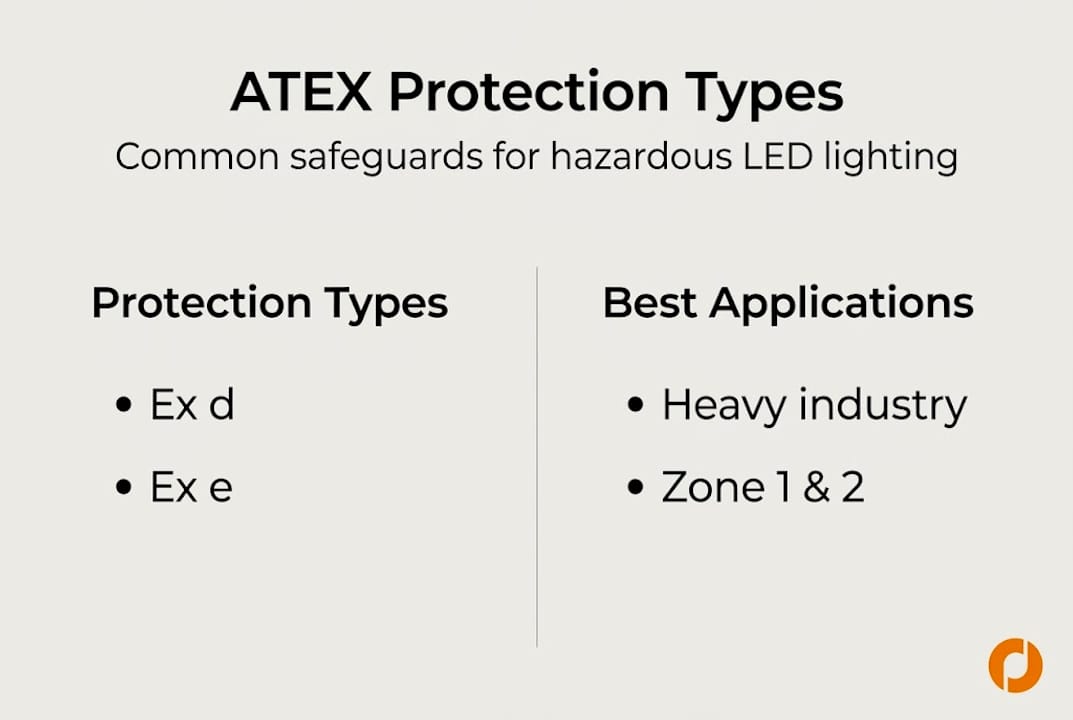
Ex d enclosures are extremely durable, which makes them popular in heavy industry. However, they are bulky and require careful maintenance because any damage to the flameproof joint compromises the entire protection concept. Ex e is generally better suited to modern LED technology because it works by preventing ignition sources from forming in the first place, rather than containing an explosion after the fact.
Pro Tip: For most LED retrofit projects in Zone 1 or Zone 2 gas environments, Ex e fittings offer the best balance of safety, weight, and long-term maintenance cost. Always confirm with a competent person before specifying.
Browse the best ATEX-rated lights for 2026 to see how these protection types translate into real product options.
Selecting and maintaining LED solutions for hazardous zones
LED technology is particularly well suited to hazardous areas because of its long operational life, low surface temperature, and reduced maintenance frequency. Fewer lamp changes mean fewer entries into a potentially dangerous space. That matters enormously when your maintenance team has to follow strict permit-to-work procedures every time they touch a fitting.
When selecting LED fittings for hazardous zones, prioritise these features:
- Correct zone and gas group rating matched to your DSEAR assessment
- IP rating suitable for the environment (IP66 or higher is common in industrial settings)
- Temperature class (T-class) indicating maximum surface temperature the fitting will reach
- UKCA or ATEX certification with documentation traceable to a notified body
- Lumen output and colour rendering appropriate for the task being performed in the zone
A common pitfall is selecting a fitting with the right zone rating but the wrong T-class for the specific gas or dust present. Ex d is robust but maintenance-intensive, whereas lighter Ex e and Ex n options suit many LED fittings and reduce the burden on your maintenance team.
| Factor | What to check | Why it matters |
|---|---|---|
| Zone rating | Matches or exceeds site zone | Core safety requirement |
| T-class | Below ignition temp of substance | Prevents surface ignition |
| IP rating | Suitable for moisture/dust level | Protects fitting integrity |
| Certification | UKCA or valid ATEX mark | Legal compliance |
For warehouse and distribution environments, the best ATEX lights for warehouses covers specific product considerations. For broader questions on LED performance and lifespan, the LED lighting FAQs is a useful reference.
Inspection scheduling should follow BS EN 60079-17. Initial inspections after installation, followed by periodic checks, keep your compliance record current and catch any deterioration before it becomes a hazard.
Our perspective: what UK safety officers often overlook
In our experience, the biggest compliance gaps are not about certification labels. Most managers understand they need ATEX or UKCA-marked products. The real oversights happen in two places: maintenance practicality and zone flexibility.
Managers often select fittings based on upfront cost without considering how difficult they are to inspect and re-lamp in a live hazardous environment. A cheaper Ex d fitting that requires a full permit-to-work shutdown for every inspection will cost far more over five years than a well-chosen Ex e LED that rarely needs attention.
The second overlooked area is zone downgrading. Improving ventilation or using inerting techniques can reduce a Zone 1 to Zone 2, which opens up a wider range of compliant products. However, zone downgrading via ventilation requires a formal DSEAR reassessment and ongoing monitoring. It is not a one-time fix.
Our recommendation is always to work with lighting specialists who understand both the product range and the regulatory framework. Read more about the importance of ATEX lighting to see why specialist input is so valuable at the specification stage.
Upgrade your hazardous area lighting with proven ATEX solutions
Getting hazardous area lighting right is not something to leave to chance or a general electrical contractor unfamiliar with Ex equipment.
At Ledsupplyandfit.co.uk, we supply and install UKCA and ATEX-certified LED fittings for every zone classification. Whether you need guidance on why ATEX lighting matters for your specific site, a walkthrough of our ATEX lighting installation guide, or a conversation about safeguarding your hazardous business with the right products, our team is ready to help. Contact us for a tailored consultation.
Frequently asked questions
What is the main difference between hazardous area and standard lighting?
Hazardous area lighting is certified to prevent ignition of explosive gases or dust, whereas standard lighting lacks the engineering controls and certification to operate safely in those environments.
What are ATEX and UKCA certifications?
ATEX certifies equipment as safe for explosive atmospheres under EU standards, while UKCA replaces CE marking for hazardous area equipment placed on the market in Great Britain following Brexit.
How do I know which zone my property is?
Your zone is determined through a DSEAR risk assessment based on the likelihood, duration, and extent of explosive atmospheres present in your facility.
How often must hazardous area lighting be inspected?
Inspections must follow BS EN 60079-17 intervals, typically annually, though your site-specific risk assessment may require more frequent checks depending on conditions.
Can I downgrade a hazardous zone by improving ventilation?
Yes, but it requires a formal DSEAR reassessment and ongoing monitoring to confirm the zone reduction remains valid over time.