Why lighting maintenance matters for your business
TL;DR:
- Neglected lighting in commercial properties increases financial, safety, and legal risks through poor maintenance and electrical faults. Regular inspections, cleaning, and upgrades like LEDs reduce energy costs, extend fixture lifespan, and ensure regulatory compliance. Integrating lighting into broader facilities management enhances operational safety, cost-effectiveness, and future-proofing against regulatory changes.
Neglected lighting is one of the most quietly expensive mistakes a commercial property manager can make. A few flickering tubes or a dimly lit corridor might seem like minor annoyances, but the real costs — financial, operational, and legal — compound fast. Understanding why lighting maintenance matters goes well beyond replacing the odd blown bulb. It touches on worker safety, energy spend, regulatory compliance, and the kind of operational accuracy that keeps your business running without preventable disruption.
Why lighting maintenance matters: the risks of neglect
Poor lighting is not just an inconvenience. It is an active hazard. When fixtures dim gradually rather than fail outright, the problem is easy to dismiss. But poor lighting impacts employee health through eye strain, headaches, and fatigue, all of which chip away at productivity in ways that rarely get traced back to the source.
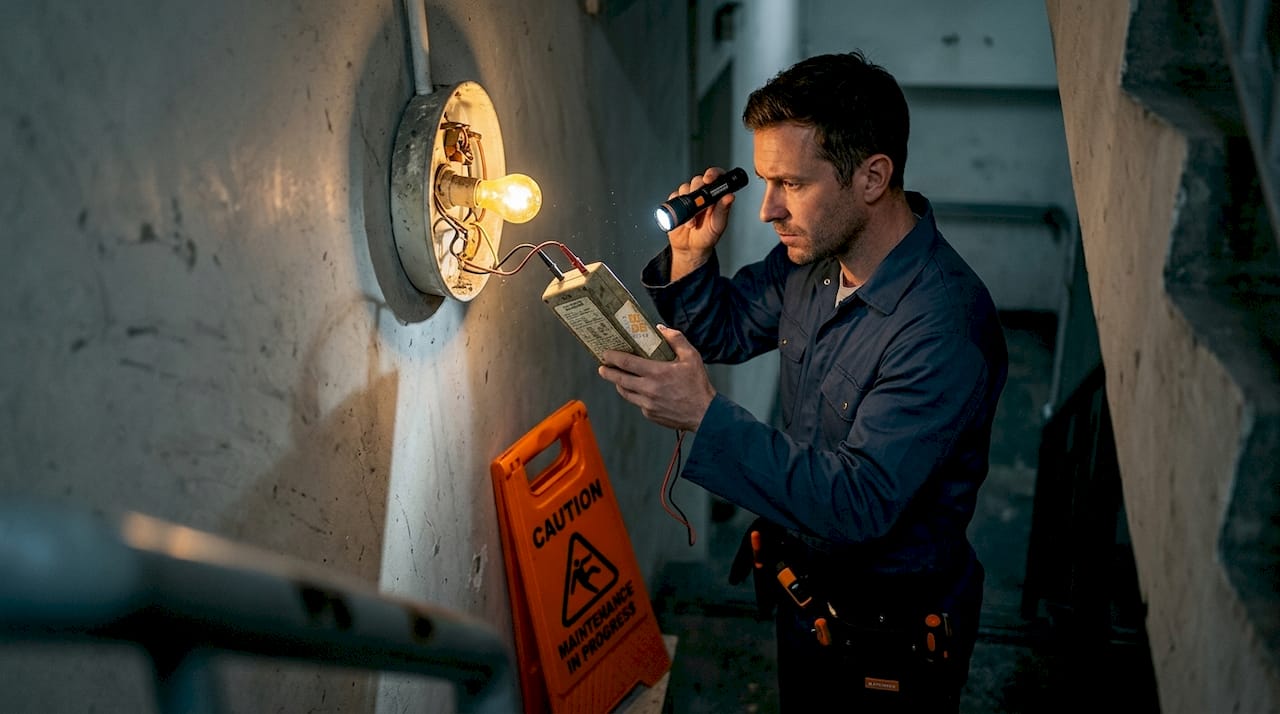
The safety risks escalate further when you factor in electrical degradation. Unmaintained wiring, corroded contacts, and overloaded circuits are not abstract concerns. In 2023, [nearly 7,400 electrical fires](https://www.facilitiesnet.com/maintenanceoperations/article/Electrical-Safety-Compliance-Under-NFPA 70B–20949) in non-residential buildings caused over £280 million in property losses, directly tied to poor electrical maintenance.
For warehouse and logistics operations specifically, the stakes are even more concrete. Poor lighting in warehouses leads to costly picking errors because staff struggle to read barcodes and labels accurately. That is a direct operational cost with a measurable impact on your bottom line.
The compliance dimension adds another layer of risk:
- Emergency lighting failures are a serious legal exposure. Emergency lighting must provide 90 minutes of illumination on backup power for safe building evacuation. Failing an inspection here can invalidate your fire risk assessment.
- Insurance implications are often overlooked. Insurers may reduce or deny claims where evidence of negligent maintenance exists.
- NFPA 70B standards require documented maintenance intervals and equipment inventories. Falling short creates regulatory exposure that a proactive schedule eliminates entirely.
The financial case for regular lighting upkeep
Spending money on maintenance to save money sounds obvious, but the numbers involved are worth understanding precisely.
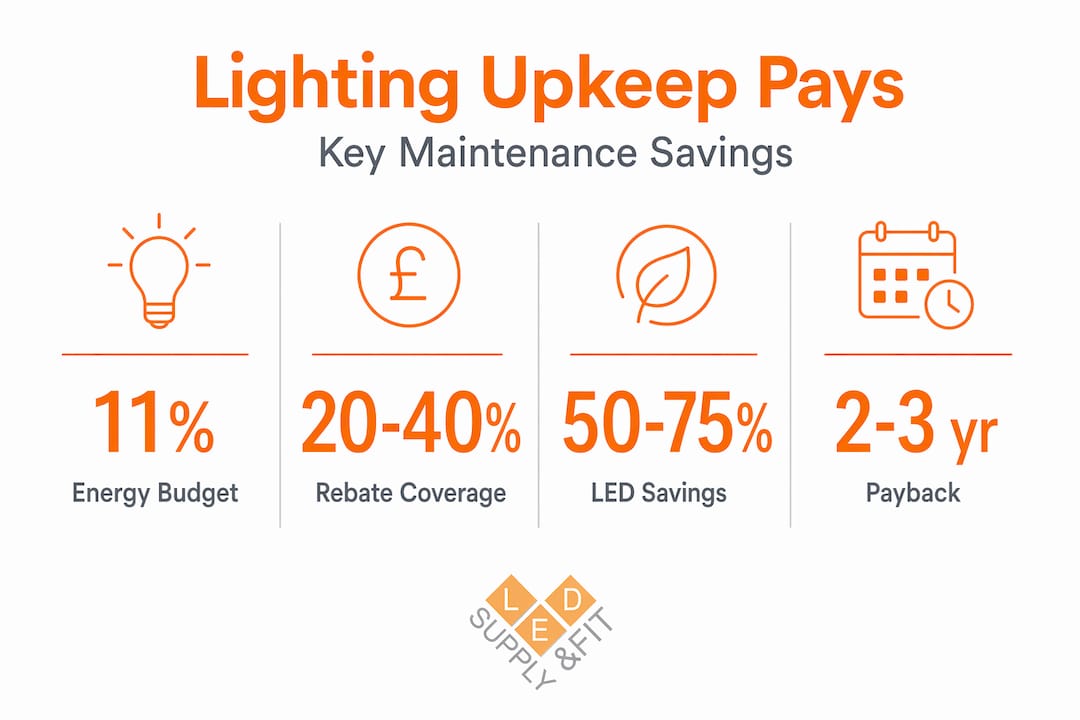
Lighting accounts for 11% of an average building’s energy budget. That figure alone makes lighting one of the most worthwhile areas to address when looking at running costs. Switching to LED from halogen or incandescent systems reduces energy use by 50% to 75%, and that saving compounds over time when maintained fixtures continue performing at rated output rather than degrading silently.
Smart lighting upgrades extend the benefits further. Well-maintained smart lighting fixtures can cut commercial energy consumption by up to 70%, paying for themselves within 18 to 36 months. For context, that is a payback period shorter than most equipment leases.
| Upgrade type | Typical energy saving | Estimated payback period |
|---|---|---|
| LED retrofit (replacing halogen) | 50%–75% | 2–4 years |
| Smart LED with occupancy controls | 60%–70% | 18–36 months |
| LED with scheduled maintenance | Sustained savings at rated output | Ongoing |
Commercial upgrades may also qualify for rebates covering 20% to 40% of installation costs. A lighting auditor can identify exactly which fixtures and schemes qualify, reducing the net outlay substantially.
Pro Tip: Before committing to any upgrade, request a lighting audit first. Auditors often identify rebate opportunities and highlight which areas offer the fastest return. This single step frequently cuts the net cost of a full upgrade by a third.
For a breakdown of how to maximise your energy cost reductions through smart scheduling and LED upgrades, Ledsupplyandfit has published detailed guidance tailored to commercial premises.
Preventive lighting maintenance: practical best practices
Reactive maintenance, fixing things when they break, is the most expensive way to manage a lighting system. Preventive lighting maintenance costs less, causes less disruption, and extends the working life of every fixture significantly.
Here is a practical framework for commercial property managers:
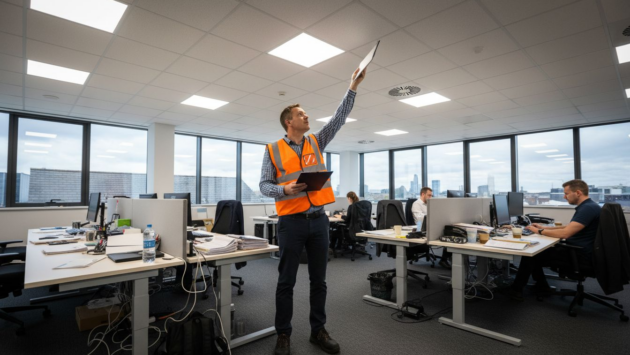
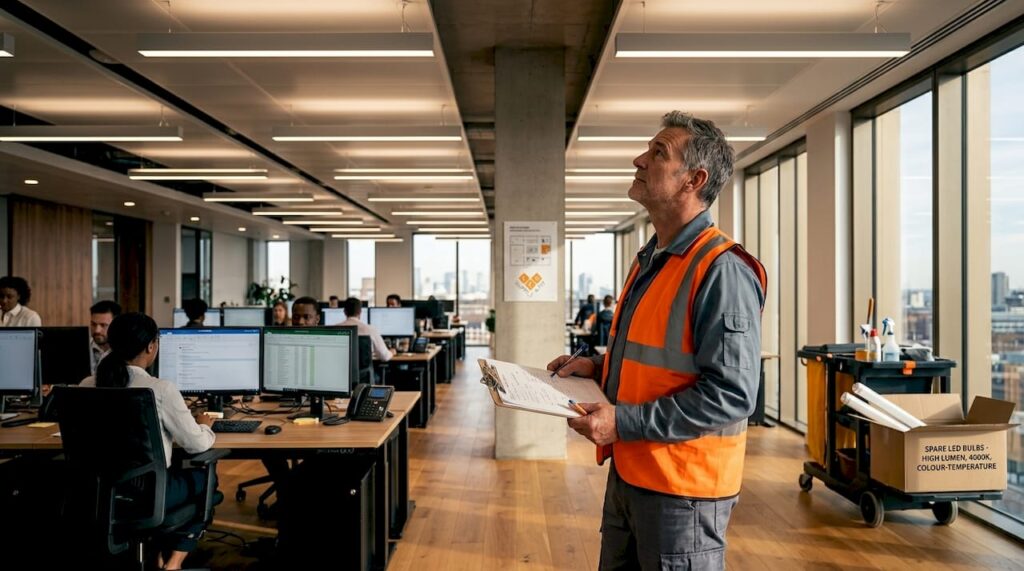
- Set a quarterly inspection schedule. Walk every zone with a checklist covering lumen output, visible damage, moisture ingress, and control system response. Quarterly reviews catch degradation before it affects safety or compliance.
- Check weep holes on outdoor fixtures. This is one of the most commonly missed maintenance tasks. Clogged weep holes cause moisture buildup that leads directly to premature LED driver failure. A simple clean during each inspection dramatically extends fixture life.
- Test emergency lighting monthly. Press the test button. Log the result. A 90-minute backup requirement cannot be verified by assumption.
- Clean fixture lenses and diffusers every six months. Dust and grime reduce light output measurably, and in food service or healthcare environments, this is also a hygiene requirement.
- Work with qualified electricians for any internal component checks. Visual inspections are within any manager’s capability. Accessing driver units, ballasts, or wiring requires a qualified professional and should be scheduled annually.
Pro Tip: Build your lighting maintenance log into your existing facilities management software rather than keeping it on a separate spreadsheet. When you need to demonstrate compliance to an insurer or environmental health officer, a unified record is significantly more credible.
A full commercial lighting maintenance guide for UK managers, covering inspection checklists and scheduling templates, is available from Ledsupplyandfit.
For a deeper look at the full range of lighting maintenance tips specific to LED systems and energy savings, that resource covers everything from driver health to control system calibration.
Reactive vs. preventive: choosing the right approach
Many businesses still default to reactive maintenance, addressing failures as they happen. The appeal is straightforward: you only spend when something breaks. The reality is less appealing.
| Factor | Reactive maintenance | Preventive maintenance |
|---|---|---|
| Cost pattern | Unpredictable, often high | Regular, predictable, lower overall |
| Compliance risk | High (gaps between failures) | Low (documented, scheduled) |
| Fixture lifespan | Reduced (failures cascade) | Maximised |
| Disruption to operations | Unplanned, disruptive | Minimal, scheduled during off-hours |
| Insurance standing | Potentially compromised | Demonstrably sound |
The shift to preventive maintenance also changes how you approach technology selection. Traditional fluorescent or HID systems tolerate neglect poorly. Modern LED systems degrade more gracefully, but they still benefit enormously from well-maintained lighting systems that deliver consistent colour temperature and lumen output over their full rated life.
NFPA 70B standards, increasingly referenced in UK commercial risk assessments, require documented inventories and maintenance intervals. Adopting a preventive schedule is the most straightforward way to meet that standard. It also positions you well for any future regulatory tightening, which is the direction commercial property compliance is heading across the UK.
My take on what most managers get wrong
In my experience working alongside facilities teams across commercial premises, the most damaging oversight is not the missed bulb replacement. It is the gradual dimming that nobody formally notices until a lighting audit reveals that certain zones are operating at 60% of their rated output.
That kind of decline does not trigger a complaint. It just becomes the new normal. Staff adapt, productivity quietly drops, and nobody connects the dots until the audit number lands in front of them.
The weep hole issue is another one I have seen cause entirely avoidable failures in outdoor car park and perimeter lighting. It takes five minutes to clear during a routine walkround. Left unaddressed, it writes off a £200 fixture in under two years.
What I have found genuinely transforms maintenance outcomes is integrating lighting into the broader facilities management cycle rather than treating it as a standalone task. When lighting inspections happen alongside HVAC checks and fire safety reviews, compliance becomes a natural output of normal operations rather than a separate stressor. The businesses that get ahead of their lighting costs are almost always the ones that stopped treating it as a reactive budget line and started treating it as an asset to be managed.
— John
Ready to take control of your lighting costs?
If the case for preventive lighting maintenance has made you want to act, Ledsupplyandfit can help you move from intention to results. Whether you manage a single commercial unit or a portfolio of premises across the UK, the team provides LED upgrade consultations, product supply, and professional installation support tailored to your specific needs.

From identifying the best commercial LED lighting for your premises to helping you access rebates and calculate payback periods, Ledsupplyandfit works with property managers and business owners who want results they can measure. See the full range of LED cost saving options and find out what a properly maintained, upgraded lighting system could mean for your energy bills.
FAQ
Why does lighting maintenance matter for commercial properties?
Regular lighting maintenance protects worker safety, supports regulatory compliance, and prevents the gradual energy and productivity losses that come from degraded fixtures. Neglected systems also carry a higher risk of electrical faults and insurance complications.
How often should commercial lighting systems be inspected?
Quarterly visual inspections are the standard recommendation for most commercial premises, with annual professional checks covering electrical components and driver health. Emergency lighting requires a monthly functional test.
What are the financial benefits of lighting upkeep?
LED systems combined with a preventive maintenance schedule reduce energy use by 50% to 75% compared to older technology, and commercial upgrades may qualify for rebates covering up to 40% of installation costs.
What is the difference between reactive and preventive lighting maintenance?
Reactive maintenance fixes failures after they occur, resulting in unpredictable costs and compliance gaps. Preventive maintenance schedules regular inspections and cleaning, extending fixture life and keeping compliance documentation current.
What are the most commonly overlooked lighting maintenance tasks?
Clearing weep holes on outdoor fixtures is one of the most frequently missed tasks. Blocked fixture drainage causes moisture to accumulate around LED drivers, leading to premature failure that a simple periodic clean would prevent entirely.