How to design retail lighting for energy efficiency
Designing retail lighting that balances energy efficiency with an inviting ambiance presents a genuine challenge for property managers and business owners. Your customers expect a welcoming atmosphere that showcases products beautifully, yet rising energy costs demand smarter solutions. LED technology has transformed how retail spaces approach lighting, offering opportunities to reduce consumption by up to 80% while enhancing visual appeal. This comprehensive guide walks you through the essential steps to create effective retail lighting that meets both aesthetic and operational goals, from initial planning through to ongoing maintenance.
Key Takeaways
| Point | Details |
|---|---|
| Layered lighting approach | Retail lighting should combine ambient, task and accent layers to create ambience and highlight merchandise. |
| LED sensor savings | LED lighting with presence and daylight sensors can reduce energy use by up to eighty per cent. |
| Glare and beam control | Proper beam angles and glare management improve product visibility and shopper comfort. |
| CIBSE LG17 guidance | CIBSE LG17 offers guidance for safe and effective retail lighting design. |
| Consult a specialist | Engaging a lighting specialist early prevents costly redesigns and aligns the strategy with technical and aesthetic requirements. |
Preparing your retail space for optimal lighting
Before selecting fixtures or planning layouts, you need a thorough understanding of your retail environment. Walk through your space and note ceiling heights, which typically range from 2.4 to 4 metres in UK retail premises. Identify key display zones, checkout areas, fitting rooms, and circulation paths where customers naturally move. Each zone serves a different purpose and requires tailored lighting approaches.
Define clear objectives for your lighting project. Are you prioritising energy savings, improving product presentation, creating a specific mood, or all three? Most successful retail lighting projects balance multiple goals, but knowing your primary driver helps make informed decisions when trade-offs arise. Consider how CIBSE LG17 provides retail-specific guidance on creative opportunities, staff safety, and diverse outlet designs, offering a framework for both compliance and innovation.
Assess existing infrastructure including electrical capacity, mounting points, and daylight availability. Large windows or skylights offer opportunities for daylight harvesting systems that automatically dim artificial lighting when natural light suffices. Document current energy consumption from utility bills to establish a baseline for measuring improvements. This data proves invaluable when calculating return on investment later.
Pro Tip: Engage a lighting specialist during the planning phase rather than after purchasing fixtures. Early professional input prevents costly redesigns and ensures your lighting strategy aligns with both aesthetic vision and technical requirements. Many retailers discover too late that beautiful fixtures create excessive glare or fail to meet lux requirements.
Key preparation steps include:
- Measure and document ceiling heights, room dimensions, and architectural features
- Map customer flow patterns and identify priority display areas
- Review existing electrical infrastructure and available mounting options
- Calculate current energy consumption and associated costs
- Set specific, measurable objectives for lighting performance and savings
Explore proven led lighting tips for cost-saving strategies that commercial properties have successfully implemented across the UK.
Implementing layered lighting design for retail
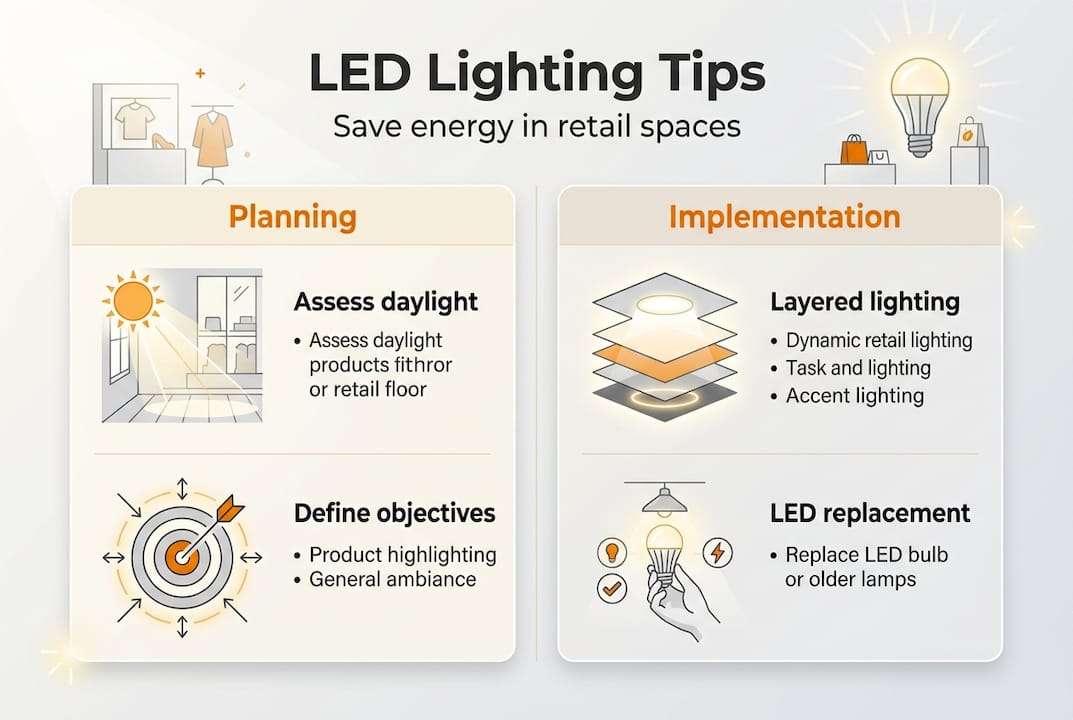
Layered lighting transforms flat, uninspiring spaces into dynamic retail environments that guide customers and highlight merchandise. This approach combines three distinct lighting types, each serving specific functions while working together harmoniously. Understanding how to balance these layers separates mediocre retail lighting from exceptional installations.
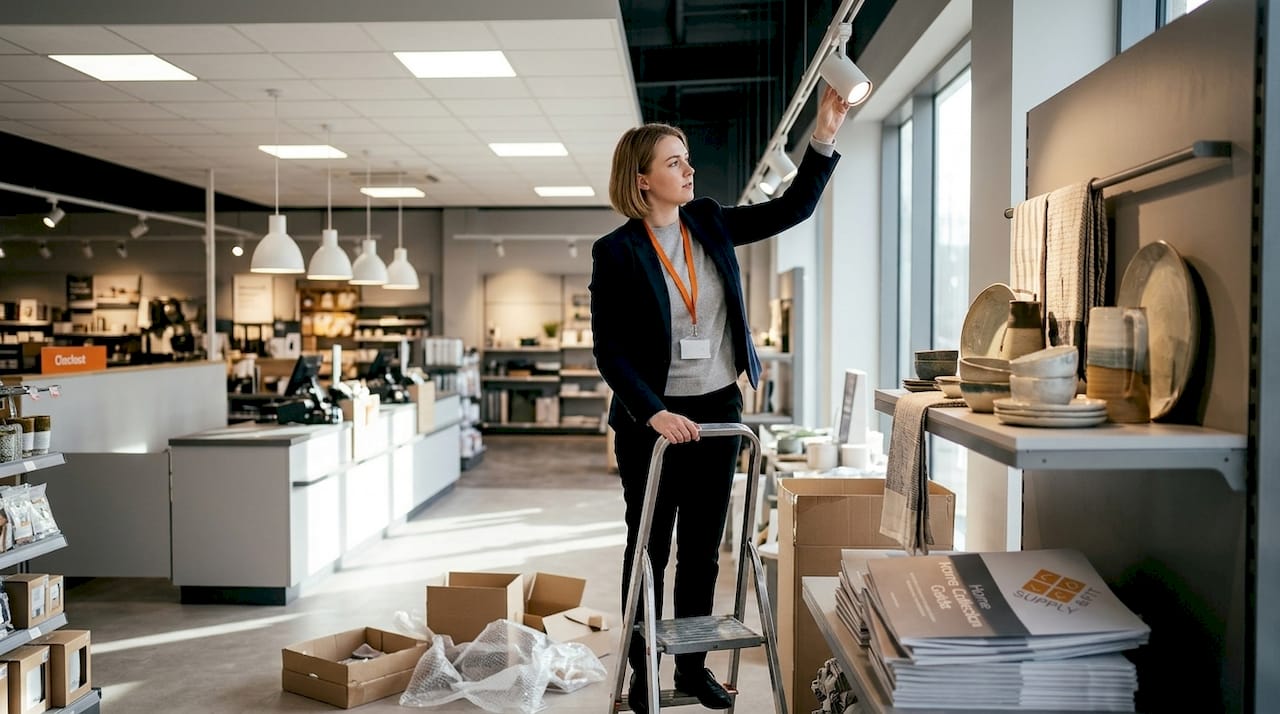
Ambient lighting forms your foundation, providing general illumination throughout the space. Retail environments typically require ambient lighting at 300-500 lux as base illumination, ensuring customers can navigate safely and comfortably. LED panels or recessed downlights mounted in regular grids deliver even distribution without creating harsh shadows. This layer should feel natural and unobtrusive, neither too bright nor too dim.
Task lighting addresses specific functional needs where customers and staff perform detailed activities. Checkout counters benefit from focused illumination at 500-750 lux, enabling staff to process transactions accurately and customers to review purchases. Fitting rooms require careful attention with 500 lux minimum and high colour rendering index values above 90 to ensure clothing appears true to colour. Wall-mounted fixtures positioned 900-1200mm from vertical surfaces prevent unflattering shadows on faces.
Accent lighting creates visual hierarchy and draws attention to featured products or displays. Track-mounted spotlights deliver concentrated beams with 1000+ lux using adjustable track spots that highlight premium merchandise or seasonal promotions. Beam angles between 30-45 degrees work well for high-ceiling settings, creating defined pools of light without excessive spill. Adjustable fixtures allow you to redirect attention as displays change.
Pro Tip: Offset wall-mounted accent fixtures by 900-1200mm from the wall surface to eliminate shadows behind displayed items. This distance creates grazing light that enhances texture and depth while maintaining even illumination across vertical displays.
Implementation steps for layered lighting:
- Install ambient lighting first to establish baseline illumination levels
- Add task lighting at functional zones requiring higher precision
- Position accent lighting to highlight key displays and create focal points
- Test lighting levels with a lux meter to verify targets are met
- Adjust beam angles and fixture positions to eliminate unwanted shadows
- Fine-tune dimming controls to allow flexibility for different times and events
| Lighting layer | Typical lux level | Primary application | Fixture types |
|---|---|---|---|
| Ambient | 300-500 lux | General illumination | LED panels, recessed downlights |
| Task | 500-750 lux | Checkouts, fitting rooms | Linear fixtures, wall-mounted spots |
| Accent | 1000+ lux | Product displays, features | Track spots, adjustable heads |
Glare control remains essential for customer comfort. Unified Glare Rating values should stay at or below 16-19 for retail environments. Achieve this through louvres, honeycomb diffusers, or carefully angled fixtures that keep bright sources out of typical sight lines. Customers who squint or feel uncomfortable will spend less time browsing.
Discover various types of commercial led lighting suitable for different retail applications and space requirements.
Reducing energy consumption with efficient led lighting and controls
Energy efficiency directly impacts your bottom line, with lighting typically accounting for 30-50% of a retail space’s electricity consumption. LED technology offers the most significant opportunity for immediate savings, but combining LEDs with intelligent controls multiplies the benefits substantially.
Replace fluorescent tubes and halogen spotlights with LED equivalents to achieve approximately 70% energy reduction while maintaining or improving light quality. A typical 58-watt fluorescent tube replaced by a 22-watt LED panel delivers the same lux levels whilst consuming less than half the power. Multiply these savings across dozens or hundreds of fixtures, and monthly utility bills drop dramatically.
Occupancy sensors prevent energy waste in areas with intermittent use. Storage rooms, staff areas, and quiet sections of large stores benefit from sensors that switch lights off automatically when spaces remain vacant for preset periods, typically 10-15 minutes. Daylight harvesting systems use photocells to dim or switch off fixtures near windows when natural light provides sufficient illumination. These automated controls require no staff intervention, ensuring consistent energy savings.
Pro Tip: Integrate lighting controls with a central management system that monitors energy consumption in real time. Modern systems provide detailed analytics showing which zones consume the most power, enabling data-driven decisions about further optimisation opportunities.
LED solutions with sensors and daylight harvesting achieve 50-80% energy savings with return on investment periods of 2-3 years in retail upgrades. Major UK retailers including Tesco and Matalan have documented substantial savings through comprehensive LED retrofits. A typical 200-square-metre retail unit spending £3,000 annually on lighting can reduce this to £600-900 after LED upgrades, recovering installation costs within 18-36 months.
| Lighting solution | Annual energy cost (200m² shop) | Payback period | Energy savings |
|---|---|---|---|
| Traditional fluorescent | £3,000 | Baseline | 0% |
| LED without controls | £1,200 | 1.5-2 years | 60% |
| LED with occupancy sensors | £900 | 2-2.5 years | 70% |
| LED with full automation | £600 | 2.5-3 years | 80% |
Beyond direct energy savings, LEDs reduce maintenance costs through extended lifespans of 50,000 hours compared to 10,000-15,000 hours for fluorescent alternatives. Fewer replacements mean less disruption to trading hours and lower labour costs for maintenance staff. Heat output drops significantly as well, potentially reducing air conditioning loads during warmer months.
Key strategies for maximising energy efficiency:
- Replace all traditional lighting with LED equivalents rated for commercial use
- Install occupancy sensors in storage areas, fitting rooms, and low-traffic zones
- Implement daylight harvesting near windows and skylights
- Use dimming controls to adjust light levels based on time of day or occupancy
- Schedule regular energy audits to identify additional optimisation opportunities
Learn more about lighting controls to cut energy costs and discover proven strategies that deliver measurable results. Additional led lighting tips to save costs provide practical guidance for ongoing optimisation.
Verifying lighting effectiveness and maintenance best practices
Installation marks the beginning, not the end, of effective retail lighting management. Verification ensures your investment delivers intended results, while proactive maintenance protects long-term performance and prevents costly failures that disrupt operations.
Conduct comprehensive lighting measurements using a calibrated lux meter. Take readings at multiple points within each zone, including corners and areas between fixtures where light levels typically dip lowest. Compare measurements against your design targets and CIBSE LG17 standards for retail premises. Document results with a simple floor plan showing lux values at each measurement point.
Verification steps for optimal performance:
- Measure lux levels at working plane height (typically 0.85 metres) across all zones
- Evaluate glare by viewing displays and products from typical customer sight lines
- Check colour rendering in fitting rooms and areas displaying coloured merchandise
- Test all controls including sensors, dimmers, and automated systems
- Adjust fixture angles or positions to eliminate shadows on key displays
- Document baseline performance for future comparison and maintenance planning
Glare assessment requires walking through your space as customers would, noting any fixtures that create discomfort or make viewing products difficult. Fitting rooms deserve special attention since poor lighting here directly impacts purchase decisions. Customers who appear unflattering in harsh overhead lighting often abandon purchases, regardless of how well garments actually fit.
Establish a maintenance schedule that keeps your lighting performing optimally. Dust and dirt accumulation reduces light output by 10-20% annually in typical retail environments. Clean fixtures every six months using appropriate methods for each fixture type. LED panels require gentle cleaning with microfibre cloths, while track lighting benefits from compressed air to remove dust from adjustment mechanisms.
Maintenance best practices include:
- Schedule biannual cleaning of all fixtures and diffusers
- Inspect electrical connections and mounting hardware quarterly
- Replace failed LED drivers or modules promptly to maintain consistent illumination
- Keep detailed records of maintenance activities and any performance issues
- Update control system programming as store layouts or operating hours change
- Monitor energy consumption monthly to identify efficiency degradation early
Failed fixtures create dark spots that make spaces feel neglected and potentially unsafe. Replace malfunctioning units within 48 hours to maintain consistent lighting quality. Stock commonly used LED modules and drivers to enable quick repairs without waiting for deliveries. Most LED failures involve drivers rather than the LED arrays themselves, making driver replacement a cost-effective repair option.
Pro Tip: Photograph your retail space quarterly under normal lighting conditions. Visual records help identify gradual degradation that might otherwise go unnoticed, such as colour temperature shifts or reduced light output from ageing fixtures.
Understand lighting design cost and compliance requirements to ensure your installation meets all relevant UK regulations whilst delivering the performance your business needs.
Discover expert retail lighting solutions with led supply & fit
Transforming your retail lighting from concept to reality requires expertise, quality products, and reliable installation. LED Supply & Fit specialises in energy-efficient lighting solutions tailored specifically for UK commercial properties, including retail environments of all sizes.
Our comprehensive service begins with design consultancy that translates your vision into practical lighting plans optimised for both ambiance and efficiency. We supply commercial-grade LED fixtures selected for durability and performance in demanding retail environments. Professional installation ensures proper positioning, secure mounting, and full integration with control systems.
Key services supporting your retail lighting success:
- Expert product selection matching your specific space requirements and budget
- Custom lighting design that balances aesthetic goals with energy efficiency
- Professional installation by qualified electricians familiar with retail environments
- Ongoing maintenance support to protect your investment long term
Explore our range of best commercial LED lighting 2026 products designed for retail applications. Discover essential LED lighting tips for businesses that help you maximise savings and performance. Learn about lighting design cost and compliance considerations for your next project.
Frequently asked questions
What lux levels are recommended for retail spaces?
Ambient lighting should provide 300-500 lux for general circulation and browsing areas, creating comfortable baseline illumination. Display accent lighting typically exceeds 1000 lux to draw attention to featured products and create visual hierarchy. Fitting rooms require 500+ lux with high colour rendering index values above 90 to ensure accurate colour perception.
How can retail businesses reduce lighting energy costs effectively?
Install LED lighting combined with occupancy sensors and daylight harvesting systems to reduce energy consumption by 50-80% compared to traditional lighting. Regular maintenance including fixture cleaning maintains optimal efficiency and prevents gradual performance degradation. Integrating automated controls with layered lighting design delivers maximum cost savings whilst enhancing the customer experience.
What are common lighting mistakes to avoid in retail design?
Overlighting creates uncomfortable glare that drives customers away and wastes energy unnecessarily. Neglecting glare control leads to poor product visibility and customer dissatisfaction, particularly in areas displaying screens or reflective merchandise. Skipping regular maintenance allows dust accumulation and failed fixtures to degrade lighting quality, increasing energy costs and creating an unprofessional appearance that damages your brand.