
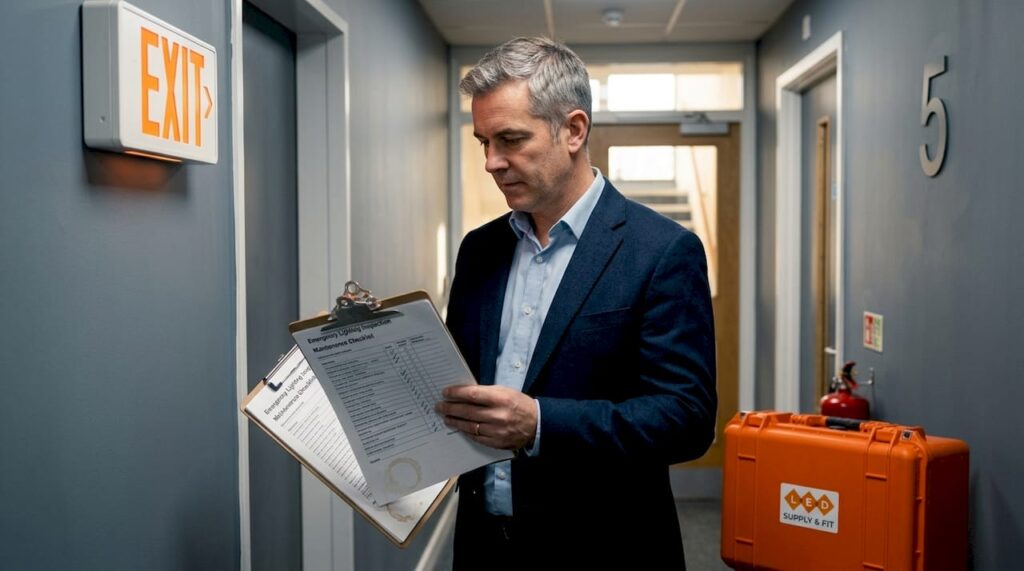
Emergency lighting in the UK: what property managers must know
TL;DR:
- Emergency lighting is essential for safe escape routes during power failures, aligning with fire safety standards like BS 5266-1. Proper placement, performance, and ongoing maintenance—linked to fire risk assessments—are crucial for compliance and occupant safety. Upgrading to LED solutions and proactive inspections help ensure reliable emergency lighting in commercial properties.
Emergency lighting is one of those compliance areas where a simple misunderstanding can have serious consequences. Most commercial property managers assume it exists solely as a backup for power cuts, but that framing misses the point entirely. According to the BS 5266-1 code of practice, emergency lighting is provided so people can safely find and use escape routes and exits when normal lighting fails, a definition that ties it directly to fire safety, evacuation planning, and your legal obligations as a property manager.
Key Takeaways
| Point | Details |
|---|---|
| Legal requirement | Emergency lighting is mandatory in UK commercial properties for fire safety and evacuation. |
| Outcome-driven design | Systems must guide occupants safely, with placement determined by fire risk assessment and BS 5266-1. |
| LED upgrades | Switching to LED emergency lighting enhances efficiency, reliability, and long-term cost savings. |
| Regular maintenance | Monthly and annual checks are essential for compliance and operational reliability. |
| Expert help | Qualified providers make emergency lighting installation and upkeep straightforward for property managers. |
What is emergency lighting?
Emergency lighting activates automatically when the normal mains lighting supply fails, whether due to a power cut, fire, or any other emergency event. Its core purpose is not simply to keep corridors lit. It is to ensure occupants can orientate themselves, identify exits, and evacuate safely within a defined period.
The BS 5266-1 standard sets out the UK framework for how emergency lighting should be designed, installed, and maintained. Understanding what this standard actually demands is the first step toward genuine emergency lighting compliance in your property.
Emergency lighting covers several distinct functions:
- Escape route lighting: Illuminates the path along corridors, stairwells, and passages to exits.
- Open area (anti-panic) lighting: Provides sufficient illumination in large spaces to reduce panic and help occupants reach an escape route.
- High-risk task area lighting: Protects people engaged in potentially dangerous processes, allowing them to shut down safely before evacuating.
- Standby lighting: Enables normal activities to continue in the event of mains failure, though this is a distinct category from escape lighting.
“Emergency lighting is provided so people can safely find and use escape routes and exits when normal lighting fails.” — BS 5266-1, Emergency Lighting of Premises Code of Practice
The key distinction here is that emergency lighting is outcome-based. It is not enough to install a few luminaires and tick a box. The lighting must actually enable safe escape, which means coverage, illumination levels, and duration all matter enormously.
How emergency lighting supports safety and compliance
Emergency lighting does not exist in isolation. Its placement and performance requirements are shaped directly by your building’s fire risk assessment. This is where many property managers make their first critical mistake: they treat fire risk assessment and emergency lighting as separate tasks, when in reality one defines the other.
The BS 5266-1 guidance confirms that emergency lighting locations and performance are determined by fire risk assessment and implemented using its detailed technical requirements. In practical terms, this means a fire risk assessor should be identifying the areas in your building where emergency lighting is necessary, and your lighting installation should then meet those specific needs.
Here is a practical sequence for linking compliance with safety outcomes:
- Commission a fire risk assessment for your premises, ensuring it covers all areas including storage rooms, server rooms, and any spaces where staff could be present after hours.
- Map the escape routes identified in the risk assessment, noting every corridor, stairwell, junction, exit door, and emergency equipment location such as fire extinguishers and first aid points.
- Specify emergency lighting positions at every change of direction, every intersection of corridors, within 2 metres of each exit door, and at each stairwell level.
- Check illumination levels against BS 5266-1 minimums: at least 1 lux on the floor along the centreline of an escape route.
- Verify duration requirements: most commercial properties need at least 1 to 3 hours of maintained illumination.
Pro Tip: Do not wait for a fire inspection to identify gaps. Walk your escape routes at night or in reduced light conditions. If you struggle to find an exit, so will your occupants in a real emergency.
Adhering to compliance lighting regulations is not optional. The Regulatory Reform (Fire Safety) Order 2005 places a legal duty on the responsible person for any commercial premises to ensure adequate emergency lighting forms part of their fire precautions. Penalties for non-compliance can include improvement notices, prohibition orders, and in serious cases, prosecution.
Managers seeking guidance on meeting lighting regulations as part of a broader LED upgrade will find that combining compliance with energy efficiency improvements is both practical and cost-effective.
Types of emergency lighting: choosing reliable solutions
Understanding the different system types helps you select what suits your property’s layout, occupancy levels, and budget.
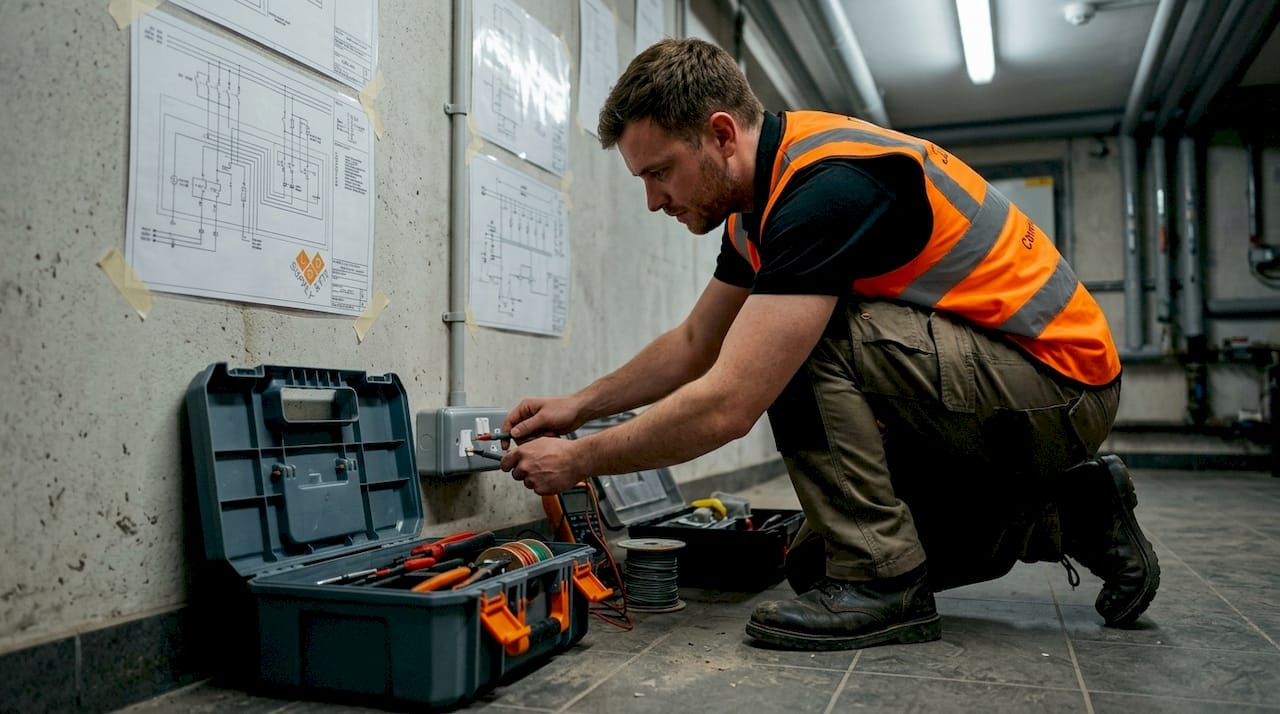
The practical definition of emergency lighting is outcome-based: achieving safe escape wayfinding and adequate illumination at key safety points. With that in mind, here is how the main system types compare:
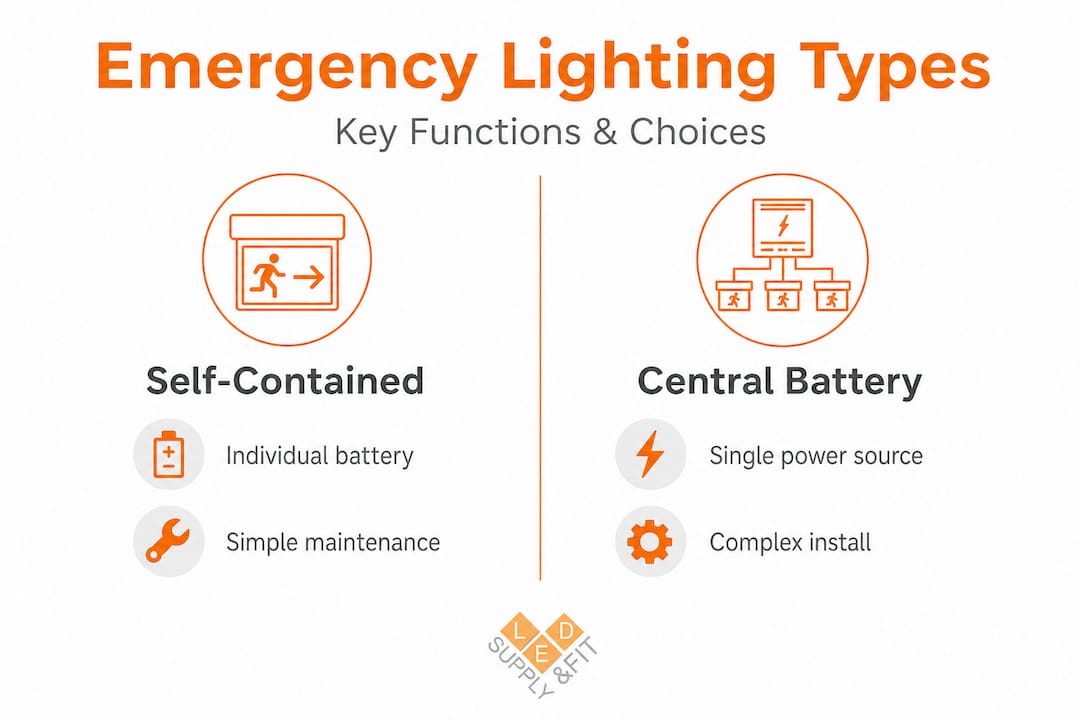
| System type | How it works | Best suited for | Key maintenance consideration |
|---|---|---|---|
| Self-contained units | Each fitting has its own battery backup | Small to medium offices, retail, restaurants | Individual battery replacements every 3 to 4 years |
| Central battery system | One central battery bank powers multiple fittings | Large warehouses, multi-storey buildings, hotels | Battery bank servicing; simpler wiring long-term |
| LED emergency fittings | Combines LED efficiency with self-contained backup | Modern offices, refurbishments, gyms | Longer lamp life; lower energy draw on battery |
| Maintained fittings | Lit continuously; switch to emergency on failure | Cinemas, theatres, public assembly spaces | Regular cleaning; monitor for continuous operation |
| Non-maintained fittings | Only illuminate when mains power fails | Back-of-house areas, staff corridors, storage | Test monthly to confirm activation |
LED technology is now the dominant choice in new commercial installations. Emergency LED solutions offer significantly longer operational lifespans, lower energy consumption during standby, and reduced battery drain during an emergency event compared with older fluorescent alternatives.
For larger or more complex premises such as multi-level warehouses or industrial facilities, it is worth understanding types of industrial lighting to ensure emergency fittings are compatible with the overall lighting scheme and lux levels achievable across wide-span spaces.
Key considerations when selecting your system:
- Battery duration: Choose systems rated for the duration required by your risk assessment, typically 1 or 3 hours.
- IP rating: In kitchens, car parks, or damp areas, ensure fittings carry the appropriate ingress protection rating.
- Self-test functionality: Many modern LED emergency fittings include self-testing and remote monitoring, reducing manual testing burden significantly.
Practical steps for installation and ongoing maintenance
Installing the right system is only worthwhile if it is maintained correctly. A system that fails during an emergency because of a flat battery or a missed test is worse than useless; it creates a false sense of security.
Emergency lighting must be maintained to BS 5266-1 to ensure it performs reliably when needed. Here is a structured approach:
- Commission a qualified electrician to carry out the initial installation, ensuring all positions align with the fire risk assessment and BS 5266-1 requirements.
- Conduct a full functional test at the point of installation, confirming every fitting activates on mains failure and achieves the required illumination level.
- Carry out monthly short-duration tests by simulating a power failure for a brief period and confirming every fitting illuminates correctly.
- Carry out annual full-duration tests where the system operates on battery power for its full rated duration, typically 1 or 3 hours.
- Record every test in a dedicated maintenance log, noting the date, findings, and any remedial actions taken.
Pro Tip: Create a simple digital maintenance log using a shared spreadsheet or facilities management software. Include photographic evidence of test results where possible. This documentation is invaluable during a fire safety inspection or if liability is ever questioned following an incident.
Common pitfalls that property managers frequently encounter include failing to test after building modifications, ignoring new areas created by refurbishment, and allowing battery replacement cycles to slip. Referencing LED safety tips and established lighting safety guidelines for workplaces can help you build a robust maintenance routine that holds up to scrutiny.
What most property managers miss about emergency lighting
Here is the uncomfortable truth: many commercial properties pass their annual inspections and still have emergency lighting systems that would fail in a real scenario. Compliance, as it is often practised, focuses on paperwork rather than outcomes.
We see this repeatedly in commercial properties across the UK. A maintenance log is kept, monthly tests are ticked off, but nobody has actually walked the escape routes with the lights off. When they do, the problems become obvious: a dark corner behind a partition wall added during a refit, a stairwell at the rear of the building that was somehow never included in the original installation, or a central battery system whose bank has degraded to the point where it cannot sustain the rated duration.
The BS 5266-1 code of practice frames emergency lighting as outcome-based, meaning achieving safe escape wayfinding and adequate illumination at key safety points. That framing should challenge every property manager to ask not “does my system meet the paperwork criteria?” but rather “could my occupants actually escape safely in the dark?”
Older buildings present particular risks. Systems installed a decade ago may pre-date current LED technology and carry battery packs that have never been replaced. Refurbishments change the layout of escape routes without triggering a corresponding review of emergency lighting coverage. The building compliance lighting guide provides a useful framework for reviewing your position holistically rather than reactively.
The most effective property managers treat emergency lighting as a live safety system rather than a static installation. They revisit their fire risk assessment annually, check that coverage maps still reflect current layouts, and plan proactive battery replacements rather than waiting for failures.
Find reliable emergency lighting solutions
If your current system is due for a review, upgrade, or full installation, working with a supplier that understands both the compliance landscape and the practical realities of commercial properties makes a measurable difference.

At LED Supply and Fit, we supply and install LED emergency lighting solutions tailored to UK commercial premises, from small retail units to large warehouses and multi-storey offices. Our team ensures installations align with BS 5266-1 requirements from the outset, giving you confidence that your system will perform when it matters. Explore our range of best commercial LED lighting solutions, or if your premises involve hazardous environments, our ATEX lighting guide explains the specialist requirements you need to consider. Contact us to discuss your requirements and arrange a site assessment.
Frequently asked questions
Is emergency lighting a legal requirement for UK businesses?
Yes, UK law requires emergency lighting in all commercial properties under the Regulatory Reform (Fire Safety) Order 2005, with technical standards set by BS 5266-1.
How often should emergency lighting be tested?
Emergency lighting systems should be tested monthly for basic operation and annually for full duration performance, with all results recorded in a maintenance log.
What are the main types of emergency lighting?
The main types are self-contained units, where each fitting has its own battery, and central battery systems, where one battery bank powers multiple fittings, each suited to different property types and scales.
Can I upgrade emergency lighting to LED technology?
Yes, LED emergency lighting is energy-efficient, long-lasting, and widely used in UK commercial buildings, often with self-testing functionality that simplifies compliance management.
Who determines where emergency lighting must be installed?
A fire risk assessment determines placement, with locations and performance defined by BS 5266-1 and reviewed whenever the building layout or occupancy changes.