
What Is LED Lighting? Key Benefits For UK Venues
Busy hospitality venues across the United Kingdom face a balancing act between creating welcoming spaces and managing rising energy bills. Outdated ideas about LED lighting—from fears of harsh glare to concerns over limited colour—still leave many hesitant to make the switch. In reality, modern LED technologies provide remarkable energy efficiency, extensive design options, and lasting cost savings. This guide breaks down common myths and shows why upgrading to energy-efficient LED lighting is a smart choice for UK hospitality businesses.
Table of Contents
- LED Lighting Defined And Common Myths
- Types Of LED Lighting For Commercial Use
- How LED Technology Works And Key Features
- Cost Savings, Longevity And Environmental Gains
- LED Lighting Versus Traditional Alternatives
Key Takeaways
| Point | Details |
|---|---|
| LED Technology Efficiency | LEDs convert up to 90% of electrical energy into light, significantly reducing energy consumption and costs. |
| Long Lifespan and Lower Maintenance | LED lights last between 30,000 to 50,000 hours, leading to reduced replacement frequency and maintenance expenses. |
| Flexibility in Applications | Various LED types are available to suit different commercial settings, enhancing overall business functionality. |
| Sustainability Benefits | Using LEDs contributes to lower greenhouse gas emissions, supporting businesses in achieving sustainability goals. |
LED Lighting Defined And Common Myths
LED lighting represents a revolutionary technology transforming illumination solutions for businesses across the United Kingdom. At its core, LED (Light Emitting Diode) technology generates light through semiconductor materials that produce photons when electrical current passes through them, creating highly efficient illumination.
Understanding LED lighting requires dispelling several persistent myths that continue to circulate. Common misconceptions about LED technology include beliefs about high costs, poor light quality, and limited applications. However, modern LED systems comprehensively challenge these outdated perceptions.
Some key myths about LED lighting include:
- LEDs are prohibitively expensive
- LED lights produce harsh, uncomfortable illumination
- LED bulbs do not last as long as manufacturers claim
- LED technology offers limited colour options
- LEDs generate excessive heat
In reality, contemporary LED technologies offer remarkable advantages that directly counter these misconceptions. Colour temperature control allows precise adjustment of light warmth, ranging from cool white to warm yellow tones. Modern LEDs consume significantly less energy, provide extended operational lifespans, and offer remarkable versatility across commercial environments.
Here’s a concise summary of how common LED myths compare with modern realities:
| Myth About LEDs | Reality Today | Business Relevance |
|---|---|---|
| High upfront cost | Costs have greatly reduced | Rapid return on investment |
| Harsh light quality | Wide range of comfortable tones | Enhances user experience |
| Short lifespan | Lasts 30,000-50,000 hours | Cuts replacement frequency |
| Limited colour options | Extensive colour customisation | Fits diverse brand needs |
| Generates excess heat | Minimal heat output | Reduces cooling expenses |
LED lighting represents not just a technological upgrade, but a strategic investment in efficiency and sustainability for UK venues.
Energy efficiency stands as one of LED lighting’s most compelling features. Traditional lighting technologies like incandescent and fluorescent bulbs convert substantial electrical energy into heat, whereas LEDs transform approximately 90% of electrical input directly into light. This efficiency translates into considerable cost savings for businesses, particularly those with extensive lighting requirements.
Pro tip: When evaluating LED lighting solutions, request comprehensive performance data and compare total lifetime costs rather than focusing solely on initial purchase price.
Types Of LED Lighting For Commercial Use
Commercial LED lighting offers a diverse range of solutions specifically designed to meet varied business requirements across different environments. Comprehensive LED bulb types enable businesses to select precise illumination solutions tailored to their unique spatial and functional needs.
The most common LED lighting types for commercial applications include:
- LED A-type bulbs for general office illumination
- PAR and BR bulbs for directional and accent lighting
- T8 and T5 tube lights for office and warehouse ceilings
- High bay bulbs for expansive spaces with significant vertical clearance
- Corn bulbs designed for retrofitting existing high-intensity discharge (HID) fixtures
Each LED lighting type serves specific purposes, with selection depending on critical factors like mounting options, fixture compatibility, required brightness levels, and energy efficiency objectives. Directional lighting options such as PAR and BR bulbs prove particularly useful for retail environments, allowing precise illumination of merchandise displays and architectural features.
This table outlines the main commercial LED lighting types and their optimal applications:
| LED Type | Ideal Setting | Key Advantage |
|---|---|---|
| A-type bulb | General offices | Broad, even coverage |
| PAR/BR bulb | Retail/displays | Focused, directional light |
| T8/T5 tube | Warehouses | High efficiency for large spaces |
| High bay | Factories | Powerful for high ceilings |
| Corn bulb | Retrofitting HID fixtures | Easy upgrade, energy savings |
Commercial LED lighting represents a strategic investment in both energy efficiency and operational performance.
Modern LED technologies offer remarkable flexibility, enabling businesses to create customised lighting environments that enhance productivity, customer experience, and workplace aesthetics. Warehouse and industrial settings typically require different lighting solutions compared to retail or office spaces, making it crucial to understand the nuanced characteristics of each LED lighting type.
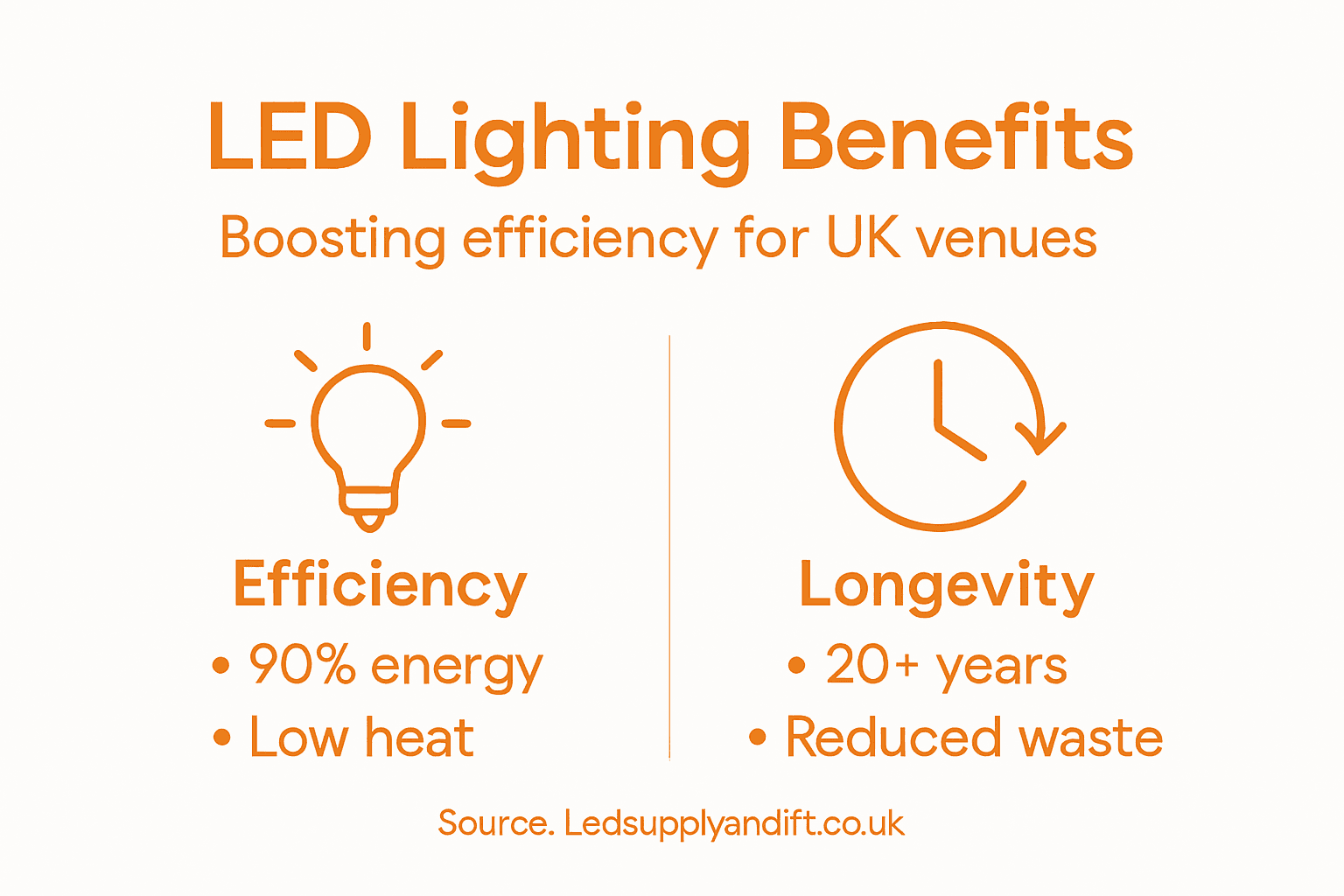
Energy consumption remains a primary consideration, with LED technologies converting approximately 90% of electrical input into light compared to traditional lighting systems. This efficiency translates into substantial cost savings and reduced environmental impact for businesses across various sectors.
Pro tip: Conduct a comprehensive lighting audit to determine the most appropriate LED solutions for your specific commercial environment, considering factors beyond initial purchase price.
How LED Technology Works And Key Features
Light Emitting Diodes (LEDs) represent a revolutionary semiconductor technology that transforms electrical energy into light through an ingenious scientific process. LED technology operates through electroluminescence, where electrical current passing through a microchip generates visible light with remarkable efficiency.
The fundamental components of LED technology include:
- Semiconductor materials like gallium arsenide or gallium nitride
- Microchip that controls electrical current
- P-N junction where electron recombination occurs
- Heat sink for thermal management
- Phosphor coating that modifies light colour and quality
Unlike traditional incandescent bulbs, LEDs do not burn out suddenly but experience gradual lumen depreciation, which means their light output diminishes incrementally over time. This characteristic allows for more predictable and planned replacement cycles, offering businesses greater operational reliability.
LED technology transforms electrical energy into light with up to 90% greater efficiency than conventional lighting systems.
The scientific mechanism behind LED illumination involves electrons and holes recombining at the semiconductor junction, releasing energy in the form of photons. The specific wavelength and colour of light depend on the semiconductor’s bandgap, enabling precise engineering of light characteristics for various applications.

Thermal management plays a crucial role in LED performance, with advanced heat sink designs ensuring consistent light output and extending the operational lifespan of lighting systems. Modern LEDs can maintain performance for tens of thousands of hours, significantly outlasting traditional lighting technologies.
Pro tip: Invest in high-quality LED systems with robust heat management to maximise long-term performance and energy efficiency.
Cost Savings, Longevity And Environmental Gains
LED lighting technologies offer unprecedented opportunities for businesses to reduce operational expenses while simultaneously minimising environmental impact. UK government studies confirm substantial energy savings through strategic lighting upgrades, demonstrating remarkable financial and ecological benefits.
The key financial advantages of LED lighting include:
- Reduced electricity consumption by up to 90%
- Extended operational lifespan of 50,000+ hours
- Lower maintenance replacement costs
- Significant reduction in energy bills
- Minimal heat generation leading to additional cooling savings
Carbon footprint reduction represents another critical benefit of LED technology. By consuming substantially less electrical energy compared to traditional lighting systems, businesses can dramatically decrease their greenhouse gas emissions and contribute to broader national sustainability objectives.
LED lighting is not merely an expense, but a strategic investment in operational efficiency and environmental responsibility.
Modern LED systems deliver remarkable long-term financial performance, with initial installation costs offset by substantial energy savings within relatively short timeframes. Most commercial venues can anticipate recovering their LED lighting investment within two to three years through reduced electricity expenses and minimal maintenance requirements.
Lifecycle analysis demonstrates that LED lighting provides exponentially better value compared to conventional lighting technologies. The combination of extended operational life, minimal energy consumption, and reduced replacement frequency makes LEDs an economically and environmentally superior lighting solution.
Pro tip: Conduct a comprehensive energy audit to quantify potential LED lighting savings specific to your business environment.
LED Lighting Versus Traditional Alternatives
LED lighting technologies represent a transformative solution for businesses seeking superior illumination alternatives. LED retrofits provide dramatic performance improvements over conventional lighting systems, delivering substantial energy efficiency and operational benefits.
Key comparative differences between LED and traditional lighting include:
- Energy conversion efficiency
- LEDs: 90% energy converted to light
- Incandescent bulbs: Significant heat waste
- Operational lifespan
- LEDs: 30,000-50,000 hours
- Traditional bulbs: Approximately 1,000 hours
- Environmental impact
- LEDs: No hazardous substances
- Fluorescent: Contains mercury
- Light quality
- LEDs: Instant full brightness
- Traditional: Slower warm-up times
- Maintenance requirements
- LEDs: Minimal replacement needs
- Traditional: Frequent bulb changes
Heat generation represents another critical distinguishing factor. Traditional lighting technologies like incandescent bulbs convert substantial electrical energy into heat, whereas LED systems prioritise light production with minimal thermal waste.
LED lighting is not merely an upgrade, but a comprehensive reimagining of illumination technology.
Modern LED technologies offer unprecedented colour rendering capabilities, allowing businesses to create precisely tailored lighting environments. Unlike traditional alternatives, LEDs provide superior light quality with adjustable colour temperatures, enabling more nuanced and adaptable illumination strategies.
Sustainability credentials further distinguish LED lighting. By consuming dramatically less electrical energy and containing no toxic materials, LED systems represent a more environmentally responsible choice for businesses committed to reducing their carbon footprint.
Pro tip: Request professional lighting consultations to design bespoke LED solutions precisely matched to your specific commercial environment.
Unlock the Full Potential of LED Lighting for Your UK Business
The article highlights the common challenges UK venues face when considering LED lighting upgrades such as overcoming myths about cost, achieving the right light quality, and ensuring long-lasting performance. If your business seeks to slash energy bills, boost operational efficiency, and enjoy tailor-made lighting solutions with extended product lifespan and exceptional colour control, then an expert LED upgrade is essential.
Discover a wide range of commercial LED lighting options and professional installation services at Ledsupplyandfit.co.uk. Benefit from bulk discounts, next-day delivery, and expert support designed specifically for shops, offices, warehouses, and hospitality venues. Take the next step towards energy-efficient, cost-effective lighting today by exploring our supply and installation solutions and experience how quality LED systems can transform your business environment.
Frequently Asked Questions
What are the main benefits of LED lighting for businesses?
LED lighting offers numerous benefits, including reduced energy consumption, longer operational lifespans, lower maintenance costs, and improved light quality. These advantages lead to significant cost savings and enhanced workplace aesthetics.
How does LED lighting compare to traditional lighting options?
LED lighting is far more energy-efficient, converting up to 90% of energy into light, compared to traditional incandescent bulbs that waste a lot of energy as heat. Additionally, LEDs have a much longer lifespan (30,000-50,000 hours) versus approximately 1,000 hours for traditional bulbs.
Why is energy efficiency important for commercial lighting?
Energy efficiency is crucial as it directly translates to cost savings on electricity bills. It also reduces the overall environmental impact and carbon footprint of a business, supporting sustainability goals and compliance with green regulations.
Can LED lighting improve the working environment in offices and retail spaces?
Yes, LED lighting can enhance the working environment by providing a range of colour temperatures that can be adjusted to suit specific needs. This flexibility helps improve visibility, reduce eye strain, and create a more pleasant atmosphere for both employees and customers.