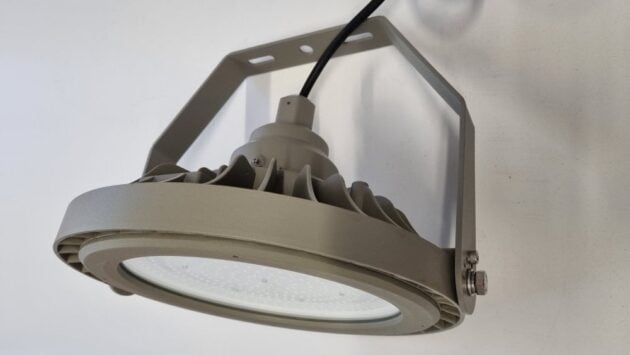

Lighting retrofitting explained: upgrade commercial spaces
TL;DR:
- Lighting retrofitting involves a systematic upgrade of fixtures, controls, and wiring to improve efficiency and compliance. It can reduce energy costs by 50 to 70 percent and enhance operational and regulatory adherence. Challenges include heritage constraints, multi-let sites, and older wiring that require careful planning and stakeholder coordination.
Retrofitting your commercial lighting is not simply a case of swapping old bulbs for new ones. Done properly, it is a systematic process that can slash energy bills, bring your premises into compliance with UK regulations, and meaningfully improve the comfort of everyone who works or shops there. Whether you manage an office block, a retail unit, or a hospitality venue, understanding what a proper retrofit involves, and what it delivers, puts you in a far stronger position to make the right investment.
Key Takeaways
| Point | Details |
|---|---|
| Beyond bulb replacement | Lighting retrofitting is a comprehensive process involving audits, controls, and compliance upgrades. |
| Compliance is essential | UK commercial retrofits must meet BS 7671 and BS EN 12464-1 standards to ensure safety and efficiency. |
| Controls drive savings | Integrating sensors and dimmers can boost energy savings by an extra 20-30%. |
| Specialised approaches needed | Heritage buildings and multi-let sites require advanced planning and coordination for successful retrofits. |
What is lighting retrofitting?
Lighting retrofitting means upgrading an existing lighting installation in a structured, planned way rather than making ad hoc replacements. It goes well beyond fitting new lamps. A genuine retrofit addresses the entire system: the fixtures, the light sources, the controls, and the wiring, all assessed against current UK standards.
In practice, retrofit office lighting involves site audits, LED selection, compliant installation to BS 7671, sensor integration, and post-install verification. The relevant standards you need to know are BS 7671 (wiring regulations), BS EN 12464-1 (lighting for workplaces), and Part L of the Building Regulations (energy efficiency). Ignoring these is not just a compliance risk; it can also invalidate insurance and affect lease obligations.
Retrofitting vs. simple replacement
| Feature | Simple replacement | Full retrofit |
|---|---|---|
| Site audit | No | Yes |
| Controls upgrade | Rarely | Standard |
| Compliance check | Unlikely | Always |
| Energy modelling | No | Yes |
| Post-install verification | No | Yes |
Typical fixtures and technologies improved during a retrofit include:
- Fluorescent tubes replaced with LED panels or strips
- High-pressure sodium or metal halide high-bays swapped for LED high-bays
- Halogen spotlights replaced with LED equivalents in retail and hospitality
- Analogue switching replaced with occupancy sensors and daylight dimming
- Emergency lighting brought up to current standards
An energy efficient lighting guide can help you identify which fixtures in your premises are the biggest energy drains and therefore the best candidates for early replacement.
Steps and methods for successful retrofitting
A well-executed retrofit follows a clear sequence. Skipping stages is where projects go wrong, costs overrun, or compliance is missed.
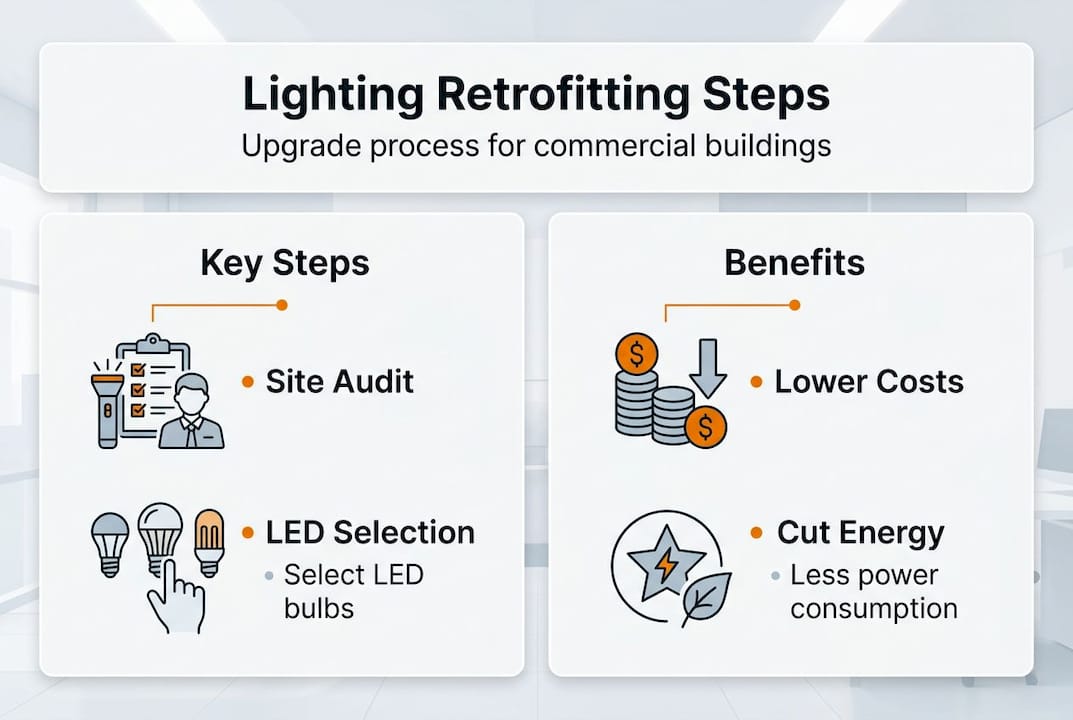
- Site audit: A qualified engineer surveys every zone, measures existing lux levels, and maps out wiring. This creates the baseline for all decisions that follow.
- LED selection: Choose fittings with an efficacy of more than 95 lm/W (lumens per watt). Anything below this threshold will underperform against modern benchmarks and reduce your return on investment.
- Controls specification: Decide which zones benefit from occupancy sensors, daylight-linked dimming, or time scheduling. This is where significant additional savings are unlocked.
- Compliant installation: All work must meet BS 7671 and deliver illuminance levels required by BS EN 12464-1 for the specific task areas in your building.
- Post-install verification: Measure actual lux levels, confirm sensor operation, and document everything for compliance records.
The LED cost saving tips that make the biggest difference are usually found at the controls stage, not the lamp stage. Many property managers focus almost entirely on the hardware and overlook this.
Pro Tip: Prioritise occupancy sensors and dimming controls during your retrofit. The best LED lighting tips consistently point to sensors and dimmers delivering 20 to 30% additional energy savings on top of the LED upgrade itself.
Once the project is complete, track your energy consumption monthly for at least six months. This gives you real data to calculate ROI and identify any zones where further optimisation is possible.
Practical benefits and expected savings
The financial case for retrofitting is strong, but the numbers vary depending on your starting point and how thoroughly you implement controls.
LED retrofits typically cut lighting energy consumption by 50 to 70% compared with older fluorescent or halogen systems. Add controls, and sensors and dimmers can deliver an extra 20 to 30% energy savings on top of that baseline reduction. For a medium-sized office or retail unit spending £10,000 per year on lighting energy, that represents a very material saving.
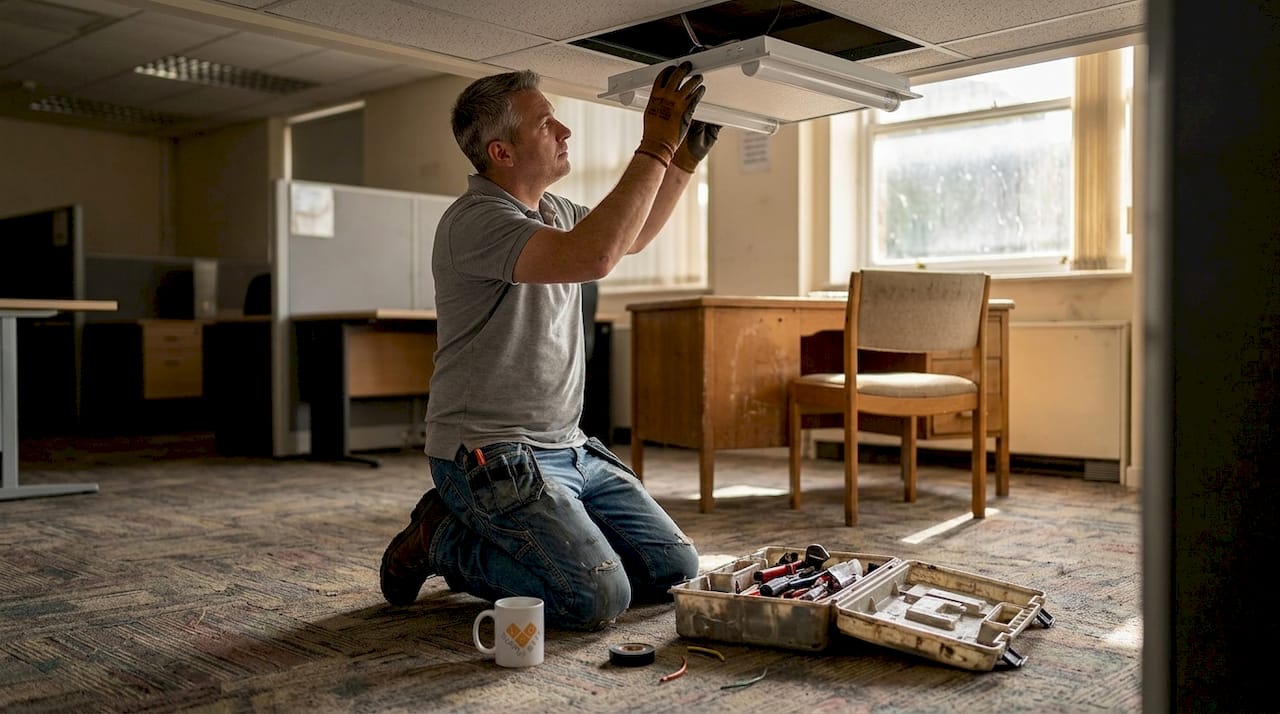
Typical savings by sector
| Sector | Estimated energy saving | Payback period |
|---|---|---|
| Office | 55 to 65% | 2 to 4 years |
| Retail | 50 to 60% | 2 to 3 years |
| Hospitality | 45 to 55% | 3 to 5 years |
Beyond direct energy costs, there are further operational and regulatory benefits worth noting:
- Compliance with Part L reduces the risk of enforcement action during building assessments
- Longer LED lifespan (typically 50,000 hours) cuts maintenance and lamp replacement costs significantly
- Improved colour rendering and consistent lux levels enhance customer experience in retail and hospitality
- Better workplace lighting supports staff wellbeing and can reduce absenteeism
- Lower heat output from LEDs reduces air conditioning load in summer
For a detailed breakdown of cost-saving lighting strategies, it is worth modelling your specific premises before committing to a specification. The savings in hospitality, for example, depend heavily on operating hours and the proportion of decorative versus task lighting. If you are planning to upgrade commercial lighting across multiple sites, phased rollouts can also help manage capital expenditure.
Challenges and nuance: heritage, multi-let and unique cases
Not every retrofit is straightforward. Certain building types and tenancy arrangements introduce complications that require careful planning before any work begins.
“The biggest risk in commercial retrofitting is not the technology. It is the assumption that every building follows the same rules.”
Heritage and listed buildings require gear tray retrofits to preserve aesthetics, multi-let sites need tenant coordination, and older wiring may necessitate full rewiring before LED installation is viable. These are not edge cases; they affect a significant proportion of UK commercial stock, particularly in city centres.
Key challenges to plan for include:
- Listed buildings: Visible fixture changes may require planning consent. Gear tray retrofits, where the internal components are replaced but the original housing is kept, are often the approved route.
- Multi-let properties: Landlords and tenants must agree on cost allocation, access arrangements, and responsibility for ongoing maintenance before work starts.
- High-ceiling spaces: Warehouses and large retail units need a photometric survey (a detailed calculation of how light distributes across a space) to ensure adequate coverage without over-specification.
- Older wiring: Buildings with pre-1990s wiring may need a full rewire to support modern LED drivers and controls, adding cost and programme time.
- Tenant disruption: Phasing installation to minimise business interruption requires detailed scheduling and communication.
For buildings with energy saving lights already partially installed, a hybrid approach is sometimes the most practical route, completing the retrofit in stages as leases renew or refurbishments are planned.
A fresh perspective: why retrofitting is more than a quick ROI
Most articles on this subject frame retrofitting as a financial calculation. Payback period, percentage saving, cost per kilowatt hour. That framing is useful, but it misses something important.
The properties that get the most from a retrofit are those where the decision-maker treated it as a strategic upgrade, not a maintenance task. Stakeholder alignment and unintended consequences in heritage and deep retrofits are the issues that derail projects, not the technology itself. DIY shortcuts, using non-compliant fittings or skipping the post-install verification, can create safety risks, void warranties, and cause friction with tenants or insurers.
Investing in sustainable lighting trends and proper compliance expertise from the outset is nearly always cheaper than fixing problems after the fact. Involve all stakeholders early, document every decision, and treat the audit as the foundation of the entire project.
How to move forward: explore expert retrofitting solutions
If you are ready to move from planning to action, the right support makes the difference between a retrofit that delivers and one that disappoints.

At LED Supply & Fit, we supply and install best commercial LED lighting across offices, retail spaces, hospitality venues, and more. From initial audit to post-install verification, our team handles compliance, controls, and installation. Explore our guidance on how to upgrade commercial lighting and get in touch to discuss your specific premises. We offer trade accounts, bulk pricing, and next-day delivery on a wide range of LED products.
Frequently asked questions
How does lighting retrofitting differ from basic bulb replacement?
Lighting retrofitting covers a full site audit, controls upgrades, and compliance with UK standards, whereas basic bulb replacement simply swaps one lamp for another without addressing the wider system.
What compliance standards must a UK lighting retrofit meet?
Typical retrofits must follow BS 7671 and BS EN 12464-1, covering electrical safety and workplace illuminance levels respectively, alongside Part L of the Building Regulations for energy performance.
How much energy and cost savings can a commercial property expect?
LED upgrades alone typically deliver 50 to 70% energy savings, and adding sensors and dimmers can produce a further 20 to 30% reduction on top of that figure.
What are the challenges for heritage or listed buildings?
Heritage sites often require gear tray retrofits that preserve the original fixture appearance while upgrading internal components, and may also need planning consent before visible changes are made.
Recommended
- How to retrofit office lighting for maximum energy savings
- How to Upgrade Commercial Lighting for Cost Savings
- Why lighting quality matters: save energy and boost wellbeing
- Lighting Design: Impact on Cost and Compliance
- Commercial relocation explained: move offices efficiently