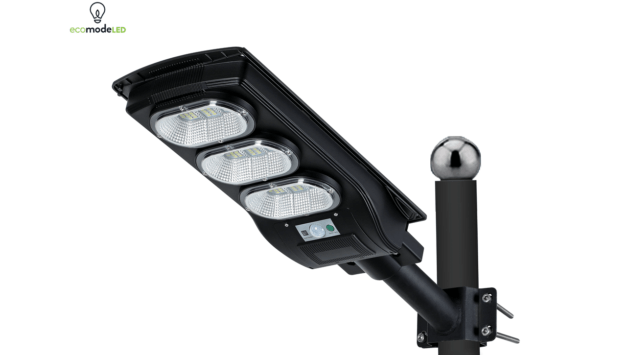

LED installation step by step: a complete guide for UK businesses
TL;DR:
- Outdated lighting in UK commercial premises increases costs, safety risks, and compliance issues.
- Proper planning, product selection, and site preparation are critical for effective LED upgrades.
- Ongoing verification, maintenance, and system management maximize long-term energy savings and safety compliance.
Outdated lighting costs UK commercial premises far more than most managers realise. Beyond inflated electricity bills, poor illumination creates compliance risks under current HSE and BS 7671 standards, and can directly affect staff productivity and safety. If you are managing an office, warehouse, retail space, or hospitality venue, getting your LED upgrade right the first time matters. This guide walks you through every stage, from initial survey to final sign-off, so you can achieve genuine energy savings, maintain legal compliance, and avoid the expensive mistakes that come from rushing the process.
Key Takeaways
| Point | Details |
|---|---|
| Plan for compliance | Accurate assessment and lux calculations are vital to meet UK standards before installation begins. |
| Select fit-for-purpose LEDs | Choose fixtures and controls rated for each space to maximise savings and safety. |
| Prioritise safety preparation | Schedule off-hours, use qualified electricians, and follow all wiring and HSE guidelines. |
| Verify and maintain | Commission systems with proper testing, ensure annual inspections, and meet all legal standards for peace of mind. |
Planning your LED upgrade: survey, targets, and assessment
Good LED installations begin long before anyone touches a fitting. Start with a full site survey: record every existing light source, note the function of each space, and measure ceiling heights. This information shapes everything that follows.
Compliance with EN 12464-1 lux targets is non-negotiable for UK commercial premises. Offices require 500 lux at desk level, whilst warehouse aisles need 150 to 300 lux. Detailed task areas such as workshop benches typically demand 750 lux or more. To calculate fixture numbers, divide the total target lumens for a zone by the lumen output of your chosen fitting, then account for the room’s reflectance and geometry using a basic utilisation factor.
| Space type | Minimum lux | Recommended lux |
|---|---|---|
| Open-plan office | 300 | 500 |
| Warehouse aisle | 150 | 300 |
| Detail task area | 500 | 750+ |
| Corridor or reception | 100 | 200 |
For large sites, phase the upgrade by zone to keep disruption manageable. When selecting LED fixtures for each area, tie fixture choice directly back to the lux requirements you have recorded. See our warehouse lighting best practices for space-specific guidance.
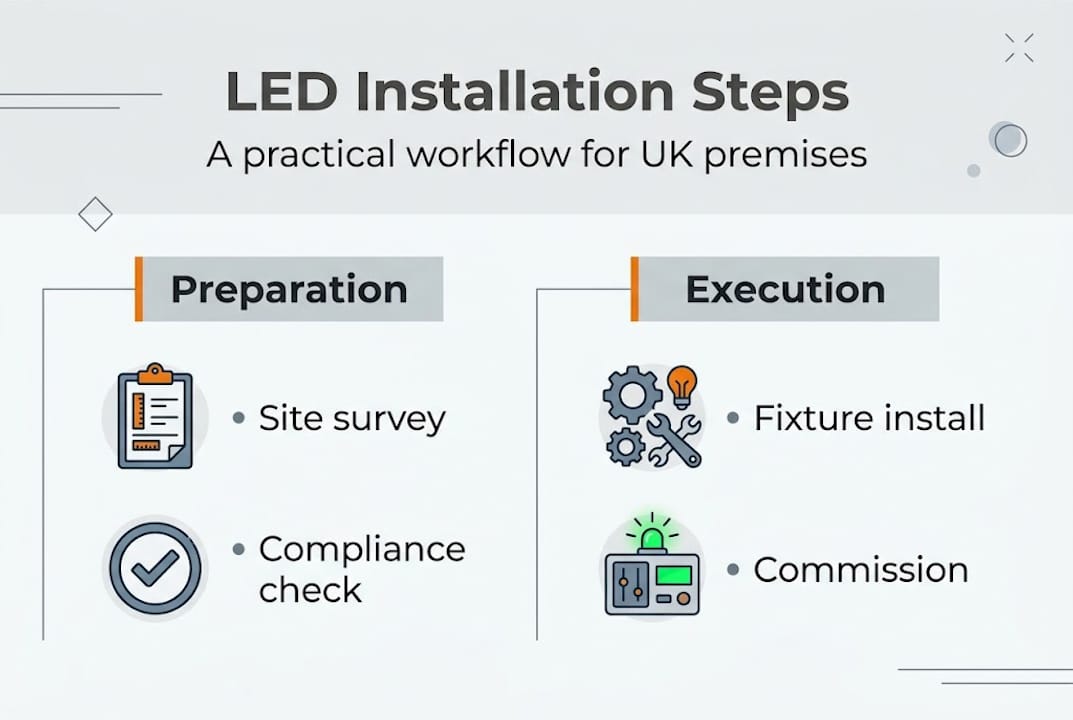
Pro Tip: Always add a 10% contingency to your fixture count. Cable runs longer than expected, awkward structural bays, and late design changes are common in commercial properties.
Selecting the right LEDs and controls
With your plan confirmed and lux targets documented, the focus shifts to product selection. The wrong fitting in the wrong environment wastes money and can create safety issues. Follow a structured shortlisting process:
- Identify the IP rating required (IP65 or higher for kitchens, plant rooms, and wash areas).
- Match fixture type to ceiling height (high-bay fittings for warehouses above 6 metres, recessed panels for offices).
- Check efficacy: aim for more than 95 lumens per watt to maximise LED cost savings.
- Confirm colour temperature: 4000K suits most office and retail environments; warmer tones around 3000K work better in hospitality.
- Verify electrical compatibility with your existing circuits and switchgear.
Controls are equally important. Occupancy sensors, daylight-linked dimming, and zone-based switching can cut energy consumption by a further 20 to 30% beyond the LED saving itself. Review selecting commercial LED fixtures for a detailed breakdown of fixture types versus environments, including IP ratings, lumen outputs, and typical applications.
| Fixture type | Typical environment | IP rating |
|---|---|---|
| Recessed panel | Office, retail | IP20-IP44 |
| High-bay fitting | Warehouse, factory | IP65 |
| Weatherproof bulkhead | Stairwell, exterior | IP65+ |
| Downlight | Hotel, restaurant | IP44-IP65 |
Pro Tip: Choose fittings with DALI or wireless dimming capability now, even if you are not activating smart controls on day one. Retrofitting control systems later costs significantly more.
Site preparation and safety compliance
Once product choices are confirmed, proper site preparation protects both your workforce and your business. Schedule installation work during off-peak hours wherever possible. A restaurant can rarely close for a week, but early mornings or overnight sessions reduce risk to staff and customers.
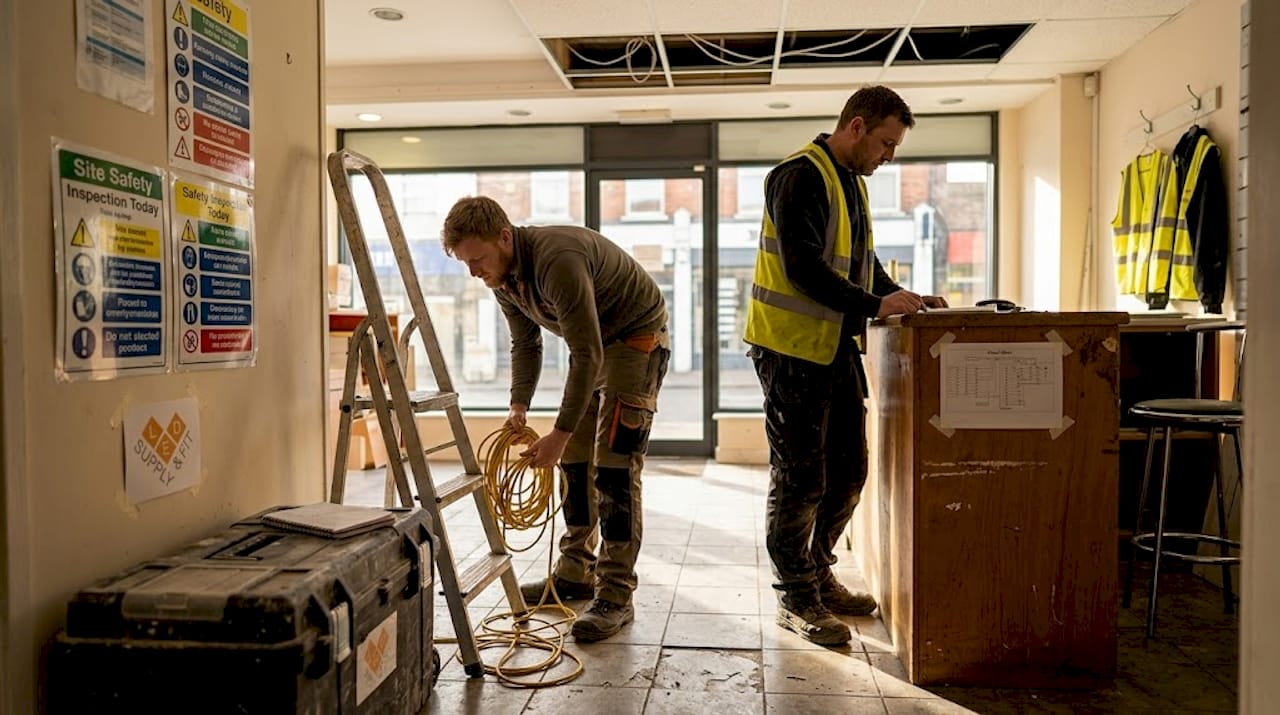
Before any work begins, isolate the relevant circuits and use a voltage tester to confirm they are dead. Do not rely on visual checks alone. Clear the workspace of stock, furniture, and obstructions so electricians can work efficiently.
All electrical work must comply with BS 7671 wiring regulations, and you should only appoint NICEIC or ECA registered electricians. This is not simply good practice; it is a legal and insurance requirement for most UK commercial premises. Detailed LED installation safety best practices are worth reviewing with your contractor before work starts.
Poor lighting directly increases accident rates and reduces productivity in commercial environments. The HSE’s HSG38 guidance sets out the employer’s duty to provide adequate, maintained illumination for all work areas.
Key preparation steps:
- Isolate circuits and confirm with a voltage tester
- Erect barriers or signage around active work areas
- Confirm electrician registration (NICEIC or ECA)
- Notify staff and building management of affected zones
- Arrange temporary lighting if areas will be dark during works
Step-by-step LED installation and commissioning
With a safe working environment established, you are ready to begin the hands-on installation. A structured sequence prevents wiring errors and simplifies commissioning:
- Remove existing fittings carefully and photograph all wiring connections before disconnecting.
- Cap and label each conductor clearly.
- Mount new LED fixtures according to the manufacturer’s specifications, checking that fixing points are structurally sound.
- Reconnect wiring, referring to your photographs and circuit documentation.
- Integrate control devices (sensors, dimmers) per the control system wiring diagram.
- Restore power to the circuit and test each fitting individually.
- Use a calibrated lux meter to verify illuminance at desk or floor level against your target values.
- Adjust fixture angles or add reflectors if uniformity is poor or glare is evident.
The energy results from a well-executed upgrade are significant. Commercial buildings regularly achieve up to 70% energy reduction following a full LED retrofit, with savings visible on the very first electricity bill. Further guidance on upgrading commercial lighting covers cost modelling and phasing strategies in more detail.
Pro Tip: Document each circuit as you go, noting fixture positions, circuit numbers, and lux readings. This log becomes invaluable if a fault develops or you need to demonstrate compliance to an insurer or environmental health officer.
Verification, handover and ongoing compliance
Completing installation is just the start; thorough verification and ongoing compliance ensure continued benefits. Before formal handover, carry out these checks:
- Conduct a full lux meter survey across all zones and compare against EN 12464-1 targets.
- Test emergency lighting function and record results.
- Complete an electrical installation condition report if circuit modifications were made.
- Walk through the site with the client or facilities manager, noting any concerns.
- Issue a signed handover document including circuit schedules, lux readings, and warranty information.
Compliance does not end at handover. Annual inspection per HSG107 is required, emergency lighting must meet BS 5266 standards, and escape route centrelines must achieve a minimum of 1 lux at all times.
| Standard | Requirement |
|---|---|
| EN 12464-1 | Task-area lux targets |
| BS 7671 | Electrical wiring compliance |
| BS 5266 | Emergency lighting |
| HSG107 | Annual inspection schedule |
Building a routine around LED maintenance best practices keeps your system performing to specification and protects you from liability if an incident occurs.
Why lighting success depends on more than just new hardware
After years of working on commercial LED projects, the pattern is clear: the installations that deliver the greatest long-term returns are never just about the fittings. They are about system-wide thinking.
Businesses that invest in zoning, controls, and scheduled maintenance consistently outperform those that simply swap old tubes for new LEDs. The LED cost saving strategies that move the needle most are often the ones that come after installation: occupancy scheduling, user feedback loops, and annual lux verification.
Contractor communication matters too. Ambiguous briefs create expensive rework. Clear documentation, shared circuit schedules, and a defined commissioning checklist reduce errors dramatically. The businesses that treat lighting as a managed asset rather than a one-off purchase see the real payback.
Take your next step with expert LED support
If you want to maximise savings and compliance with zero hassle, expert support can make all the difference.
At Ledsupplyandfit.co.uk, we handle everything from product selection to project management and ongoing compliance support. Our team helps you choose from our range of best commercial LED lighting solutions tailored to your specific premises, with bulk pricing, next-day delivery, and qualified installation available nationwide. Ready to move forward? Request a free quote and we will put together a clear, costed plan for your upgrade.
Frequently asked questions
What are the key UK standards for LED installation in commercial buildings?
Key UK standards include EN 12464-1 for lux levels, BS 7671 for wiring, HSE guidance for lighting safety, and BS 5266 for emergency lighting. Meeting all four is essential for legal compliance and insurance purposes.
How long does an LED upgrade usually take in a typical office or warehouse?
Most projects require several days, depending on size and phasing. Bulk installs save time with zoned working, but always allow a 10% contingency for wiring or structural surprises.
Does LED lighting save costs immediately and what is a typical payback period?
Yes, savings begin from the first billing cycle. Energy savings of 40 to 75% are typical for UK commercial premises, with most installations paying for themselves within one to three years.
What is the minimum light level required for emergency escape routes?
UK guidelines require a minimum of 1 lux along the centreline of all designated escape routes, in line with BS 5266.