
LED beam angle explained for commercial spaces
TL;DR:
- Understanding LED beam angle is crucial for effective lighting design, as it determines how light is distributed in a space. It is measured at 50% of peak luminous intensity using precise photometric testing, and should be distinguished from the wider field angle at 10% intensity. Selecting the appropriate beam angle based on mounting height, target coverage, and environment ensures optimal illumination and avoids costly misapplications.
When you’re planning a commercial lighting installation, one specification matters more than most people realise. Understanding what is LED beam angle separates a lighting design that performs from one that simply consumes power. It’s not about brightness alone. Two fixtures with identical lumen outputs can illuminate a space in completely different ways depending on their beam angle, yet this figure is routinely overlooked when businesses are specifying LED products.
What is LED beam angle?
The LED beam angle definition is rooted in a straightforward technical standard. Beam angle is the angular full width at half maximum (FWHM), which describes the cone of light between two directions where the luminous intensity drops to 50% of its peak value. In plain terms: if you draw an imaginary cone from the centre of your fixture outward, the beam angle is the total width of that cone at the point where the light becomes half as bright as the centre.
This measurement is not a visual estimate. Beam angles are derived from photometric testing using instruments called goniophotometers, which rotate around a fixture and sample luminous intensity at dozens of angular positions. The result is a precise intensity distribution profile, not a guess.
Worth noting is that IES and Energy Star definitions differ slightly when intensity distributions are asymmetrical or batwing-shaped. Most standard LED products use the FWHM method, but for specialist applications it pays to confirm which reference point the manufacturer used.
Pro Tip: When a product datasheet lists a beam angle without specifying the measurement method, treat that figure as approximate. Ask for the IES or EULUMDAT photometric file before committing to a large order.
Beam angle vs field angle: a critical distinction
Many buyers conflate beam angle with a related term called field angle. They are not the same, and confusing them leads to real design errors.
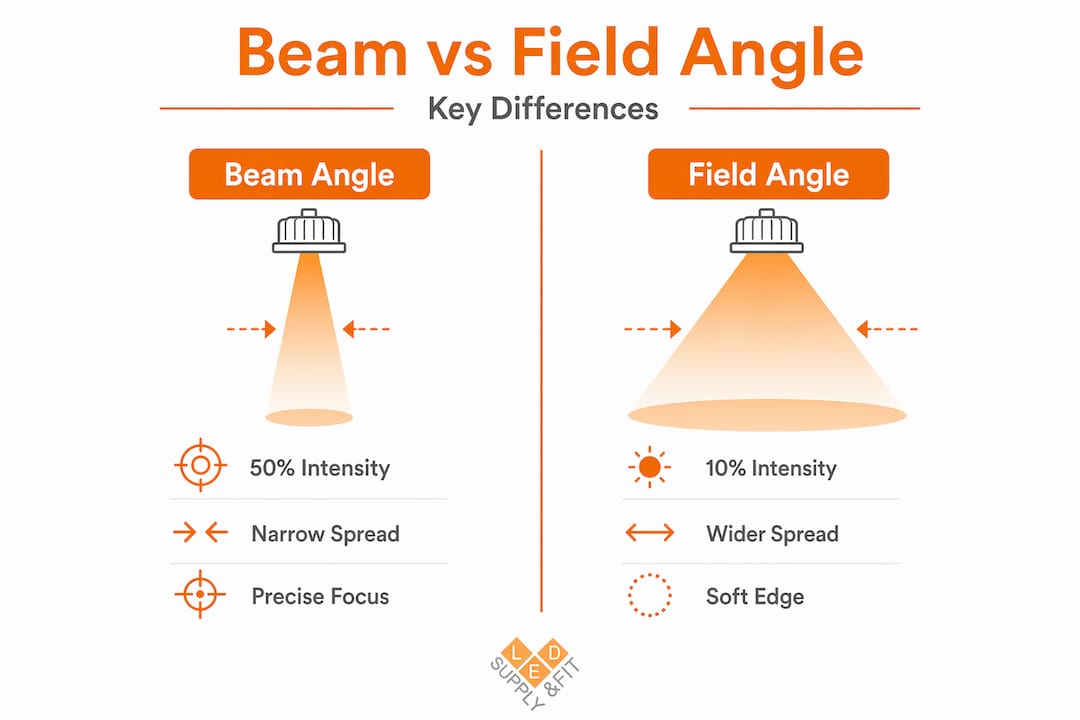
Beam angle uses the 50% intensity threshold, while field angle is typically measured at 10% intensity. Field angle is therefore always wider than beam angle for the same fixture. A product might have a 25° beam angle but a 50° field angle, which means the actual spread of visible light in the room is considerably broader than the headline figure suggests.
The practical implications are significant. Here are the key points to keep in mind when reading specifications:
- Beam angle (50% intensity) is the bright, usable core of the beam and the figure most often quoted on datasheets.
- Field angle (10% intensity) describes the full extent of detectable light, including the dim spill around the edges.
- Manufacturers may report either, making direct comparisons between brands unreliable without checking the methodology.
- Comparing fixtures by lumens alone without considering beam angle can seriously mislead your brightness expectations for a specific zone.
If you are fitting downlights in a hotel corridor and one product quotes a 40° field angle while another quotes a 40° beam angle, the second will concentrate far more light into a tighter area. Spacing your fixtures based on the wrong interpretation will leave dark patches between them.
Practical application: choosing the right beam angle
Understanding the definition is one thing. Knowing how to apply it in a real space is where the value lies. These steps walk you through the process of selecting the right beam angle for a commercial fit-out.
- Establish your mounting height. The higher the fixture, the wider the beam angle you may need to achieve adequate floor coverage. A 15° spotlight at 6 metres throws a very small circle of light. The same fixture at 2.5 metres creates a concentrated pool.
- Calculate your spot size. Approximate spot radius follows the formula: r = distance × tan(beam angle ÷ 2). A 25° beam at 3 metres gives you a radius of roughly 0.66 metres. That is useful data when planning fixture spacing.
- Combine beam angle with lumens. A high-lumen fixture with a narrow beam is ideal for accent lighting or picking out architectural detail. A moderate-lumen fixture with a wide beam suits ambient lighting in open-plan offices or retail floors.
- Account for aiming and trim. Small shifts in aiming or fixture height change where the 50% intensity boundary falls on the work surface. Recessed downlights that are slightly off-axis can create noticeably uneven illumination across a space.
- Consider the environment. Reflective surfaces like polished concrete or white walls scatter and amplify light. Darker surfaces absorb it. The same beam angle in a warehouse with dark racking behaves differently to the same product in a white-walled veterinary surgery.
Pro Tip: Always model your lighting layout with photometric software before purchasing at scale. A correct lighting project plan based on accurate beam data can prevent costly re-dos after installation.
Types of LED beam angles and when to use them
Beam angles generally fall into three broad categories. The table below covers typical ranges and their commercial applications.
| Beam angle range | Type | Typical applications |
|---|---|---|
| 10° to 20° | Narrow / spot | Display lighting, artwork, merchandise spotlighting, architectural accent |
| 25° to 45° | Medium | Retail downlights, restaurant table lighting, office task zones |
| 60° and above | Wide / flood | Warehouses, car parks, open-plan offices, general ambient lighting |
Narrow beam angles around 10 to 15° concentrate light tightly, producing high intensity over a small area. They suit retail environments where drawing attention to a product is the goal, but they are a poor choice for even background illumination. Wide beam angles at 60° or more scatter light broadly, which suits general ambient use but reduces intensity at any given point on the floor.

Increasingly, adjustable beam angle products offer flexibility where a single fixture type needs to serve multiple functions. These are particularly useful in hospitality or mixed-use spaces where the lighting brief changes between daytime service and evening dining.
How beam angle is measured and verified
Before a product reaches your premises, its beam angle should have been precisely determined under laboratory conditions.
- Goniophotometers measure luminous intensity by rotating a fixture through hundreds of angular positions, producing an intensity distribution curve from which beam angle is calculated.
- Reputable manufacturers publish this data as IES files (North American standard) or EULUMDAT files (European standard), both of which can be loaded directly into lighting design software.
- Datasheets lacking clarity on measurement methodology should prompt a request for the full photometric report. Do not base a large specification on a single quoted degree value without it.
- Testing standards and certifications, such as IESNA LM-79, govern how photometric testing must be conducted to produce reliable published data.
Verifying beam angle through photometric files rather than assuming nominal values is one of the most effective ways to avoid performance gaps between expectation and reality on site.
My perspective on beam angle in real projects
I’ve seen more commercial lighting projects go wrong because of beam angle mismatches than for almost any other reason. Clients arrive with a lumen specification, compare prices, and then wonder why their new installation looks either glaringly bright in patches or disappointingly dim across the floor. In my experience, the culprit is nearly always an unconsidered beam angle.
What I’ve found is that even experienced buyers overlook the interplay between mounting height, aiming accuracy, and the reflective properties of their specific space. The beam angle affects coverage in ways that a lumens figure simply cannot tell you. Trusting a nominal angle from a datasheet without the underlying photometric data is a shortcut that regularly costs more to fix than it saved at specification stage.
My honest advice: treat beam angle as equally important as wattage and lumens. If you’re specifying for a warehouse, a restaurant, or a medical facility, request the IES file, model the layout, and check your fixture spacing before you order in bulk. Getting this right the first time is far cheaper than a remedial fit-out.
— John
Get the beam angle right with Ledsupplyandfit
Getting beam angle right matters for every commercial space, and Ledsupplyandfit has the experience to help you do exactly that. From careful product selection through to full installation, the team brings photometric knowledge to every project, as demonstrated through successful fit-outs for clients including Wilson Veterinary Group and Stockton Riverside College. Whether you’re upgrading a retail floor, a college campus, or a warehouse, Ledsupplyandfit matches beam angle, lumen output, and fixture positioning to your specific environment. Explore the full range of commercial LED solutions and get in touch to discuss your project requirements.
FAQ
What is the standard LED beam angle definition?
LED beam angle is defined as the angular full width at half maximum (FWHM), the angle between two directions where luminous intensity falls to 50% of the peak value. This is the most widely used standard for measuring the cone of useful light from an LED fixture.
How is LED beam angle measured?
Beam angle is measured using a goniophotometer, which rotates around the fixture and records luminous intensity at multiple angles to produce an accurate intensity distribution profile. The resulting data is published as IES or EULUMDAT photometric files.
What is the difference between beam angle and field angle?
Beam angle is measured at 50% peak intensity, while field angle is measured at 10% peak intensity, making field angle always wider than beam angle for the same fixture. Comparing these two figures as if they were equivalent is a common and costly mistake.
Which beam angle is best for commercial spaces?
There is no single correct answer. Narrow angles (10° to 20°) suit accent and display lighting; medium angles (25° to 45°) work well for retail and office downlights; wide angles (60°+) are best for general ambient lighting in warehouses or open-plan areas.
Why does beam angle matter alongside lumens?
Beam angle and lumens measure different things: lumens express total light output while beam angle describes how that light is distributed. A high-lumen fixture with a narrow beam can leave most of a room in shadow, so both figures must be considered together for effective lighting design.