
DALI lighting control explained for commercial buildings
TL;DR:
- DALI lighting control is a standardized, bi-directional digital protocol that enables precise management and monitoring of individual luminaires on a shared two-wire bus. It offers energy savings, fault detection, and flexible scene programming for commercial spaces by supporting up to 64 devices per segment and integrating with wider building automation systems through gateways. The enhanced capabilities of DALI-2, including certified devices and real-time energy monitoring, improve interoperability and operational efficiency across diverse property types.
DALI lighting control is defined as Digital Addressable Lighting Interface, a standardised, bi-directional digital protocol governed by IEC 62386 that gives building managers individual command and monitoring of every luminaire on a shared two-wire bus. Unlike analogue dimming systems that treat entire circuits as one unit, DALI addresses each fitting separately, enabling grouping, scene programming, and real-time fault feedback across a single installation. For commercial property professionals managing offices, hotels, warehouses, or retail spaces, this level of precision directly translates into lower energy bills and simpler maintenance. Understanding how the DALI lighting system works is the first step toward specifying it correctly.
What is DALI lighting control and how does it work technically?
DALI operates over a two-wire, low-voltage bus that carries both control signals and power to connected devices. The wiring is polarity-free, which removes a common installation error and speeds up commissioning. Each piece of control gear receives a unique digital short address between 0 and 63, assigned automatically through a discovery algorithm during setup.
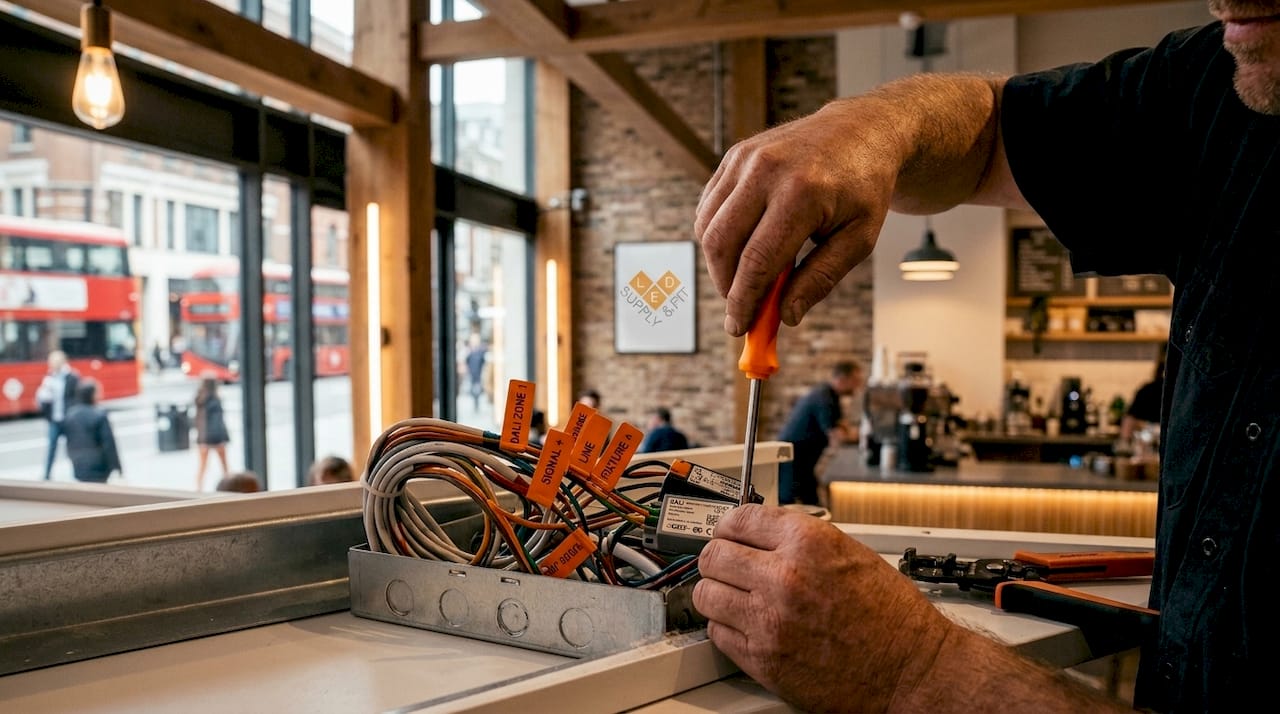
A single DALI bus segment supports up to 64 addressable devices, covering most small to medium commercial floors without additional hardware. Larger buildings simply add more bus segments, each linked through a gateway or router. This segmented architecture keeps each line stable and predictable.
Communication is bi-directional. The controller sends commands to luminaires, and luminaires report back their status, including lamp failures or driver faults. This feedback loop is what separates DALI from older one-way control systems and makes it genuinely useful for facilities management.
- Polarity-free two-wire wiring reduces installation errors
- Automated address assignment replaces manual addressing, cutting commissioning time
- Up to 64 devices per bus segment with gateway expansion for larger sites
- Bi-directional communication delivers live fault and status data to the controller
Pro Tip: Plan your bus segments before installation begins. Trying to split an overloaded DALI line after commissioning is far more disruptive than segmenting correctly from the outset.
How does DALI-2 improve on the original DALI protocol?
DALI-2 is the current certified version of the standard and its most significant change is not extended dimming range. DALI-2’s biggest benefit is standardising the control device ecosystem so that sensors, switches, and controllers from different manufacturers work together reliably. This interoperability was inconsistent under the original specification.
| Feature | Original DALI | DALI-2 |
|---|---|---|
| Certification | Voluntary | Mandatory for all device types |
| Input devices | Drivers only | Sensors, switches, and controllers included |
| Diagnostics | Basic fault reporting | Real-time energy monitoring and fault feedback |
| Dynamic automation | Limited | Occupancy and daylight response standardised |
| Interoperability | Manufacturer-dependent | Guaranteed across certified products |
The inclusion of certified input devices such as occupancy sensors and daylight sensors is the practical upgrade most building managers notice first. A DALI-2 presence detector can automatically dim or switch off luminaires in unoccupied zones without any manual intervention or separate control layer.
Standardised device profiles, tied to specific parts of IEC 62386, mean that a DALI-2 driver from one manufacturer and a DALI-2 controller from another will behave consistently. This removes the integration guesswork that plagued earlier installations.
Pro Tip: When specifying products, always confirm DALI-2 certification rather than accepting “DALI compatible” claims. Certified products carry a formal test mark and guarantee interoperability that uncertified devices cannot.
How do grouping and scenes work in a DALI lighting system?
Groups and scenes are the two practical tools that make DALI genuinely flexible for day-to-day building management. A group is a set of luminaires that receive identical commands simultaneously. Switching or dimming a group affects every fitting assigned to it, regardless of where those fittings sit physically on the bus.
DALI supports 16 groups and 16 scenes per bus segment. Groups simplify zone control, for example all fittings in an open-plan office, a corridor, or a car park can each form a separate group. A single command then controls an entire zone without addressing each luminaire individually.
Scenes work differently and deliver more nuance. Each scene stores individual brightness and colour temperature parameters per luminaire, so activating a scene can simultaneously set one fitting to 80% output, another to 40%, and a third to off. Scene programming prevents users from manually adjusting multiple fittings and increases operational efficiency across the building.
Common scene applications in commercial properties include:
- Occupied mode: Full output across workstations, reduced output in circulation areas
- Presentation mode: Dimmed ambient lighting with focused task lighting at the front of a room
- Cleaning mode: Full output across all zones for thorough visibility
- Night mode: Minimum output for security lighting only
DALI-2 extends scene control to include colour temperature adjustments, which is particularly useful in hospitality and retail environments where ambience directly affects customer experience.
What energy savings and practical benefits can commercial properties achieve?
The measurable case for DALI is strong. A 2026 National Theatre project achieved up to 60% energy reduction using a DALI-LINK dimming system with presence detection and app-based commissioning. That figure reflects what automated occupancy and daylight response can deliver in a complex, multi-zone commercial environment.
“The system’s ease of programming via the BEG One app enabled sustained energy savings in a complex commercial environment, demonstrating that DALI control delivers measurable results beyond the specification sheet.”
The advantages of DALI lighting for building managers extend well beyond energy bills. Fault detection through bi-directional communication means maintenance teams receive precise location data when a driver fails, rather than walking an entire floor to find the problem. This cuts response times and reduces the labour cost of reactive maintenance.
Key operational benefits for commercial properties:
- Automated dimming based on occupancy sensors and daylight harvesting reduces consumption during low-use periods
- Fault diagnostics identify failed drivers and lamps by address, not just by zone
- Scalable architecture accommodates building extensions without rewiring existing segments
- BMS integration connects DALI lighting data to broader building management systems for unified reporting
- Occupant comfort improves through tailored lighting presets that match task requirements
For a practical look at how these benefits translate to a real commercial site, the Ravensworth Golf Club project illustrates the kind of energy and maintenance gains achievable with a well-specified LED and controls upgrade.
How to integrate DALI control with wider building automation systems
DALI is a lighting protocol. It does the lighting layer exceptionally well, and the most effective building automation strategies keep it focused on that role. Linking DALI to KNX through a gateway is the standard approach for whole-building automation, preserving native DALI lighting features while enabling centralised control alongside HVAC, access, and security systems.
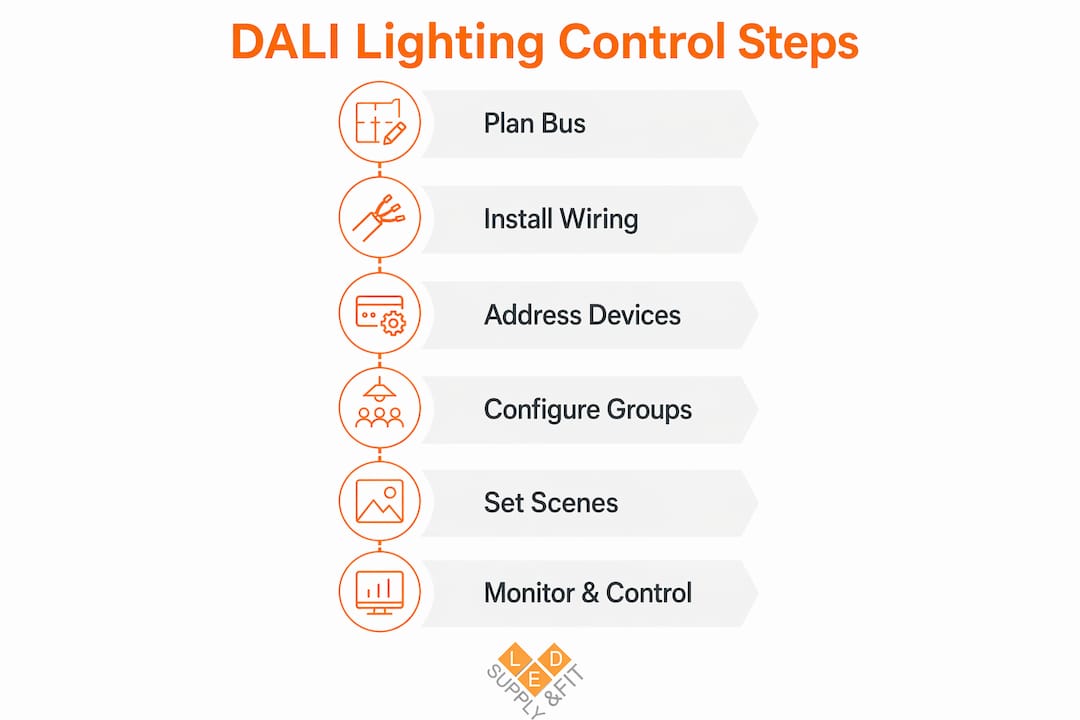
- Define the lighting layer first. Map all DALI bus segments, group assignments, and scene configurations before connecting to any higher-level system.
- Use a dedicated DALI gateway. A gateway translates between DALI and protocols such as KNX, BACnet, or Modbus without compromising the lighting system’s native performance.
- Assign short addresses during commissioning. Automated address assignment through the discovery algorithm reduces errors and simplifies future maintenance.
- Segment large installations correctly. Keep each DALI bus below 64 devices to maintain reliable communication and stable long-term operation.
- Test bi-directional feedback independently. Confirm that fault and status data flows correctly from luminaires to the controller before integrating with the BMS.
Integrations that drive efficiency in asset management consistently show that layered protocols outperform single-protocol attempts to control everything. DALI handles lighting with precision; the gateway handles translation; the BMS handles the bigger picture.
Why I think most DALI installations underuse what the system can do
Having worked with commercial lighting upgrades across offices, leisure facilities, and retail environments, the pattern I see most often is this: the DALI hardware gets installed correctly, and then the scene and group configuration receives about 20% of the attention it deserves. Building managers end up with a sophisticated system running basic on/off switching because nobody spent the time programming the scenes properly before handover.
The diagnostics capability is equally underused. DALI’s real-time fault feedback is one of its strongest arguments for commercial properties, yet many facilities teams never configure alerts. They find out about a failed driver the same way they always did: a tenant complaint.
My recommendation is to treat the commissioning phase as seriously as the hardware specification. Work with an experienced integrator who will programme group and scene configurations to match actual building use patterns, not generic defaults. Emerging technologies such as D4i (DALI for luminaire data) and DALI+ are extending the protocol further into energy monitoring and asset tracking. Getting the fundamentals right now means those upgrades slot in without a full recommission.
— John
Upgrade your commercial lighting with DALI-ready LED solutions
If you are evaluating DALI control for a commercial property, the LED products you specify need to be DALI-2 compatible from the outset. Ledsupplyandfit supplies and installs LED lighting solutions across UK commercial premises, from offices and warehouses to hotels and retail spaces, with full support for DALI-controlled systems.
Ledsupplyandfit’s range of commercial LED lighting includes DALI-2 compatible drivers and fittings suited to every commercial zone. For properties focused on reducing running costs, the smarter LED lighting solutions page outlines the energy savings achievable when LED efficiency combines with DALI automated control. Contact the team directly to discuss your project requirements or to arrange a product demonstration at the Darlington showroom.
FAQ
What is DALI lighting control in simple terms?
DALI lighting control is a digital protocol that lets building managers address, dim, group, and monitor individual luminaires over a shared two-wire bus, defined by the IEC 62386 standard.
How many devices can a single DALI bus support?
A single DALI bus segment supports up to 64 short-addressable control devices. Larger installations use multiple bus segments connected through gateways or routers.
What is the difference between DALI and DALI-2?
DALI-2 introduces mandatory certification for all device types, including sensors and switches, and adds real-time energy monitoring and fault feedback. The original DALI standard covered drivers only and lacked enforced interoperability testing.
How much energy can DALI lighting control save?
A 2026 National Theatre installation achieved up to 60% energy reduction using DALI-LINK dimming with presence detection, demonstrating the savings possible in complex commercial environments.
Can DALI integrate with a building management system?
DALI integrates with building management systems through gateways that translate between DALI and protocols such as KNX or BACnet, preserving native lighting control features while enabling whole-building automation.