

Bulk Order Lighting: Unlocking Commercial Savings
Choosing lighting for hotels or restaurants often feels overwhelming, with countless options and technical terms to consider. For UK facility managers and procurement officers, the demand for energy efficiency and cost reduction is constant. Bulk order lighting brings real advantages, from streamlined purchasing to bulk LED solutions tailored for commercial needs, helping you achieve both sustainability goals and operational savings without hassle.
Table of Contents
- Bulk Order Lighting: Definition And Fundamentals
- Types Of Bulk Order Led Lighting Solutions
- How Bulk Order Pricing And Discounts Work
- Regulatory Standards And Legal Compliance
- Financial Benefits And Common Cost Pitfalls
Key Takeaways
| Point | Details |
|---|---|
| Bulk Order Lighting Benefits | Businesses can achieve significant cost savings of 10-35% through bulk purchasing strategies, alongside improved inventory management and streamlined procurement processes. |
| Types of LED Lighting Solutions | Various options like LED Bulbs, Strip Lights, and High Bay Lights cater to specific commercial needs, ensuring appropriate illumination for different environments. |
| Navigating Pricing Models | Adopting tiered pricing and volume-based discounts allows for substantial financial advantages, enabling more predictable budgeting and better supplier relationships. |
| Compliance and Financial Considerations | Adhering to regulatory standards is crucial to avoid legal pitfalls, while an in-depth cost-benefit analysis is essential for maximising the financial viability of bulk lighting investments. |
Bulk order lighting: definition and fundamentals
Bulk order lighting represents a strategic procurement approach where businesses purchase large quantities of lighting fixtures, designed to deliver significant cost efficiencies and operational advantages. Understanding these fundamentals requires examining the core principles that drive commercial lighting acquisitions.
At its essence, bulk order lighting involves purchasing multiple lighting units simultaneously, typically for commercial, industrial, or institutional settings. The fundamental principles of lighting encompass several critical considerations that inform purchasing decisions:
- Quantity of illumination requirements
- Energy efficiency standards
- Installation complexity
- Long-term operational costs
- Compatibility with existing electrical infrastructure
Commercial buyers leverage bulk ordering strategies to achieve substantial financial benefits. These advantages extend beyond mere price reductions and include streamlined procurement processes, reduced administrative overhead, and more predictable inventory management.
The economic rationale for bulk lighting purchases is compelling. Businesses can typically expect significant per-unit discounts ranging from 10-35% compared to individual product acquisitions. Additionally, bulk orders often provide opportunities for customised specifications, enabling organisations to tailor lighting solutions precisely to their operational environments.
Pro tip: Before finalising a bulk lighting order, request comprehensive technical specifications and conduct a thorough site assessment to ensure optimal product compatibility and performance.
Types of bulk order LED lighting solutions
The world of bulk order LED lighting encompasses a diverse range of solutions designed to meet varying commercial and industrial illumination requirements. Bulk LED lighting solutions represent a strategic approach to purchasing lighting fixtures that cater to specific operational needs across multiple environments.
Commercial LED lighting typically includes several key categories:
- LED Bulbs: Standard replacements for traditional incandescent and fluorescent lighting
- Strip Lights: Versatile illumination for architectural and functional applications
- LED Panels: Uniform lighting for office and institutional spaces
- High Bay Lights: Ideal for warehouses, factories, and large industrial areas
- Floodlights: Powerful exterior lighting for security and landscape illumination
- Smart LEDs: Programmable lighting with advanced control capabilities
Each lighting type offers unique advantages tailored to specific environments. For instance, high bay lights provide intense, wide-area illumination crucial for industrial settings, while LED panels deliver consistent, glare-free lighting perfect for modern office spaces. The commercial LED lighting spectrum includes specialised options like A-type bulbs for general lighting, PAR and BR bulbs for directional applications, and T8 tubes for comprehensive ceiling installations.

Choosing the right LED lighting solution involves careful consideration of specific operational requirements, energy efficiency targets, and long-term cost-effectiveness. Businesses must evaluate factors such as lumens, colour temperature, beam angle, and compatibility with existing electrical infrastructure to ensure optimal performance.
Below is a comparison of common LED lighting solutions for bulk orders and their optimal business applications:
| Lighting Solution | Best Use Case | Business Impact | Customisation Potential |
|---|---|---|---|
| LED Bulbs | General office lighting | Reduced energy costs | Multiple wattage and shape options |
| Strip Lights | Retail and display areas | Enhanced visual appeal | Adjustable length, various colours |
| LED Panels | Conference rooms | Improved workspace comfort | Size and mounting options |
| High Bay Lights | Warehouses and factories | Increased productivity | Beam angle, sensor integration |
| Floodlights | Outdoor security | Safer premises | Motion sensors and brightness control |
| Smart LEDs | Modern offices | Automation and flexibility | Remote programmability, scheduling |
Pro tip: Conduct a comprehensive site survey and lighting audit before finalising your bulk LED order to ensure precise matching of lighting solutions to your specific operational environment.
How bulk order pricing and discounts work
Bulk order pricing represents a sophisticated procurement strategy that enables businesses to unlock substantial financial advantages through strategic purchasing approaches. Bulk order discounts operate on the fundamental economic principle of economies of scale, where increased purchase volumes directly correlate with reduced per-unit costs.
Typical bulk order pricing structures include:
- Tiered Pricing Models: Progressively increasing discounts as order quantities rise
- Volume-Based Discounts: Percentage reductions linked to total purchase quantities
- Cumulative Purchase Incentives: Rewards for consistent, long-term buying patterns
- Bulk Quantity Breaks: Specific price reductions at predetermined order thresholds
- Wholesale Price Brackets: Standardised pricing levels based on order magnitude
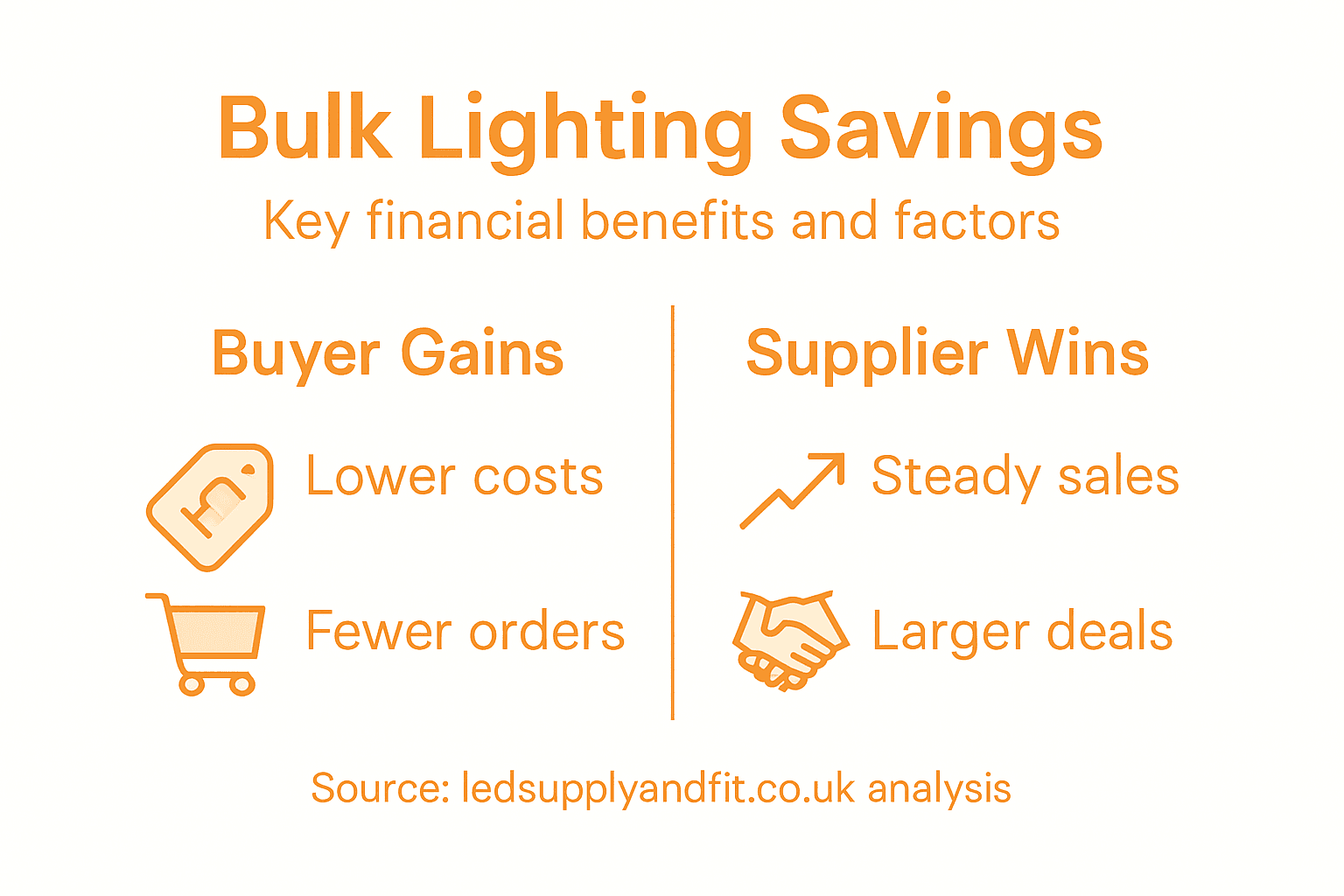
The underlying mechanics of bulk pricing are designed to benefit both suppliers and purchasers. Suppliers gain consistent revenue and reduced administrative overhead, while buyers enjoy significant cost reductions. These pricing strategies typically result in savings ranging from 10% to 35% compared to standard retail pricing, making bulk orders an attractive option for commercial lighting procurement.
Businesses must carefully navigate pricing compliance requirements to ensure transparent and fair pricing across different procurement scenarios. This involves maintaining consistent discount structures, tracking price modifications, and ensuring uniform application of pricing strategies across various purchasing channels.
To help navigate bulk pricing, the following table summarises key price models and their benefits for both buyers and suppliers:
| Pricing Model | Buyer Benefit | Supplier Advantage | Common Scenario |
|---|---|---|---|
| Tiered Pricing | Higher discounts | Predictable sales volume | Large corporate orders |
| Volume-Based Discount | Clear savings | Easy to administer | Monthly repeat purchases |
| Cumulative Incentives | Reward for loyalty | Strong customer retention | Ongoing partnerships |
| Bulk Quantity Breaks | Immediate cost relief | Efficient stock turnover | Single, high-value transactions |
| Wholesale Brackets | Consistent pricing | Stable market positioning | Distribution and resale |
Pro tip: Negotiate flexible pricing terms and request detailed volume discount breakdowns before finalising your bulk lighting order to maximise potential savings.
Regulatory standards and legal compliance
Legal compliance forms a critical foundation for commercial lighting procurement, establishing essential safety, performance, and environmental standards that businesses must navigate carefully. Global lighting product regulations create a comprehensive framework designed to protect consumers, ensure product quality, and maintain rigorous industry benchmarks.
Key regulatory certification requirements include:
- Safety Certifications
- UL (Underwriters Laboratories)
- CE (European Conformity)
- IEC (International Electrotechnical Commission)
- Environmental Standards
- RoHS (Restriction of Hazardous Substances)
- Energy Star ratings
- Performance Compliance
- Maximum energy consumption limits
- Luminous efficacy requirements
- Colour rendering specifications
Commercial lighting projects must adhere to specific commercial lighting codes that govern energy efficiency, safety, and accessibility. These regulations encompass complex requirements such as maximum power allowances, mandatory lighting control systems, and stringent installation guidelines that vary across different jurisdictions and building types.
Navigation of these regulatory landscapes requires detailed understanding and proactive compliance strategies. Businesses must continually update their knowledge of evolving standards, ensuring that bulk lighting purchases not only meet current regulations but anticipate potential future legislative changes in environmental and safety requirements.
Pro tip: Engage a compliance specialist to conduct a comprehensive regulatory review before finalising large-scale lighting procurement to mitigate potential legal and financial risks.
Financial benefits and common cost pitfalls
Commercial lighting procurement represents a sophisticated financial strategy where strategic purchasing decisions can yield significant economic advantages. Bulk lighting discounts enable businesses to transform lighting upgrades into financially intelligent investments by leveraging economies of scale and sophisticated negotiation techniques.
Key financial benefits of bulk lighting orders include:
- Direct Cost Reductions
- Per-unit price savings
- Lower overall project expenditure
- Reduced procurement administrative costs
- Long-Term Financial Advantages
- Improved energy efficiency
- Reduced maintenance expenses
- Extended equipment lifespan
- Strategic Procurement Benefits
- Predictable budgeting
- Enhanced supplier relationships
- Potential tax incentives
Common financial pitfalls in bulk lighting procurement can significantly undermine potential savings. Businesses often make critical errors such as overestimating lighting requirements, neglecting total lifecycle costs, and failing to conduct comprehensive comparative analyses. These mistakes can transform potentially lucrative investments into unnecessarily expensive propositions.
Successful financial management in bulk lighting orders requires meticulous planning, detailed technical understanding, and strategic approach. Organisations must balance immediate cost considerations with long-term operational efficiency, carefully evaluating each procurement decision against comprehensive financial performance metrics.
Pro tip: Develop a detailed cost-benefit analysis that includes initial purchase price, installation expenses, energy consumption, and projected maintenance costs before finalising any bulk lighting investment.
Maximise Your Commercial Savings with Expert Bulk LED Lighting Solutions
Businesses face the challenge of balancing high-quality, energy-efficient lighting with budget constraints and compliance demands. The article highlights critical pain points such as navigating bulk order pricing, ensuring regulatory compliance, and avoiding costly procurement pitfalls. By understanding concepts like tiered pricing models, performance compliance, and long-term financial advantages, you can transform your lighting upgrade into a cost-effective investment that enhances productivity and reduces operational expenses.
At Ledsupplyandfit.co.uk, we specialise in providing tailored bulk order lighting solutions designed specifically for commercial environments including offices, warehouses, and retail spaces. Benefit from customisable LED options, next-day delivery, and professional installation services that guarantee both compliance with current commercial lighting standards and maximised energy efficiency. Our expertise simplifies complex procurement processes, helping you avoid common overspending mistakes discussed in the article.
Ready to unlock substantial savings and elevate your premises with premium LED lighting?
Explore our comprehensive range and bulk discounts now at Ledsupplyandfit.co.uk and take the first step towards smarter lighting procurement that works for your business today.
Frequently Asked Questions
What are the main benefits of bulk order lighting?
Bulk order lighting offers significant cost savings, reduced administrative workload, predictable inventory management, and the opportunity for customised specifications tailored to operational needs.
How do I choose the right LED lighting solution for bulk orders?
Choosing the right LED lighting solution involves evaluating factors like lumens, colour temperature, beam angle, and compatibility with your existing electrical infrastructure to ensure optimal performance for your specific operational requirements.
What pricing models are commonly used for bulk lighting orders?
Common pricing models for bulk lighting orders include tiered pricing, volume-based discounts, cumulative purchase incentives, bulk quantity breaks, and wholesale price brackets, all of which can help businesses achieve significant savings.
What compliance and regulatory standards should I consider when ordering bulk lighting?
When ordering bulk lighting, businesses must adhere to safety certifications (such as UL, CE, IEC), environmental standards (like RoHS and Energy Star), and performance compliance guidelines, including energy consumption limits and luminous efficacy specifications.