LED lighting safety tips: Secure energy savings for UK businesses
TL;DR:
- UK law mandates suitable lighting and regular inspections in workplaces, including emergency systems.
- Conducting a proper lux audit ensures lighting levels meet safety and task-specific standards before upgrading.
- Choosing fixtures with correct IP ratings and professional installation prevents safety risks and ensures compliance.
Upgrading your commercial lighting to LED should be straightforward. In practice, many property managers find themselves caught between chasing energy savings and staying on the right side of UK safety law. Get it wrong and you risk enforcement action, staff complaints, or costly rewiring. Get it right and you cut energy bills significantly while creating a safer, more productive workplace. This article gives you practical LED lighting safety tips, regulation-backed tips to manage both priorities without the guesswork.
Key Takeaways
| Point | Details |
|---|---|
| Meet UK safety rules | Every business must comply with specific lighting standards to stay legal and avoid fines. |
| Audit your lighting properly | Regular lux audits ensure every area is bright enough for safe, productive work. |
| Install only compliant fixtures | Use qualified electricians and ensure all LEDs and fittings meet wiring and IP standards. |
| Control glare and shadows | Smart lighting design prevents eye strain and hazards so staff can work safely. |
Know UK regulations and compliance basics
Before you touch a single fitting, you need to understand what the law actually requires. The Workplace (Health, Safety and Welfare) Regulations 1992 place a legal duty on employers to provide suitable and sufficient lighting in all work areas, including functional emergency lighting systems. This is not optional guidance. It is enforceable legislation.
The Health and Safety Executive’s HSG38 guidance sets minimum illuminance (measured in lux, meaning the amount of light falling on a surface per square metre) for different work environments. Key benchmarks include:
- Corridors and walkways: 50 lux minimum
- General offices and retail floors: 300 lux minimum
- Process control rooms: 300 lux
- Detailed tasks such as engineering drawings: 750 lux
- Emergency escape routes: 1 lux along the centre line
“UK regulations under the Workplace (Health, Safety and Welfare) Regulations 1992 require suitable and sufficient lighting, including emergency systems, for all workplaces. HSE HSG38 provides guidance on minimum illuminance levels.”
Beyond initial installation and general LED lighting safety tips, you must also schedule annual lighting inspections, test emergency luminaires monthly, and maintain written records of all checks. These records can be requested during a Health and Safety Executive inspection. Our workplace compliance guidelines offer a deeper breakdown of what documentation you need on file. As of 2026, updated enforcement priorities mean inspectors are paying closer attention to emergency lighting certification in commercial buildings, so do not leave this as an afterthought.
Conduct a lux audit and plan for correct brightness
Once you grasp the compliance landscape, the next piece is getting your lighting levels right. A lux audit is the only reliable way to confirm your facility actually meets the required standards rather than assuming it does.
Here is how to carry one out properly:
- Source a calibrated lux meter. Cheap consumer devices give inaccurate readings. Use a calibrated instrument certified to BS EN 13032.
- Set the measurement height. For desk-based tasks, measure at 0.85 metres above floor level. For floor-level hazards, measure at ground level.
- Map each zone separately. Take multiple readings across a grid pattern in every distinct work area, not just one reading per room.
- Record and compare. Log your readings and compare them against the lux level guidance for your specific tasks: offices need 300 to 500 lux, detailed tasks 750 lux, warehouse aisles 200 to 300 lux, and storage areas around 100 lux.
- Identify and fix gaps. Areas falling short need additional fixtures, repositioning, or a higher-output LED specification.
Pro Tip: Do not rely on the lux claims printed on a product box. Real-world output drops due to dirt, heat, and ageing. Always build in a maintenance factor of 0.7 to 0.8 when specifying LEDs to keep levels compliant over time.
Getting this step right before purchase prevents the expensive mistake of buying fixtures that underperform. Review installation best practices and consider selecting the right LEDs as part of an integrated audit-then-specify approach.
Choose safe LED fixtures: Compatibility and installation
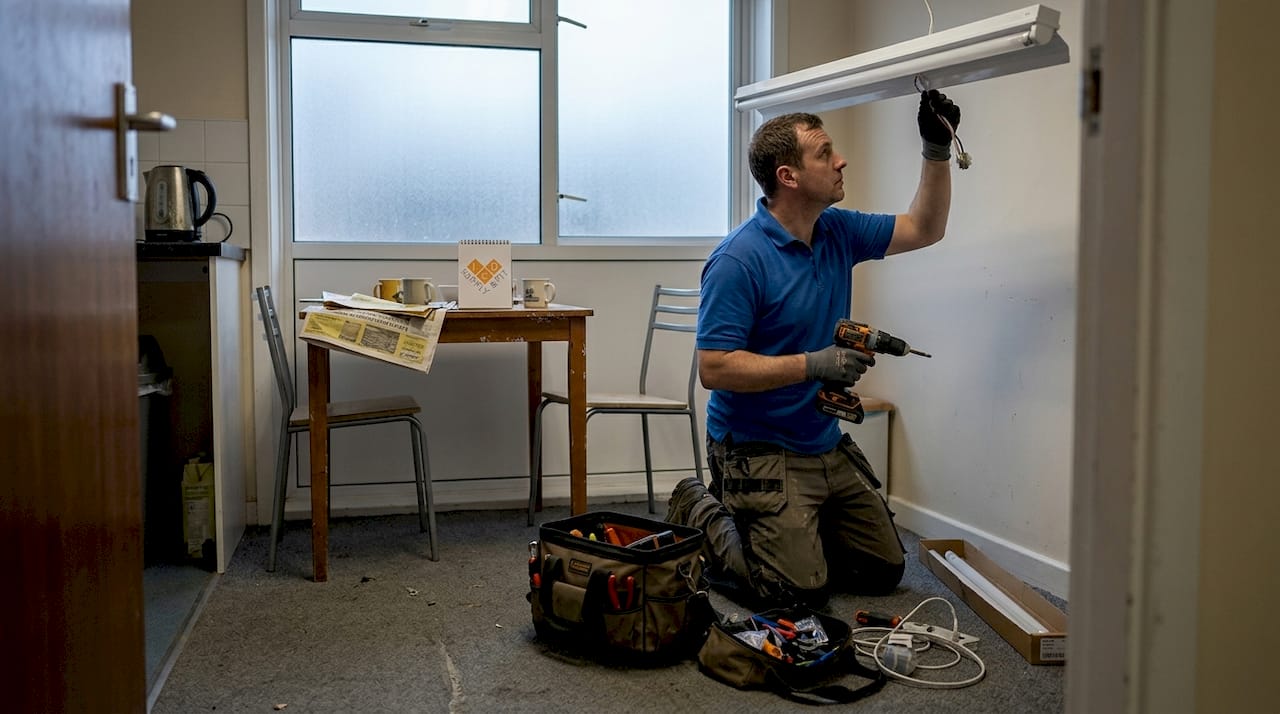
Once your brightness plan is established, choosing the correct LED fixtures and a safe installation approach is next. The single most important standard here is BS 7671, the UK wiring regulations. Every electrical installation in a commercial premises must comply with this standard, and BS 7671 compliance requires using qualified electricians and ensuring your LED drivers are compatible with existing circuit breakers to avoid overheating risks.
| Fixture type | Best-use environment |
|---|---|
| IP20 panel lights | Dry offices and retail interiors |
| IP44 batten fittings | Staff kitchens and washrooms |
| IP65 weatherproof battens | Outdoor areas and loading bays |
| IP66 high-bay LEDs | Warehouses and sports halls |
| ATEX-rated fittings | Fuel stores and chemical handling areas |
IP ratings describe how well a fixture resists dust and moisture. The first digit (0 to 6) rates dust resistance; the second (0 to 9) rates water ingress. Specifying the wrong rating in a damp or fume-prone area is a genuine fire and safety risk.
When vetting installation contractors, ask for evidence of:
- Part P certification or membership of a recognised body such as NICEIC or ELECSA
- Experience with LED driver compatibility checks
- Test and inspection certificates (EICR) issued after completion
Pro Tip: Always confirm IP ratings for kitchens, outdoor canopies, and any zone exposed to cleaning chemicals. An IP65-rated fitting costs only marginally more than an IP20, but the safety and legal difference is enormous.
For further guidance on reducing costs alongside safety, our cost-saving installation tips cover practical ways to minimise both project spend and running costs.
Prevent glare, shadows and visual discomfort
Even with safe equipment, mistakes in placement or design can create dangerous glare and blind spots. Glare is not merely an annoyance. It causes eye strain, slows reaction times, and increases error rates on production and packing lines.
The key metric is the Unified Glare Rating, or UGR. This is a scale from 10 to 30 measuring how much a light source causes discomfort. Lower is better. According to HSE glare guidance, offices need a UGR below 19 and detailed task environments such as laboratories or drawing offices require UGR below 16.
| Environment | Main glare risk | Shadow risk |
|---|---|---|
| Open-plan office | Screen reflections, polished floors | Under-desk dark zones |
| Warehouse | High-bay hotspots on racking | Aisle shadow between shelves |
| Retail | Bright display spots causing contrast | Corner dead zones |
Quick fixes to reduce glare and visual hazards:
- Fit anti-glare optics or diffusers to exposed LED panels
- Position fixtures between workstations, not directly above screens
- Use matte surface finishes on ceilings and walls where possible
- Avoid stainless steel or polished concrete directly under high-output LEDs
LEDs can cut energy use by up to 80% compared with older fluorescents, but poor optic quality can make glare worse than the fittings you replaced. For full design support, see our guidance on lighting design for visual safety.
Our expert view: Go beyond compliance for real business impact
With these practical LED lighting safety tips in mind, it is worth reassessing the true value of a thoughtful LED upgrade. Most conversations about commercial lighting stop at compliance and energy bills. That undersells what good lighting actually does for a business.
Studies consistently link better lighting quality to fewer workplace accidents and higher staff satisfaction. The businesses’ LED advantages go well beyond kilowatt savings. We see it repeatedly: facilities that invest in proper lighting design, not just compliant kit, report measurable improvements in staff morale and reduced error rates within months. The up-front cost of using a qualified lighting designer is typically recovered faster than most financial directors expect. Compliance is the floor, not the ceiling.
Need help upgrading your lighting safely?
If your facility is due an upgrade or you are unsure whether your current setup meets 2026 standards, professional support removes the risk entirely.
At Ledsupplyandfit.co.uk, we supply and install a wide range of best commercial LED lighting suited to every commercial environment, from offices and warehouses to kitchens and outdoor areas. Our team handles compliance, driver compatibility, and full installation to BS 7671. Happy with the LED lighting safety tips and ready to move forward? Request a custom quote and let us take care of the technical detail so you can focus on running your business.
Frequently asked questions
What does a lux audit involve for commercial properties?
A lux audit measures workplace lighting using a calibrated meter to confirm each area meets the minimum brightness standards required for safety and specific tasks such as assembly or office work.
Do LED installations need to be checked annually?
Yes, UK HSE guidance calls for annual lighting inspections across all workplace lighting systems, along with monthly emergency luminaire tests, to maintain legal compliance.
How do I prevent glare in an open-plan office?
Ensure your fixtures carry a UGR below 19, fit anti-glare diffusers, and avoid positioning luminaires directly above polished floors or screen-facing workstations.
What are the common legal pitfalls with LED lighting upgrades?
The most frequent issues are failing to meet required lux levels, using non-compliant fixtures in wet or hazardous zones, and neglecting emergency lighting, all of which breach the Workplace (Health, Safety and Welfare) Regulations 1992.