
Why choose LED lighting for retail spaces to cut costs
Many property managers believe that simply choosing lower wattage bulbs guarantees better efficiency. That’s only half the story. In retail environments, the real measure of lighting efficiency combines lumens per watt with intelligent controls, not just wattage figures on a label. LED lighting delivers both superior brightness and substantial energy savings when properly specified for commercial spaces. This article explains how to optimise LED solutions for retail environments, balancing energy efficiency with the colour quality and ambiance that drive customer engagement whilst reducing your operational costs.
Key Takeaways
| Point | Details |
|---|---|
| Lumens per watt focus | In retail settings, energy efficiency comes from high lumens per watt combined with intelligent controls rather than wattage alone. |
| Control systems boost savings | Adding motion sensors and automated dimming can boost savings by twenty to thirty per cent in spaces with variable occupancy. |
| High CRI trade offs | Higher CRI enhances product appearance but may reduce lumens per watt, so use high CRI selectively for merchandise displays and standard CRI for circulation areas. |
| Ambience 3000 to 4000K | The 3000 to 4000 Kelvin range creates a warm yet alert atmosphere suitable for most retail environments. |
Understanding energy efficiency in retail lighting
Lumens per watt measures how much visible light a fixture produces for each watt of electricity consumed. This metric matters far more than wattage alone when evaluating retail lighting efficiency. A 15-watt LED producing 1,500 lumens delivers 100 lumens per watt, whilst a 60-watt incandescent producing the same brightness manages only 25 lumens per watt. The LED uses 75% less energy for identical illumination.
Beyond the fixture itself, integrating motion sensors and controls adds 20-30% savings in stores with variable occupancy. Stockrooms, changing areas, and quiet zones benefit most from automated dimming or switching. This layered approach compounds LED efficiency gains, reducing both consumption and demand charges on utility bills.
Commercial property managers should evaluate both lighting power density and control system capabilities when specifying retail installations. Designing retail lighting for energy efficiency requires considering fixture placement, zoning strategies, and occupancy patterns. A well-designed system delivers the right light levels precisely when and where needed, eliminating waste without compromising visibility.
Key efficiency considerations include:
- Fixture efficacy ratings above 100 lumens per watt for general retail lighting
- Zoned control systems that respond to occupancy and daylight availability
- Task lighting focused on merchandise displays rather than over-illuminating entire spaces
- Dimming capability to adjust light levels throughout trading hours
Pro tip: Choose LEDs rated for high lumens per watt and use adaptive lighting controls that respond to natural daylight and occupancy patterns. This combination maximises energy savings whilst maintaining optimal visibility for customers and staff.
Balancing colour quality and energy use in retail spaces
Colour rendering index measures how accurately lighting reveals product colours compared to natural daylight. High CRI lighting, typically above 90, enhances merchandise appearance and influences purchasing decisions. Shoppers perceive products more favourably under lighting that renders colours faithfully, particularly in fashion, cosmetics, and food retail.
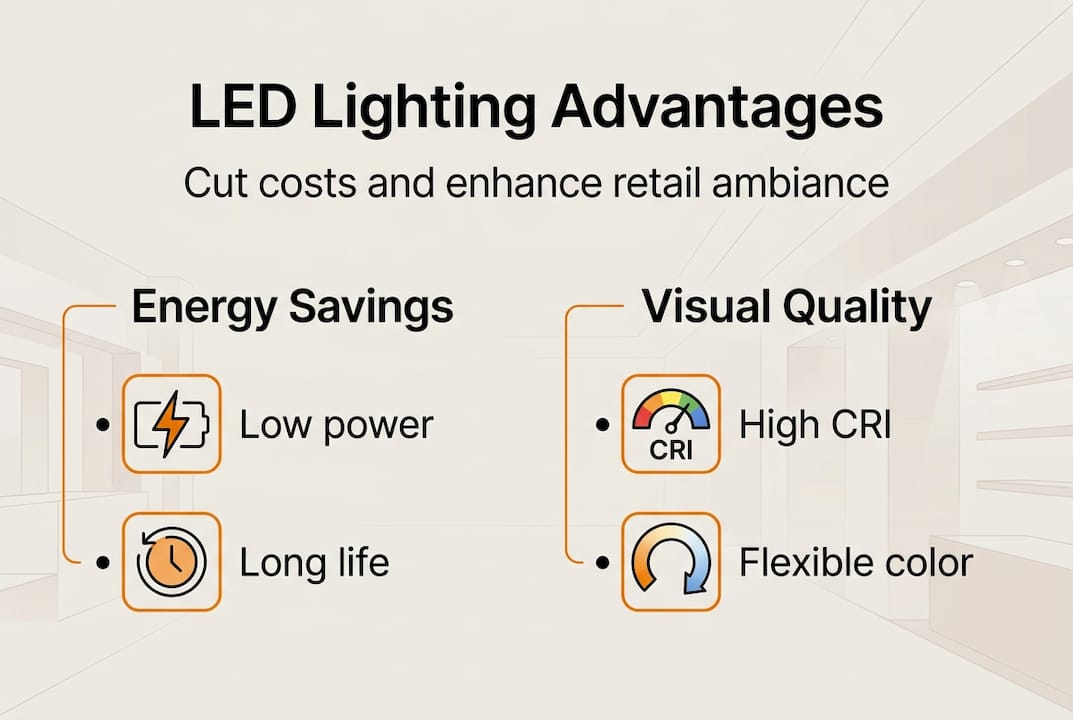
There’s an efficiency trade-off with higher CRI LEDs, which may deliver fewer lumens per watt than standard options. Phosphor coatings that improve colour rendering absorb some light energy, reducing overall efficacy. This doesn’t mean avoiding high CRI fixtures, rather selecting them strategically for product display areas whilst using standard CRI for general circulation spaces.
Correlated colour temperature, measured in Kelvin, affects retail ambiance significantly. The 3000-4000K range creates a warm yet alert atmosphere suitable for most retail environments. Warmer temperatures around 3000K feel inviting and comfortable, whilst cooler temperatures near 4000K provide clarity for detailed product examination. Your choice should align with brand positioning and merchandise characteristics.
| Lighting characteristic | Standard retail | Premium retail | Impact on efficiency |
|---|---|---|---|
| CRI rating | 80-85 | 90-95 | Higher CRI reduces efficacy by 5-10% |
| Colour temperature | 3500-4000K | 3000-3500K | Minimal efficiency impact |
| Lumens per watt | 110-130 | 100-120 | High CRI fixtures trade efficacy for quality |
| Application focus | General lighting | Display lighting | Strategic placement optimises both goals |
Balancing priorities requires understanding your merchandise and customer expectations. Fashion retailers benefit most from high CRI lighting in fitting rooms and display areas. Hardware stores may prioritise efficacy over colour rendering for warehouse sections. Designing retail lighting involves matching fixture specifications to each zone’s purpose.
Pro tip: Prioritise balance between colour quality and energy goals rather than chasing the lowest possible energy consumption. Strategic high CRI placement for key merchandise areas, combined with efficient general lighting elsewhere, delivers both shopper appeal and cost control.
Why LEDs outperform traditional lighting in retail environments
LEDs provide superior illumination quality tailored for retail visibility needs. Unlike fluorescent tubes that emit diffuse light in all directions, LED fixtures direct light precisely where needed. This directional characteristic reduces wasted light and improves visual merchandising effectiveness. Retailers achieve better product highlighting with lower overall wattage.
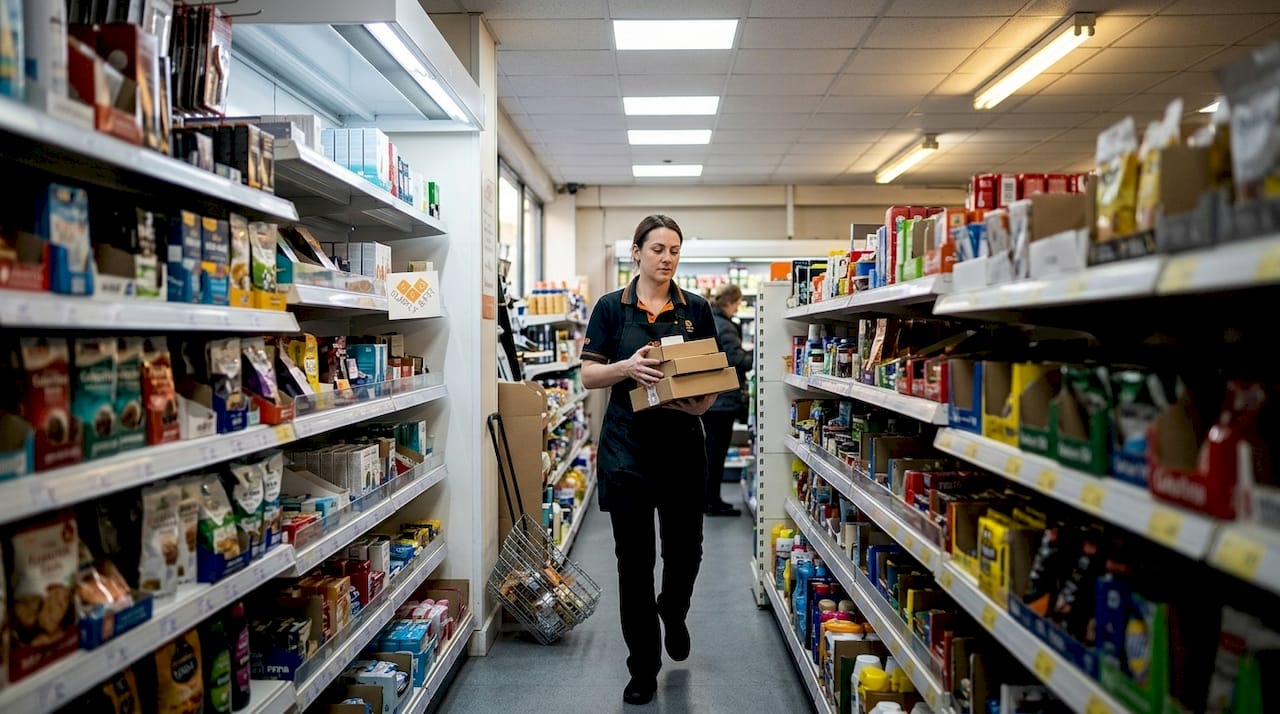
Energy consumption differences prove substantial in commercial applications. A typical fluorescent tube system consuming 32 watts per fitting can be replaced with LED equivalents using 15-18 watts whilst delivering comparable or superior light output. Across a 200-fixture retail space, this represents annual savings exceeding £2,000 at current commercial electricity rates.
Lower heat output reduces HVAC load and operational expenses throughout the year. Fluorescent and halogen lamps convert significant energy to heat, forcing cooling systems to work harder during warmer months. LEDs generate minimal heat, improving customer comfort whilst reducing climate control costs. This benefit compounds in spaces with high fixture density.
Key operational advantages of LEDs over traditional lighting:
- Lifespan of 50,000 hours versus 10,000 for fluorescent tubes reduces replacement frequency
- Instant full brightness eliminates warm-up delays that frustrate staff and customers
- No mercury content simplifies disposal and reduces environmental compliance concerns
- Dimming capability without flicker or colour shift supports flexible lighting scenes
- Reduced maintenance disruption allows stores to operate without frequent lamp changes
| Performance metric | LED | Fluorescent | Halogen |
|---|---|---|---|
| Typical efficacy | 100-130 lm/W | 60-80 lm/W | 15-25 lm/W |
| Rated lifespan | 50,000 hours | 10,000 hours | 2,000 hours |
| Colour stability | Excellent | Good | Excellent |
| Heat output | Very low | Moderate | Very high |
| Dimming performance | Excellent | Poor | Good |
Whilst LEDs better support circadian rhythms in office environments compared to fluorescent lighting, retail applications prioritise visibility and merchandise presentation over biological effects. The controllability and quality of LED lighting creates retail environments that feel inviting whilst delivering measurable cost reduction benefits. Property managers report payback periods of 18-36 months on LED retrofits, with ongoing energy savings continuing for years beyond initial investment recovery.
Implementing LED lighting for better retail performance and cost control
Assessing current lighting establishes baseline performance and identifies improvement opportunities. Document existing fixture types, quantities, wattages, and operating hours across different zones. Measure light levels with a lux meter to ensure replacement solutions meet visibility requirements. This data informs specification decisions and ROI calculations for LED upgrades.
Motion and daylight sensors enable intelligent control in retail environments. Occupancy sensors automatically dim or switch off lighting in stockrooms, offices, and changing areas during unoccupied periods. Photocells reduce artificial lighting when natural daylight provides adequate illumination near windows and skylights. These controls deliver 20-30% additional savings beyond LED fixture efficiency alone.
Choosing optimal colour temperature and CRI requires understanding your merchandise and brand positioning. Fashion and cosmetics retailers typically specify 3000-3500K with CRI above 90 for display areas. Hardware and electronics stores often prefer 3500-4000K with CRI 80-85 for clarity and efficiency. Test samples in your actual space before committing to large orders, as perceived colour quality varies with surrounding finishes and merchandise.
Maintenance savings from longer LED lifespans reduce both direct costs and operational disruption. A 50,000-hour rated LED operating 12 hours daily lasts over 11 years before requiring replacement. This eliminates the frequent relamping cycles that disrupt retail operations and consume maintenance labour. Reduced service calls and lamp inventory costs contribute to total cost of ownership benefits.
Implementation considerations include:
- Conducting lighting audits during peak and off-peak hours to understand usage patterns
- Specifying fixtures with at least five-year warranties from reputable manufacturers
- Planning phased retrofits that minimise disruption to trading operations
- Training staff on control system operation to maximise efficiency benefits
- Documenting energy consumption before and after installation to verify savings
Pro tip: Schedule lighting audits regularly, at least annually, to ensure continued efficiency and ambiance quality. Light output degrades gradually over time, and control systems may require recalibration. Regular assessment maintains optimal performance and identifies opportunities for further improvement as LED technology advances and new efficiency strategies emerge.
Enhance your retail space with expert LED solutions
Transforming your retail lighting delivers immediate energy savings whilst creating the inviting atmosphere that drives customer engagement. LED Supply & Fit specialises in commercial LED lighting solutions designed specifically for UK retail environments. Our product range includes high-efficacy fixtures with optimal colour rendering for merchandise display, backed by comprehensive installation support.
We understand that every retail space presents unique lighting challenges. Our team provides tailored guidance on fixture selection, control integration, and installation planning that maximises both energy efficiency and shopper experience. Whether you’re retrofitting an existing store or specifying lighting for a new location, our LED lighting expertise ensures you achieve measurable cost reductions without compromising visibility or ambiance. Contact LED Supply & Fit to discuss how professional LED solutions can enhance your retail performance whilst reducing operational costs.
Frequently asked questions
Is LED lighting cost effective for small retail stores?
Yes, LEDs reduce energy and maintenance costs even for small retail operations. The percentage savings remain consistent regardless of store size, though absolute pound savings scale with consumption. Smaller retailers benefit particularly from reduced maintenance disruption, as fewer lamp changes mean less time spent on non-revenue activities. Proper installation and controls maximise ROI, with payback periods typically ranging from 18 to 36 months depending on existing lighting efficiency and operating hours.
How does colour temperature impact customer behaviour in stores?
Warm lighting in the 3000-4000K range creates an inviting atmosphere that encourages longer dwell time and browsing. Customers perceive warmer environments as more comfortable and welcoming, which supports impulse purchasing and extended shopping sessions. Cooler temperatures above 4000K can highlight product details effectively but may feel less welcoming in fashion and lifestyle retail. Retailers balance temperature to support brand image and shopper comfort, often using warmer tones in customer areas and cooler tones in back-of-house spaces.
Can integrating sensors with LEDs really save 30% on retail lighting energy?
Yes, sensor controls add significant savings by reducing unnecessary lighting use in variable occupancy areas. Stockrooms, offices, changing rooms, and quiet zones benefit most from occupancy sensing. Actual savings depend on store traffic patterns, existing lighting schedules, and sensor quality. Poorly calibrated sensors may cause nuisance switching or miss occupancy, reducing benefits. They complement LEDs’ inherent efficiency for best results, with combined savings often exceeding 50% compared to traditional lighting without controls.
What maintenance advantages do LEDs offer to retail managers?
LEDs last significantly longer than traditional bulbs, with rated lifespans of 50,000 hours compared to 10,000 hours for fluorescent tubes and 2,000 hours for halogen lamps. This reduces replacement frequency and eliminates the disruption of frequent relamping during trading hours. Lower heat generation decreases fixture wear and reduces HVAC load, particularly during warmer months. Less maintenance disruption benefits store operations and budgets, freeing staff time for customer-facing activities rather than facilities management tasks.