Role of LEDs in cost reduction for UK businesses 2026
Lighting accounts for up to 20-30% of commercial energy bills across UK properties, yet many businesses still operate with outdated, inefficient systems that drain budgets month after month. LED technology has transformed this landscape, offering commercial property managers a proven pathway to slash operational expenses whilst improving workplace quality. This guide explores exactly how LEDs deliver measurable cost reductions, from energy consumption to maintenance savings, and provides practical implementation strategies tailored for UK businesses seeking to optimise their lighting investments in 2026.
Key takeaways
| Point | Details |
|---|---|
| Energy efficiency | LEDs consume up to 80% less electricity than traditional lighting, directly reducing monthly energy bills |
| Extended lifespan | LED bulbs last 25 times longer than conventional options, slashing replacement and maintenance costs |
| Installation optimisation | Professional fitting and strategic placement maximise cost-saving potential across commercial spaces |
| Rapid payback | Initial LED investment typically recovers within 2-4 years through operational savings |
Understanding the cost challenges of traditional commercial lighting
Traditional lighting systems impose substantial financial burdens on UK businesses through multiple cost channels that extend far beyond the initial purchase price. Incandescent and fluorescent fixtures consume excessive electricity, converting much of their energy into heat rather than usable light, which directly inflates utility bills. These older technologies operate at significantly lower efficiency rates, requiring more fixtures to achieve adequate illumination levels and compounding the energy waste problem.
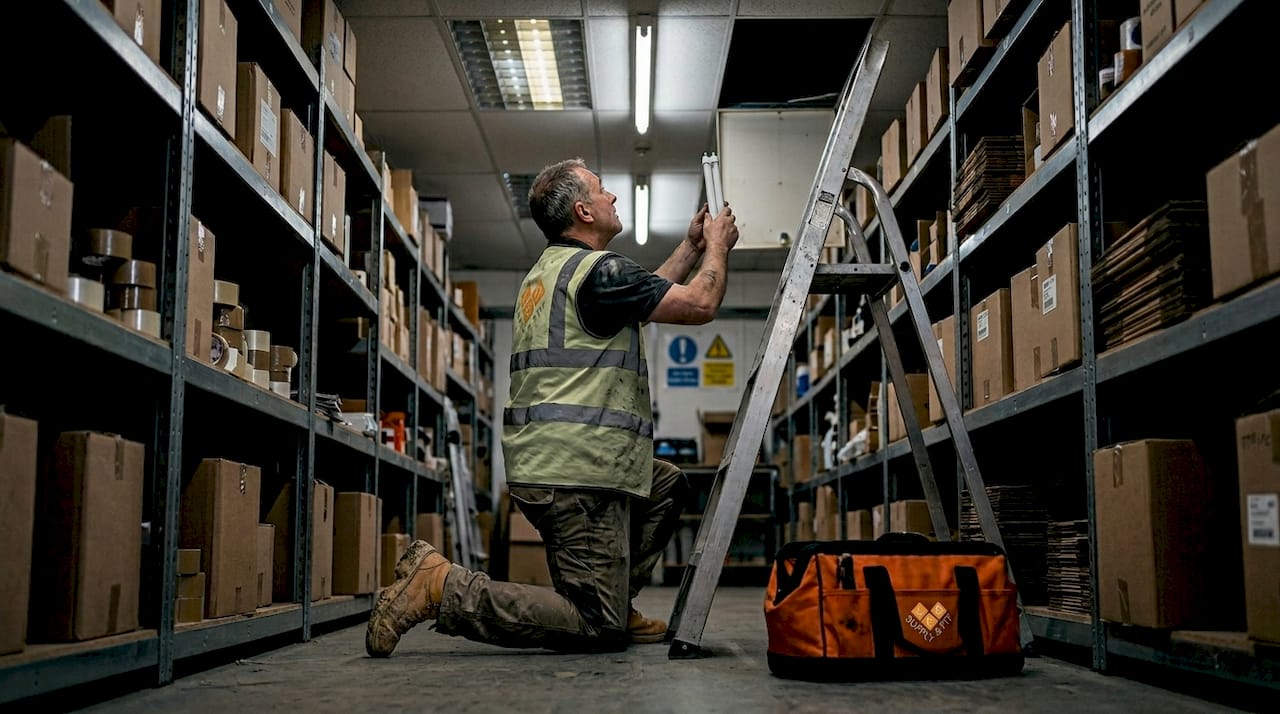
Maintenance demands create another persistent expense. Conventional bulbs fail frequently, necessitating regular replacement cycles that consume staff time and incur ongoing material costs. Fluorescent tubes contain hazardous materials requiring specialised disposal, adding environmental compliance expenses to the maintenance burden. The cumulative effect of these replacement cycles creates unpredictable operational costs that complicate budget planning.
UK businesses face particular vulnerability to energy price volatility, with commercial electricity rates subject to market fluctuations and regulatory changes. Lighting comprises up to 20-30% of energy bills in typical commercial properties, making this expense category a prime target for cost reduction strategies. When energy prices spike, traditional lighting systems amplify the financial impact across the entire operation.
Poor lighting quality introduces indirect costs through reduced productivity and safety concerns:
- Inadequate illumination increases error rates and slows task completion
- Flickering fluorescent tubes cause eye strain and headaches, affecting staff performance
- Dim or uneven lighting creates hazardous conditions, raising accident risks
- Substandard lighting compromises security monitoring and surveillance effectiveness
Traditional lighting technology locks businesses into a cycle of high consumption, frequent maintenance, and unpredictable costs that undermine operational efficiency and profit margins.
The combination of energy inefficiency, maintenance demands, and quality issues creates a compelling case for exploring alternative lighting solutions. Commercial property managers who continue operating traditional systems effectively subsidise outdated technology whilst competitors gain cost advantages through modern alternatives. Understanding these baseline challenges provides essential context for evaluating LED technology’s transformative potential in reducing operational expenses.
How LED technology drives cost reductions in commercial properties
LED lighting delivers cost savings through multiple mechanisms that address the fundamental inefficiencies of traditional systems. The primary advantage stems from exceptional energy efficiency, where LEDs use up to 80% less energy than incandescent bulbs and roughly 50% less than fluorescent tubes. This dramatic reduction translates directly into lower electricity bills, with the savings compounding over thousands of operating hours across commercial spaces.
Longevity represents the second major cost driver. LED bulbs typically operate for 50,000 hours or more, compared to 1,000 hours for incandescent bulbs and 10,000 hours for fluorescent tubes. This extended lifespan means businesses replace LEDs far less frequently, slashing both material costs and labour expenses associated with maintenance activities. The reliability of LED technology also reduces emergency replacement scenarios that disrupt operations and incur premium costs.
Thermal efficiency contributes additional savings often overlooked in initial calculations. Traditional bulbs emit substantial heat, forcing HVAC systems to work harder to maintain comfortable temperatures, particularly in spaces with numerous fixtures. LEDs generate minimal heat output, reducing cooling loads during warmer months and delivering secondary energy savings that enhance the overall cost reduction impact. This benefit proves especially valuable in enclosed spaces like retail shops and offices where temperature control directly affects comfort and productivity.
LED technology supports enhanced operational performance through superior light quality. Consistent, flicker-free illumination reduces eye strain and fatigue, supporting staff productivity and accuracy. Better visibility improves safety outcomes, potentially reducing accident-related costs and insurance premiums. The instant-on capability eliminates warm-up periods, ensuring immediate full brightness that supports security and operational readiness.
Implementing LEDs following this strategic sequence maximises cost benefits:
- Conduct a comprehensive lighting audit identifying high-usage areas and inefficient fixtures
- Prioritise spaces with longest operating hours for immediate conversion to capture maximum savings
- Select LED products matching specific operational requirements and environmental conditions
- Schedule professional installation to ensure proper fitting, optimal positioning, and electrical compatibility
- Implement monitoring systems tracking energy consumption and identifying further optimisation opportunities
Pro Tip: Focus initial LED upgrades on areas operating 12+ hours daily, such as warehouses and production floors, where energy savings accumulate fastest and payback periods shrink to under two years.
The cumulative effect of these cost reduction mechanisms creates a compelling financial case for LED adoption. Businesses transitioning from traditional lighting typically observe immediate decreases in monthly energy expenses, followed by sustained savings as maintenance cycles lengthen and replacement costs diminish. The predictability of LED performance enables accurate long-term budget forecasting, eliminating the variability associated with frequent bulb failures and emergency replacements that characterise traditional lighting operations.
Practical comparison: LED versus traditional lighting cost factors
Direct cost comparison reveals the stark financial differences between LED and traditional lighting technologies across multiple operational dimensions. Energy consumption stands as the most immediate differentiator, with practical implications for monthly utility expenses. A typical 60-watt incandescent bulb consumes five times more electricity than a 12-watt LED producing equivalent light output. Across a commercial property with 200 fixtures operating 12 hours daily, this difference translates to thousands of pounds in annual savings.
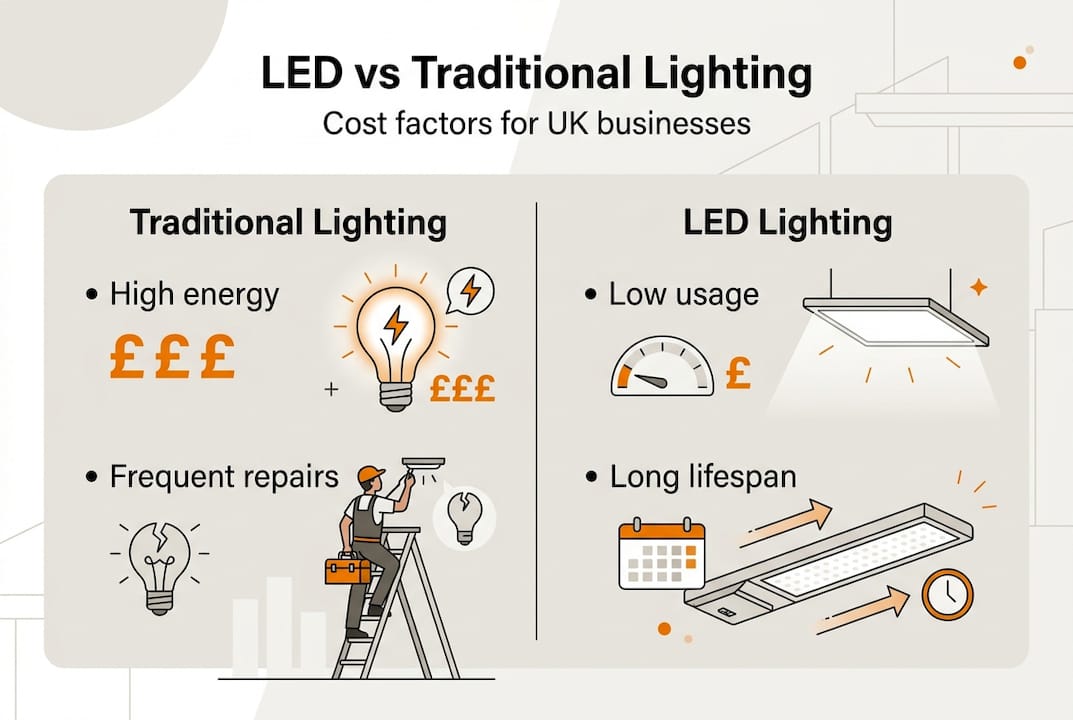
Switching to LEDs reduces lighting costs by up to 75% through combined energy and maintenance savings, with maintenance expenses potentially dropping 90% due to extended bulb lifespan. These reductions prove particularly significant for businesses operating multiple locations or large facilities where lighting represents a substantial operational expense category.
| Cost Factor | Incandescent | Fluorescent | LED |
| — | — | — |
| Average wattage (equivalent light) | 60W | 15W | 12W |
| Typical lifespan (hours) | 1,000 | 10,000 | 50,000 |
| Annual energy cost (12 hrs/day) | £47 | £12 | £9 |
| Replacement frequency (5 years) | 22 times | 2 times | Once or less |
| Heat output | High | Moderate | Minimal |
Initial investment costs present the primary barrier to LED adoption, with quality LED fixtures typically costing more upfront than traditional alternatives. However, this price differential narrows when calculating total cost of ownership over the product lifecycle. A £15 LED bulb lasting 50,000 hours delivers better value than purchasing 50 incandescent bulbs at £1 each over the same period, even before factoring in installation labour and energy savings.
Maintenance scheduling differs dramatically between technologies:
- Incandescent systems require near-constant attention with monthly replacement cycles in high-usage areas
- Fluorescent installations need quarterly to annual maintenance depending on operating hours
- LED systems operate for years without intervention, freeing maintenance staff for other priorities
- Emergency call-outs for failed lighting decrease substantially with LED reliability
Environmental considerations increasingly influence cost calculations as UK businesses face growing pressure to meet sustainability targets and report carbon emissions. LEDs contain no hazardous materials, eliminating specialised disposal costs and regulatory compliance burdens associated with fluorescent tubes. The reduced energy consumption directly lowers carbon footprints, supporting corporate environmental commitments whilst delivering cost savings.
Payback period analysis demonstrates LED financial viability across diverse commercial applications. High-usage environments like 24-hour warehouses and production facilities recover LED investments within 18-24 months purely through energy savings. Standard office spaces with 10-hour daily operation typically achieve payback within 3-4 years. Even low-usage areas benefit from extended LED lifespan that eliminates maintenance costs over decades of operation.
The comparison extends beyond simple cost metrics to operational flexibility and quality factors. LEDs support dimming capabilities without lifespan reduction, enabling dynamic lighting strategies that further reduce energy consumption. Instant-on functionality eliminates the warm-up delays of fluorescent systems, improving security response and operational efficiency. These qualitative benefits complement the quantitative cost advantages, creating a comprehensive value proposition for LED adoption.
Implementing LED solutions to maximise cost savings
Successful LED implementation requires strategic planning that extends beyond simple bulb replacement to encompass comprehensive lighting system optimisation. The process begins with thorough assessment of current lighting infrastructure, identifying inefficient fixtures, measuring existing light levels, and documenting operational patterns. This audit establishes baseline metrics for measuring post-installation savings and guides product selection decisions.
Operational requirements vary significantly across commercial environments, demanding tailored LED solutions rather than one-size-fits-all approaches. Retail spaces benefit from high colour rendering index LEDs that accurately display merchandise, whilst warehouses prioritise high lumen output for safety and productivity. Offices require adjustable colour temperature options supporting circadian rhythm alignment, and hospitality venues need dimmable fixtures creating appropriate ambience. Matching LED specifications to specific use cases maximises both cost efficiency and operational effectiveness.
Professional installation proves critical for realising full LED cost-saving potential. Professional LED installation ensures sustained cost reduction through proper electrical integration, optimal fixture positioning, and compliance with UK building regulations. Qualified installers identify opportunities for additional savings through lighting controls, occupancy sensors, and daylight harvesting systems that reduce energy consumption beyond baseline LED efficiency gains.
Implementing LED upgrades following this systematic approach delivers optimal results:
- Map lighting zones by usage intensity, identifying areas where LED benefits accumulate fastest
- Calculate potential savings for each zone using current energy costs and operating hours
- Develop phased implementation plan prioritising highest-return areas first
- Source quality LED products from reputable suppliers offering appropriate warranties
- Schedule installation during off-peak hours minimising operational disruption
- Commission lighting controls and automation systems enhancing LED efficiency
- Establish monitoring protocols tracking energy consumption and identifying optimisation opportunities
- Train facilities staff on LED system management and basic troubleshooting procedures
Advanced LED features multiply cost-saving opportunities when properly implemented. Occupancy sensors automatically extinguish lights in unoccupied spaces, eliminating wasted energy from lights left on unnecessarily. Daylight harvesting systems dim artificial lighting when natural light suffices, reducing consumption during peak daylight hours. Time-based controls adjust lighting levels matching operational schedules, ensuring full illumination only when needed whilst maintaining security lighting during closed hours.
Pro Tip: Install separate circuits for perimeter and interior lighting zones, enabling daylight harvesting strategies that reduce interior lighting when natural light penetrates window areas, typically saving an additional 15-20% on lighting energy costs.
Ongoing optimisation extends LED cost benefits throughout the system lifecycle. Regular monitoring identifies underperforming fixtures requiring attention before complete failure. Periodic reviews of lighting schedules ensure automation settings align with current operational patterns. Cleaning fixtures maintains optimal light output, preventing the gradual efficiency losses that occur when dust accumulation blocks illumination. These maintenance activities require minimal effort compared to traditional lighting systems whilst preserving the cost advantages that justified the initial LED investment.
Financing options can accelerate LED adoption for businesses concerned about upfront costs. Many suppliers offer payment plans spreading expenses over multiple years, aligning payments with realised savings. Government schemes and energy efficiency programmes occasionally provide grants or tax incentives for commercial LED upgrades, further improving project economics. Lease arrangements transfer ownership and maintenance responsibilities to third parties whilst delivering immediate operational savings. Exploring these alternatives often reveals pathways to LED implementation that preserve working capital whilst capturing cost reduction benefits.
Find expert LED supply and installation services
Transitioning to LED lighting demands expertise that ensures your investment delivers maximum cost reduction and operational benefits. LED Supply & Fit specialises in supplying and installing commercial LED solutions tailored for UK businesses seeking to slash energy expenses and improve workplace lighting quality. Our team understands the unique requirements of shops, offices, warehouses, and hospitality venues, providing curated selections of best commercial LED lighting products proven to deliver sustained savings.

Professional installation services ensure your LED system integrates seamlessly with existing infrastructure whilst meeting all UK electrical and safety standards. We implement LED lighting cost saving tips through strategic fixture placement, intelligent controls, and optimised lighting designs that maximise efficiency across your commercial property. From initial consultation through final commissioning, our approach focuses on delivering measurable cost reductions that improve your bottom line. Visit LED Supply & Fit to explore how expert LED solutions can transform your operational expenses in 2026.
Frequently asked questions
What is the typical payback period for LED installations in UK businesses?
Most UK businesses recover their LED investment within 2-4 years depending on operating hours and installation scale. High-usage environments like warehouses and 24-hour operations often achieve payback within 18-24 months purely through energy savings. Standard office spaces typically see full cost recovery within 3-4 years when factoring combined energy and maintenance reductions.
Can LEDs improve workplace safety whilst reducing costs?
LEDs provide brighter, more consistent illumination that significantly reduces accident risks in commercial environments. The flicker-free, instant-on performance eliminates the visibility issues associated with failing fluorescent tubes. Improved lighting supports compliance with UK health and safety standards whilst simultaneously delivering the energy cost reductions that justify the upgrade investment.
Are LED upgrades compatible with existing commercial lighting fixtures?
Many LED products are specifically designed as retrofit solutions that integrate with existing fixture infrastructure, minimising installation costs and disruption. However, professional assessment ensures compatibility and identifies cases where complete fixture replacement delivers better long-term value. Qualified installers evaluate electrical systems, mounting configurations, and operational requirements to recommend optimal upgrade pathways that maximise cost efficiency whilst ensuring reliable performance.