How lighting enhances safety in UK workspaces
TL;DR:
- Proper workplace lighting is essential for safety and reducing accidents.
- Meeting UK regulations and adjusting lighting zones enhances staff wellbeing and compliance.
- Targeted upgrades and proactive management foster a safety-focused company culture.
Many property managers assume that if a space is lit, it is safe. That assumption quietly causes hundreds of avoidable accidents every year. Lighting quality is not just about brightness — it involves glare, shadow distribution, colour rendering, and uniformity across a space. Each of these factors shapes how confidently and safely people move through your building. This guide covers the role of lighting in safety, regulations you need to follow, the benchmarks that matter, the mistakes most businesses make, and the practical steps you can take to build a genuinely safer workplace.
Key Takeaways
| Point | Details |
|---|---|
| Lighting goes beyond brightness | Uniformity, lack of glare, and correct colour temperature all help prevent accidents in the workplace. |
| Legal standards apply | UK law sets clear requirements for workplace lighting—meeting these protects staff and your business. |
| Targeted improvements matter most | Focusing on risky areas and using the right controls can quickly boost safety and confidence. |
| Safety culture benefits | Good lighting not only leads to compliance but also boosts wellbeing and reduces fear of crime. |
Why lighting matters for safety and navigation
Good lighting does far more than illuminate a room. It shapes how people read their environment, judge distances, and respond to hazards. A poorly placed fitting can cast a shadow directly onto a stairwell. A high-glare source can temporarily blind someone walking from a dark corridor into a bright space. These are not minor inconveniences — they are accident triggers and clearly highlights the role of lighting in safety.
“Lighting is a fundamental part of workplace safety. Get it wrong, and you increase the risk of slips, trips, falls, and long-term visual fatigue for your staff.”
The Health and Safety Executive confirms that poor lighting contributes to slips, trips, and falls, as well as visual fatigue and headaches. The same research notes that giving workers local control over their lighting environment increases job satisfaction and reduces stress — a finding that many facilities managers overlook entirely.
Beyond physical hazards, lighting also shapes how safe a space feels. Staff working in dim or unevenly lit areas report higher stress and lower concentration. This matters because poor wellbeing leads to slower reaction times and more errors. Research into lighting quality and wellbeing consistently shows that workplaces investing in proper illumination see measurable gains in staff performance and morale.
Key safety impacts of poor lighting include:
- Increased shadow zones concealing floor hazards
- Glare causing temporary vision impairment near screens or reflective surfaces
- Non-uniform lighting creating adaptation delays when moving between areas
- Insufficient illuminance in high-risk zones such as loading bays and stairwells
- Staff stress and fatigue from sustained visual strain
Having highlighted lighting’s overlooked impact on safety, let’s examine the regulatory foundations behind workplace lighting.
UK regulations and recommended lighting benchmarks
Under the UK Workplace Regulations 1992, specifically Regulation 8, employers must provide suitable and sufficient lighting for safe work and movement, with natural light preferred where practicable. This is not a suggestion — it is a legal requirement. Failing to meet it exposes your business to health consequences for staff, legal liability, and potential insurance complications.
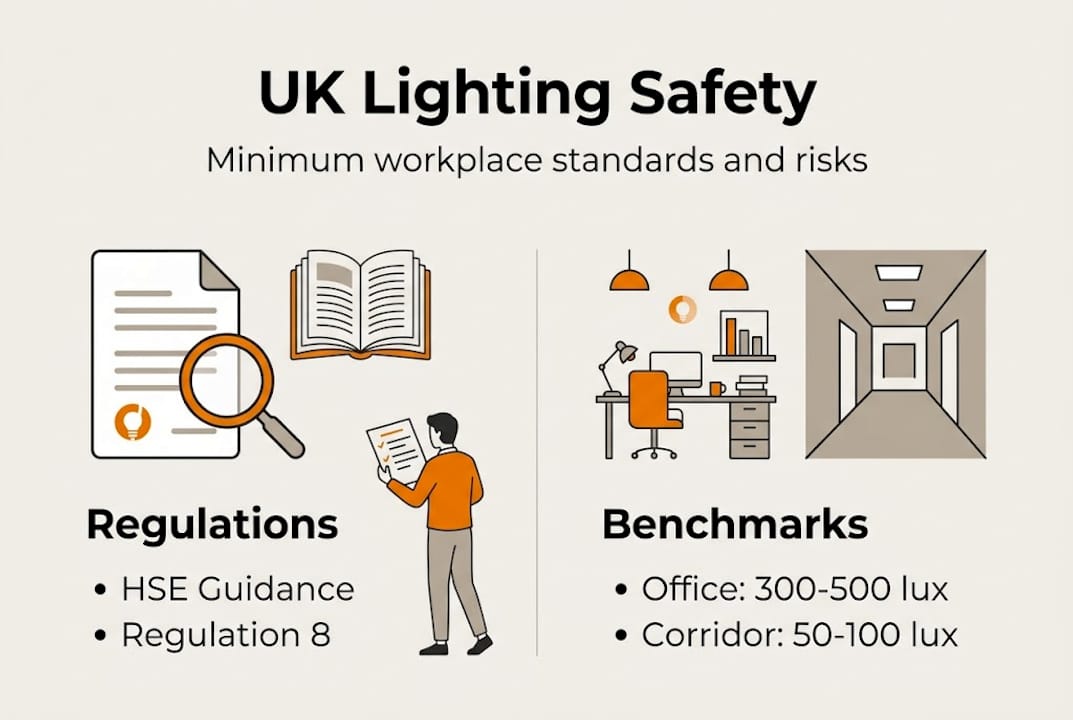
The HSE’s guidance document HSG38 Lighting at Work sets out specific minimum illuminance levels by area type:
| Area or task | Minimum illuminance (lux) |
|---|---|
| Corridors and walkways | 50 to 100 |
| General offices | 300 to 500 |
| Detailed or precision tasks | 750 |
| Control rooms | 300 |
| Warehouses (general) | 100 to 200 |
These are minimums, not targets. Many well-run commercial premises exceed them to reduce risk further and improve comfort.
To ensure compliance, follow these steps:
- Commission a lux-level survey of all occupied areas, including corridors and external routes
- Compare results against HSG38 benchmarks for each zone type
- Document any shortfalls and create a remediation schedule
- Review office lighting best practices to understand task-specific requirements
- Consult a lighting design compliance guide before specifying new installations
Pro Tip: Non-compliance is not just a regulatory risk. Insurance providers increasingly scrutinise lighting adequacy following workplace injury claims. A documented lighting audit can strengthen your position significantly and strengthen the role of lighting in safety.
With UK standards in mind, we can now break down how lighting risks show up in practice and which mistakes to avoid.
Common risks and mistakes in workplace lighting
Most lighting failures in commercial properties are not dramatic. They are gradual, overlooked, and cumulative. A fitting positioned behind a storage rack. A luminaire that has never been cleaned. A stairwell running on a motion sensor set to switch off too quickly. Each of these creates genuine risk.
Common mistakes include:
- Incorrect placement creating shadow zones behind equipment, vehicles, or shelving
- Insufficient lux levels in walkways, yards, or storage areas that have expanded since original installation
- Glare from poorly angled fittings near display screen equipment (DSE) workstations
- Failure to zone lighting so high-risk areas receive higher illuminance than general spaces
- Overlooking emergency and external pathway lighting which is often poorly maintained
- Ignoring occupant controls, particularly for screen-based work where glare causes real strain
The HSE specifically highlights edge-case hazards such as shadows from vehicles or equipment in yards, the need for specific pedestrian lighting in those areas, and the importance of higher lux on stairs and other high-risk zones.
Pro Tip: Walk your site at different times of day and with different natural light conditions. A corridor that looks fine at noon may be dangerously dark at 7am in winter.
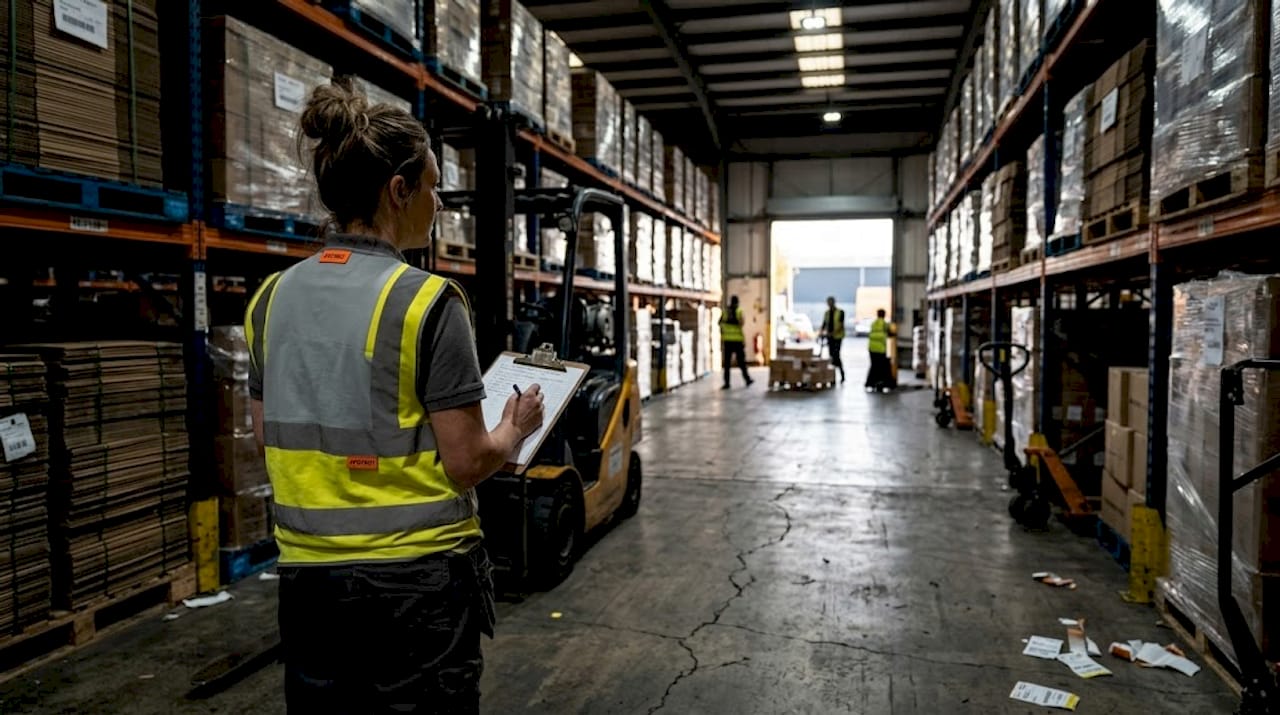
Warehouses and industrial settings carry particular risk. Reviewing warehouse lighting safety steps before specifying fittings can save you from costly retrofits later. For installation-specific risks, LED installation safety tips offer practical guidance on avoiding common errors during fit-out.
Knowing what not to do, the next step is applying smart strategies to optimise lighting for maximum safety and compliance.
Practical strategies for safer, compliant lighting
Moving from assessment to action requires a clear understanding of what different lighting approaches actually deliver. Not every site needs a cutting-edge automated system — but every site does need a deliberate strategy and a clear role of lighting in safety.
| Approach | Features | Best suited to |
|---|---|---|
| Basic LED retrofit | Fixed output, high lumen efficiency | Warehouses, corridors, low-complexity spaces |
| Advanced zoned lighting | Separate circuits by area, manual dimming | Offices, retail, mixed-use premises |
| Automated smart lighting | Occupancy sensors, daylight harvesting, remote monitoring | Large commercial buildings, multi-floor offices |
CIBSE and SLL guidance, including LG7 office recommendations, supports these benchmarks and adds that well-designed lighting actively reduces fear of crime in public and commercial spaces — a benefit relevant to car parks, reception areas, and external routes.
To implement safer lighting across your premises:
- Conduct a full audit comparing current lux levels against HSG38 requirements
- Identify high-risk zones (stairs, loading areas, emergency routes) for priority upgrades
- Specify appropriate colour temperatures — generally 4000K for workspaces, warmer tones for reception or rest areas
- Explore industrial lighting solutions suited to your specific environment
- Review energy usage alongside safety — LED lighting cost-saving tips show how compliance and efficiency can work together
Embed lighting reviews into your regular facility management cycle. Lamps degrade, fittings shift, and usage patterns change. A quarterly check of critical areas is far cheaper than a post-incident investigation.
The overlooked link: how lighting quality shapes culture and compliance
Here is something most lighting checklists will never tell you. The businesses that genuinely improve safety through lighting are not the ones that simply replace fittings and tick a box. They are the ones that treat lighting as part of how they run their organisation.
When staff notice that hazardous areas have been properly lit, that glare on their screens has been resolved, and that corridors no longer feel dim or oppressive, they respond differently. They take safety more seriously because they can see that management does too. That cultural shift is difficult to quantify, but it is real.
Simple targeted upgrades — addressing the specific zones where poor uniformity causes adaptation problems and increases trip risk — often deliver more measurable impact than expensive overhauls of spaces that were already adequate. Prioritise where the risk is highest, and your investment goes further.
Understanding the importance of commercial lighting design is the first step toward moving from reactive compliance to proactive safety leadership.
Connecting safety with lighting expertise
If your current lighting leaves you uncertain about compliance or risk, the solution does not have to be complicated.
At LED Supply and Fit, we work with commercial premises across the UK to assess, specify, and install lighting that meets both safety regulations and operational needs. Our lighting project cost and compliance service gives you a clear picture of what is needed and what it will cost. You can also see how we have helped businesses such as Wilson Veterinary Group and Stockton Riverside College achieve compliant, effective lighting across varied commercial environments. and increased the role of lighting in safety.
Frequently asked questions
What are the minimum workplace lighting levels in the UK?
Corridors require 50 to 100 lux, general offices 300 to 500 lux, and detailed or precision tasks up to 750 lux per HSG38 guidance.
How does poor lighting increase workplace accidents?
It creates shadow zones, glare, and low-visibility areas that trigger slips, trips, and falls — with increased injury risk particularly pronounced in stairs, yards, and loading areas.
Do employers need to provide natural light in workplaces?
UK law requires suitable and sufficient lighting with natural light preferred where practicable, but artificial lighting is acceptable where natural light is not feasible.
How can lighting improve safety in outdoor areas or warehouses?
Dedicated pedestrian lighting, higher lux levels on stairs, and shadow reduction in loading zones all reduce navigation risks and are recommended in HSE workplace guidance.