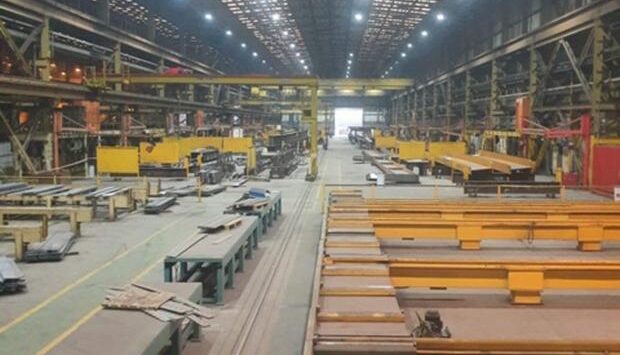
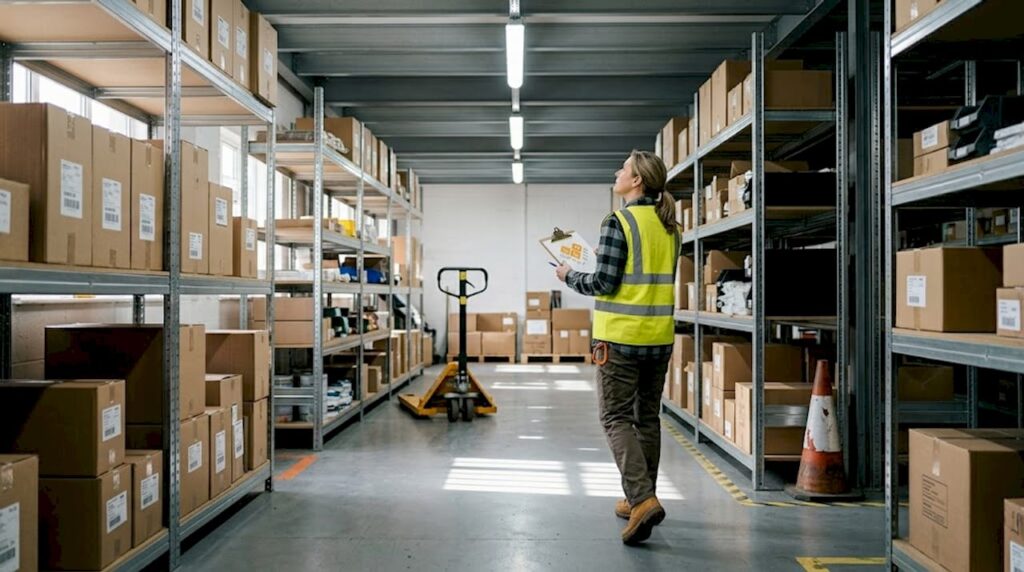
Why warehouse lighting matters for safety and efficiency
TL;DR:
- Poor warehouse lighting poses safety, compliance, and operational risks.
- LED upgrades significantly reduce energy use and offer quick return on investment.
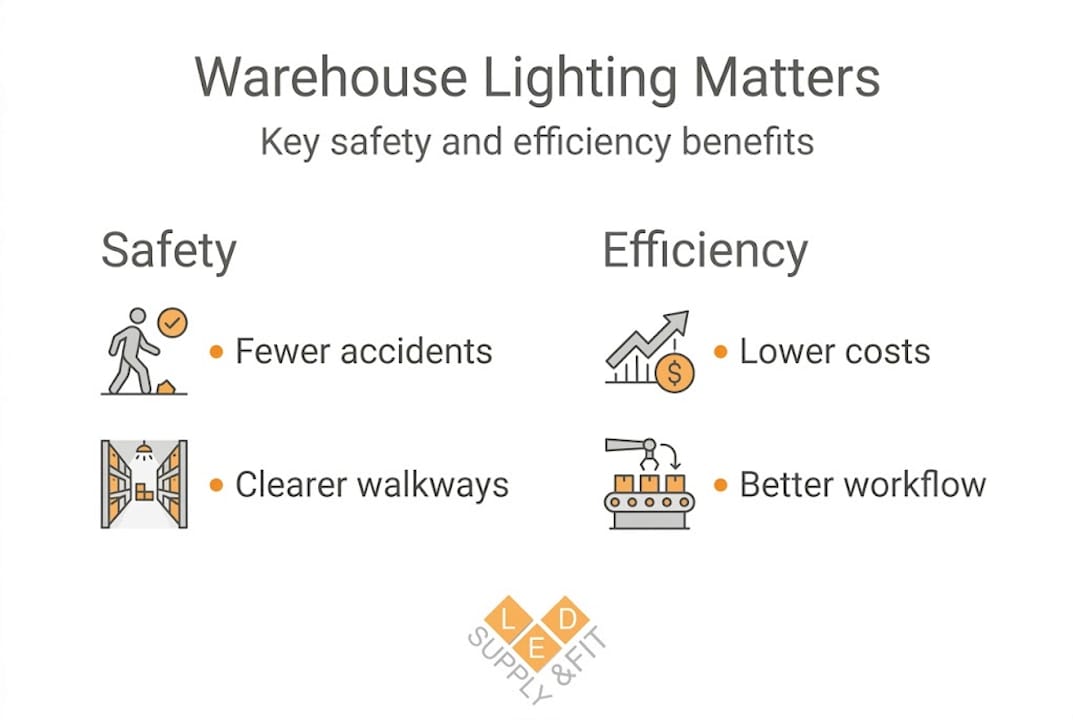
- Proper lighting improves safety, productivity, and strategic business resilience.
Poor lighting in a warehouse is not a minor inconvenience. It is a safety risk, a compliance liability, and a silent drain on your operational budget. Many property managers underestimate how much their lighting choices affect worker productivity, injury rates, and energy bills. LED upgrades reduce energy use by 50-90% compared to traditional systems, yet many facilities are still running decades-old fluorescent or metal halide installations. This guide covers the standards, safety case, financial returns, and practical controls that help you make a genuinely informed decision.
Key Takeaways
| Point | Details |
|---|---|
| Compliance first | Meeting UK warehouse lighting standards is essential for safety, insurance, and legal protection. |
| LEDs offer major savings | Switching to LED lighting can cut energy costs by up to 90% with fast ROI. |
| Controls boost efficiency | Adding smart sensors and zoning systems can save an extra 20-50% on lighting energy. |
| Design impacts safety | Uniform, glare-free lighting greatly reduces workplace accidents and increases productivity. |
| Maintenance matters | Regular reviews and upgrades ensure ongoing compliance and efficiency gains. |
The legal and standards framework for warehouse lighting
Understanding the importance of lighting starts with knowing the legal framework and why minimum standards matter.
UK warehouses must comply with the Health and Safety at Work Act 1974, the Health and Safety (Display Screen Equipment) regulations, and the European standard EN 12464-1, which sets out minimum illuminance levels for different working tasks. HSE guidelines specify that warehouse lighting must meet EN 12464-1 with task-specific lux levels across every functional zone. A lux is simply the unit used to measure how much light reaches a surface. Getting it wrong is not just a technical failure; it creates real legal and financial exposure.
| Zone | Required lux level | Notes |
|---|---|---|
| General storage | 100-200 lux | Low-activity areas |
| Access routes and corridors | 150-300 lux | Movement safety critical |
| Order picking and packing | 300-500 lux | High-accuracy tasks |
| Quality control | 500+ lux | Fine detail inspection |
Emergency lighting is governed by BS 5266-1, which requires a minimum of 1 lux on escape routes, 15 lux in high-risk work areas, and systems that maintain those levels for at least 3 hours during power failure. Regular testing and maintenance logs are a legal obligation, not optional best practice.
Reviewing your warehouse lighting best practices against these standards should include:
- Annual photometric surveys (measuring actual lux across all zones)
- Emergency lighting duration tests every 6 and 12 months
- Review of task areas if operations or racking layouts change
- Insurance audit records kept up to date
Non-compliance can invalidate insurance claims following an incident and expose your business to HSE prosecution. That is a risk no property manager should leave unaddressed.
Safety first: How lighting prevents accidents and boosts productivity
Legal requirements lay the foundation, but the case for lighting is strongest in its impact on daily safety and operational flow.
Research consistently shows that poor lighting causes accidents, fatigue, and errors, while well-designed environments directly improve productivity and worker satisfaction. In warehouse settings specifically, the difference between adequate and inadequate lighting is measured in near-misses, mis-picks, and sick days.
“Good lighting is not about illuminating space. It is about illuminating the right detail, in the right place, at the right intensity.”
Three lighting design factors that matter most in a warehouse setting:
- CRI (colour rendering index): A rating from 0-100 measuring how accurately a light source renders colours. CRI 80+ is the minimum for picking and packing; anything lower makes label colours harder to distinguish, increasing error rates.
- Light uniformity: The ratio of minimum to average lux across a zone. Poor uniformity creates bright spots and shadows, which cause eye strain over a shift and slow movement between zones.
- Anti-glare control: Direct glare from unshielded fittings causes squinting and visual fatigue. UGR (unified glare rating) below 19 is the benchmark for task-intensive warehouse areas.
To boost safety with warehouse lighting, conduct a simple walk-through audit:
- Check actual lux readings in all task zones with a lux meter
- Note any flickering or dimmed fittings
- Review accident and near-miss logs for patterns near specific zones
- Ask staff directly where they struggle visually during their shift
Pro tip: The highest-risk lighting failures are nearly always at racking ends, crossover zones, and loading bays. These transition areas often fall between planned lighting zones and are frequently under-lit.
Better lighting does not just prevent injury. It keeps experienced staff engaged, reduces headaches and fatigue complaints, and has a measurable effect on throughput per shift.
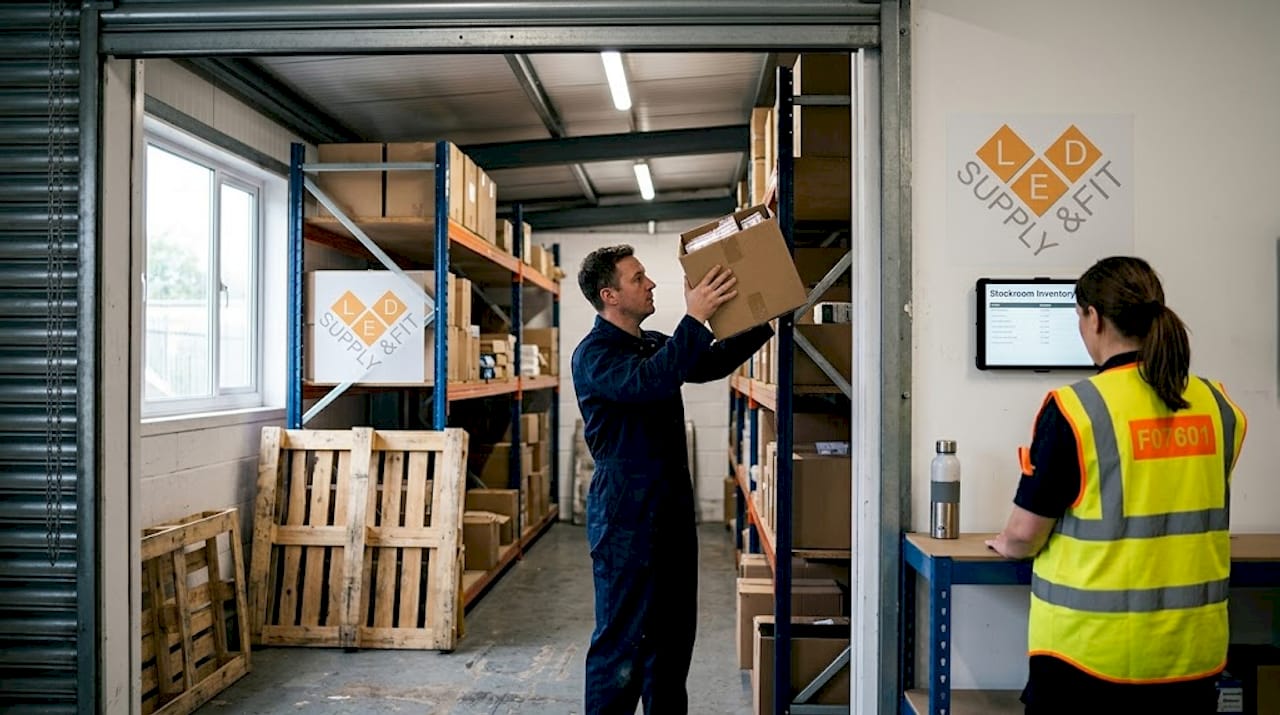
LED vs traditional warehouse lighting: Energy, cost, and ROI
With safety covered, the next challenge is weighing the financials and practicalities of a lighting upgrade.
The numbers are not subtle. LED upgrades reduce energy use by 50-90%, with typical payback periods of 1-3 years and lifespans far exceeding fluorescent or metal halide alternatives. Understanding energy-efficient lighting savings in real terms helps build a board-level business case.
| Technology | Average lifespan | Energy per 100m² | Annual maintenance cost |
|---|---|---|---|
| T8 fluorescent | 10,000-15,000 hrs | High | Regular tube/ballast replacement |
| Metal halide | 6,000-15,000 hrs | Very high | High, lamp warmup delays |
| LED high bay | 50,000-100,000 hrs | Low | Near-zero, sealed units |
The upfront cost of LED appears higher until you account for what you stop paying. Metal halide lamps require a warmup period of up to 5 minutes, waste significant energy as heat, and need frequent replacement. Those labour and replacement costs accumulate quickly in a large facility.
Secondary financial benefits of an LED upgrade include:
- Lower heat output: Less strain on cooling systems in summer
- No flickering: Less worker fatigue and fewer quality-check errors
- Carbon footprint reduction: Progress towards ESG reporting targets
- Less downtime: Failed lamps in hard-to-reach bays mean costly cherry-picker hire
For a practical overview of the installation process, the LED lighting installation guide outlines what to expect during a warehouse fit-out. For those still choosing between options, guidance on efficient warehouse lighting covers product selection in detail.
maximising savings: Smart controls and ongoing maintenance
Once you understand the basic advantages, taking savings further means looking at controls and maintenance.
Lighting controls are where significant additional savings live. Motion sensors, daylight harvesting, and zoning can add 20-50% extra energy savings beyond the LED unit efficiency alone. That is not a marginal gain; on a large warehouse energy bill, it compounds significantly year on year.
What smart controls deliver:
- Motion-triggered switching in low-traffic zones (40-60% reduction in run hours)
- Zone-based dimming that matches light output to actual occupancy
- DSM modelling for forecasting demand and planning phased upgrades
- Integration with building management systems for centralised control
- LED maintenance schedules that prevent gradual lumen depreciation going unnoticed
Maintenance is equally important. Even high-quality LEDs lose output over time through a process called lumen depreciation. Without scheduled photometric testing, you may be technically running lights that no longer meet minimum lux requirements, creating a hidden compliance risk.
For a structured approach to reducing running costs across your facility, reviewing warehouse lighting cost-saving tips covers both hardware and control strategies.
Pro tip: Set up a lighting maintenance log that includes lux readings, control system test dates, and emergency lighting test results. This single document makes HSE inspections and insurance renewals significantly smoother.
The overlooked reality: lighting is a strategic business advantage
Most facilities teams treat lighting as a utilities line item. That framing causes real missed value.
The organisations that approach lighting upgrade ROI strategies as a capital investment rather than a facilities cost consistently outperform on productivity metrics. Better light genuinely changes the working environment. Staff notice it. Output improves. Error rates fall. These are not soft benefits; they appear in throughput data and retention figures.
The deeper opportunity is resilience planning. A facility with modern LED controls, emergency lighting compliance, and documented maintenance is not just safer. It is more insurable, more attractive to logistics clients who audit supplier premises, and better positioned for carbon reporting obligations that are tightening across UK industry in 2026.
Lighting is infrastructure. The businesses that treat it that way stop reacting to failures and start extracting strategic advantage from a properly planned system.
Find the best LED warehouse lighting solutions for your business
If you are ready to address warehouse lighting strategically, the right support makes a significant difference to both the process and the outcome.
At LED Supply & fit, we work with commercial property managers and warehouse operators across the UK to assess existing installations, specify compliant upgrades, and handle full fit-out projects. Whether you need guidance on best commercial LED lighting products or want to explore smarter LED solutions that integrate controls and maintenance planning, we can help you build a case and deliver the result. Contact us to arrange a site assessment or get a quote tailored to your facility.
frequently asked questions
What lux levels are legally required in UK warehouses?
UK regulations require 100-200 lux for general storage, 300-500 lux for picking and packing, and 500+ lux for quality control areas, in line with EN 12464-1 and HSE guidance.
How much can switching to LED lighting really save?
LED upgrades reduce energy use by 50-90%, with most UK warehouses seeing payback within 1-3 years through lower energy bills and reduced maintenance costs.
What emergency lighting is required in warehouses?
BS 5266-1 requires a minimum of 1 lux on escape routes, 15 lux in high-risk work areas, and systems that sustain those levels for a full 3-hour duration during power failure.
How do lighting controls save extra money?
Smart controls including motion sensors, zoning, and daylight harvesting reduce active running hours and can deliver 20-50% additional savings on top of LED unit efficiency alone.
Is LED warehouse lighting worth the upfront investment?
Yes. Despite higher initial costs, LED lighting pays back quickly through energy savings, near-zero maintenance, and stronger compliance with UK workplace lighting standards.