Effective lighting maintenance: Enhance energy efficiency and cut costs
TL;DR:
- Most property managers treat lighting maintenance reactively, leading to higher costs and non-compliance.
- A proactive, structured program includes cleaning, inspections, calibrations, and compliance checks, saving energy and reducing failures.
- Proper maintenance enhances safety, tenant satisfaction, property value, and is a strategic asset for businesses.
Many commercial property managers treat lighting maintenance as a simple to-do item, something dealt with reactively when a lamp fails or a fitting looks dingy. That assumption is costing UK businesses thousands of pounds every year in wasted energy, avoidable repairs, and compliance failures. Proper lighting maintenance is a structured, strategic discipline that directly affects your energy bills, your building’s regulatory standing, and even the wellbeing of the people working inside it. This guide explains what it really involves and how to make it work harder for your organisation.
Key Takeaways
| Point | Details |
|---|---|
| Lighting maintenance essentials | Regular cleaning, inspections, and timely replacement of parts ensure compliance and reliability. |
| Benefits for energy efficiency | Well-maintained lighting uses less energy, reducing costs and environmental impact. |
| Regulatory compliance | Proper maintenance helps meet legal requirements under UK building regulations. |
| Strategic planning | Adopt planned maintenance and upgrades to maximise financial and operational benefits. |
What is lighting maintenance?
To get started, it’s important to understand what lighting maintenance means in a commercial context. It is far broader than simply swapping out failed lamps. In a commercial building, lighting maintenance covers the full lifecycle of your lighting system: routine inspection, cleaning of luminaires and reflectors, testing of controls, replacement of degraded components, and periodic compliance checks.
Each of these activities plays a distinct role. Dirty fixtures, for example, can reduce light output by 20 to 30 percent before a single lamp fails, yet cleaning is routinely skipped because the lights appear to still be on. Controls that drift out of calibration, such as occupancy sensors set to the wrong sensitivity, can leave lights burning in empty rooms for hours. These are not trivial issues. Cumulatively, they inflate energy bills and push your building towards non-compliance with current UK regulations.
Good maintenance tips for managers always emphasise a proactive programme rather than a reactive one. Reacting to failures is always more expensive: you pay emergency rates, disrupt building operations, and often find that a single failed component has masked a wider systemic issue.
Key activities in a commercial lighting maintenance programme:
Lamp and LED driver replacement, luminaire cleaning, wiring and connection inspection, lighting controls testing and calibration, photometric checks, and formal compliance documentation.
Approved Document L 2026 confirms that lighting maintenance supports regulatory compliance and energy efficiency for non-domestic buildings, making it a legal and operational necessity rather than an optional extra.
Why lighting maintenance matters: Cost, compliance, and energy efficiency
Now that we’ve defined lighting maintenance, let’s examine why it must be part of every property manager’s cost-saving and compliance strategy.
The financial case is straightforward. Poor maintenance leads to what engineers call “light loss factors”: cumulative degradation in output caused by dirty fixtures, ageing lamps, and failing controls. This means your system consumes full energy while delivering progressively less usable light. That is pure waste. Beyond the energy bill, neglected systems create unplanned outages, liability exposure if lighting fails in a fire escape or car park, and potentially significant fines.

Compliance is increasingly non-negotiable. Under the 2026 Part L regulations, non-domestic lighting must achieve a minimum of 95 lumens per circuit watt, with mandatory controls including occupancy sensors and daylight harvesting. A maintained system holds its efficacy ratings; an unmaintained one quietly falls below the threshold without anyone noticing until an inspection.
Smarter LED lighting combined with properly maintained lighting controls can amplify savings dramatically. Occupancy sensors alone can cut energy use in intermittently occupied spaces by 30 to 50 percent, but only if they are calibrated and functioning correctly.
Pro Tip: Run a simple “lights-on audit” outside working hours. Walk your building at 9pm and photograph every space where lights are burning unnecessarily. This single exercise often reveals enough wasted energy to justify a full controls maintenance programme within weeks.
| Maintenance approach | Average annual energy saving | Unplanned failure rate | Compliance risk |
|---|---|---|---|
| Reactive only | Minimal | High | Elevated |
| Planned preventive | 15 to 25 percent | Low | Managed |
| Planned preventive with controls | 30 to 50 percent | Very low | Fully mitigated |
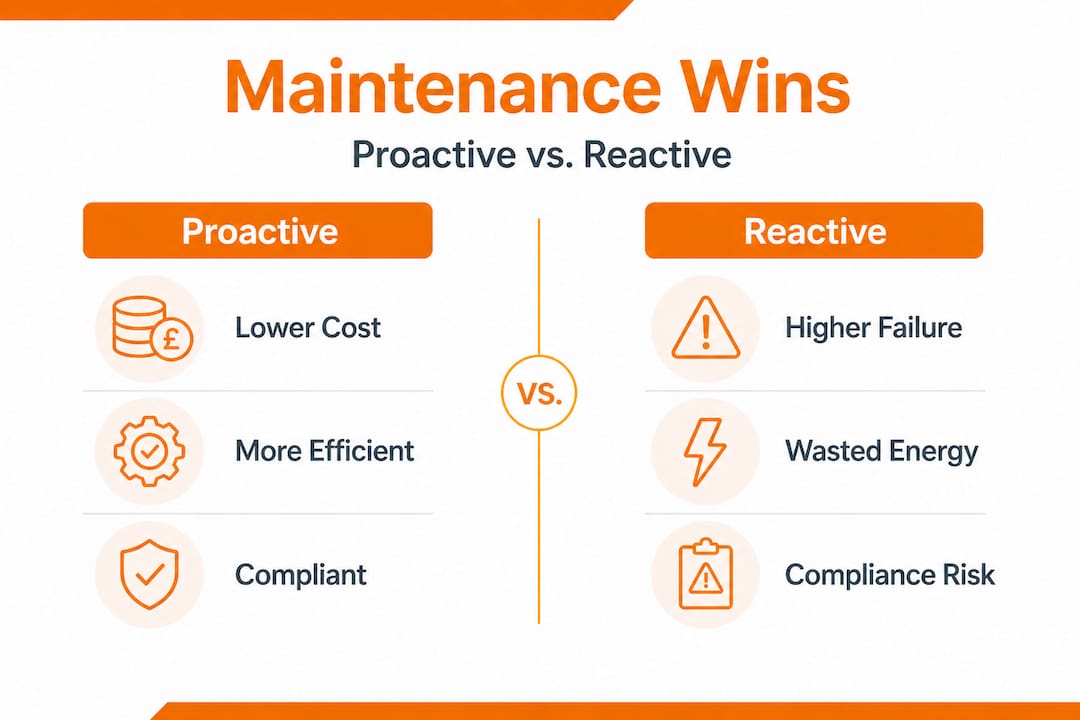
The numbers in that table represent real-world outcomes we see across our commercial client base. Reactive maintenance might feel cheaper month to month, but the total cost of ownership over a three to five year period tells a very different story.
Lighting maintenance tasks: What needs doing and when
Understanding ‘why’ is important. Now let’s look at ‘how’ lighting maintenance is delivered in practice.
A well-structured programme combines regular routine tasks with periodic deeper inspections. Here is a practical sequence most commercial buildings should follow:
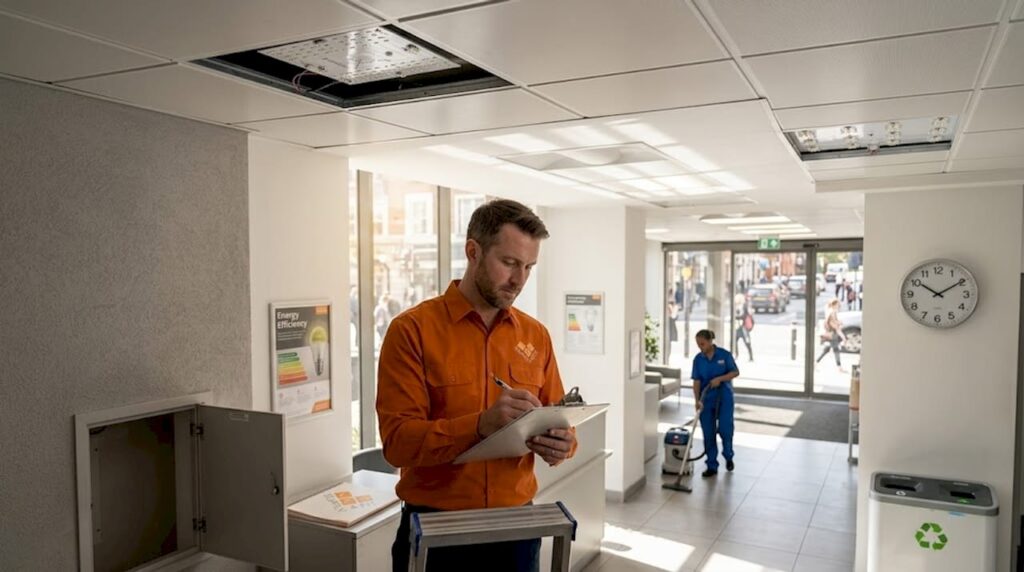
- Monthly visual inspections. Walk every zone and log failed lamps, damaged housings, flickering fittings, and obviously dirty luminaires. This takes minutes and prevents small issues from becoming expensive ones.
- Quarterly controls checks. Test occupancy sensors, daylight sensors, and timers in each zone. Recalibrate any that have drifted. Record findings formally.
- Bi-annual fixture cleaning. Clean reflectors, diffusers, and outer covers to restore full light output. In dusty environments such as warehouses or manufacturing facilities, increase this to quarterly.
- Annual compliance review. Measure lux levels across key areas, verify that efficacy ratings are being maintained, and confirm that controls are operating as designed. Produce a written record for building control purposes.
- Periodic full condition survey. Every three to five years, commission a full photometric survey and review whether ageing components should be replaced or upgraded.
Using LED lighting maintenance tips as a reference point helps you tailor this schedule to your specific system. LED systems, for instance, require less frequent lamp replacement than fluorescent or legacy HID (high-intensity discharge) systems, but their drivers and controls still need regular attention.
According to Approved Document L 2026, integrating occupancy sensors and daylight harvesting reduces both energy use and maintenance frequency when properly maintained, making the investment in controls self-reinforcing over time. If you are still operating fluorescent or HID systems, now is an excellent time to upgrade to LEDs as part of your next maintenance cycle.
| System type | Lamp replacement cycle | Controls check | Cleaning frequency | Annual compliance check |
|---|---|---|---|---|
| LED | 50,000 to 100,000 hours | Quarterly | Bi-annual | Yes |
| Fluorescent | 8,000 to 15,000 hours | Quarterly | Quarterly | Yes |
| HID / legacy | 6,000 to 12,000 hours | Bi-annual | Quarterly | Yes |
These figures provide a starting framework. High-footfall environments such as retail floors, gyms, or hotel lobbies may warrant more frequent attention given the operational stakes of a failure.
Best practices for efficient lighting maintenance
With the essentials in place, here are the practices that set high-performing facilities apart.
The most important shift is integrating maintenance planning with energy-saving upgrades. Too many facilities treat these as separate workstreams, missing the opportunity to combine a lamp replacement visit with a controls audit or a fixture upgrade. Bundling activities reduces labour costs and means your maintenance supplier can spot upgrade opportunities at the same time.
Prioritising LED systems matters enormously here. Not only do they last significantly longer, but their stability means your maintenance programme becomes more predictable and less disruptive. Pairing LEDs with smart controls creates a system that is far easier to maintain and far more forgiving of schedule slippage.
- Document everything. Every inspection, cleaning visit, and controls check should be logged with dates, findings, and actions taken. This is your compliance evidence if building control ever queries your lighting system.
- Avoid ad-hoc repairs. One-off reactive fixes, while sometimes unavoidable, should be captured within the planned programme rather than replacing it. Each ad-hoc call-out should trigger a review of the surrounding zone.
- Do not ignore controls. Failed sensors and miscalibrated timers are the silent energy thieves in most commercial buildings. Fixing a sensor can save more than replacing fifty lamps.
- Review your maintenance supplier regularly. Not all contractors approach lighting maintenance with the same rigour. Ask to see their inspection records and calibration methodology before renewing a contract.
Reviewing sustainable lighting trends alongside your cost-saving lighting workflow ensures your maintenance programme stays aligned with where both regulation and technology are heading. Part L Building Regulations confirm that ongoing compliance with efficacy and control requirements depends on active maintenance, not just the initial installation.
Pro Tip: Create a simple lighting asset register for your building. List every zone, the installed system type, the last service date, and the next scheduled visit. A spreadsheet is sufficient to start. This single document will save hours of guesswork and give you the audit trail you need for compliance purposes.
What most property managers miss about lighting maintenance
Before you move to next steps, consider this deeper perspective on why lighting maintenance matters for your business.
Most conversations about lighting maintenance focus on cost avoidance and regulatory compliance. Both are valid and important. But there is a third dimension that rarely makes it into the discussion: the strategic value of a well-maintained lighting environment as an asset in its own right.
Short-term thinking dominates most facilities budgets. Maintenance is cut when costs need trimming, and the consequences are diffuse enough that no single person notices immediately. But consider what gradually deteriorating lighting actually does to a workplace. Research consistently shows that proper lighting maintenance improves productivity and safety. Poor lighting increases eyestrain, reduces concentration, and raises the risk of accidents. These are real costs that never appear on a maintenance invoice but absolutely appear on your HR and insurance records.
Well-maintained lighting also has a measurable effect on property value and tenant satisfaction in multi-occupancy buildings. A building with a documented, up-to-date lighting maintenance programme is more attractive to prospective tenants and commands a stronger position in lease negotiations. This is the kind of argument that resonates at board level, not just facilities management.
We encourage every property manager we work with to think of lighting maintenance as a strategic management function rather than a building services chore. The shift in thinking is modest, but the outcomes, in energy savings, compliance confidence, staff wellbeing, and asset value, are anything but modest.
Unlock greater savings and compliance with professional lighting support
Taking a strategic approach to lighting maintenance is straightforward when you have the right partner behind you.

At LED Supply and Fit, we work with commercial property managers and facility teams across the UK to design, supply, and maintain high-performance lighting systems that stay compliant and cost-efficient year after year. Whether you need guidance on the best commercial LED options for your premises, practical LED tips to save costs, or a complete maintenance and upgrade programme, our team is ready to help. Explore our full range of commercial lighting solutions and get in touch to discuss what a professionally managed lighting programme could save your building this year.
Frequently asked questions
What does lighting maintenance typically involve?
Lighting maintenance involves cleaning fixtures, replacing faulty lamps, inspecting controls, and ensuring compliance with UK energy regulations under Approved Document L 2026.
How often should lighting be serviced in a commercial building?
Most experts recommend at least annual inspections, but frequency should match system type and building use, with higher-traffic or dusty environments requiring quarterly attention.
Does regular lighting maintenance save on energy costs?
Yes, proactive maintenance ensures your lighting runs at its designed efficacy level, and properly maintained controls cut energy use significantly compared to neglected systems.
What happens if a building fails to meet Part L lighting requirements?
Failure to comply with regulations mandating efficacy and controls for non-domestic lighting can lead to increased operating costs and enforcement action by building control authorities.