

Bulkhead lighting explained: benefits for UK commercial spaces
TL;DR:
- Bulkhead lighting is a durable, impact-resistant, and weatherproof solution ideal for external and industrial commercial areas. It offers energy savings, long lifespan, and safety compliance features like emergency backups and sensors. Proper zone-specific selection and upgrades to LED bulkheads can significantly reduce operational costs and improve safety.
Not all commercial lighting is created equal, and yet far too many property managers treat every fitting as interchangeable. Bulkhead lighting is one of the most practical, durable, and cost-effective solutions available for UK commercial premises, yet it consistently gets overlooked in favour of flashier alternatives. This guide cuts through the confusion, explaining exactly what bulkhead lighting is, why it delivers genuine business value, and how to upgrade your premises without common mistakes that waste budget and cause operational headaches.
Key Takeaways
| Point | Details |
|---|---|
| Bulkhead defined | Bulkhead lighting means robust, surface-mounted or recessed fittings designed for demanding commercial environments. |
| Why choose bulkhead | Bulkhead lights provide unmatched durability and water resistance for shops, offices, and industrial spaces. |
| Efficiency impact | Upgrading to LED bulkhead fittings can cut lighting energy costs by up to 40%. |
| Upgrade smartly | A step-by-step approach ensures you gain all the safety, cost, and performance benefits when switching lighting. |
What is bulkhead lighting?
Bulkhead lighting refers to surface-mounted luminaires housed within a robust, sealed casing. Unlike pendant or recessed fittings that rely on a clean indoor environment to function reliably, bulkhead lights are engineered to withstand real-world punishment. That means moisture, dust, accidental knocks, and the general wear of busy commercial operations.
The term “bulkhead” originates from maritime engineering, where sealed, impact-resistant compartments are essential for survival in hostile conditions. The same principle applies in commercial settings. Bulkhead lighting is designed for robustness and is commonly used in commercial and industrial environments, from car parks and loading bays to stairwells and external walkways.
Key features that define a quality bulkhead fitting include:
- IP-rated enclosures that protect against water ingress and dust accumulation
- Impact-resistant polycarbonate or die-cast covers offering physical protection
- Surface-mounted design for straightforward installation on walls or ceilings
- Even, wide-angle light distribution that eliminates dark corners
- Compatibility with LED sources for long-term energy efficiency
If you are considering large volumes for a refurbishment project, understanding the bulk LED procurement explained process will help you secure better unit pricing and avoid supply delays.
Key benefits for commercial properties
After grasping the basics, it is now crucial to ask: why specifically choose bulkhead lighting in commercial spaces?
The answer comes down to four practical business priorities: durability, safety compliance, energy savings, and flexibility. Bulkhead fittings offer high resilience and low maintenance, making them cost-effective for businesses that cannot afford frequent lamp replacements or emergency call-outs.
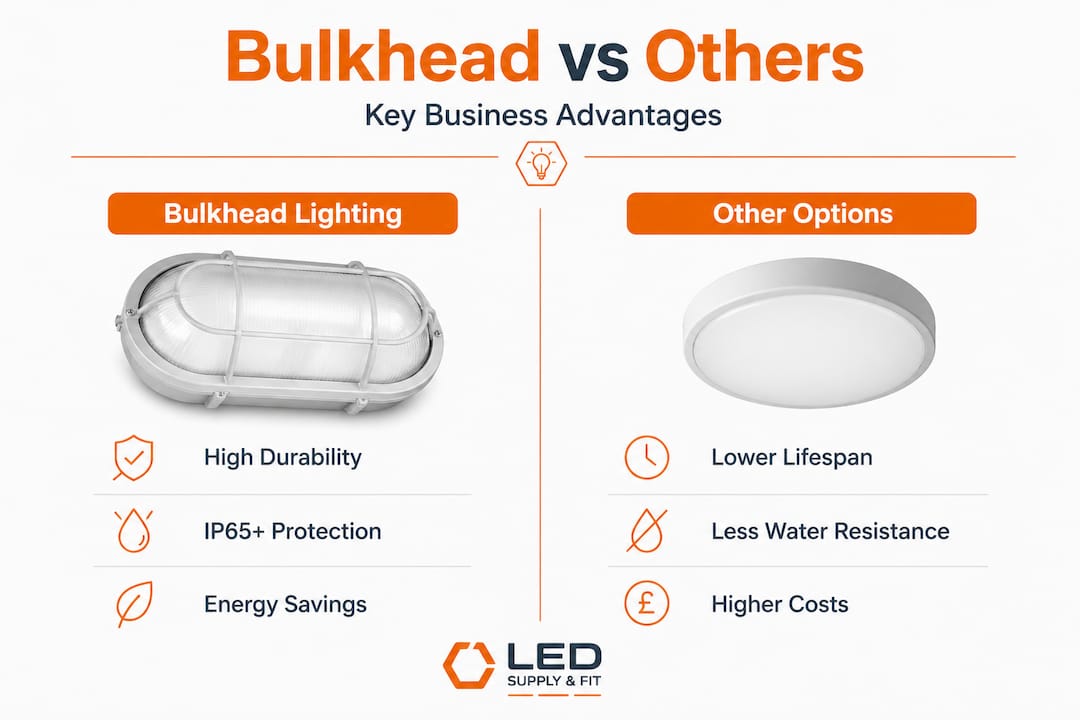
| Feature | Benefit to your business |
|---|---|
| IP65 or higher rating | Safe for wet rooms, exteriors, and washdown areas |
| LED light source | Up to 50,000 hours lifespan, minimal replacements |
| Polycarbonate housing | Withstands knocks in busy corridors or industrial areas |
| Emergency battery backup | Meets fire safety and building regulations |
| Motion sensor option | Cuts energy waste in low-traffic zones |
| Dusk-to-dawn sensor | Automates exterior lighting without manual switching |
The durability advantage is significant for any premises that operates across multiple shifts or in conditions where replacements are disruptive. Consider a food production facility where lighting maintenance requires a hygiene shutdown, or a multi-storey car park where accessing high-mounted fittings demands specialist equipment. Fewer replacements directly translate to lower operational costs and less disruption.

Energy savings are equally compelling. LED bulkhead fittings consume a fraction of the electricity used by fluorescent or incandescent alternatives. If you want to understand the full financial picture before committing, reviewing cost-saving LED lighting tips will give you a clear sense of typical payback periods and ongoing savings potential.
Additional features worth specifying include:
- Emergency battery backup for compliance with BS 5266 fire safety standards
- Passive infrared (PIR) motion sensors ideal for infrequently used corridors
- Dusk-to-dawn photocells for automatic external lighting management
- Microwave sensors for more reliable detection in cold or draughty spaces
Pro Tip: When buying bulkhead fittings for multiple locations across a site, consolidating your order unlocks meaningful price reductions. Explore bulk order savings before finalising your specification to get the best possible cost per unit.
How bulkhead lighting compares to other options
Having covered the distinct advantages, let us see where bulkhead lighting fits amongst other lighting solutions commonly specified for commercial premises.
“Bulkhead lights offer a unique combination of affordability, resilience, and suitability for harsh environments compared to open fittings or panels, making them the sensible default for utility and access spaces.”
| Criteria | Bulkhead fitting | Open batten fitting | LED panel |
|---|---|---|---|
| IP protection | IP44 to IP66 | IP20 (unrated) | IP20 to IP44 |
| Impact resistance | High | Low | Medium |
| Installation complexity | Low | Low | Medium |
| Maintenance frequency | Very low | Medium | Low |
| Best environment | Corridors, exteriors, wet rooms | Clean indoor ceilings | Offices, retail |
| Cost per unit | Low to medium | Very low | Medium to high |
| Emergency option available | Yes | Rarely | Yes |
The table makes clear that each fitting type has its place. The mistake many businesses make is defaulting to open batten fittings or panels for every area of a building, including utility rooms, stairwells, or external storage areas where those fittings simply are not designed to perform reliably.
Here is how to approach the decision systematically:
- Map each zone in your premises by environment type: clean office, wet utility, external, industrial, or mixed use.
- Assign IP requirements to each zone based on likely moisture or dust exposure.
- Specify fittings by zone, reserving panels for office environments and bulkheads for anywhere exposed to the elements or physical risk.
- Cross-check emergency lighting obligations under BS 5266 for escape routes and stairwells.
- Review lux level requirements per area to ensure the chosen bulkhead wattage delivers adequate illumination.
For premises such as retail spaces, where aesthetics and display quality matter alongside practicality, reading about LED retail lighting advantages will help you balance functionality with customer-facing presentation.
Upgrading to energy-efficient LED bulkhead lighting
Comparisons made, the logical next step is understanding how to practically upgrade your own lighting to realise these benefits.
Switching to LED bulkhead lights can cut lighting-related energy bills by up to 40%, which on a medium-sized commercial site represents thousands of pounds saved annually. That figure alone justifies treating an upgrade as a capital investment rather than a maintenance cost.
Follow this process to avoid the most common pitfalls:
- Conduct a full lighting audit. Walk every zone of your premises and document current fittings, their condition, approximate age, and wattage. Note any areas where lamps frequently fail or where light levels feel inadequate.
- Identify IP rating requirements per location. A corridor inside a dry office building may only need IP44, while an external wall or plant room may require IP65 or higher.
- Specify LED bulkhead wattage carefully. Match output in lumens to the lux requirements of each zone. Do not simply replace a 28W fluorescent with a low-wattage LED without checking lumen equivalence.
- Plan installation scheduling. Aim to minimise disruption by scheduling electrical work during low-activity periods or overnight if your business operates around the clock.
- Check emergency lighting obligations. Escape routes, stairwells, and fire exit corridors must meet BS 5266 standards. Emergency bulkhead fittings with integral battery backup are a straightforward solution.
- Verify compliance before sign-off. Ensure your electrician conducts a photometric check and issues appropriate certification on completion.
For more detailed LED savings advice covering typical upgrade scenarios and return on investment calculations, it is worth reviewing guidance tailored specifically to UK commercial properties. When you are managing a larger project across several areas, planning how to streamline installation across multiple zones can save significant time and reduce contractor costs.
Pro Tip: Always request photometric data sheets from your supplier before ordering. These confirm the actual light spread and intensity delivered by a fitting under real conditions, not just the headline wattage figure.
Why bulkhead lighting is the unsung hero of commercial upgrades
We have worked with energy auditors, facilities managers, and maintenance teams across a wide range of UK commercial sites, and a consistent pattern emerges. The areas that cause the most ongoing grief, repeated call-outs, persistent lamp failures, and safety compliance concerns, are almost always the zones fitted with the wrong luminaire for the environment.
Bulkhead lights are rarely glamorous. They do not feature in design mood boards or showroom displays. But they quietly keep corridors lit, keep car parks safe, and keep energy bills lower month after month, year after year. That is genuinely more valuable than a visually impressive fitting that deteriorates after six months in a damp stairwell.
The conventional wisdom in commercial lighting upgrades tends to focus on high-visibility areas: the shop floor, the reception, the meeting rooms. Those are legitimate priorities. However, neglecting the back-of-house, the access routes, and the external zones introduces real compliance risk and ongoing maintenance expense that erodes the savings made elsewhere.
Our field experience also shows that businesses that specify sustainable lighting choices holistically, rather than cherry-picking the most visible areas, achieve better overall cost reductions and score more consistently in energy performance assessments. Bulkhead fittings, often specified last or not at all, frequently make the biggest difference to the headline energy figure when they replace aged fluorescent units across dozens of locations within a site.
Take the next step: smarter lighting for your business
If this article has shifted your thinking about where bulkhead lighting fits within your commercial upgrade plans, the next move is practical. At LED Supply and Fit, we supply and install professional LED lighting solutions for UK businesses of all sizes, with trade pricing, next-day delivery, and expert installation support.
Whether you need to unlock commercial savings through a bulk order or simply want to browse the best commercial LED options available right now, we have the products and expertise to match your project requirements. Our team can advise on IP ratings, emergency compliance, sensor integration, and installation scheduling to ensure your upgrade runs smoothly from specification through to commissioning.
Frequently asked questions
Where are bulkhead lights most commonly used in commercial settings?
Bulkhead lights are most commonly used in corridors, stairwells, exterior walkways, car parks, and service areas. Bulkhead lighting is designed for robust commercial and industrial use, including car parks and exteriors where standard fittings would quickly deteriorate.
How do bulkhead lights help with energy efficiency?
LED bulkhead lights reduce energy consumption significantly, and switching to LED bulkhead lights can cut energy bills by up to 40% compared to traditional fluorescent alternatives.
Are bulkhead lights suitable for outdoor and wet environments?
Yes, bulkhead fittings are water-resistant and ideal for outdoor or industrial applications, with IP ratings from IP44 for sheltered exteriors through to IP66 for fully exposed or wash-down environments.
What features should I look for in an energy-efficient bulkhead light?
Look for high IP ratings, LED technology with a minimum 50,000-hour lifespan, and options such as emergency battery backups or PIR sensor integration. Modern bulkhead lights offer LED technology, automation, and robust protection in a single, cost-effective fitting.
Recommended
- Why choose sustainable lighting for UK commercial properties in 2026
- Lighting controls explained: cut energy costs by up to 83%
- Benefits of Commercial LED Lighting in the UK
- Office Lighting – Enhancing Workplace Performance and Savings
- Complete Guide to Benefits of Natural Lighting – Mats4U USA
- Why indoor lighting matters for your comfort and mood