
Essential commercial lighting maintenance tips for UK managers
TL;DR:
- Regular maintenance and audits ensure lighting remains compliant, efficient, and cost-effective.
- Proactive lighting upkeep enhances staff wellbeing by reducing glare, eye strain, and fatigue.
- Upgrading to smart LED controls and planned replacements maximizes energy savings and system longevity.
Maintaining consistent, energy-efficient lighting across a busy commercial premises is harder than most managers expect. Poor upkeep quietly drains energy budgets, creates compliance risks, and reduces staff productivity long before a single bulb visibly fails. Whether you oversee a warehouse in the North East, a hotel in London, or a chain of retail units, the principles are the same: lighting that isn’t actively maintained will underperform, cost more, and eventually fall foul of UK workplace regulations. This article gives you practical, evidence-backed steps to keep your LED systems running at their best.
Key Takeaways
| Point | Details |
|---|---|
| Follow EN 12464-1 standards | Ensure all workspaces meet the recommended lux levels and uniformity for compliance and efficiency. |
| Maintain regularly and log results | Routine checks, cleaning, and record-keeping extend LED lifespan and optimise energy savings. |
| Measure and adjust lighting | Use lux meters to confirm lighting output and adjust for ageing and dust to maintain standards. |
| Optimise for user comfort | Control glare and use localised task lighting for occupant satisfaction and productivity. |
| Invest in proactive upgrades | Strategic upgrades and modern controls provide ongoing cost and energy savings. |
Understand lighting standards and compliance
Before you can maintain lighting effectively, you need to know what “effective” actually means in legal and technical terms. In the UK, workplace lighting is governed by the Health and Safety at Work Act 1974 and the Workplace (Health, Safety and Welfare) Regulations 1992, with the HSE providing detailed guidance on adequate illumination. The European standard EN 12464-1 sets the benchmark for interior workplace lighting and is widely adopted across UK commercial projects.
Lux levels vary by task: offices require 300 to 500 lux for general work, detailed tasks such as technical drawing or fine assembly need up to 750 lux, and warehouses typically require 150 to 300 lux. Uniformity ratios should sit between 0.6 and 0.8 to avoid harsh contrasts that cause eye strain. A maintenance factor of 0.7 to 0.8 must also be applied to account for the gradual loss of light output due to dust accumulation and lamp ageing.
Understanding the importance of lighting design from the outset makes compliance far easier to sustain over time.
Key EN 12464-1 lux requirements for common UK commercial spaces:
| Space type | Minimum lux | Uniformity ratio |
|---|---|---|
| General office | 300-500 lux | 0.6 |
| Detailed task area | 750 lux | 0.7 |
| Warehouse (general) | 150-300 lux | 0.6 |
| Retail floor | 300-500 lux | 0.6 |
| Corridor/circulation | 100 lux | 0.4 |
Failure to meet these standards is not just an operational inconvenience. HSE inspectors can issue improvement notices, and inadequate lighting that contributes to a workplace accident can expose your organisation to significant legal liability. Regular lux audits are your first line of defence.
Compliance checklist at a glance:
- Conduct lux meter audits at least annually, or after any significant layout change
- Apply the maintenance factor (0.7 to 0.8) when interpreting results
- Document all audit findings and corrective actions
- Ensure emergency lighting is tested and certified separately
- Review standards when changing space function or occupancy
Top tips for regular LED lighting maintenance
LED technology is far more durable than older fluorescent or halogen systems, but it is not maintenance-free. Consistent upkeep is what separates a lighting system that delivers its promised 50,000-hour lifespan from one that degrades noticeably within two or three years.
Follow these energy-saving maintenance tips as a structured routine:
- Carry out monthly visual inspections. Walk the space and look for flickering, dimming, discolouration, or any fittings that have failed entirely. Flickering LEDs often indicate a driver fault rather than a failed chip, and early detection prevents cascading failures.
- Clean fittings and diffusers every three to six months. Dust on diffusers can reduce light output by 10 to 30% over time. Use a dry microfibre cloth for polycarbonate diffusers and avoid abrasive cleaners that scratch surfaces and scatter light unevenly.
- Monitor failure rates across zones. If a particular zone shows a cluster of failures, it may indicate a wiring issue, voltage fluctuation, or a batch of substandard drivers. Treat clusters as a diagnostic signal, not just a replacement job.
- Schedule replacements proactively. Rather than waiting for individual fittings to fail, plan group replacements at around 70% of rated lifespan. This is especially important in areas where access requires scaffolding or specialist equipment, as it reduces labour costs significantly.
- Keep a maintenance logbook. Record every inspection, cleaning session, replacement, and lux reading. This creates an audit trail that supports compliance and helps you spot deterioration trends before they become costly.
“A lighting system that is never cleaned or inspected will consume the same energy as a well-maintained one, but deliver far less light. You are paying full price for a fraction of the output.”
When considering upgrading commercial lighting, a well-documented maintenance history also gives you accurate data to build a business case for investment.
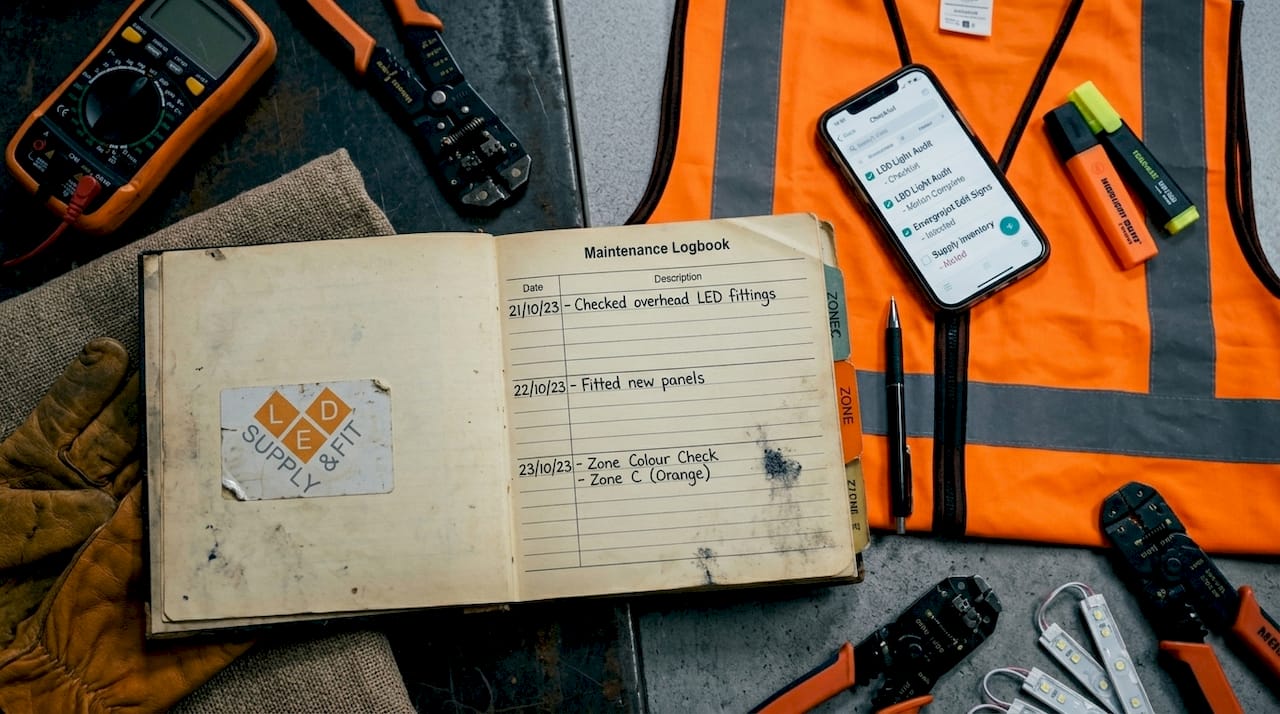
Pro Tip: Colour-code your maintenance logbook by zone. When you can see at a glance that Zone C has had three cleaning sessions and two driver replacements in 18 months, the decision to investigate further or upgrade becomes obvious.
Measure and monitor light levels correctly
A lux meter is one of the most underused tools in a facility manager’s kit. Many managers rely on visual judgement alone, which is unreliable. Human eyes adapt to poor lighting conditions gradually, meaning a space can fall well below compliance thresholds before anyone notices.
Here is how to carry out a proper lux measurement:
- Set up the meter correctly. Hold the sensor horizontally at working plane height (typically 0.85 metres above floor level for desk work, floor level for circulation areas).
- Take multiple readings. Measure at a grid of points across the space, not just in the centre. Calculate the average and the minimum to determine your uniformity ratio.
- Compare against EN 12464-1 targets. Lux meter audits should be benchmarked against space-specific standards, not a single generic figure.
- Apply the maintenance factor. If your target is 500 lux and your maintenance factor is 0.8, your installed system should deliver 625 lux when new to ensure compliance throughout its life.
- Record and set intervals. Log every measurement with the date, time of day, and any relevant conditions such as blinds open or closed. Repeat audits every six to twelve months, or after any significant change.
For high-throughput environments, consider a cost-saving lighting workflow that integrates regular lux monitoring into your broader facilities management schedule. For specific guidance on large spaces, warehouse lighting best practices cover the additional considerations around racking height and task zones.
Optimise controls and upgrade for task-specific efficiency
Getting the right light level in the right place at the right time is where modern LED systems genuinely outperform older technologies. Static, uniform lighting across an entire floor plate is an outdated approach that wastes energy and often fails to meet task-specific needs.
HSE guidance is clear that task-specific lux levels are preferable to uniformly high illumination across an entire space. A reception desk, a server room, and a breakout area all have different needs, and treating them identically wastes energy and reduces comfort.
Key strategies for optimising controls:
- Install occupancy sensors in low-traffic areas such as corridors, storage rooms, and meeting rooms. These alone can reduce lighting energy consumption by 20 to 40% in those zones.
- Use daylight-linked dimming in spaces with significant glazing. Photocell controls automatically reduce LED output when natural light is sufficient, maintaining target lux levels without manual intervention.
- Specify UGR below 19 for office environments. UGR (Unified Glare Rating) measures discomfort glare. Fittings with a UGR below 19 are essential for screen-based work. Positioning luminaires correctly and using blinds to manage solar glare are equally important.
- Implement local task lighting at workstations in areas where general illumination cannot meet detailed task requirements without over-lighting the whole space.
Pro Tip: Programme your controls to dim lighting gradually in the 30 minutes before and after core working hours. Sudden transitions from bright to dim are jarring and affect concentration. Gradual changes of around 10% per five minutes are barely perceptible and significantly reduce adaptation discomfort.
Explore smarter LED lighting solutions for sensor and control options suited to commercial environments, and review LED lighting cost-saving tips for a broader view of where savings can be found.
Commercial lighting maintenance checklist: summary comparison
For busy managers who need a quick reference, here is a side-by-side comparison of the core maintenance activities:
| Activity | Frequency | Key standard | Primary benefit |
|---|---|---|---|
| Visual inspection | Monthly | HSE guidelines | Early fault detection |
| Fitting and diffuser clean | Every 3-6 months | EN 12464-1 MF 0.7-0.8 | Restore light output |
| Lux meter audit | Every 6-12 months | EN 12464-1 | Compliance assurance |
| Driver and control check | Annually | Manufacturer guidance | Prevent system failure |
| Group lamp replacement | At 70% rated life | EN 12464-1 | Cost and labour efficiency |
As lux levels, maintenance, and uniformity requirements vary by space and task, a one-size-fits-all schedule will always leave gaps. Tailor your programme to the specific demands of each area within your premises.
Quick tips for facility managers:
- Never skip lux audits after a space is repurposed or refurbished
- Keep spare drivers on-site for your most critical zones
- Photograph fittings during inspections to track physical deterioration
- Review your LED tips for UK businesses annually as technology and standards evolve
Why lighting maintenance is a strategic investment, not a chore
Here is an uncomfortable truth: most facility managers treat lighting maintenance as a reactive, box-ticking exercise. A fitting fails, it gets replaced. An audit is due, it gets done. That approach keeps you compliant on paper, but it leaves significant value on the table.
The businesses that genuinely benefit from their LED investment are the ones that treat maintenance as a continuous improvement process. They track lux trends over time and spot degradation before it affects productivity. They use audit data to justify targeted upgrades rather than wholesale replacements. They integrate lighting controls with their wider building management systems, creating a feedback loop that drives down energy costs year on year.
There is also a staff wellbeing dimension that rarely appears in maintenance schedules. Poor lighting is a known contributor to fatigue, headaches, and reduced concentration. When you maintain lighting proactively, you are not just protecting your energy budget. You are actively supporting the people who work in your buildings.
The managers who get this right are not spending more time on lighting. They are spending their time more intelligently, using data, planning ahead, and investing in strategic LED lighting solutions that compound their returns over time. That is the difference between maintenance as a cost and maintenance as a strategy.
Upgrade your commercial lighting with LED Supply & Fit
Putting these maintenance principles into practice is straightforward when you have the right products and support behind you. At LED Supply & Fit, we work with commercial clients across the UK to supply, install, and maintain high-performance LED systems tailored to the specific demands of each space.

Our work with Wilson Veterinary Group and Stockton Riverside College demonstrates how a proactive approach to lighting upgrades delivers measurable energy savings and improved working environments. Whether you need a full compliance audit, a phased upgrade plan, or bulk supply with next-day delivery, our team is ready to help. Contact us today to discuss a cost-saving lighting solution for your premises.
Frequently asked questions
What are recommended lux levels for UK offices and warehouses?
UK offices should have 300 to 500 lux for general work, with detailed task areas requiring up to 750 lux, and warehouses needing 150 to 300 lux, as specified in EN 12464-1 standards.
How often should commercial LED lighting be cleaned and checked?
LED fittings should be visually inspected monthly and cleaned every three to six months, with more frequent cleaning in dusty or high-particulate environments to maintain the 0.7 to 0.8 maintenance factor required for accurate lux audits.
What is a lighting maintenance factor?
A maintenance factor is a value, typically 0.7 to 0.8, that accounts for the reduction in light output caused by dust accumulation and lamp ageing, and is applied during lighting audits to ensure installed systems remain compliant throughout their operational life.
Why is glare control important in office lighting?
Controlling glare to a UGR below 19 in office environments reduces eye strain and discomfort, directly improving concentration and productivity for screen-based workers.