

Bulk lighting purchase workflow: a step-by-step guide
TL;DR:
- A structured bulk LED lighting upgrade can significantly reduce energy costs and improve system reliability for UK property managers.
- Careful planning, clear specifications, and engaging experienced suppliers are essential to avoid compliance issues, delays, and cost overruns.
Getting a bulk LED lighting upgrade right is one of those projects that looks straightforward until you are knee-deep in conflicting specifications, missed compliance documents, and a supplier quoting a price that bears no relation to the full scope of work. Done well, a structured bulk lighting purchase can reduce business energy costs by 60% or more while improving light quality and reducing maintenance call-outs across your estate. Done poorly, it stalls, overruns, and leaves you with a patchwork of non-compliant fixtures and no clear accountability. This guide walks you through every stage, from initial scoping to sign-off and beyond, with specific guidance for both public and private sector decision-makers in the UK.
Key Takeaways
| Point | Details |
|---|---|
| Map your workflow | Define each stage from procurement to maintenance for smooth project delivery. |
| Align with regulations | Ensure compliance with all UK lighting and energy standards before purchasing. |
| Bundle services wisely | Consider integrated contracts covering installation and maintenance for best value. |
| Prioritise lifecycle value | Total cost and reliability outweigh upfront fixture price in the long run. |
Understanding the bulk lighting purchase workflow
A bulk lighting purchase workflow is the documented sequence of steps that takes a lighting upgrade project from initial need through to operational completion. It covers specification, procurement, delivery, installation, commissioning, and post-installation maintenance. For UK commercial property managers, the workflow is not just administrative tidiness; it is the mechanism that protects your budget, your compliance position, and your contractors’ accountability.
The approach differs significantly depending on whether you are operating in the public or private sector. UK public-sector projects often bundle supply, installation, and ongoing maintenance into a single procurement process, which means the tender document itself defines the full service scope. Private sector buyers, by contrast, frequently negotiate price per fixture and manage installation separately, which can appear cheaper upfront but introduces coordination risks and gaps in accountability.
Understanding a well-structured bulk order lighting workflow helps you avoid those gaps. The benefits are tangible: lower unit costs through volume, consistent compliance across all areas of your premises, simpler maintenance scheduling, and a clear audit trail for energy performance certificates. Investing time in the workflow structure at the outset is what separates a smooth rollout from a disruptive one.
| Factor | Public sector | Private sector |
|---|---|---|
| Contract scope | Supply, install, maintain | Often supply only or supply and install |
| Procurement method | Formal tender or framework | Negotiated or competitive quote |
| Compliance priority | Mandatory, documented | Variable, risk-managed |
| Asset lifecycle focus | High, multi-year | Often lower, upfront cost focus |
| Accountability structure | Defined in contract | Depends on agreement |
Key workflow stages for both sectors:
- Initial site assessment and energy audit
- Technical specification and product selection
- Supplier identification and bulk lighting discounts negotiation
- Contract or purchase order agreement
- Delivery, installation, and commissioning
- Compliance sign-off and documentation
- Ongoing maintenance and inspection scheduling
Essential requirements before starting your project
Before you approach a single supplier, you need to have your foundations in place. Many bulk lighting projects stall not because of supplier problems but because the buyer has not clarified what they actually need, who is responsible for what, and what the compliance obligations are.

Your technical specification is the most critical starting document. This should define the required lumen output per area, colour temperature preferences, ingress protection ratings for wet or dusty environments, emergency lighting requirements, and any specific mounting or dimming needs. Without this, every supplier quote you receive will be based on different assumptions, making comparison impossible.
Energy performance regulations in the UK require commercial buildings to meet specific efficiency standards, and your lighting specification must align with those obligations. Emergency lighting in particular has strict requirements for battery duration, test schedules, and signage. Notably, lighting system tenders in the UK often include ongoing inspection, battery testing, and emergency replacements in the contract scope, so ensure your specification reflects this even if you are a private buyer.
Your team roles must also be clear. A typical project needs a budget holder, a technical lead (often a facilities manager or electrical consultant), a procurement contact, and someone to manage contractor access and scheduling. Confusion over who approves what is one of the most common causes of delay.
| Requirement | Owner | Document needed |
|---|---|---|
| Site audit and lumen calculations | Facilities manager or consultant | Survey report |
| Compliance specification | Technical lead | BS EN 12464 reference |
| Budget sign-off | Finance or director | Purchase authority |
| Contractor vetting | Procurement | Insurance, NICEIC cert |
| Emergency lighting compliance | Facilities manager | BS 5266 documentation |
Pro Tip: Always clarify ongoing maintenance responsibilities before signing any supply agreement. A contract that covers only installation leaves you exposed to reactive call-out costs that can quickly erode any savings on the initial fixture price. Build maintenance and emergency replacement terms into the agreement from day one.
Pitfalls when requirements are missed:
- Mismatched product specifications that require expensive replacements
- Compliance failures discovered during post-installation inspection
- Budget overruns from uncoordinated labour and delivery scheduling
- Delays caused by unclear approval authority
- Emergency lighting gaps that breach BS 5266 and invalidate your fire risk assessment
Reviewing the bulk LED procurement process in detail before issuing any request for quotation will save you significant time and cost. Consider also how bulkhead lighting benefits can address stairwell and circulation area compliance requirements in one product choice.
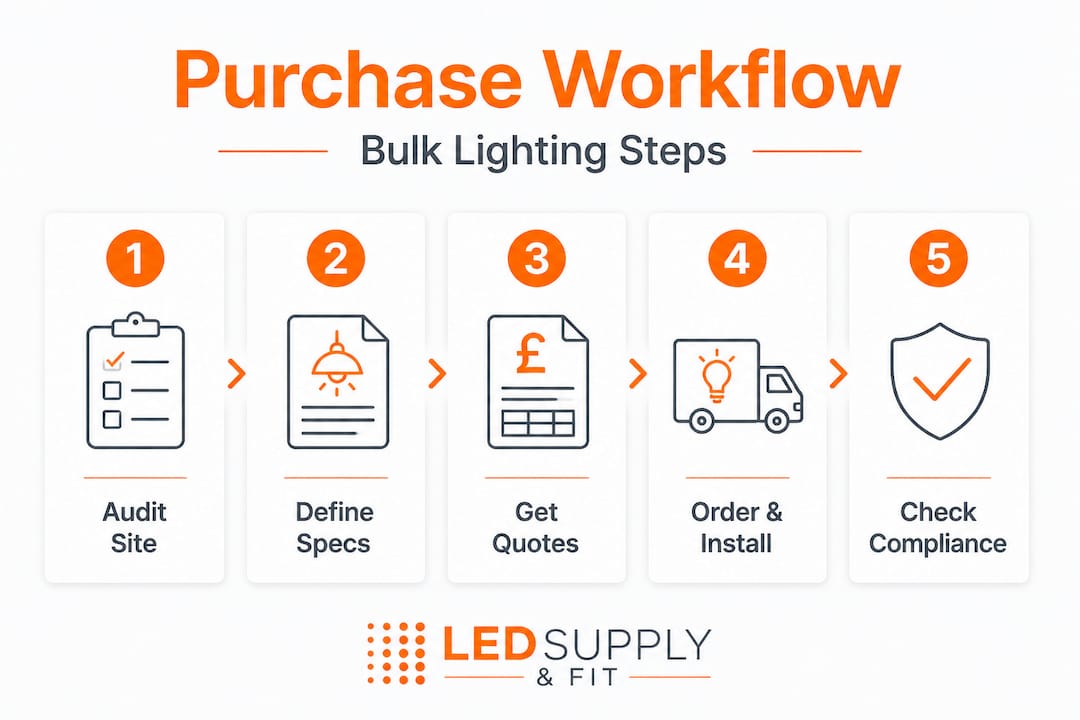
Step-by-step workflow for bulk lighting purchases
With your requirements documented and your team aligned, you can move through the procurement process with confidence. Here is the sequence that delivers a compliant, auditable, and cost-effective outcome.
- Conduct a full site assessment. Measure every area, document existing fittings, and record current energy consumption. This data informs your specification and gives you a baseline to measure savings against post-installation.
- Produce a detailed specification. Define product types, wattage, colour rendering index, emergency requirements, and installation standards. Use this as the basis for all supplier engagement.
- Identify and approach shortlisted suppliers. Request itemised quotes that separate product cost, delivery, installation labour, commissioning, and warranty terms. Never compare a supply-only quote with a full-service quote directly.
- Evaluate tenders or quotes on total value. Consider product quality, delivery reliability, LED lighting cost-saving tips built into the proposal, and the supplier’s ability to handle your project scale.
- Agree contract terms, including maintenance. Bundling installation, testing, and future repairs minimises operational disruption and improves accountability. Ensure warranty periods, replacement lead times, and escalation routes are all written into the agreement.
- Schedule installation with minimal disruption. Coordinate with your operations team to phase work during low-occupancy periods. Stagger delivery of products to avoid storage issues on site.
- Commission and test all installed fittings. This includes emergency lighting duration tests, dimmer compatibility checks, and lux level verification against your specification.
- Complete compliance documentation and sign-off. Produce a commissioning report, update your building’s asset register, and file all warranty documents.
- Plan ongoing maintenance. Set calendar reminders for emergency lighting tests, lamp life reviews, and scheduled inspections.
Pro Tip: Combine your LED upgrade with routine electrical inspection and condition reports. Scheduling both together reduces access disruption, cuts contractor mobilisation costs, and gives you a complete picture of your installation’s health from the outset.
Important: Never accept a completed installation without a full commissioning report and documented lux level readings. Without these records, you have no evidence of compliance if your premises are inspected or if an incident occurs. This documentation is your legal protection.
Thinking carefully about optimising energy consumption across your estate means the workflow itself should include checkpoints after assessment, after installation, and three months post-completion to verify actual energy savings align with projections. You can also streamline installation workflow planning by working with a supplier experienced in multi-site and large-scale commercial projects.
Avoiding mistakes: common pitfalls in bulk lighting procurement
Even experienced property managers make avoidable errors in bulk lighting projects, usually under time or budget pressure. Recognising these pitfalls before they become problems is far less costly than fixing them afterwards.
Private buyers often underestimate the added value of an integrated service contract versus only securing the lowest price per fixture. A £2 saving per fitting across 500 units sounds significant, but if the supplier cannot guarantee delivery timescales, lacks installation capacity, or offers no post-installation support, that saving evaporates quickly in project management time and reactive costs.
Research across UK commercial projects consistently suggests that a significant proportion of lighting upgrades experience some form of cost overrun or timeline delay, with the most common causes being incomplete specifications, unplanned compliance requirements discovered during installation, and poor coordination between procurement, facilities, and operational teams.
Common pitfalls to avoid:
- Shortcutting the technical specification to save time at the start
- Choosing supply-only contracts without accounting for installation coordination costs
- Ignoring emergency lighting compliance until post-installation inspection
- Failing to document maintenance responsibilities in writing
- Treating fixture unit cost as the primary evaluation metric
Think beyond the price tag on individual fittings. The asset lifecycle value of a well-specified LED fitting, including energy savings, reduced maintenance, and a five to seven year operational lifespan, will always outperform a cheaper product that fails within two years or requires frequent servicing. The best LED lighting tips for UK businesses consistently point to lifecycle costing, not unit price, as the measure that matters.
A pragmatic take: why workflow discipline trumps bargain hunting
There is a persistent temptation in commercial property to treat a lighting upgrade as a purchasing exercise rather than a project management exercise. The logic runs that if you secure the lowest price per fitting from a reputable brand, you have done the job well. In reality, that approach misses the majority of where value is won or lost.
The public sector gets this right more often than the private sector, not because of bureaucratic process for its own sake, but because integrated contracts with defined accountability structures force procurement teams to think about the full service lifecycle from day one. When a council or NHS trust issues a lighting tender, the specification includes not just the fixture but the installation method, the commissioning standard, the emergency lighting test schedule, and the response time for future replacements. The result is a more reliable outcome, better documentation, and a lower total cost of ownership over five years.
Private sector property managers who adopt the same thinking, using documented workflows and prioritising integrated supplier relationships over transactional price-per-unit deals, consistently report smoother projects and fewer post-installation surprises. The real-world workflow examples from commercial LED projects make this clear: the upfront discipline of a thorough workflow pays back many times over in avoided disruption, rework, and reactive costs.
Futureproofing matters too. An LED system installed today with a structured maintenance plan and a responsive supplier relationship will serve your premises reliably for a decade. A system procured on price alone, with no maintenance agreement and a supplier who has moved on, will cost you more within three years. Workflow discipline is not bureaucracy. It is the most pragmatic cost-saving strategy available to commercial property managers.
Accelerate your bulk lighting project with expert help
Navigating a bulk lighting purchase correctly requires the right products, the right process, and a supplier who understands commercial-scale project delivery. At LED Supply and Fit, we work with property managers, facilities teams, and business owners across the UK to plan and execute lighting upgrades that deliver measurable energy savings and long-term reliability.

Whether you are reviewing your best commercial LED options for a warehouse, office block, or retail environment, or need help structuring an integrated workflow from assessment to sign-off, our team is ready to support you. We offer bulk pricing, next-day delivery across the UK, and professional installation services. Explore our energy-saving LED solutions or speak to our lighting workflow experts directly to get your project moving with confidence.
Frequently asked questions
What are the typical stages in a UK public-sector lighting procurement?
UK public-sector projects bundle supply, installation, commissioning, and maintenance into one integrated process, usually governed by a formal tender or framework agreement with defined accountability at every stage.
Can I buy LEDs in bulk without including installation?
Private sector buyers may purchase fixtures only, but public contracts frequently require supply and installation together to ensure compliance, accountability, and a complete commissioning record.
How do I ensure compliance with lighting and energy regulations?
Align your specification with BS EN 12464 for general lighting and BS 5266 for emergency lighting, and ensure your compliance checks and documentation are completed as part of the installation sign-off process.
What is the biggest mistake in bulk lighting procurement?
Private buyers often undervalue integrated service contracts versus a low price per fixture, overlooking the total cost of maintenance, compliance management, and project coordination over the asset’s full lifespan.
Recommended
- Streamline your bulk lighting installation workflow
- Bulk Order Lighting: Unlocking Commercial Savings
- Bulk Lighting Discounts: Maximising Savings for Businesses
- How to Upgrade Commercial Lighting for Cost Savings
- Bulk supplies: power savings and efficiency for UK SMEs – SubliBlanks Ltd
- DIY crystal light fixture upgrade: step-by-step guide – CrystalPlace