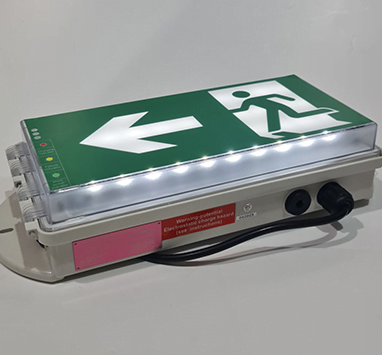

How to reduce lighting costs for commercial properties
TL;DR:
- Lighting costs are highly controllable and often overpaid due to a lack of proper system assessment. Conducting a detailed lighting audit allows businesses to identify inefficient fixtures, optimize zones, and plan effective LED upgrades for significant savings. Combining LED technology with smart controls and leveraging rebates can deliver substantial energy and maintenance cost reductions across commercial properties.
Lighting is one of the most controllable costs on a commercial property’s energy bill, yet most businesses overpay year after year simply because nobody has ever properly examined the system they inherited. If your premises run on ageing fluorescent tubes, metal halide high bays, or standard halogen fittings, knowing how to reduce lighting costs is not a minor efficiency exercise. It is a direct route to recovering thousands of pounds annually while improving the quality of your working environment at the same time.
Assessing current lighting usage and planning upgrades
Before you change a single fitting, you need to know exactly what you are running. A detailed lighting audit records every fixture type, wattage, operating schedule, and maintenance cost across your site. Without this baseline, you are guessing rather than managing.
The audit process covers more ground than most managers expect:
- Record every fixture: type, wattage, lamp technology, and approximate age
- Log operating hours per zone across a typical week, including out-of-hours usage
- Note maintenance records: how often lamps are replaced, who replaces them, and what it costs
- Map task-specific zones where lighting intensity genuinely matters versus circulation areas where lights burn all day for little practical reason
- Identify dark spots or overlit areas where output does not match actual need
Proper assessment is the foundation of effective lighting optimisation, not an optional first step. Businesses that skip this stage frequently upgrade the wrong fixtures first and see underwhelming payback.
| Audit element | What to record | Why it matters |
|---|---|---|
| Fixture type | Fluorescent, halogen, HID, LED | Determines replacement priority |
| Wattage | Per fitting and total zone load | Calculates current energy spend |
| Operating hours | Daily and weekly usage patterns | Reveals biggest savings opportunities |
| Maintenance frequency | Lamp replacements per year | Exposes hidden labour costs |
| Zone purpose | Task, ambient, security | Guides specification of replacement |
Pro Tip: Prioritise the zones with the longest operating hours and highest wattage first. A warehouse running 400W metal halide fittings for 16 hours a day offers far greater payback than an office corridor on a timer.
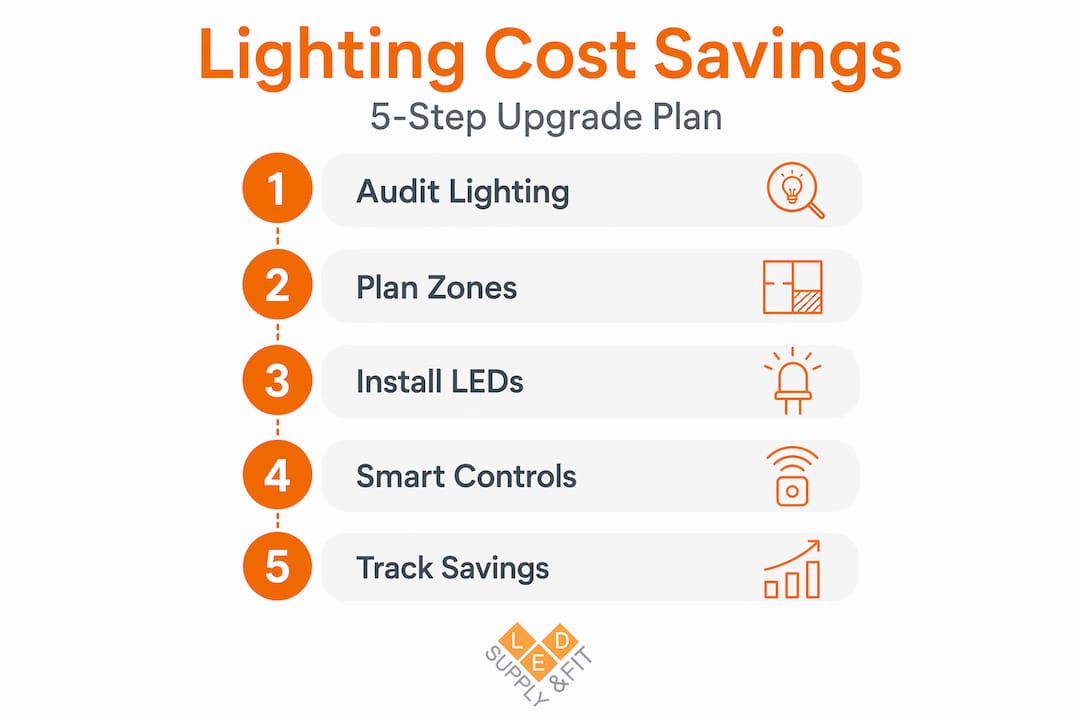
Implementing LED lighting upgrades for maximum savings
LEDs are the core of every serious cost reduction plan, and the numbers justify why. LED lighting reduces energy consumption by 50 to 80 percent compared to traditional technologies, with typical lifespans of 25,000 to 50,000 hours. That is not just a smaller electricity bill. It means years between replacements, which matters enormously in commercial settings.
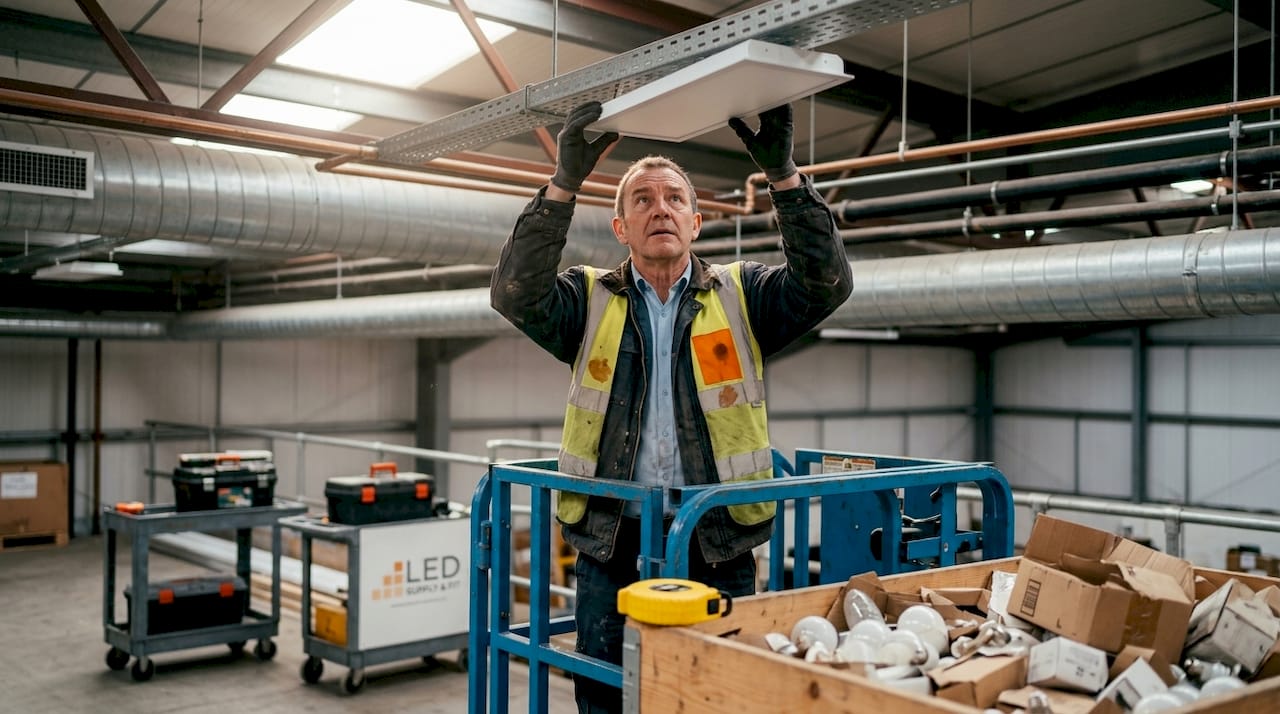
When specifying LEDs, stop thinking in watts and start thinking in lumens. Matching output to task needs avoids both over-lighting and the energy waste that comes with it. A colour temperature of 4000K suits most offices and retail environments. Colour rendering index (CRI) of 80 or above maintains visual accuracy without requiring premium fixtures across every zone.
The table below gives a working comparison of the most common commercial LED types:
| LED type | Typical wattage | Replaces | Best application | Approx. annual saving vs. old tech |
|---|---|---|---|---|
| LED high bay | 100W | 400W metal halide | Warehouses, factories | Up to 75% |
| LED panel | 40W | 70W fluorescent | Offices, retail | Up to 50% |
| LED tube | 18W | 58W fluorescent | Corridors, storage | Up to 65% |
| LED downlight | 10W | 50W halogen | Hospitality, gyms | Up to 80% |
One factor that consistently surprises property managers is the hidden value in maintenance cost savings. In high-ceiling warehouses, replacing lamps requires scaffolding or powered access platforms. When you account for that labour and equipment, the financial case for LED retrofits becomes considerably stronger than a simple fixture-for-fixture cost comparison suggests. The total cost of ownership almost always favours LEDs by a wider margin than the upfront price implies.
Additionally, LEDs generate significantly less heat, reducing the cooling load in air-conditioned commercial spaces. For hotels, server rooms, and restaurants, this secondary saving on HVAC adds up over a full year.
Pro Tip: When comparing LED products, ask suppliers for photometric data sheets. Lumen output figures on packaging can be measured under idealised conditions. Real-world output in commercial installations may differ, and you want verified performance data before committing to a bulk order.
Smart controls and behavioural changes
Technology alone will not deliver the full savings potential. The combination of smart lighting controls with LED fittings can achieve 20 to 60 percent additional energy savings by dimming or switching lights off when they are genuinely not needed.
The main control types worth deploying in commercial properties:
- Occupancy sensors: Switch lights off automatically in meeting rooms, toilets, storage areas, and corridors within minutes of the space being vacated
- Daylight harvesting: Photosensors detect available natural light and dim artificial lighting proportionally, a particularly effective strategy in spaces with south-facing glazing
- Timers and scheduling: Prevent lights remaining on overnight or during non-trading hours in zones where staff rarely check
- Dimming controls: Reduce output during low-activity periods such as early mornings and late evenings without turning off security lighting entirely
- Zoning: Separate controls for different areas so you are not lighting an entire floor when only one section is occupied
Beyond technology, natural light is the most energy-efficient source available. Strategic use of light-reflecting surfaces and unobstructed windows can reduce artificial lighting needs significantly. Encourage staff to raise blinds in the morning before reaching for a light switch.
Behavioural change also matters. Staff awareness campaigns, clear signage in back-of-house areas, and simple operational policies such as lights off when leaving a room cost nothing to implement and reduce wasted energy immediately.
Pro Tip: Occupancy sensors in meeting rooms typically deliver payback within six months. They are one of the lowest-cost, highest-return control investments available to any commercial property.
Financial incentives and rebates for lighting upgrades
The cost of a lighting upgrade does not have to sit entirely on your capital expenditure budget. Utility rebate programmes often cover 20 to 50 percent of retrofit project costs, but the timing and documentation requirements are strict. Miss the application window or fail to submit the right pre-approval paperwork, and you lose access to funding that was legitimately available to you.
Key steps to maximise financial support:
- Contact your energy supplier before starting any work to identify available rebate schemes
- Request pre-approval documentation where required; some programmes will not pay retrospectively
- Gather detailed project specifications, expected energy savings, and product data sheets to support your application
- In the UK, ask your installer about Enhanced Capital Allowances and current HMRC guidance on energy-saving technologies
- Factor confirmed rebates directly into your payback calculation so you are working from an accurate return figure
Stat to know: Section 179D in the US offers up to $1.00 per square foot for commercial buildings achieving 50% lighting energy savings. UK equivalents exist through energy efficiency schemes worth investigating with your accountant before budgeting.
Measuring and verifying savings after your upgrade
Completing the upgrade is not the end of the process. Verifying that your investment is performing as expected closes the loop and gives you the data to improve further.
- Record your baseline energy consumption from utility bills for the three months before the upgrade, broken down by meter where possible.
- Compare consumption figures at one month, three months, and twelve months post-installation to track actual savings against projected figures.
- Review your lighting maintenance schedule regularly. Even LEDs lose output over time if fittings are not cleaned and drivers are not checked annually.
- Audit your control system settings after the first month. Sensor sensitivity, time delays, and dimming schedules often need fine-tuning once real usage patterns emerge.
- Report verified savings to stakeholders using utility bill comparisons and metered data. This strengthens the business case for further investment in other areas of the property.
Continuous measurement also supports any carbon reporting obligations your business may have, turning operational data into documented sustainability progress.
My honest view on cutting lighting costs effectively
I’ve worked with commercial property managers across retail, hospitality, warehousing, and education, and the single biggest mistake I’ve seen is treating a lighting upgrade as a one-off procurement exercise rather than a managed project. People buy the fittings, have them installed, and then assume the savings will take care of themselves.
In my experience, the properties that achieve the best results are the ones that combine a rigorous pre-project audit with proper control commissioning and at least one post-installation review. The audit tells you where the money actually is. The controls extract savings the LEDs alone cannot reach. And the review catches the settings that were never optimised in the first place.
What genuinely surprises managers is how much improvement staff notice. Better colour rendering in offices, no more flickering fluorescent tubes, consistent illumination in warehouses. These are not trivial. They affect how people work, and I’ve seen property managers use verified lighting improvements as part of broader wellbeing initiatives.
If you are planning your first commercial lighting upgrade, start with your three highest-cost zones. Get the audit data, model the payback including maintenance and rebates, and then make the decision on evidence. The total cost of ownership argument for LEDs is strong, but only when you have calculated it properly for your specific site.
— John
How Ledsupplyandfit can help reduce your lighting costs
If you are ready to move from assessment to action, Ledsupplyandfit provides end-to-end LED supply and installation services tailored specifically for commercial properties across the UK. The team handles everything from initial site audit through to specification, supply, and professional fitting, including support with rebate applications to maximise your financial return.
Projects completed for clients such as Wilson Veterinary Group and Stockton Riverside College demonstrate consistent, documented energy savings across very different commercial environments. Whether you manage a single retail unit or a multi-site portfolio, Ledsupplyandfit can build a cost reduction plan around your specific usage profile. Explore the best commercial LED options available for 2026 upgrades, or contact the team directly to discuss a bespoke lighting audit for your site.
FAQ
How much can LED upgrades reduce a commercial lighting bill?
LED upgrades typically reduce energy consumption by 50 to 80 percent compared to fluorescent and halogen systems. When combined with smart controls, additional savings of 20 to 60 percent are achievable on top of the base LED saving.
What is a lighting audit and why does it matter?
A lighting audit records every fixture, its wattage, operating hours, and maintenance cost across your site. Without this data, it is impossible to prioritise upgrades correctly or calculate an accurate payback period.
Are there financial incentives available for commercial lighting upgrades in the UK?
Yes. Utility rebate programmes often cover 20 to 50 percent of retrofit costs, and UK businesses may also access Enhanced Capital Allowances on qualifying energy-saving equipment. Apply before starting work, as many schemes require pre-approval.
How do smart lighting controls add to LED savings?
Occupancy sensors and daylight harvesting reduce operating hours and dim lights dynamically based on real usage, achieving a further 20 to 60 percent energy reduction on top of what LEDs deliver on their own.
How long does a commercial LED retrofit typically take to pay back?
Payback periods vary by property type and energy tariff, but most commercial LED retrofits pay back within two to four years when maintenance savings and available rebates are included in the calculation.