
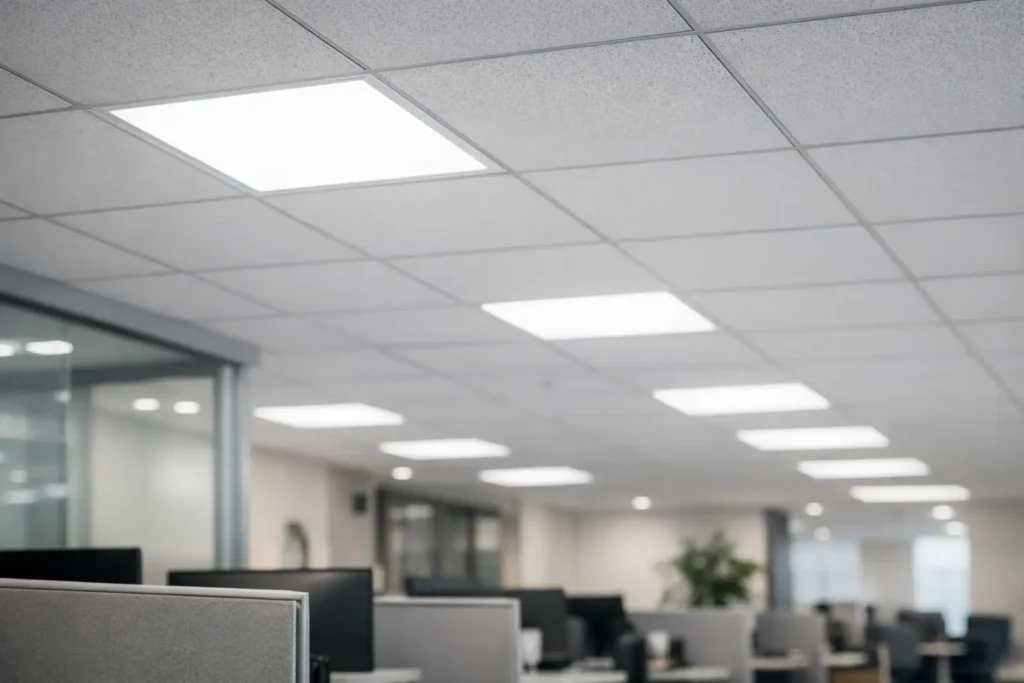
Choosing Office LED Panel Lights
Poor office lighting shows up quickly. Staff complain about glare, meeting rooms feel flat, screens become harder to work on, and energy bills stay higher than they should. Office LED panel lights solve a lot of those problems, but only when the specification matches the space, the ceiling type and the way the building is used.
For facilities managers, contractors and business owners, the attraction is straightforward. LED panels give a clean, professional finish, lower running costs and a longer service life than older fluorescent fittings. They also suit the layout of most modern offices, whether you are refurbishing a single floor, fitting out a multi-room workspace or upgrading a larger commercial site.
Why office LED panel lights are a strong commercial choice
The main reason offices move to LED panels is cost. Replacing fluorescent modular fittings with LED alternatives can significantly reduce energy consumption, especially in buildings where lights are on all day across open-plan areas, corridors and meeting rooms. Lower wattage, better efficacy and reduced maintenance all contribute to a better whole-life cost.
That said, cost is only part of the decision. Office environments need consistent light distribution. A panel fitting spreads light evenly across desks and walkways, which helps reduce harsh shadows and bright spots. In practical terms, that creates a more comfortable working environment for screen-based tasks, reception areas and shared spaces where appearance matters.
There is also the question of maintenance. Traditional fluorescent fittings bring lamp changes, ballast failures and the inconvenience of repeated access. With LED panels, you are usually looking at a much longer lifespan and fewer disruptions. For managed buildings and busy workplaces, that matters just as much as the unit price.
What to look for when choosing office LED panel lights
Not all panel lights are the same, even when they look similar on paper. The right choice depends on output, dimensions, installation method and the visual demands of the space.
Panel size and ceiling compatibility
In many UK offices, 600 x 600 panels are the standard option because they fit suspended grid ceilings commonly used in commercial interiors. In some settings, 1200 x 600 panels may be more suitable, particularly where a different ceiling module is already in place or a wider light spread is required.
If the office does not have a suspended ceiling, recessed fitting may not be possible without additional work. In those cases, surface-mounted frames or suspension kits can provide a practical route to installation while keeping a neat finish. This is where product supply and fitting knowledge makes a real difference, because the same panel can require a different installation approach depending on the site.
Brightness and wattage
Higher wattage does not automatically mean better lighting. The aim is to achieve the right lux levels for the working environment without over-lighting the room. Open-plan offices, breakout spaces and boardrooms all have different needs, and daylight levels can affect the final requirement.
A well-specified panel should deliver strong lumen output with efficient power consumption. Cheap fittings can look attractive on upfront price, but if output is poor or consistency is weak, the result is a space that still feels underlit. Commercial buyers are usually better served by focusing on efficacy and application rather than wattage alone.
Colour temperature
For most offices, a neutral white output tends to work best. It keeps the space bright and professional without feeling too cold or clinical. Warm white can suit hospitality-led commercial interiors or informal meeting areas, while cooler temperatures may be used in task-focused environments, but they are not always the best fit for general office use.
The right colour temperature depends on the brand of the space and the tasks taking place there. A creative studio, a call centre and a legal office may all want slightly different results. This is one of those decisions where there is no single perfect answer.
Glare control and screen comfort
Glare matters more in offices than many buyers expect. If staff spend most of the day looking at monitors, poor glare control can quickly become a problem. Panels designed for office use should provide a diffused, comfortable output that supports desk work rather than creating reflected brightness on screens.
Where visual comfort is a priority, low-glare options are worth considering. They may cost more than basic panels, but the upgrade can be justified in larger offices, education spaces and professional environments where staff productivity and comfort are part of the wider calculation.
Performance matters more than the cheapest unit price
Office fit-outs often work to a tight budget, so there is always pressure to keep product costs down. The problem is that lighting which looks cheap at purchase stage can become expensive later through early failure, poor driver quality, uneven light output or higher replacement rates.
A better panel will usually offer stronger reliability, more consistent colour performance and a longer operating life. When you are fitting dozens or hundreds of units across a site, that reliability matters. It reduces call-backs, avoids avoidable maintenance and protects the overall value of the project.
This is especially relevant for contractors and trade buyers. A dependable fitting helps protect your installation standards and your reputation with the client. It also makes future phases of work more straightforward if the same specification needs to be repeated elsewhere in the building.
Where LED panels work best in office settings
Most people think first of open-plan workspaces, and that is where panel lights are commonly used. They suit desk rows, circulation areas and shared offices because they produce broad, even illumination without dominating the ceiling visually.
They are also a strong choice for meeting rooms, reception spaces, education rooms, staff areas and corridors linked to office environments. In some cases, the same panel family can be used throughout the building to create a consistent look while varying output or emergency options by area.
There are limits, though. Decorative front-of-house areas, heritage interiors or exposed-ceiling office designs may call for a different fitting style. In those settings, a panel might still be suitable in back-office rooms, but not across the full scheme. Good lighting specification is rarely about forcing one product into every zone.
Installation planning makes the project easier
On paper, panel replacement can look simple. In reality, commercial lighting upgrades often involve access restrictions, existing wiring conditions, emergency lighting requirements and the need to minimise disruption during working hours. Planning the installation properly avoids delays and unexpected costs.
Before ordering, it helps to confirm ceiling type, fitting dimensions, driver location and any controls that need to be integrated. Some projects also need consideration of fire safety, emergency backup and phased replacement to keep the office operational. If the building is occupied, installation timing can be just as important as product choice.
This is where working with a supplier that understands both supply and fit can save time. Practical advice on compatibility, quantities and installation method can prevent common mistakes and help keep the job on schedule.
Should you add controls and emergency options?
In many office projects, yes. Motion sensors, daylight dimming and smart controls can increase energy savings beyond the panel upgrade itself. If lights are left on in meeting rooms, toilets, corridors or low-occupancy zones, controls can make a measurable difference to running costs.
Emergency versions are also relevant in many commercial premises. Depending on the layout and use of the building, integrated emergency panel lights can support compliance requirements while keeping the ceiling design clean and consistent. The right answer depends on the building layout, risk assessment and existing emergency scheme.
Not every space needs every upgrade. A straightforward small office may only need standard panels with simple switching. A larger multi-room site may benefit from a more considered lighting and controls package.
Buying office LED panel lights for long-term value
For commercial buyers, the best purchase is rarely the one with the lowest basket value. It is the one that delivers the right light levels, dependable operation, low maintenance and efficient installation across the life of the building.
That means looking at the full picture – product quality, warranty, availability, delivery times, bulk pricing and technical support. If you are managing multiple sites or buying for repeat projects, consistency of supply matters as well. Delays, mixed specifications and product changes can all create unnecessary cost.
At LED Supply & Fit, that practical approach is central to the offer. Commercial customers do not just need a panel light in a box. They need a product that suits the space, arrives on time and performs properly once installed.
If you are reviewing an office refurbishment, replacing fluorescent fittings or planning a new commercial fit-out, office LED panel lights are a proven option for cleaner presentation, lower energy bills and a more dependable lighting scheme. The best results come from choosing panels that fit the building as well as the budget, because good office lighting should keep working quietly in the background for years.