
How to meet lighting regulations and upgrade to LEDs
TL;DR:
- Outdated lighting systems pose safety, energy, and regulatory compliance risks for UK businesses.
- Conducting thorough audits and choosing certified LED solutions ensures compliance and maximizes energy savings.
- Ongoing maintenance and documentation are essential to sustain compliance and improve workplace safety.
Outdated lighting is one of the most overlooked compliance risks in UK commercial premises. Many property managers are running fluorescent systems that fall short of current health and safety standards, waste significant energy, and expose their business to regulatory penalties. The good news is that switching to LED lighting addresses both problems at once. This guide walks you through every practical stage of the process, from understanding what the law requires, right through to maintaining documentation and staying ahead of future changes.
Key Takeaways
| Point | Details |
|---|---|
| Conduct thorough audits | Assess current lighting and compliance needs before making upgrades. |
| Follow step-by-step upgrades | Upgrade with efficient LEDs, certified installers, and clear documentation for compliance. |
| Maintain ongoing records | Regular checks and accurate records preserve compliance and save costs long term. |
| Go beyond minimum standards | Exceeding regulations delivers better safety, savings, and brand reputation. |
Understanding UK lighting regulations and compliance challenges
Before you touch a single fitting, you need to know what you are working against. UK businesses face lighting obligations from several directions simultaneously. The Health and Safety at Work Act 1974 requires that workplaces maintain adequate lighting for safe operation. The Workplace (Health, Safety and Welfare) Regulations 1992 go further, specifying that lighting must be suitable and sufficient for the tasks being performed. On the energy side, the Energy Performance of Buildings Regulations and local planning conditions can impose efficiency requirements, particularly for larger commercial sites or new build fit-outs.
The risks of ignoring these requirements are real and varied. A workplace injury linked to poor visibility can trigger an HSE investigation and expose your business to substantial fines. Energy inefficiency drives up operating costs and, for businesses subject to mandatory reporting, can result in non-compliance notices. Insurance claims related to lighting failures may also be disputed if the installation was not up to standard at the time of the incident.
Common compliance gaps include:
- Lighting levels below the minimum lux ratings for specific tasks (for example, detailed assembly work requires far higher illuminance than corridor lighting)
- Fittings without current CE or UKCA marking for the UK market
- Emergency lighting that has not been tested within the required schedule
- No record of installation certificates or periodic inspection reports
- Glare and colour rendering that fall short of recommended standards for the work environment
The financial case for acting quickly is compelling. Energy-efficient lighting can cut commercial energy costs by up to 75%, which transforms the payback calculation for most upgrade projects. You can also adopt energy saving practices more broadly to compound those savings.
Reviewing your current lighting safety guidelines is the natural starting point, and understanding the LED installation benefits specific to your type of premises helps frame the investment properly.
“Compliance is not a one-time event. Regulations evolve, installations degrade, and business activities change. Treating lighting compliance as an ongoing responsibility rather than a fixed project is the mindset that keeps businesses protected.”
Preparing for compliance: Audits, planning and requirements
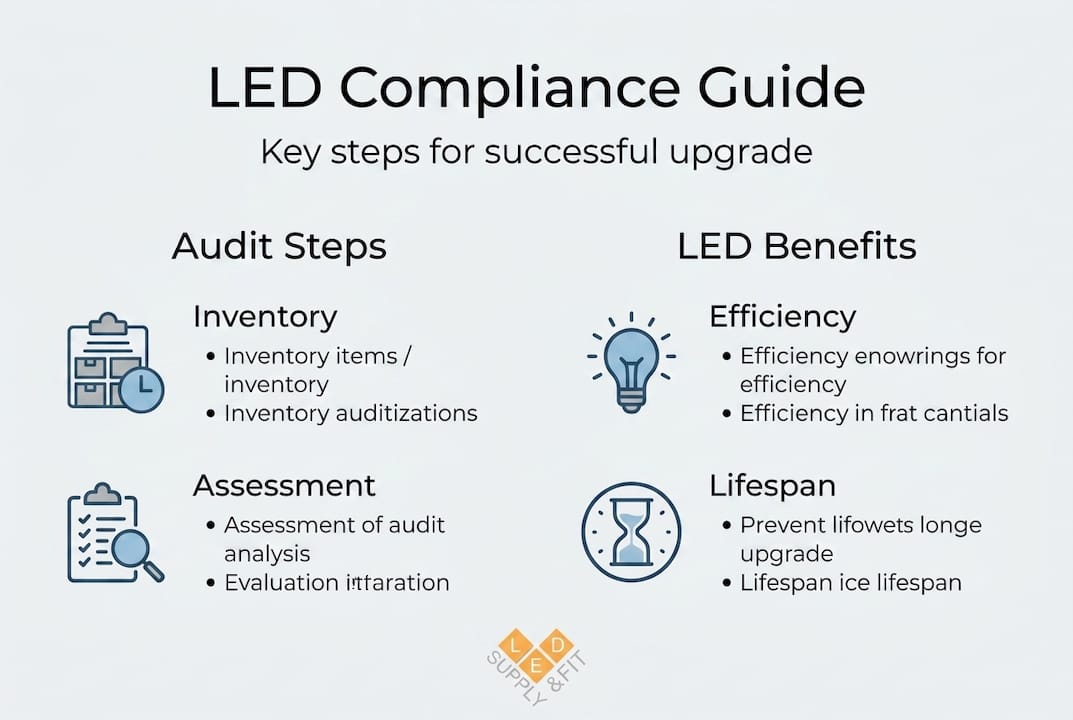
Conducting a thorough lighting audit is the first essential step before any upgrade. Without it, you risk replacing the wrong fittings, missing problem zones, or investing in products that do not meet the specific requirements of each area within your premises.

A proper audit covers every area of your building. You or your appointed professional should record the type, wattage, age, and condition of every fitting, measure actual lux levels at task height, check emergency lighting test logs, and note any areas where glare or shadows create hazards. The energy audit process is well established and gives you a clear picture of both compliance gaps and efficiency losses.
Here is a summary of what a typical commercial lighting audit involves:
| Audit element | Tools or documents needed | Responsible party |
|---|---|---|
| Inventory of all fittings | Site drawings, existing specs | Facilities manager or surveyor |
| Lux level measurements | Calibrated lux meter | Accredited lighting engineer |
| Emergency lighting log review | BS 5266 test records | Responsible person or contractor |
| Energy consumption baseline | Utility bills, meter data | Facilities or energy manager |
| UKCA/CE marking verification | Product data sheets | Electrical contractor |
| Glare and colour rendering check | IES or CIBSE guidelines | Lighting designer |
Once you have the audit data in hand, you can build a compliance checklist. Your checklist should confirm minimum lux levels per zone, emergency lighting coverage and test schedule, correct product certification, documentation of the installation date and installer qualifications, and a plan for periodic re-inspection.
Key documents to prepare before starting work include:
- Current site plan with all lighting zones marked
- Existing installation certificates (if available)
- Details of any planning or building regulation consents that affect lighting
- Evidence of previous emergency lighting tests
Pro Tip: For larger or more complex premises such as warehouses, hotels, or multi-storey offices, engage a CIBSE-accredited lighting engineer to lead the audit. Their report carries weight with insurers and local authorities, and their recommendations will reflect the most current sustainable lighting solutions available for your building type.
Implementing upgrades: Step-by-step guide to compliant LED lighting
With your audit complete and your compliance checklist ready, the physical upgrade can begin. A structured approach avoids costly errors and keeps the project on schedule.
-
Evaluate each zone individually. Use the audit data to select the correct LED luminaire for each area. A warehouse high bay has very different requirements from an office task light or a hotel lobby fixture. Match the lumen output, beam angle, colour temperature, and colour rendering index (CRI) to the task.
-
Select certified products. Every fitting must carry UKCA marking for the UK market. Check IP ratings for wet or dusty environments, and confirm that dimming controls are compatible with your chosen luminaires.
-
Arrange qualified installation. Appoint a Part P registered electrician or a contractor accredited under a competent person scheme. For industrial or hazardous environments, ensure ATEX-rated fittings are specified where required.
-
Install and commission systematically. Work zone by zone, testing each area after installation before moving to the next. This makes snag identification far easier than a whole-building switch-over.
-
Test all emergency lighting. Verify that emergency luminaires meet BS 5266 requirements, record the test results, and establish the ongoing test schedule before handover.
-
Integrate controls and monitoring. Smart lighting controls such as occupancy sensors, daylight dimming, and centralised management systems extend energy savings further and give you data to demonstrate ongoing compliance. Reviewing cost-saving strategies at this stage helps you maximise the return on your investment.
| Feature | Standard fluorescent | Compliant LED |
|---|---|---|
| Typical lifespan | 8,000 to 15,000 hours | 50,000+ hours |
| Energy consumption | High | Up to 75% lower |
| UKCA/CE compliance | Often out of date | Current certification |
| Emergency test integration | Manual, often undocumented | Automated with logging |
| Dimming capability | Limited | Full range available |
| Maintenance frequency | Frequent lamp changes | Minimal for 5 to 7 years |
Proper LED installation not only meets current regulations but can future-proof your business against stricter standards as the UK continues to tighten energy efficiency requirements. Reviewing the full LED safety guidelines before signing off any installation is a step worth taking.
Pro Tip: Specify luminaires that already support DALI or wireless control protocols, even if you do not activate those features immediately. When regulations around energy monitoring tighten, you will have hardware in place that can be upgraded via software rather than a full replacement.
Maintaining compliance: Verification, documentation and ongoing best practice
Installing compliant LED lighting is a significant achievement. Keeping it compliant over time is equally important and, frankly, where many businesses fall short.
After installation, your verification process should include:
- Written sign-off from the installing contractor including a Electrical Installation Certificate or Minor Works Certificate
- Post-installation lux measurements to confirm that every zone meets the required levels
- Emergency lighting commissioning certificate under BS 5266
- Records of all luminaire serial numbers, installation dates, and warranty terms
- A scheduled review date, typically 12 months after installation
Regular checks and documentation ensure ongoing compliance and help avoid costly penalties that can arise from an unannounced inspection or an incident investigation. Monitoring energy saving lights performance over time also flags any degradation early, before it becomes a compliance issue.
Staff awareness matters too. Designate a responsible person for lighting compliance within your team. That person should know where documentation is kept, understand the emergency lighting test schedule, and know how to report faults promptly. Using energy monitoring advice to track consumption against your post-installation baseline will also identify problems long before they become visible to the naked eye.
“Businesses that treat lighting maintenance as an afterthought often discover compliance gaps during the worst possible moment, which is during an insurance claim or an HSE audit. A simple annual review prevents exactly that scenario.”
Regulations themselves are not static. The HSE updates guidance, building regulations are revised, and energy efficiency standards tighten. Subscribe to HSE updates and monitor CIBSE guidance so that your next review cycle incorporates any new requirements before they become mandatory.
Why doing more than the regulatory minimum pays off
Here is an observation we have made across many commercial projects: the businesses that approach lighting compliance as a bare minimum exercise consistently underperform compared to those that use it as a genuine improvement opportunity.
Meeting the legal threshold keeps you out of trouble. Exceeding it makes your premises measurably safer, more comfortable for staff, and more attractive to clients visiting your site. Studies consistently link better workplace lighting with reduced error rates and improved staff wellbeing, which translates directly into productivity and retention. Review LED lighting cost tips and you will see that the incremental cost of going beyond minimum standards is often recovered within the first year through energy savings alone. Small extra steps, such as adding occupancy sensors or upgrading to a higher CRI in customer-facing areas, deliver outsized returns.
Get expert help with lighting compliance and upgrades
If you want to take the next step without the guesswork, professional support makes the entire process faster and more reliable.

At LED Supply and Fit, we work with commercial clients across offices, warehouses, retail spaces, and hospitality venues to deliver compliant, energy-efficient lighting upgrades from audit through to installation. Our team handles product selection, qualified fitting, and compliance documentation. Browse our range of best commercial LED lighting solutions or get in touch to discuss your site’s specific requirements. We offer bulk pricing, next-day delivery, and full installation support across the UK.
Frequently asked questions
What are the main lighting regulations UK businesses must follow?
UK businesses must comply with health and safety, energy efficiency, and specific local authority standards for workplace lighting, as outlined in the workplace lighting compliance guidance covering the Health and Safety at Work Act and the Workplace Regulations 1992.
How do I begin an audit for lighting regulation compliance?
Start by listing all lighting fittings, checking their efficiency ratings, and comparing them to current regulatory requirements, following LED installation best practices to ensure every zone is assessed accurately.
Do I need to hire a qualified electrician for LED upgrades?
For compliance and insurance purposes, a competent, accredited professional should design and install significant upgrades, as installation best practices make clear for any commercial premises.
What documents should I keep after upgrading lighting?
Keep your audit report, installer certifications, and compliance verification records for future inspections, as ongoing documentation is essential for demonstrating compliance during inspections or claims.
How often do lighting regulations change?
Updates can occur annually or as standards evolve, so monitor guidance from the HSE and local authorities regularly to ensure your installation remains current.