Lighting demonstrations: maximise energy savings and compliance
TL;DR:
- Lighting demonstrations ensure realistic performance verification of LED upgrades, leading to significant energy savings and compliance. Combining physical trials with software modelling optimizes results, aligns with standards, and maximizes control-related savings. Properly conducted demos improve occupant comfort, reduce maintenance costs, and strengthen long-term business outcomes.
Many businesses invest in LED upgrades expecting dramatic savings on their energy bills, only to face a frustrating reality: the results fall well short of what was promised. The problem is rarely the quality of the fittings. It is the absence of an evidence-based process to verify performance before and after installation. A structured lighting demonstration bridges that gap, turning projected figures into measurable, repeatable outcomes that satisfy both your finance team and your compliance obligations.
Key Takeaways
| Point | Details |
|---|---|
| Demonstrations validate savings | Lighting demonstrations ensure energy savings are proven before full-scale installation. |
| Compliance requires standards | Align demonstrations with CIBSE/SLL guides and BS EN 12464-1 for measurable results. |
| Controls boost efficiency | Integrating controls delivers up to 60% additional energy savings for commercial properties. |
| Modelling increases credibility | Using tools like Dialux provides clear, standardised evidence for compliance and performance. |
| Practical workflow saves money | Following demonstration-led workflows reduces operational costs and supports long-term success. |
Why lighting demonstrations matter for energy efficiency
Replacing old fluorescent or halogen fittings with LED alternatives is a sensible step, but it is not a guarantee of savings. The gap between projected and actual energy reduction can be significant when nobody measures baseline performance, tests the new installation properly, or integrates controls into the upgrade plan.
A lighting demonstration guide provides the structured process that turns a product swap into a verified outcome. Rather than relying on manufacturer data sheets, a demonstration measures real-world lux levels, checks uniformity across a working space, and quantifies energy consumption before and after the trial. This is the difference between hope and evidence.
Demonstrations also serve a compliance function. UK commercial premises must align with recognised industry guidance:
- Lux levels appropriate to the task area (for example, 500 lux for office workstations)
- Uniformity ratios that prevent harsh shadows or glare
- Daylight integration where windows or roof lights are present
- Occupancy and dimming controls to reduce energy during unoccupied periods
- Documentation to support energy audits and building assessments
“The SLL lighting publications from CIBSE, including LG10 Daylighting and LG14 Controls, provide the authoritative framework for lighting design and controls integration, making them the natural reference point for any demonstration validation.”
Without this framework, even a well-intentioned LED upgrade can leave a business under-lit, over-lit, or simply not saving as much as it should. Achieving smarter LED savings requires evidence, not assumptions.
Key standards and frameworks for lighting demonstration
Industry standards exist precisely because lighting design is a technical discipline, not just a product selection exercise. The two most important frameworks for UK commercial clients are CIBSE/SLL guidance and BS EN 12464-1, the European standard for lighting in indoor workplaces.
BS EN 12464-1 specifies maintained illuminance values, uniformity requirements, and limits for glare across a wide range of commercial spaces. It applies to offices, retail floors, warehouses, kitchens, and gyms alike. Complying with this standard is not optional when health and safety or building management expectations are in play. The SLL lighting publications from CIBSE add practical design guidance on top of that regulatory baseline, particularly around daylight control and automated systems.
| Standard | Scope | Key metric |
|---|---|---|
| BS EN 12464-1 | Indoor workplace lighting | Maintained lux and uniformity |
| CIBSE LG10 | Daylighting integration | Daylight factor and glare control |
| CIBSE LG14 | Controls design | Occupancy and dimming strategies |
| Dialux modelling | Software simulation | Predicted lux and uniformity maps |
Dialux is the industry-standard software for lighting modelling. It allows designers to simulate a full daylight control modelling scenario, showing how natural light interacts with artificial sources across different times of day and seasons. This is particularly useful for open-plan offices, showrooms, and warehouses with extensive roof glazing.
Controls integration deserves special attention. Occupancy sensors, daylight-linked dimming, and time-scheduling can add a further 20 to 60% reduction on top of the basic LED energy saving. That is a figure that changes the entire business case for a project. A cost-saving lighting workflow that ignores controls is leaving significant value on the table.
Pro Tip: Always benchmark your existing installation against CIBSE LG10 and LG14 before the demonstration begins. This gives you a defensible baseline that makes the post-installation comparison genuinely meaningful, and it can also reveal compliance issues in your current setup that need addressing regardless of the LED upgrade.
Here is a step-by-step approach to aligning your demonstration with these standards:
- Audit the existing installation: measure lux levels, uniformity, and energy consumption at peak occupancy hours.
- Define the compliance target: identify which BS EN 12464-1 values apply to each zone in your premises.
- Run Dialux modelling: simulate the proposed LED scheme, including daylight contributions and control scenarios.
- Conduct a trial installation: fit LED luminaires in a representative area and take empirical measurements.
- Compare measured data against modelled predictions and compliance thresholds.
- Assess controls options: model the additional savings from occupancy sensing or daylight-linked dimming.
- Document everything for your energy audit, building management report, or ESOS assessment.
The LED energy savings impact of following this workflow consistently outperforms ad hoc installations by a substantial margin.
Practical demonstration methods for LED upgrades
There are two primary approaches to demonstrating LED performance: physical trial installations and software modelling. Each has strengths, and the most robust process combines both.
A trial installation places actual LED fittings in a live working environment. It captures real-world variables that software cannot easily replicate: reflectance from painted walls that have aged, dust accumulation on diffusers, the specific positioning of workstations, and seasonal daylight patterns. The limitation is that a trial covers only one area and one set of conditions at a time.
Software modelling fills in the gaps. Dialux and similar tools allow you to model the entire building, test multiple luminaire configurations, and evaluate controls strategies without touching a single fitting. The designing daylight control-based approach outlined by lighting engineers confirms that combining trials with modelling and aligning both against BS EN 12464-1 produces the most precise lux and uniformity results, alongside realistic controls savings projections.
Before vs after: demonstration impact comparison
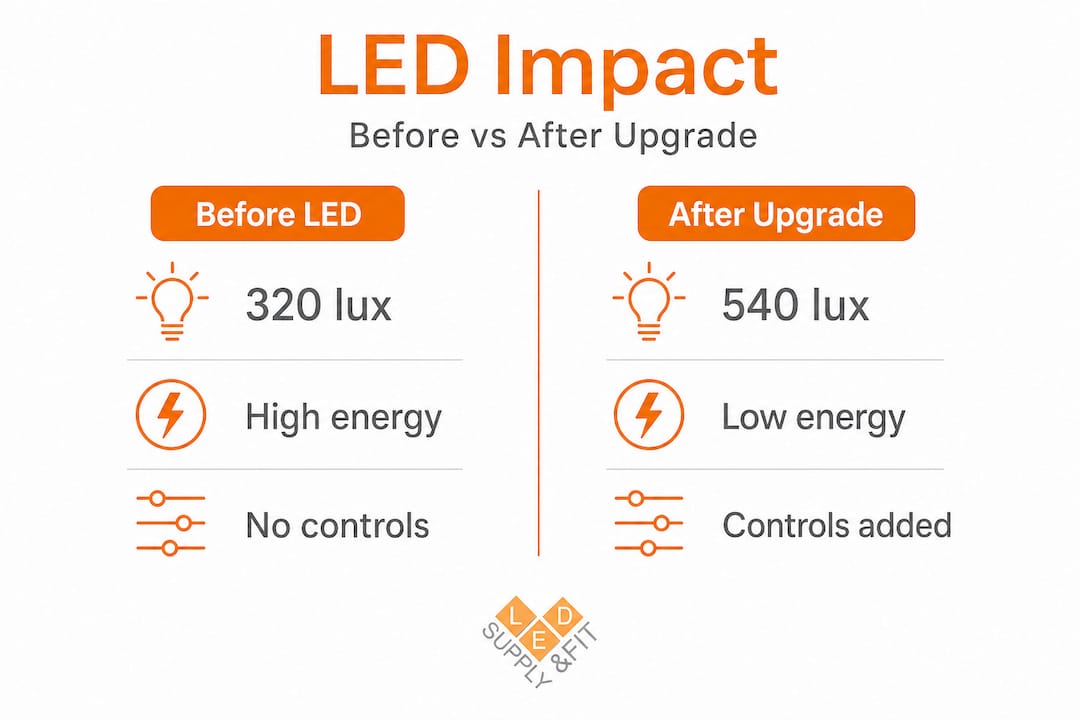
| Metric | Before LED upgrade | After LED upgrade with controls |
|---|---|---|
| Average lux (office) | 320 lux (non-compliant) | 520 lux (compliant) |
| Energy consumption | 18 W/m² | 6 W/m² |
| Uniformity ratio | 0.4 | 0.7 |
| Annual energy cost | £12,000 | £3,800 |
| Controls saving (additional) | None | Up to 60% further reduction |
The figures above represent a typical commercial office scenario and illustrate why skipping demonstration is a costly mistake.
Key metrics to capture during any demonstration include:
- Lux levels at task height across multiple measurement points
- Uniformity ratio (minimum divided by average lux)
- Colour rendering index to confirm visual comfort
- Power consumption in watts per square metre
- Occupancy hours and actual operating patterns
Lighting controls boost savings substantially when they are specified as part of the demonstration process rather than bolted on as an afterthought. Ensuring controls are tested during the trial, not just designed on paper, is what separates a confident investment decision from a guess. Building managers looking at sustainable lighting trends will also find that demonstrated, verified performance is increasingly expected by tenants, insurers, and auditors.
Applying lighting demonstrations to compliance and cost reduction
When the demonstration process is followed correctly, the results are not just impressive on paper. They hold up to scrutiny in practice. A compliant workflow typically produces energy cost reductions in the range of 60 to 83% compared to legacy fluorescent or halogen installations. The lighting controls cut energy costs by 83% figure is achievable in real UK commercial settings when controls and LED are deployed together with verified performance data.
Key compliance actions that demonstrations validate include:
- Confirming maintained illuminance meets BS EN 12464-1 for each task zone
- Verifying that glare indices remain within acceptable limits
- Documenting lux uniformity for health and safety records
- Demonstrating that daylight sensors and occupancy controls are functioning correctly
- Producing energy consumption data for ESOS, BREEAM, or EPC assessments
The financial impact compounds over time. A retail unit reducing its lighting energy bill from £15,000 to £4,000 per year does not just save £11,000 in year one. That saving recurs annually, improves net operating income, and strengthens the asset’s EPC rating for future lease negotiations. The best LED lighting tips consistently point to demonstrated, controls-integrated schemes as the most reliable route to those outcomes.
Why most businesses miss the true value of lighting demonstrations
Most businesses approach a lighting upgrade the same way they approach buying office furniture: choose a product, place an order, fit it, and move on. This thinking treats lighting as a commodity rather than a system. It is understandable but expensive.
The conventional wisdom says the savings are in the fittings. In reality, the savings are in the process. A demonstration-led workflow produces measurable, repeatable results because it forces everyone involved, from the facilities manager to the finance director, to agree on what success looks like before any money is spent. That alignment alone prevents the most common failure mode: a completed installation that nobody is confident has actually worked.
We have seen projects where businesses replaced 400 fluorescent fittings, spent significant capital, and still ended up with a non-compliant lux level in half their workspace because nobody modelled the scheme or measured the baseline. A cost-saving workflow that starts with a demonstration avoids that outcome entirely.
Pro Tip: Involve your facilities and maintenance teams at the very start of the demonstration. They know where the actual pain points are, which zones have the most occupancy variability, and where previous upgrades have caused complaints. Their input makes the demonstration design sharper and the buy-in at rollout far smoother.
The long-term benefits extend beyond energy bills. Properly demonstrated and controlled LED schemes reduce maintenance callouts, extend fitting lifespan by avoiding thermal stress from over-driving luminaires, and measurably improve occupant satisfaction scores. In hotels, offices, and retail environments, lighting quality directly influences how people feel and behave in a space. That is a business outcome worth measuring.
Enhance your lighting project with expert-led demonstrations
Transitioning from a theoretical understanding of lighting demonstrations to a real, verified outcome for your premises is exactly where we can help.
At Ledsupplyandfit.co.uk, we support commercial clients from initial audit through to full installation and post-installation measurement. Whether you are managing a single retail unit or a multi-site portfolio, our team provides best commercial LED lighting solutions backed by demonstration data. Explore our cost-saving LED solutions built specifically for UK businesses in 2026, or browse our practical LED lighting tips to start planning your upgrade with confidence. Next-day delivery, trade accounts, and expert consultation are all available.
Frequently asked questions
How can lighting demonstrations help reduce operational costs?
Lighting demonstrations verify the energy-saving impact before full installation, ensuring you achieve maximum cost reduction and compliance with frameworks such as CIBSE LG14 rather than relying on unverified projections.
What standards should my lighting demonstration comply with?
Businesses should align demonstrations with CIBSE/SLL guides and BS EN 12464-1, which together cover illuminance levels, uniformity, daylighting, and controls integration across all common commercial environments.
How much extra savings do controls integration offer?
Integrating occupancy sensors and daylight-linked dimming can deliver an additional 20 to 60% energy reduction on top of the baseline LED saving, depending on occupancy patterns and natural light availability.
Is software modelling like Dialux necessary in lighting demonstrations?
Dialux modelling confirms predicted lux levels and uniformity before physical installation, making demonstrations more credible and straightforward to validate against BS EN 12464-1 requirements.